Sexual Symbolism and
Meaning in Tarot
Tarot is a mirror. It reflects back every dimension of human experience, including the parts we are sometimes reluctant to examine in full light. Among the most layered and frequently misunderstood aspects of the tarot is its rich sexual symbolism: a thread that runs through the deck from the earliest Italian tarocchi to the most modern interpretations.
This is not a topic to approach with embarrassment. Sexuality, desire, passion, and the creative life force are woven into the very architecture of the cards. Understanding this symbolism deepens your readings and connects you to centuries of esoteric tradition that recognized sexual energy as one of the most powerful forces in human experience.
Each of the twenty-two Major Arcana cards carries its own teaching about love, intimacy, and desire. We have written a complete series of contemplative guides exploring every card through the lens of love and sexual energy, drawing on Jungian psychology, Kabbalistic wisdom, and five centuries of deck traditions. What follows here is the foundation: the symbolic architecture that runs beneath them all.
The Dance of Masculine and Feminine
Before looking at individual cards, it helps to understand a structural principle that runs through the entire deck. The four suits of the tarot are organized around a polarity that esoteric traditions have long associated with masculine and feminine creative energy.
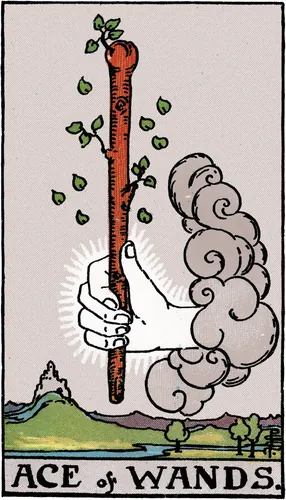
Wands and Swords carry traditionally masculine symbolism. The wand is a staff, a rod, a pillar. The sword is a blade. These are phallic images, and the suits they govern deal with fire (desire, will, passion) and air (thought, communication, assertion).
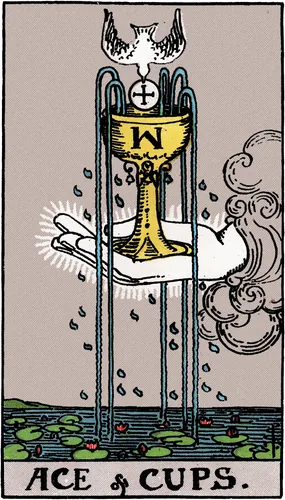
Cups and Pentacles carry traditionally feminine symbolism. The cup is a chalice, a vessel, a womb. The pentacle is a disc, connected to the body and the earth. These suits govern water (emotion, intuition, intimacy) and earth (the physical, the sensual, the tangible).
This is not about gender in the modern sense. It is about the interplay of active and receptive, projective and containing, yang and yin. When these polarities meet in a reading, something creative happens. That creative charge is, at its root, the same energy that traditions from Tantra to Kabbalah have recognized as sacred sexuality.
The Lovers: More Than Romance
This is the card most people think of first when the topic of sex arises in tarot, but its history reveals something more complex than simple romance.
In the Tarot de Marseille, this card showed a young man standing between two women while Cupid aimed an arrow from above. It was called L'Amoureux (the Lover, singular) and depicted a choice: the moral crossroads between virtue and vice.
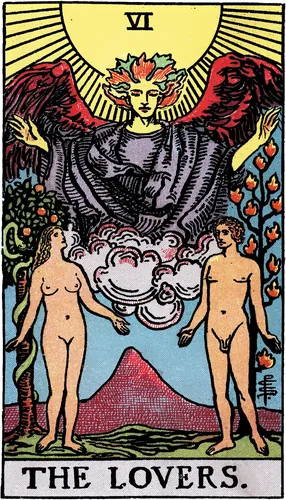
When Arthur Edward Waite and Pamela Colman Smith redesigned the card for the Rider-Waite-Smith deck, they replaced the choice scene with Adam and Eve in the Garden of Eden. The two figures stand nude beneath Archangel Raphael. Behind Eve, the Tree of Knowledge with its coiled serpent. Behind Adam, the Tree of Life bearing twelve fruits.
The nudity here represents Edenic innocence, the state before shame entered the world. But the symbolism is charged with the knowledge of what comes next: the fruit, the fall, the awakening of desire. The Lovers card holds the moment just before human beings became aware of their own bodies, their own wanting.
If you add the digits of The Devil's number (XV: 1+5=6), you arrive at The Lovers' number (VI). The same couple appears in both cards. In The Devil, they are chained and horned. The arc between these two cards tells a story about what happens when desire is unconscious versus conscious, when passion serves growth versus when it becomes compulsion.
→ The Lovers Tarot Love Meaning: Desire, Choice & Sacred Union
The Empress: Sensuality as Creative Power
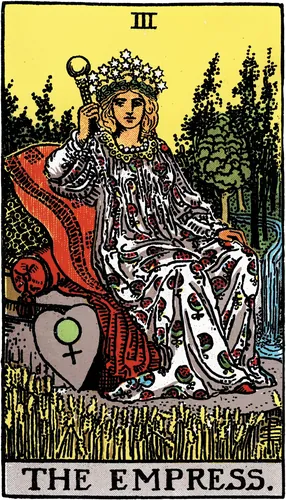
The most openly sensual figure in the Major Arcana. Where the High Priestess sits veiled and reserved between two pillars, the Empress reclines among ripening grain, her shield bearing the symbol of Venus, her crown adorned with twelve stars.
Everything about her imagery communicates fertility, abundance, and the life-giving power of the body. She is not ashamed of her physicality. She celebrates it.
In many interpretive traditions, the Empress represents the creative force of nature expressing itself through pleasure, through the senses, through the body's own wisdom. In Aleister Crowley's Thoth deck, the Empress is depicted even more explicitly as a figure of voluptuous abundance, surrounded by symbols of Venus and the Moon. Crowley understood her as the embodiment of the divine feminine principle: creative, generative, and unashamedly physical.
The Empress is the body's yes. Not urgently, not desperately, but with the full, unhurried pleasure of something that has come home. When she appears in a reading, she often speaks to a season of sensual aliveness, whether that manifests as physical intimacy, artistic creativity, or a deep reconnection with the pleasures of being embodied.
→ Empress Tarot Love Meaning: Sensuality, Desire & the Body's Yes
The Devil: Shadow, Desire, and the Chains We Choose
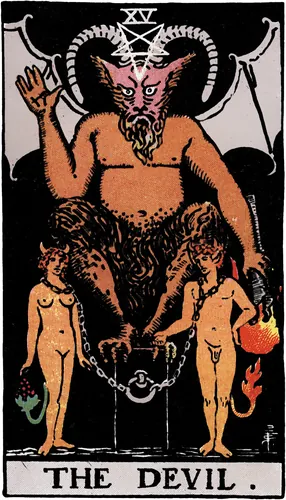
This card confronts us with the parts of desire we would rather not examine. The Baphomet figure sits on a dark throne, an inverted pentagram on its brow. Below, the same couple from The Lovers stands chained to the pedestal, now bearing small horns and tails of their own.
But look closely at the chains. They are loose. The figures could slip free at any moment. They choose to remain.
This is the card's profound teaching about sexuality and desire. The Devil does not represent evil. It represents unconscious bondage to appetite, the moment when desire stops serving us and we begin serving it. Obsession, addiction, power dynamics that have lost their balance, the compulsive pull of attraction that overrides better judgment: this is the Devil's territory.
And yet, for some readers, the Devil also carries a more liberating message. Approached with awareness, this card can represent the healthy exploration of taboo, the shadow work of acknowledging desires that mainstream culture has taught us to suppress. The card asks: what would it mean to look honestly at your desires without shame and without compulsion?
→ Devil Tarot Love Meaning: Shadow, Bondage & Conscious Desire
Strength and Lust: Where the Sacred Meets the Wild
Here is where the difference between tarot traditions becomes most vivid.
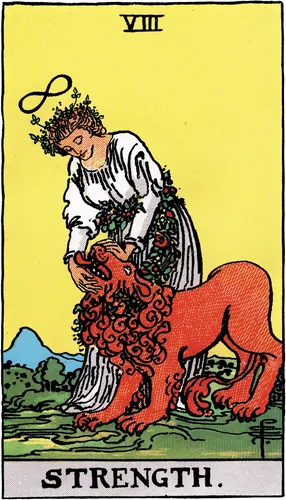
In the Rider-Waite-Smith deck, Strength shows a woman gently opening the jaws of a lion. An infinity symbol floats above her head. The image speaks of taming the animal nature not through force but through gentleness, patience, and inner authority. The sexual dimension is subtle: the integration of instinct and spirit, wildness held within a loving embrace. The hand on the lion's jaw is itself an erotic image: gentle contact with raw power, the paradox that vulnerability is the truest form of strength.
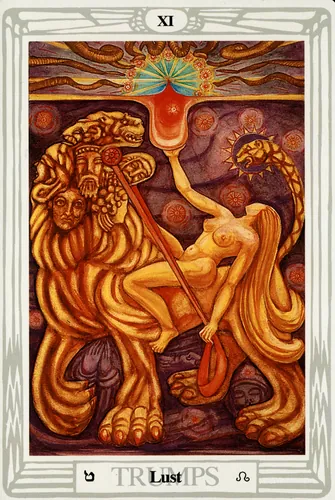
Crowley saw the same archetype very differently. He renamed the card Lust and commissioned Lady Frieda Harris to paint one of the most striking images in the Thoth deck: Babalon, the Scarlet Woman, riding a seven-headed beast and holding the Holy Grail aflame with ecstatic fire.
This is not subtle. For Crowley, this card represented the divine feminine in its most liberated and ecstatic form. Babalon is not ashamed, not restrained, not domesticated. She rides the beast of her own desire with full awareness and full consent.
The Babalon figure connects to Thelemic traditions of sacred sexuality, where sexual energy is understood as Kundalini: the same current that fuels biological desire, artistic creativity, spiritual vitality, and mystical awakening. This is perhaps the card in the entire tarot that most directly bridges the gap between physical passion and spiritual transformation.
→ Strength Tarot Love Meaning: Desire, Gentleness & Surrender
The Star: Vulnerability as Intimacy
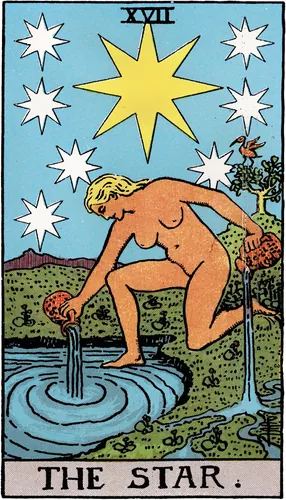
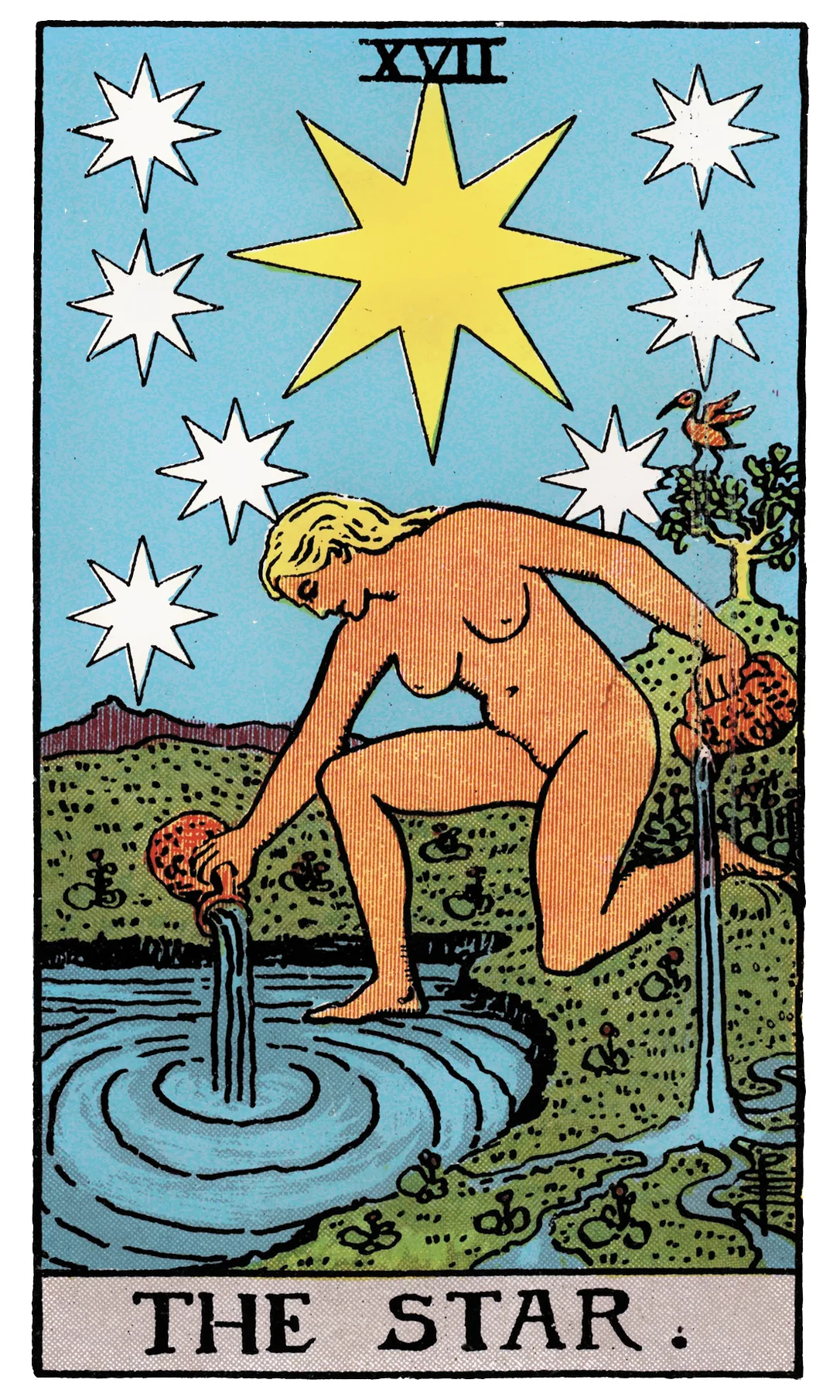
Another nude figure, but the energy here is entirely different from the Lovers or the Devil. A woman kneels by a pool, pouring water from two vessels: one into the water, one onto the land. Eight stars shine above her.
The Star follows the catastrophe of the Tower. After everything has been shattered and stripped away, what remains is a soul laid bare, pouring itself out without defense or pretense.
The nudity in this card is not about sexuality in the way we usually mean the word. It is about the kind of radical vulnerability that deep intimacy requires. The Star reminds us that true connection, whether sexual or otherwise, asks us to be seen as we actually are. No masks, no performance, no armor.
For readings that touch on intimacy and relationships, the Star often signals a moment of profound openness. It is the willingness to be truly naked with another person, in every sense. The body after the storm.
→ Star Tarot Love Meaning: Vulnerability, Healing & Radical Openness
La Petite Mort: Death, the Tower, and Surrender
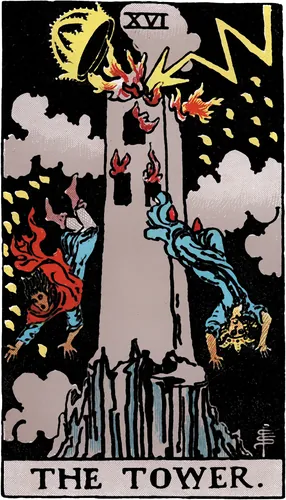
Two other Major Arcana cards deserve mention for their connection to a very old metaphor. La petite mort, the little death, is the French phrase for orgasm, and it has deep roots in both literary and mystical traditions. The moment of climax involves a surrender of control, a temporary dissolution of the ego, a small rehearsal of the ultimate letting go.
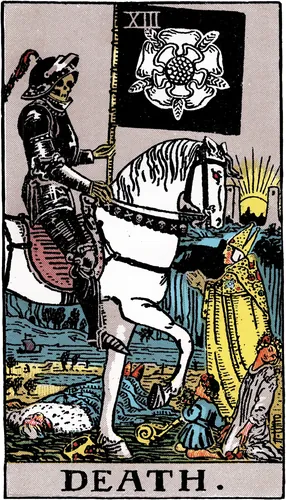
→ Death Tarot Love Meaning: Transformation & Surrender · → Tower Tarot Love Meaning: Revelation & Release
Temperance: The Tantric Card
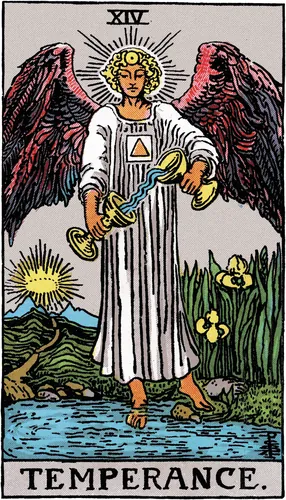
Easily overlooked in discussions of sexual symbolism, but perhaps one of the most important cards in this context. An angel stands with one foot in water and one on land, pouring liquid between two cups in an endless flow. This is the card of balance, of sacred mixture, of bringing together what has been separate.
In traditions that recognize sacred sexuality, from Hindu Tantra to Kabbalistic teachings on divine union, the merging of polarities is the path to transcendence. Temperance represents this principle in its purest form: the patient, attentive blending of masculine and feminine, body and spirit, desire and devotion. The slow pour.
When Temperance appears in readings about intimacy, it often suggests taking the physical dimension of a relationship to a more conscious, spiritual level. Slow down. Pay attention. Let the mixing of energies become a practice rather than just an act.
→ Temperance Tarot Love Meaning: Sacred Balance & the Slow Pour
Every Card Has Something to Say About Love
The cards discussed above carry the most explicit sexual symbolism in the Major Arcana. But every card in the deck speaks to some dimension of love, desire, and intimate relationship. Here are the cards whose teachings may surprise you.

The leap before you know there's a net. The Fool is desire before it becomes cautious, the willingness to fall in love without calculating the odds. In intimacy, this card teaches that the most transformative connections begin when we stop trying to control the outcome.
→ Fool Tarot Love Meaning: Innocence, Risk & the Leap of Faith

The moment intention meets desire. The Magician channels raw energy into focused action, and in love readings, he represents the alchemy of conscious attraction: not manipulation, but the art of showing up with full presence and purpose.
→ Magician Tarot Love Meaning: Intention, Alchemy & Attraction
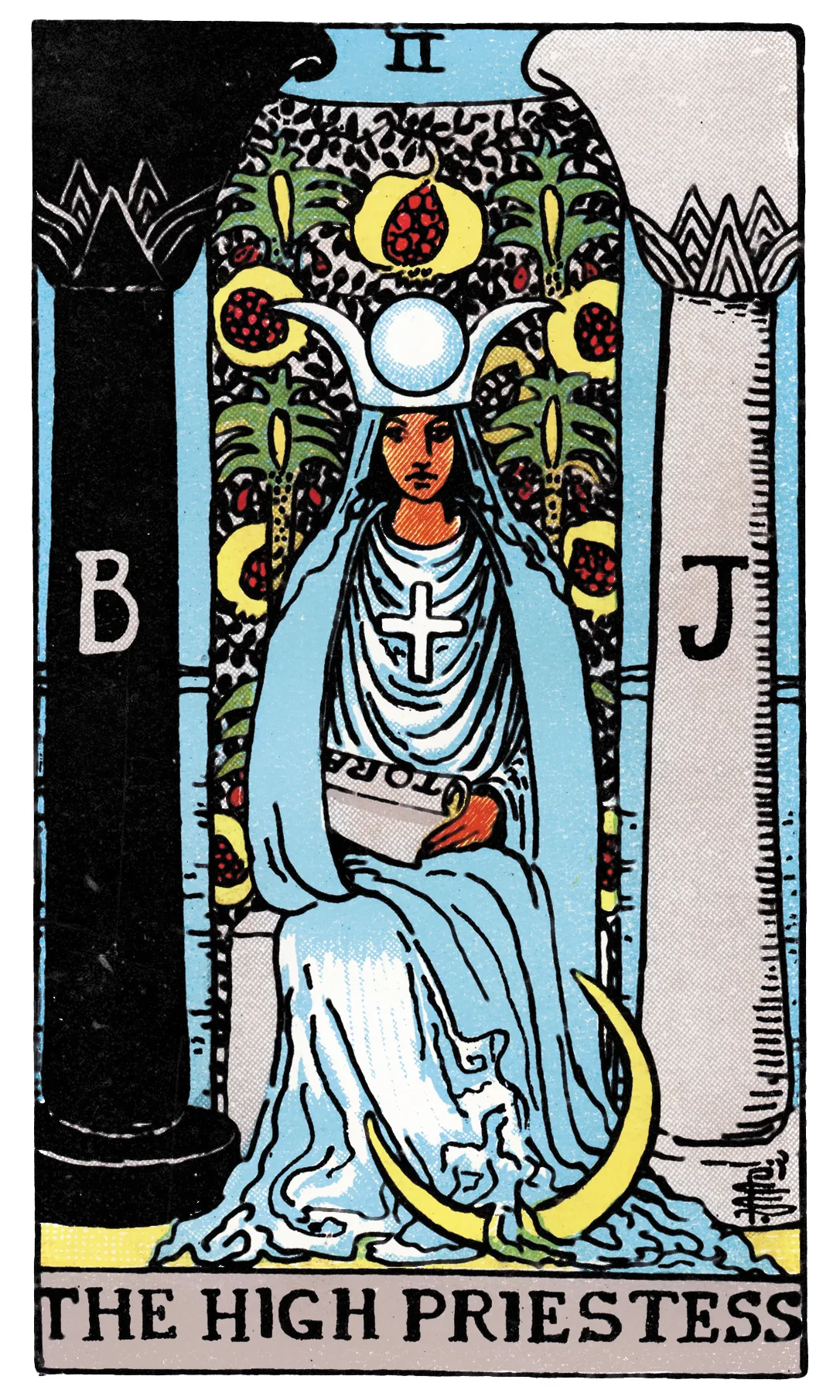
Desire before it speaks. Where the Empress is the body's yes, the High Priestess is the knowing that precedes language, the pull toward someone you cannot explain. She sits between the pillars of duality, veiled, holding the mysteries of attraction that live below conscious awareness.
→ High Priestess Tarot Love Meaning: Mystery, Intuition & Hidden Desire

The structure love needs to survive. The Emperor teaches that desire which only burns eventually destroys, and that the deepest intimacy requires someone willing to build walls that protect without imprisoning. The paradox of authority in love: the one who protects can also control.

The vow beneath the vow. Where the Lovers chooses, the Hierophant consecrates. This is the card of sacred commitment, the spiritual dimension of partnership that transcends legal contracts and social expectations. The bridge between human love and something larger.
→ Hierophant Tarot Love Meaning: Sacred Vows & Spiritual Bonds

Desire that drives rather than drifts. The Chariot harnesses opposing forces and moves forward with purpose. In love readings, it speaks to the directed will that carries a relationship through difficulty, the refusal to be passive about what matters most.

Desire that waits. The Hermit's lantern illuminates from within, and in love readings, this card speaks to the seasons when solitude is not loneliness but preparation. Self-knowledge as the foundation for genuine intimacy.
→ Hermit Tarot Love Meaning: Solitude, Self-Knowledge & Sacred Waiting

Love turns. The Wheel teaches that passion has seasons, that relationships cycle through intensity and quietness, that the moment of feeling stuck is often the moment just before the wheel begins to move again.
→ Wheel of Fortune Tarot Love Meaning: Cycles, Seasons & Turning Points
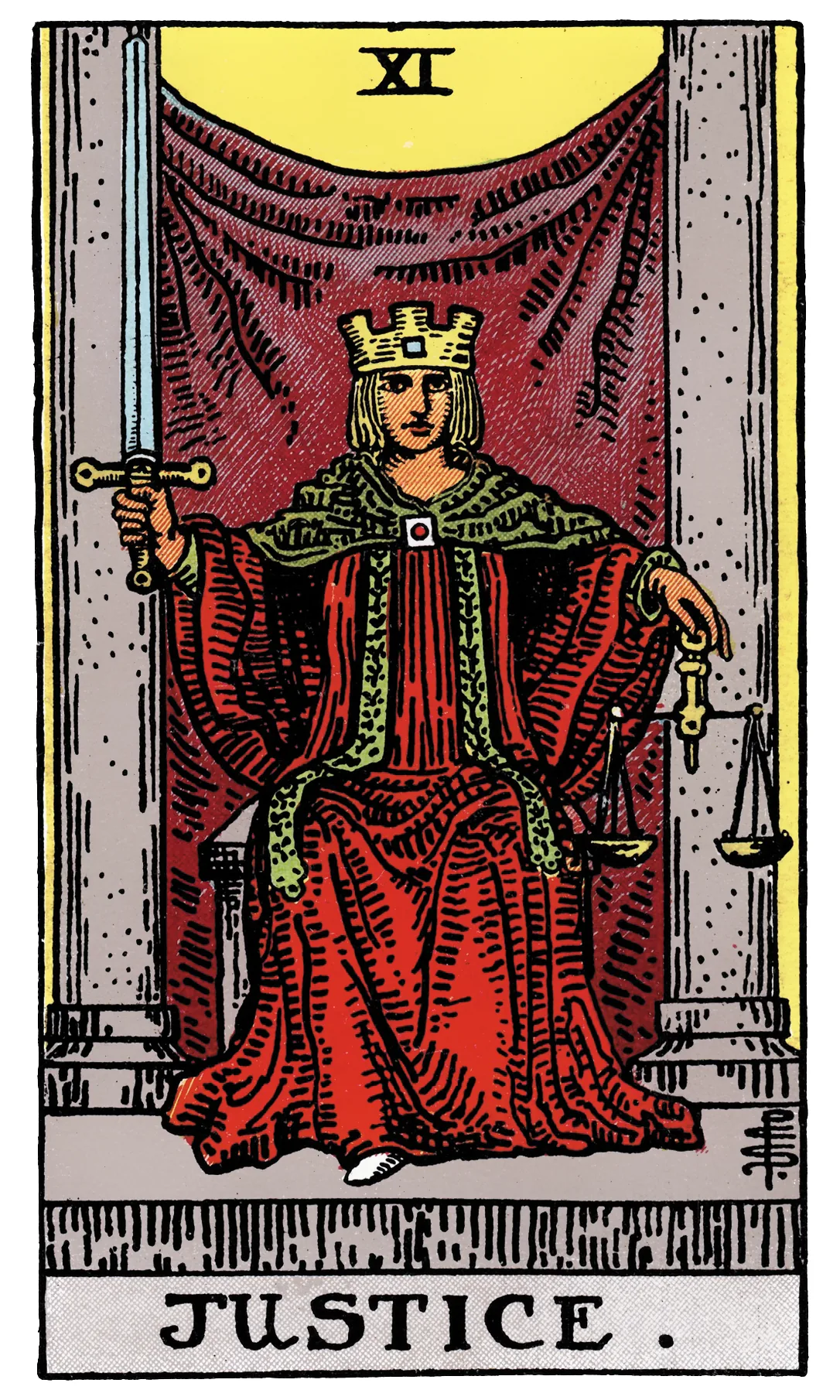
Love weighed, not measured. Justice asks whether a relationship is truly reciprocal, whether both people are showing up with honesty. The scales and sword together: truth-telling as an act of love, accountability as the ground on which trust is built.
→ Justice Tarot Love Meaning: Truth, Reciprocity & Accountability

The surrender that precedes all transformation. The Hanged Man inverts our usual understanding of desire, suggesting that sometimes the most powerful act in a relationship is the willingness to stop striving and simply be present to what is.
→ Hanged Man Tarot Love Meaning: Surrender, Patience & Letting Go

Desire you cannot name. The Moon illuminates the territory of fantasy, projection, and the unconscious forces that shape attraction. Not every pull toward another person is what it appears to be, and the Moon asks us to sit with that uncertainty rather than rush past it.
→ Moon Tarot Love Meaning: Shadow, Fantasy & the Unconscious

The naked yes. After the Moon's shadows and the Star's quiet vulnerability, the Sun is desire without concealment: joyful, radiant, and wholly uncomplicated. The child on the white horse. In love readings, this card signals the rare and precious experience of love that simply feels like coming into the light.

The call that changes everything. Judgement is the moment when a relationship is called to rise to a higher purpose, when the trumpet sounds and something that has been dormant is awakened. Renewal, resurrection, the second chance that arrives not through effort but through grace.
→ Judgement Tarot Love Meaning: Awakening, Renewal & the Call

The dance at the end of longing. The World is the culmination of the entire Major Arcana journey, and in love readings, it represents the experience of wholeness within relationship: not completion by another person, but the sacred dance of two complete beings choosing to move together.
→ World Tarot Love Meaning: Completion, Wholeness & Sacred Dance
The Complete Major Arcana · Love & Intimacy Series
Each of the twenty-two Major Arcana cards has been given its own contemplative guide, exploring its teachings on love, intimacy, and sexual energy through historical symbolism, Jungian psychology, and Kabbalistic wisdom. Select any card to read its full guide.


Love & Desire at a Glance · All 22 Major Arcana Cards
| Card | Theme | Upright in Love | Reversed in Love |
|---|---|---|---|
| 0 · The Fool | Innocence · The Leap | New beginnings · Trust · Spontaneity | Recklessness · Fear of commitment |
| I · The Magician | Charm · The First Word | Genuine charm · Attraction · Intentional pursuit | Manipulation · Love-bombing · Deception |
| II · The High Priestess | Mystery · Silent Desire | Sacred feminine · Emotional depth | Secrets creating distance · Withholding |
| III · The Empress | Sensuality · The Body's Yes | Sensuality · Body wisdom · Abundant love | Over-giving · Smothering · Depleted nurturing |
| IV · The Emperor | Structure · Authority | Protective love · Stability · Commitment | Control as care · Rigidity · Possessiveness |
| V · The Hierophant | Vows · Sacred Union | Sacred vows · Devotion · Shared values | Obligation over love · Empty vows |
| VI · The Lovers | Choice · Inner Marriage | Sacred union · Authentic choice · Deep partnership | Misaligned values · Loss of self in merger |
| VII · The Chariot | Desire in Motion | Momentum in love · Directed desire | Obsessive pursuit · Ego-driven desire |
| VIII · Strength | Gentleness · Surrender | Gentle power · Patience · Sacred eroticism | Suppressed desire · Lust without tenderness |
| IX · The Hermit | Solitude · Inner Light | Purposeful solitude · Self-knowledge | Isolation as avoidance · Fear of intimacy |
| X · Wheel of Fortune | Timing · Fate | Destined meeting · Positive timing | Missed connections · Stuck cycles |
| XI · Justice | Truth · Accountability | Honest desire · Fair partnership | Unfairness · Self-deception · Blame imbalance |
| XII · The Hanged Man | Surrender · Waiting | Letting go of control · Changed perspective | Paralysis · Martyrdom as devotion |
| XIII · Death | La Petite Mort · Rebirth | Transformation · Necessary ending | Resistance to change · Stagnation |
| XIV · Temperance | Alchemy · Sacred Blend | Alchemical union · Balance · Tantric awareness | Imbalance in giving · Forced compatibility |
| XV · The Devil | Shadow · Loose Chains | Shadow desire · Obsession acknowledged | Liberation from toxicity · Breaking codependency |
| XVI · The Tower | Revelation · Crisis | Truth revealed · Liberation through destruction | Suppressed truth · Delayed crisis |
| XVII · The Star | Vulnerability · Healing | Vulnerability after heartbreak · Renewed hope | Closed after heartbreak · Loss of faith in love |
| XVIII · The Moon | Illusion · The Unconscious | Unnamed desires · Intuition in love | Fog lifting · Deception revealed |
| XIX · The Sun | Joy · Sexual Celebration | Joyful love · Sexual celebration · Clarity | Joy blocked · Sabotaging happiness |
| XX · Judgement | Awakening · Second Chances | Relational awakening · Second chances | Refusing the call · Fear of change |
| XXI · The World | Wholeness · The Final Dance | Wholeness in union · Sacred completion | Incompletion · Holding pattern |
See the complete printable chart
All 22 cards with their intimate themes, key symbols, and upright and reversed love meanings · in one printable chart.
View the Complete Love & Intimacy ChartSexual Symbolism in the Minor Arcana
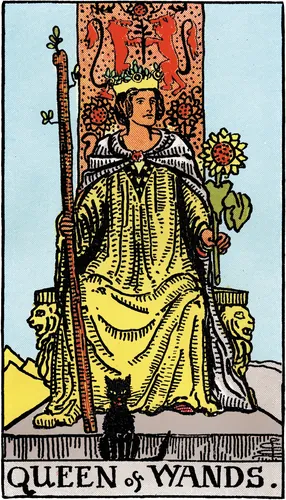
The Minor Arcana carries its own rich sexual vocabulary. These are the cards that most frequently appear in everyday readings about relationships and desire.
From Renaissance Courts to Modern Decks
Sexual symbolism in tarot has evolved significantly across five centuries.
The earliest Italian tarocchi decks of the 15th century, such as the Visconti-Sforza, kept their symbolism coded and courtly. The Lovers depicted an actual aristocratic marriage alliance. There was no nudity, no explicit imagery. Sexual themes were expressed through allegory and moral choice.
The Tarot de Marseille tradition continued this pattern, with the Lovers card presenting a young man choosing between sacred and profane love while Cupid aimed from above.
The early 20th century brought a shift. The Rider-Waite-Smith deck reframed nude imagery the tradition already carried · the Tarot de Marseille had long shown nude figures in the Star, the Sun and Judgement · reworking it in the Lovers, the Star, and the Sun, though always framed within Christian and esoteric symbolism rather than eroticism.
Crowley's Thoth deck (painted in the 1940s, published in 1969) pushed much further, explicitly connecting sexual energy to spiritual practice and renaming Strength as Lust.
Contemporary tarot has continued this opening. Many modern decks bring sexuality to the foreground as a legitimate and sacred dimension of the human experience, expanding representation beyond the heteronormative framework of earlier traditions and reflecting a more inclusive understanding of desire and intimacy.
Sources & Tradition
The love and intimacy meanings on this page draw on Arthur Edward Waite's Pictorial Key to the Tarot (1910), Rachel Pollack's Seventy-Eight Degrees of Wisdom (1980), Juliet Sharman-Burke and Liz Greene's The Mythic Tarot (1986), and the iconographic tradition of the Rider-Waite-Smith deck as painted by Pamela Colman Smith (1909). Kabbalistic correspondences follow the Golden Dawn assignments.
The Secret Ingredient for Effective Relationship Readings
The cards name the themes. But a genuine love reading happens in the space between reader and querent. Jenne Perlstein teaches how to hold the conversation that relationship readings truly are · not predicting outcomes, but making visible the dynamics both people already feel.
Explore Relationship ReadingsReading with Awareness
Understanding sexual symbolism in tarot is not about reducing every reading to questions of physical desire. It is about recognizing that the creative life force, the energy that drives attraction, passion, and intimacy, is the same energy that fuels artistic creation, spiritual awakening, and personal transformation.
When these cards appear in your readings, let them speak on multiple levels. The Empress may be inviting you into sensual pleasure, or she may be calling you to create something beautiful. The Devil may be warning about unhealthy attachment, or it may be asking you to honestly examine what you desire. Strength may be about taming your impulses, or it may be about finding the courage to fully inhabit your own passionate nature.
The tarot does not shy away from any dimension of being human. Neither should we.
Our courses with Mary K. Greer explore the historical and psychological dimensions of the cards, while Evelynne Joffe's Kabbalistic courses examine the mystical traditions of divine union that connect directly to the sacred sexuality themes discussed here.
Frequently Asked Questions
Which tarot cards represent sexual attraction?
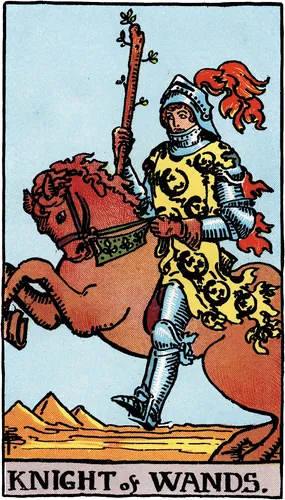
The Lovers, the Devil, the Empress, the Ace of Wands, and the Knight of Wands are the cards most commonly associated with sexual attraction. The Lovers represents conscious desire and choice, while the Devil can indicate intense, sometimes compulsive attraction. Strength and the Magician also carry strong magnetic energy in intimacy readings.
What does The Devil card mean in a love reading?
In a love reading, the Devil often points to intense physical chemistry, power dynamics, or patterns of attachment that may not be healthy. It can also represent the exploration of taboo desires. The key question is whether the desire is conscious and chosen, or compulsive and binding. Read our complete Devil love guide for upright, reversed, and pairing meanings.
Is The Lovers card always about romance or sex?
No. Historically, the Lovers was primarily about moral choice rather than romance. In modern readings, it can represent any significant choice involving values, alignment, or the integration of opposites. However, in questions about intimacy, it does carry strong sexual and romantic symbolism. Our Lovers love guide explores both the Kabbalistic and psychological dimensions of this card in intimate contexts.
What is the most sensual card in the tarot?
What does sacred sexuality mean in tarot?
Sacred sexuality refers to traditions (including Tantra, Kabbalah, and Thelema) that view sexual energy as a spiritual force. In tarot, this perspective appears most clearly in the Temperance card (the blending of opposites), the Lust/Strength card (ecstatic union), and the structural polarity of the suits (Wands/Cups as masculine/feminine creative energy).
What does the High Priestess mean for love and intimacy?
The High Priestess represents desire before it speaks: the intuitive pull toward someone that precedes conscious understanding. In love readings, she often signals hidden feelings, unspoken attraction, or the need to trust your instincts about a relationship rather than forcing clarity before it arrives naturally.
How do Death and the Tower relate to intimacy?
Death represents transformation through surrender in relationships, the willingness to let an old dynamic end so something truer can begin. The Tower represents sudden revelation or upheaval that strips a relationship down to its authentic core. Both connect to the concept of la petite mort and the relationship between surrender and profound intimacy.
Does every Major Arcana card have a love meaning?
Yes. Every Major Arcana card speaks to some dimension of love, desire, or intimate relationship. Even cards that seem unrelated to romance, like the Hermit (solitude as preparation for love), the Wheel of Fortune (cycles and seasons of desire), or Justice (fairness and accountability in partnership), carry profound teachings when they appear in intimacy readings. Explore our complete 22-card series for the full journey.