Strength
The Hand on the Lion's Jaw · Desire Tamed by Gentleness, Not Force

In love, intimacy and sexual-energy readings, Strength is the card of tender power: desire met with gentleness rather than control.
Strength in a love reading represents patience, gentle power, and the courage to be vulnerable. When this card appears in questions about romance or partnership, it signals a relationship that requires compassion over force, the taming of fears through trust, and intimacy built on quiet confidence rather than control.
Look at her hand on the lion's jaw. She is not gripping. She is not forcing the mouth closed. She is not wrestling the animal to the ground. She is opening the jaw, gently, with a touch so light it could almost be a caress.
This is the image that the Tarot has been carrying for six hundred years, and most of us have been reading it backward. We see the card and think: control your passions. Tame the beast. Rise above desire. But look again. She is not controlling the lion. She is meeting it. Her hands are bare. Her body is unarmored. The garland of roses draped between them is not a leash. It is an offering.
The Strength card teaches something that most discussions of love and intimacy fail to say clearly: the deepest form of strength in relationship is not the ability to suppress what you feel, but the willingness to remain open to it. To stand before the full force of your own desire, your own animal nature, your own hunger for touch and closeness and being known, and instead of clenching your jaw, to open it. To let yourself be seen in the act of wanting.
This is not the kind of strength that builds walls. It is the kind that takes them down.
To understand Strength in love, we have to listen to several streams at once: the long visual history of a woman and a lion, from medieval virtue allegory to Crowley's radical renaming of the card to Lust; Carl Jung's work on the integration of instinct and the shadow; the Kabbalistic teaching of Teth, the serpent coiled between mercy and severity; and the psychology of erotic surrender, where vulnerability becomes the truest form of power. What follows is an exploration of what this card means when love is the question.
Strength began as Fortitude, one of the cardinal virtues, shown in the early Italian decks as a figure overcoming a lion. Waite and Smith's 1909 card shows a woman gently opening a lion's jaw, and Waite moved it from XI to VIII; Crowley renamed it Lust, joyful union with the beast rather than its suppression. For love, the card moved from restraint to a loving partnership with passion.
Read for love, the open jaw is passion welcomed rather than forced shut, the lemniscate above her head is the endless circulation of desire, and the garland of roses joining woman and lion shows instinct gentled by love, not by force.
On the Tree of Life Strength is Path 19, Teth ('serpent'), joining Chesed (mercy) to Geburah (severity), under Leo. In intimacy it is serpent energy held between giving and limiting: passion that is free because it is cared for. Full Strength meaning, history and symbolism.
The Lion as Libido: Jung and the Integration of Instinct
In Carl Jung's analytical psychology, the Strength card enacts one of the central dramas of the individuation process: the encounter between the conscious self and its own instinctual nature.
Jung distinguished sharply between suppression and integration of instinct. Suppression pushes the instinct into the unconscious, where it does not disappear but grows stronger, more distorted, and more likely to erupt in destructive ways. Integration means acknowledging the instinct, engaging with it consciously, and finding a way to incorporate its energy into the whole personality. The woman in the Strength card is performing integration. She has not chained the lion. She has not caged it. She has placed her bare hands on its jaw and is looking directly into it.
Jung wrote that the shadow, the repository of everything we have rejected about ourselves, is the first great encounter on the path to wholeness. He described it as "the 'apprentice-piece' in the individual's development." The shadow contains not only our darkest impulses but also our unlived vitality, our suppressed desires, our creative energy that was deemed unacceptable by family, culture, or our own frightened ego. The lion in the Strength card is this shadow given a body: golden, powerful, alive, and not inherently evil. It is only dangerous when denied.
The encounter with the anima (the unconscious feminine principle in a man's psyche) or animus (the unconscious masculine principle in a woman's psyche) is what Jung called "the masterpiece." On the Strength card, we see this encounter depicted: the feminine figure (anima) engaging directly with the beast (shadow, instinct). The anima does not fight the shadow. She tames it through presence, through the quality of her attention, through the willingness to remain soft in the face of something fierce. This is the exact mechanism by which Jung said unconscious material is integrated: not by force of will, but by sustained, compassionate awareness.
For love readings, this Jungian framework carries a specific teaching. When Strength appears, it often indicates that the querent is encountering their own shadow in the mirror of relationship. The partner who triggers your deepest reactions, who brings up your jealousy, your possessiveness, your fear of abandonment, your hunger for control, is showing you the lion. And the card's teaching is not to suppress those reactions or to pretend they do not exist. It is to meet them the way the woman meets the lion: with open hands, with steady presence, without flinching.
Beauty and the Beast: The Archetype of Transformative Love
The Strength card is the Tarot's version of the oldest love story in Western culture: Beauty and the Beast.
The tale we know today descends primarily from Gabrielle-Suzanne Barbot de Villeneuve's 1740 novel and Jeanne-Marie Leprince de Beaumont's shortened 1756 version. But its roots reach much further: to the Roman myth of Cupid and Psyche (from Apuleius's The Golden Ass, 2nd century CE), where a mortal woman must love an unseen god in the dark; to the Norwegian "East of the Sun and West of the Moon," where a girl's curiosity about her bear-husband triggers a quest for redemption; and to dozens of other folk tales across cultures where love between a human and a beast leads to transformation.
The Jungian reading of this archetype is precise. The Beast represents the shadow: the part of the psyche that has been rejected, distorted, made monstrous by its exile from consciousness. Beauty represents the anima: the soul quality that can see past the monstrous exterior to the essential nature beneath. The curse is broken not by defeating the Beast but by loving it as it is. Not by demanding that it change first. Not by requiring that it prove itself safe before being accepted. But by the radical act of seeing it clearly and choosing to stay.
This is the Strength card's teaching for relationships. The lion does not become a housecat. It does not stop being a lion. The woman does not transform it into something tame and manageable. She transforms the relationship between them: from adversarial to intimate, from fearful to trusting, from a battle for dominance to a meeting between equals. In love, this translates to the moment when you stop trying to fix your partner's flaws and start trying to understand the wound beneath them. When you stop performing a curated version of yourself and let the other person see the beast you have been hiding. When the mask comes off, not because someone ripped it away, but because the hand on the jaw was gentle enough that it felt safe to let go.
Erotic Surrender: Vulnerability as True Strength
There is a dimension of the Strength card that conventional Tarot interpretation tends to avoid: its relationship to erotic surrender.
The image on the card is intimate. A woman's bare hands on the mouth of a powerful animal. No weapons. No distance. No defensive posture. The proximity alone suggests something that goes beyond intellectual understanding. She is touching the lion. And the lion, despite its power, is allowing itself to be touched. Both parties are surrendering something: the woman surrenders her safety; the lion surrenders its dominance. What emerges between them is neither conquest nor submission, but a third thing, a mutuality that could not exist if either one held back.
Contemporary psychology has begun to articulate what this image has always shown. Vulnerability, far from being a weakness, is the essential ingredient of genuine intimacy. Passion itself depends on it. Desire without vulnerability becomes performance. Physical closeness without emotional exposure becomes mechanical. The willingness to be seen in the act of wanting, to risk rejection, to let someone witness your need, is the foundation on which every meaningful intimate encounter is built.
The paradox at the heart of erotic surrender is the same paradox at the heart of this card: it takes more strength to open than to close. Clenching the jaw is easy. It is a reflex. Every animal does it when threatened. But opening the jaw, letting the breath come, letting the sound emerge, letting the body respond without censoring itself, that requires a kind of courage that has nothing to do with muscular force and everything to do with trust.
If a relationship involves coercion, fear, or harm, the invitation is not to "surrender" but to seek real-world support from trusted people and qualified professionals. The Strength card's surrender is always a choice, never an imposition. It exists only where safety has been established first.
Crowley's Lust: The Radical Teaching
Crowley's renaming of the Strength card to Lust was not a provocation for its own sake. It was, in his system, a correction. He believed that the word "Strength" implied something static: a fortress, a wall, a capacity to endure. What the card actually depicted, he argued, was something dynamic: the joy of strength exercised, energy in motion, the ecstatic engagement with the full spectrum of experience.
These traditions are not the same, and they should not be collapsed into one another. Waite's Strength and Crowley's Lust emerge from different spiritual systems with different assumptions about the body, desire, and the sacred. But the tension between them illuminates something that neither captures alone.
In the Thoth deck, the gentle woman has become Babalon, a figure from Crowley's Thelemic mythology: the Scarlet Woman, the sacred harlot, the divine feminine who has "submitted herself to everything." She does not stand beside the Beast. She rides it. She holds the Holy Grail aloft, overflowing with the mingled blood of the saints, the essence of every experience she has embraced without flinching. The Beast beneath her has seven heads: an Angel, a Saint, a Poet, an Adulterous Woman, a Man of Valour, a Satyr, and a Lion-Serpent. These seven heads represent the totality of human experience, from the most spiritual to the most carnal, all carried by a single creature, all part of the same body.
Crowley's teaching, stripped of its deliberate provocations, is this: you cannot be strong about desire by holding yourself apart from it. You cannot understand the lion by studying it from behind glass. Strength, in the fullest sense, requires engagement. The woman on the Rider-Waite-Smith card demonstrates this with her bare hands on the jaw. Babalon demonstrates it by riding the Beast through the desert, drunk on the cup of experience. Both are showing the same thing from different angles: strength is not the opposite of desire. It is what happens when you meet desire fully.
Strength and Control: What the Card Does Not Mean
The most common misreading of the Strength card in love contexts is that it means "control your emotions." Keep a lid on it. Be the bigger person. Do not let them see you sweat. Maintain composure.
This reading mistakes the card entirely. The woman on the card is not composed in the sense of being shut down. She is composed in the sense of being fully present. There is a vast difference. One involves suppression. The other involves integration. One creates distance from feeling. The other creates intimacy with it.
The difference matters enormously in relationships. A person who controls their emotions is performing stability. They may appear calm, reliable, unshakable. But the lion is still there, pacing behind the wall they have built, growing more agitated the longer it is confined. Eventually it breaks out: as an explosion of rage in an otherwise "calm" person, as a sudden affair from an otherwise "devoted" partner, as the inexplicable departure of someone who seemed to have everything under control. Suppressed instinct does not stay suppressed. It returns, and it returns with interest.
The Strength card offers a different model. The lion is not behind a wall. It is right there, in the open, its mouth being gently held by bare hands. The woman has not eliminated her instinctual nature. She has met it. She is in active, ongoing relationship with it. The garland of flowers between them is not a cage. It is a living, fragile connection that requires constant tending.
In love readings, this distinction is the difference between a partner who "never gets angry" (and eventually implodes) and a partner who can say, clearly and without hostility, "I am angry, and here is why." It is the difference between desire suppressed until it becomes compulsive and desire acknowledged until it becomes a conversation. The Strength card does not advise you to be in control. It advises you to be in contact.
Upright and Reversed in Love Readings
Gentleness as power in intimate connection. The courage to remain open and vulnerable rather than defensive. Patience with a partner's process, and with your own. The integration of desire into the whole self rather than its suppression. A relationship where both people feel safe enough to show their full nature, shadow included. Deep physical and emotional compatibility built on trust rather than performance. The capacity to love someone as they actually are, not as you wish they would be. Waite's keywords: "Power, energy, action, courage, magnanimity; also complete success and honours."
Desire suppressed until it becomes destructive. The lion unchained: lust without tenderness, passion without awareness, intensity that overwhelms rather than connects. Alternatively, the lion over-caged: emotional numbness, fear of one's own desire, shame about the body or its appetites. Self-doubt masquerading as modesty. The inability to say what you want. Domination disguised as care, or submission disguised as devotion. A relationship where one person is always taming and the other is always wild, with no reciprocity. Waite's reversed keywords: "Despotism, abuse of power, weakness, discord, sometimes even disgrace."
- Where in your intimate life are you gripping when you could be opening?
- What would it mean to meet your own desire with gentleness rather than judgment?
- Is there a part of yourself you have caged that your relationships are asking you to set free?
- When your partner shows you their lion, do you reach for armor or for the garland?
- What is the difference, in your body, between controlling a feeling and being present with it?
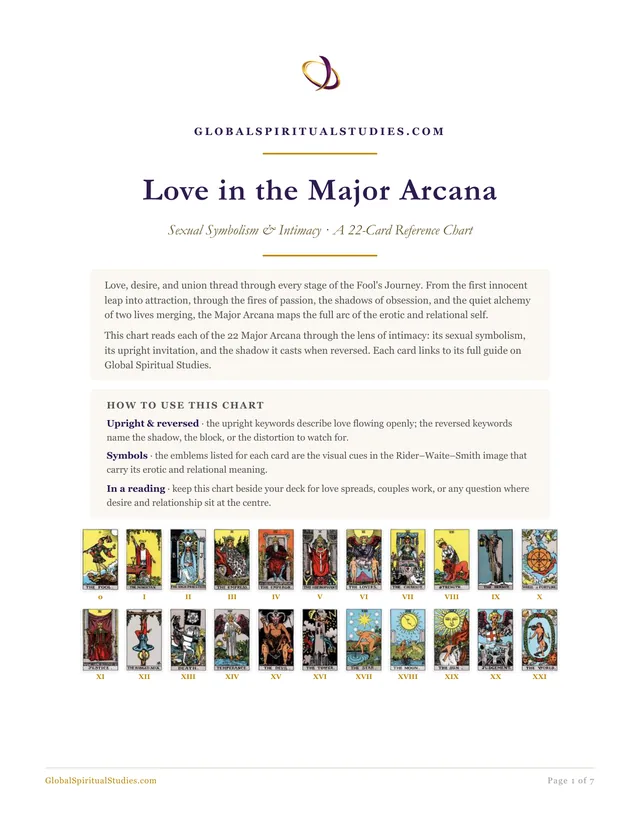
To compare the Strength with the other twenty-one Major Arcana in love readings, upright and reversed, open the free Tarot love chart.
Card Pairings in Intimacy Readings
Strength takes on specific dimensions when she appears alongside other cards in love and relationship spreads.
The Lovers chooses; Strength sustains. This pairing often appears when a relationship has moved past the initial decision to be together and is now asking for a different kind of engagement: not the fire of attraction but the patient warmth of acceptance. The Lovers brings two people face to face. Strength teaches them how to stay there once the easy part is over.
The lion freed and the chains examined. These two cards form a profound axis in love readings: the Devil shows desire bound by unconsciousness (notice that the chains around the figures' necks are loose enough to remove), while Strength shows desire met with awareness. Together, they ask whether you are engaging your passions from a place of choice or compulsion. The Devil's bondage and Strength's garland are both circles connecting two beings. But one is a chain and the other is a flower.
Interior knowing meets embodied courage. The High Priestess senses what is true. Strength acts on it. Together, they describe a person (or a moment in a relationship) where deep intuitive understanding is being paired with the bravery to be vulnerable. The Priestess knows the lion is there. Strength reaches out and touches it.
Cards VIII and IX side by side: the mastery of instinct followed by the retreat into wisdom. Strength has met the lion. Now the Hermit integrates what was learned in that encounter. In love readings, this pairing indicates that significant inner work has been done or is being done on desire, attachment, and the animal self. The Hermit carries the lantern; Strength has given him something real to illuminate.
The body honored and the instinct embraced. The Empress celebrates the sensual world without reservation; Strength brings awareness to that celebration without dampening it. Together, these cards describe a deeply embodied intimacy: physical pleasure held within the container of emotional presence. The Empress says "feel everything." Strength says "feel it with your eyes open."
Two approaches to the same problem of desire. The Chariot controls through willpower, discipline, and direction: the sphinxes are harnessed, the driver holds the reins. Strength controls through gentleness, presence, and relationship: the lion is unbound, the woman's hands are bare. In love readings, this pairing asks whether you are trying to drive the relationship forward by force of will or by the slower, deeper work of genuine connection. The Chariot conquers. Strength befriends.
The lion met and the waters balanced. These two cards share a quality of gentle, sustained engagement with powerful forces. Strength faces the animal within. Temperance pours between two vessels, finding the exact proportion. Together in a love reading, they suggest a relationship (or a period within one) where the hard work of integration is producing real results: desire that is neither repressed nor reckless, passion held in exquisite balance with care.
Strength walks Path 19 on the Kabbalistic Tree of Life, the serpent road between Mercy and Severity. Evelynne Joffe's course explores how each Major Arcana card maps onto the Tree, revealing the hidden architecture beneath every reading.
Explore the CourseFor the mystic's path through desire and devotion, Cynthia Ray's Tarot and the Path of the Mystic explores the contemplative dimensions of the cards, including the Strength card's teaching on meeting the sacred through the body.
Go deeper · explore our Tarot courses, or download the free 7 chakra chart to map the body's energy centres.
Frequently Asked Questions
What does Strength mean in a love reading?
Strength in a love reading indicates that gentleness, patience, and emotional courage are the most important qualities right now. The card points to a relationship (or a readiness for one) where both people can show their full nature without fear of rejection. It suggests that love is being deepened not through grand gestures but through the quiet, sustained work of accepting another person as they actually are, lion and all. Strength often appears when the querent is learning to integrate their own desires rather than suppress them, or when a relationship is moving from the excitement of attraction into the more demanding terrain of genuine intimacy. It can also indicate a partner who is gentle, self-assured, and emotionally grounded.
Is Strength a yes or no card for love?
In yes-or-no style readings, Strength often leans toward yes, but not a fast or forceful yes. It suggests that what you are asking about has real potential, but it will unfold through patience and inner work rather than through dramatic action. The card's "yes" is the yes of the open hand, not the clenched fist. It points toward a love that develops through mutual trust and genuine vulnerability rather than through pursuit or conquest. If you are asking whether a relationship is worth continuing, Strength says: yes, but bring your whole self to it, including the parts you have been hiding.
What does Strength reversed mean in a love reading?
Strength reversed in love can indicate one of two imbalances. The first is the lion unleashed: desire without tenderness, intensity without awareness, passion that overwhelms rather than connects. This can manifest as jealousy, possessiveness, or sexual dynamics where power has replaced intimacy. The second is the lion over-caged: emotional numbness, shame about desire, the inability to express what you want, the fear of your own animal nature. Both are failures of the card's central teaching, which is integration. Reversed, the card asks: are you suppressing your instincts out of fear, or are you being driven by them without reflection? Waite's reversed keywords, "despotism, abuse of power, weakness, discord," point to what happens when gentleness is replaced by either force or collapse.
What does Strength represent as a person in a love reading?
When Strength represents a person, it describes someone who is quietly powerful, emotionally courageous, and deeply comfortable with themselves. This is not someone who dominates a room. It is someone whose presence calms it. They have done their inner work. They know their own shadow and are not afraid of yours. They are patient without being passive, gentle without being weak, and passionate without being reckless. In romantic contexts, a Strength person tends to love steadily rather than dramatically. They are not threatened by their partner's complexity. They can hold space for difficult conversations without withdrawing or escalating. They may have a strong physical presence and a quiet confidence that comes from self-knowledge rather than self-promotion.
What is the sexual meaning of the Strength card?
The Strength card's sexual dimension is inseparable from its broader teaching about desire and vulnerability. The lion represents libido, the body's wanting, the animal self that desires without apology. The woman's bare-handed engagement with the lion represents the willingness to meet that energy with presence rather than shame, strategy, or suppression. Crowley made this explicit by renaming the card Lust, which he defined as "the joy of strength exercised." In the Kabbalistic tradition, the Hebrew letter Teth (serpent) connects to kundalini, the creative and sexual energy that yogic and esoteric traditions describe as coiled at the base of the spine. The card suggests an intimate life where desire is integrated rather than compartmentalized, where physical connection is an expression of emotional trust, and where the full force of wanting is met with the full force of tenderness.
Why did Crowley rename Strength to Lust?
Crowley renamed the card because he believed "Strength" was too static a word. It implied endurance, walls, the capacity to resist. What the card actually depicted, in his reading, was something active: the joy of engaging fully with life's forces. He defined Lust as "the joy of strength exercised," meaning strength in motion, in use, in passionate encounter with the world. His Thoth card replaced the gentle woman with Babalon, the Scarlet Woman riding a seven-headed Beast, intoxicated with the ecstasy of total experience. The seven heads represented the full range of human nature: spiritual, creative, carnal, valorous, deviant, and divine. Crowley's point was that genuine strength does not stand apart from desire. It meets desire fully, embraces the whole of experience, and transforms both self and world through that engagement.
What is the difference between Strength and the Chariot in love readings?
The Chariot and Strength both address the relationship between the self and powerful forces, but they use fundamentally different methods. The Chariot (Card VII) governs through willpower, discipline, and direction. Its sphinxes are harnessed. Its driver holds the reins. It is the ego in command of opposing energies. In love readings, the Chariot often appears when someone is pursuing a relationship through determination, trying to make things happen through effort and will. Strength (Card VIII) governs through gentleness, patience, and relationship. The lion is unbound. The woman's hands are open. There are no reins, only roses. In love readings, Strength appears when the situation calls for surrender rather than conquest, for patience rather than pursuit. The Chariot asks: "How do I get what I want?" Strength asks: "How do I remain present with what is?"
What is the Kabbalistic meaning of the Strength card?
In Kabbalah, Strength corresponds to Path 19 on the Tree of Life, connecting Chesed (Mercy, expansive love) to Geburah (Severity, disciplined strength). The Hebrew letter is Teth, meaning "serpent," representing concealed power and the life force coiled within matter. The astrological attribution is Leo, the sign of the heart, solar courage, and creative vitality. The Yetziratic title is "The Intelligence of the Secret of all Spiritual Activities." This placement is significant because Path 19 bridges the two great opposing forces on the Tree: unconditional giving and necessary limitation. The Strength card's serpent wisdom lies in knowing when to open and when to hold, moving fluidly between mercy and severity as each moment in a relationship requires.