The Devil
Desire, Shadow, and the Chains You Could Remove at Any Moment

In love, intimacy and sexual-energy readings, the Devil is the card of compulsive desire: obsession, attachment and the chains we could lift off if we chose.
The Devil in a love reading represents desire, attachment, and the shadow side of intimacy. When this card appears in questions about romance or partnership, it signals passionate but potentially unhealthy bonds, power dynamics, or the need to examine what keeps you chained to patterns that no longer serve you.
Look at the chains.
They are loose. The two figures standing at the Devil's feet wear them around their necks, yes. But the loops are wide enough to lift over their heads. They could step away at any moment. They could walk free into the open air. And they do not. Perhaps they have not noticed. Perhaps the bondage has grown so familiar it feels like home. Perhaps some part of them wants to stay.
This is the detail that changes everything about Card XV. The Devil is not only a card about being trapped. It is a card about the painful places where bondage becomes familiar, where freedom may be possible but not yet imaginable, and where some part of us may still believe the trap is keeping us safe.
No card in the Tarot provokes more anxiety in love readings. Querents see the horned figure and assume the worst: infidelity, manipulation, a relationship damned beyond repair. But the Devil is far more subtle than that. This card is the Tarot's most unflinching mirror for the unconscious dimensions of desire. It asks the questions that polite conversation avoids. What keeps you in a relationship that hurts you? What draws you toward what you know is wrong for you? And what would it actually cost you to take the chains off?
A note: if a relationship involves coercion, fear, or harm, the invitation is not to analyze the bond alone, but to seek real-world support from trusted people and qualified professionals.
This guide draws on the original sources that shaped this card's meaning: Waite's Pictorial Key to the Tarot (1910), Eliphas Lévi's Baphomet illustration (1856), Carl Jung's theory of the Shadow, Aleister Crowley's Book of Thoth (1944), the Kabbalistic tradition of the Tree of Life, and contemporary research on limerence and the neuroscience of obsessive love. What follows is a complete exploration of what the Devil means when love, desire, and sexual energy are the question.
The Devil is missing from the surviving Visconti-Sforza cards; the Marseille Le Diable shows a horned figure above two small chained imps. Waite and Smith's 1909 version, drawing on Eliphas Lévi's Baphomet, put a chained man and woman at his feet, and Crowley painted him as Pan, the goat of Capricorn and raw creative force. For love, the card moved from damnation to the psychology of attachment.
Read for love, the loose chains are bonds the couple could slip if they noticed, the inverted pentagram is spirit placed beneath appetite, and the downward torch is desire pointed at the body alone.
On the Tree of Life the Devil is Path 26, Ayin ('eye'), joining Tiferet (the heart) to Hod (the intellect), under Capricorn. In intimacy Ayin is the eye that sees: once you look clearly at a pattern of compulsion, the chains start to loosen. Full Devil meaning, history and symbolism.
The Numerological Mirror: The Devil and The Lovers
The Devil is Card XV. Reduce the digits: 1 + 5 = 6. Card VI is The Lovers.
This is not a coincidence. It is one of the deepest structural relationships in the entire Tarot, and for love readings it may be the single most important numerological connection in the deck.
Look at the two cards side by side. In both, a large figure presides over a man and a woman. In The Lovers, Archangel Raphael blesses the couple from above; in the Devil, Baphomet looms over them from a throne. In The Lovers, the couple stands nude and unashamed in the Garden of Eden; in the Devil, the couple stands nude and chained, growing horns and tails. In The Lovers, the figures stand apart, each in their own space; in the Devil, they are bound to the same pedestal.
The Lovers represents desire that is conscious, chosen, and blessed. The Devil represents desire that has become unconscious, compulsive, and binding. They are not opposites. They are the same energy at different levels of awareness.
Every love story contains both cards. The intoxication of new attraction (Lovers) can calcify into codependency (Devil). The thrill of sexual chemistry (Lovers) can become an addiction you cannot break (Devil). The choice to open your heart to someone (Lovers) can become the inability to close it even when staying hurts you (Devil). The movement between these two cards is not a fall from grace. It is what happens when desire goes underground, when wanting becomes needing, when the freedom to choose becomes the compulsion to stay.
Jung's Shadow and the Golden Shadow
In Carl Jung's analytical psychology, the Devil is the Shadow: the sum of everything the conscious personality has rejected, denied, and refused to acknowledge.
The Shadow is not evil. It is everything you have decided you are not. If you have built an identity around being generous, your Shadow holds your greed. If you are proud of your independence, your Shadow holds your desperate need to be held. If you present yourself as rational and controlled, your Shadow holds your wildness, your appetite, your capacity for excess. The Shadow is the basement of the psyche, and every trait you have exiled from the upstairs of your personality lives down there, growing stranger in the dark.
Jung was clear that the Shadow operates most powerfully in romantic relationships. We project our Shadow onto our partners, seeing in them the qualities we refuse to acknowledge in ourselves. The person who infuriates you most is often carrying a piece of your own unacknowledged self. The lover who attracts you most powerfully may be embodying something your conscious personality has disowned.
Everyone carries a shadow, and the less it is embodied in the individual's conscious life, the blacker and denser it is. At all counts, it forms an unconscious snag, thwarting our most well-meant intentions.
But Jung also described something he called the golden shadow: the positive qualities we have repressed alongside the negative ones. Not just our darkness lives in the Shadow. Our unlived creativity, our unacknowledged power, our unclaimed passion also reside there. When the Devil appears in a love reading, it may not only be pointing to what is toxic. It may also be pointing to what is unlived.
Consider: the person who stays in a relationship that diminishes them may be doing so because they have projected their own power onto their partner. They worship in their lover what they refuse to claim in themselves. The chains are not just made of pain. They are made of all the gold you have handed to someone else because you could not bear to own it yourself.
This is the Devil's deepest psychological teaching for love readings. The card does not simply say "this relationship is bad for you." It asks: what part of yourself have you chained to this person? What would you have to become if you took it back?
The Neurochemistry of Obsessive Love
Modern neuroscience has given us a language for what the Devil card depicts. The loose chains are not only a spiritual metaphor. They have a biochemical correlate.
Psychologist Dorothy Tennov coined the term limerence in 1979 to describe the involuntary state of obsessive romantic attachment: the intrusive thoughts, the desperate need for reciprocation, the emotional dependency on another person's attention. Neuroscientist Helen Fisher, using fMRI imaging, demonstrated that the brains of people in the early stages of intense romantic love show activation patterns nearly identical to those of people experiencing addiction. The same dopamine reward circuits that respond to cocaine and gambling respond to the face of the beloved.
When love becomes obsessive, the neurochemistry shifts. Dopamine surges during contact, creating euphoria. Cortisol elevates during separation, creating anxiety. Serotonin drops, producing the intrusive, repetitive thoughts characteristic of obsessive-compulsive disorder. The combination creates a biochemical trap: the beloved becomes the only reliable source of relief from the distress their absence causes. This is the neurochemical portrait of the Devil's loose chains.
Stanton Peele, in his landmark work Love and Addiction (1975), was among the first to argue that love itself can function as an addiction, complete with tolerance (needing more intensity to feel the same effect), withdrawal (the devastating crash when the object of attachment is unavailable), and continued use despite harmful consequences. The parallels to substance addiction are not metaphorical. They are structural.
Attachment theory adds another dimension. The psychologist John Bowlby demonstrated that our earliest experiences of caregiving create templates for all later intimate bonds. When those early bonds were inconsistent, when love arrived unpredictably or was withdrawn as punishment, the nervous system learns that love is something scarce that must be desperately secured. The adult result can be what clinicians now call trauma bonding: the paradoxical intensification of attachment through intermittent reinforcement, the way abuse followed by tenderness creates a bond stronger than consistent kindness ever could.
The Devil card, read through this lens, becomes a diagnostic instrument of startling precision. The loose chains are the attachment patterns that feel inescapable but are, with awareness and support, subject to change. The horns growing on the chained figures are the ways we internalize and replicate the patterns that bind us. The half-cube pedestal is the partial awareness that keeps the system running: seeing enough to suffer but not enough to leave.
Desire as Teacher: Pan, Dionysus, and Sacred Fire
Everything discussed so far paints the Devil as a problem. But the card holds another teaching entirely, one that Crowley understood better than Waite and that ancient traditions understood better than either.
The Devil's zodiacal attribution is Capricorn, the goat. The goat-god Pan was, in Greek religion, not a figure of evil but of wild nature: the forests, the pastures, the undomesticated places where civilization's rules did not reach. Pan was the god of shepherds, of flocks, of the noonday heat that made mortals drowsy and strange. He was associated with sudden, irrational terror (our word "panic" comes from his name) and with uninhibited sexuality. He chased nymphs through the woods. He played the pipes. He was, above all, alive.
Plutarch recorded a famous story: during the reign of Tiberius, a ship's pilot sailing near the Greek islands heard a divine voice cry out across the water that "Great Pan is dead." The early Christians interpreted this as the death of paganism at the coming of Christ. But read symbolically, Pan's death represents the repression of instinctual nature by an increasingly rationalized civilization. When the wild god dies, what remains is the Devil: instinct stripped of its divinity, desire without its sacred dimension, the body's knowing reduced to mere appetite.
Euripides dramatized this same truth in The Bacchae. When King Pentheus of Thebes attempts to suppress the worship of Dionysus, the god of wine, ecstasy, and theatrical transformation, the repressed energy does not disappear. It returns with catastrophic force. Pentheus is torn apart by his own mother in a Dionysian frenzy. The teaching is clear: what you refuse to acknowledge does not go away. It goes underground and returns as destruction.
Crowley grasped this when he identified the Devil with Pan Pangenetor. For Crowley, the card represented not bondage but liberation through the full embrace of creative and sexual energy. In Thelemic philosophy, the same force that manifests as biological desire also manifests as artistic creativity, spiritual aspiration, and mystical ecstasy. Tantra, the Hindu and Buddhist tradition of sacred sexuality, teaches the same principle: sexual energy is not separate from spiritual energy. It is spiritual energy, experienced through the body. The Sanskrit term is Kundalini, the coiled serpent at the base of the spine that, when awakened, rises through the energy centers and produces both physical pleasure and spiritual illumination.
The Devil, read through this tradition, becomes the card of the sacred fire misunderstood. The energy it depicts is not evil. It is raw, powerful, and dangerous when unconscious, but it is the same energy that fuels everything creative and alive in the human experience. The question is not whether to feel it. The question is whether you feel it with awareness or are consumed by it in the dark.
The Devil and The Lovers: The Deepest Mirror in the Deck
These two cards deserve their own extended reflection, because the arc between them describes the full trajectory of desire in human life.
In The Lovers, the couple stands in the Garden of Eden. Behind Eve, the Tree of Knowledge with its serpent. Behind Adam, the Tree of Life. Above them, Archangel Raphael extends his blessing. The scene is saturated with possibility. Desire is present but has not yet been acted upon. The couple can choose. They are free.
In the Devil, the same couple reappears. The garden is gone. The angel is replaced by Baphomet. The trees have become chains. The fruit of knowledge, once an invitation, has become compulsion. The figures are no longer choosing. They are staying.
But here is the detail that transforms both cards: the Devil's chains are loose. Freedom has not been destroyed. It has been forgotten. And the path from the Devil back to the Lovers is not a retreat. It is an advancement. You cannot return to the Garden of Eden, to the innocence of desire before it becomes complicated. But you can arrive at something the Garden never offered: conscious desire. The Lovers choose without knowing what desire will cost. The person who has faced the Devil and removed the chains chooses knowing the cost, and chooses anyway.
This is why the Devil is, paradoxically, one of the most important cards for understanding mature love. It teaches that desire which has never been tested, never gone wrong, never become obsessive or painful, is not yet fully conscious. The passage through the Devil's territory, through attachment, through shadow, through the honest confrontation with your own capacity for obsession and self-deception, is part of how desire matures into something that can actually sustain a life shared with another person.
Upright and Reversed in Love Readings
Powerful physical attraction that may override better judgment. Codependency, obsession, or power imbalances in a relationship. Patterns of attachment that feel inescapable but are maintained by unconsciousness, not by necessity. Sexual energy experienced as compulsion rather than choice. Honest confrontation with the shadow dimensions of desire: jealousy, possessiveness, the need to control. An invitation to examine what keeps you in a situation that hurts you. Potentially: the healthy exploration of taboo, the deliberate investigation of desires that mainstream culture has taught you to suppress. Waite's upright keywords include "ravage, violence, extraordinary efforts, fatality."
The chains come off. Liberation from a toxic relationship, an addictive pattern, or a cycle of codependency. The moment of seeing the trap clearly for the first time. Shadow integration: acknowledging desires and patterns that were previously unconscious. Recovery from attachment wounds. Reclaiming power that was given away to a partner, a fantasy, or a pattern. Waite's reversed keywords, rarely cited by other sources, include "weakness, pettiness, blindness" and "evil fatality." The reversal does not always mean freedom has been achieved. It can also indicate that the bondage has become so normalized it is no longer recognized as bondage.
- What chains in your intimate life are loose enough to remove, if you chose to?
- Where do you confuse intensity with intimacy?
- What part of yourself have you projected onto a partner and now worship in them instead of claiming in yourself?
- What desire have you refused to look at honestly, and what does it cost you to keep it in the dark?
- How do you distinguish between a bond that challenges you to grow and a bond that diminishes you?
- If you removed the chains, who would you have to become?
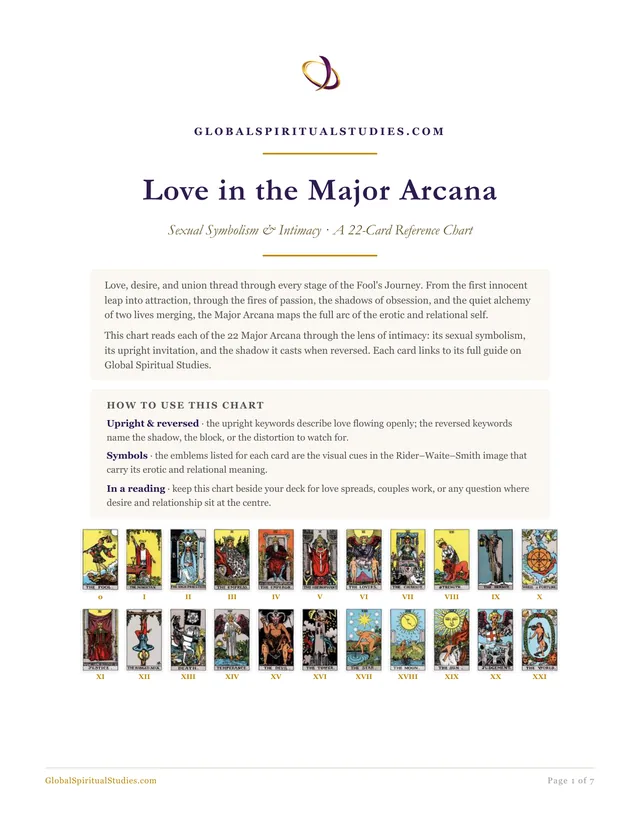
To compare the Devil with the other twenty-one Major Arcana in love readings, upright and reversed, open the free Tarot love chart.
Card Pairings in Intimacy Readings
The Devil takes on specific dimensions when paired with other cards in love and relationship spreads.
The deepest mirror in the deck. The same couple, two realities. Together, these cards ask whether desire is being experienced consciously (Lovers) or compulsively (Devil). This pairing often appears at the turning point of a relationship: the moment when attraction either matures into genuine choosing or calcifies into dependency.
The most explosive sequence in the Tarot for love readings. The Tower's lightning shatters the Devil's illusions. The chains do not just loosen; they are blown apart. This pairing frequently appears when a relationship ends suddenly and catastrophically, when an affair is discovered, when the truth arrives like a demolition charge. Devastating, but also potentially liberating.
What you desire but will not admit. The High Priestess governs the threshold between conscious and unconscious; the Devil is what happens when desire stays on the unconscious side too long. Together, these cards suggest that honest self-examination, the willingness to look behind the veil at your own wanting, is the path out of the chains. The High Priestess holds the key; the Devil holds the lock.
Shadows upon shadows. Both cards govern the unconscious, and together they suggest deep confusion about what is real in a relationship. Illusions reinforcing compulsions. The pull of something that may not exist as you imagine it. This pairing warns that you may be in love with a projection rather than a person, and that the projection is being maintained by your own unwillingness to see clearly.
Cards VIII and XV share a numerological column with the Magician (I): 1, 8, 15. The Magician creates; Strength tames with compassion; the Devil binds. Together, Strength and the Devil ask whether instinct is being befriended or enslaved. Can you hold your desire with gentleness rather than being held by it? Strength suggests that the way out of the Devil's chains is not suppression but loving integration.
From bondage to radical vulnerability. The Star follows the Tower in the Major Arcana sequence, and this pairing echoes that journey in a love reading: after the chains fall and the structures collapse, what remains is the soul stripped bare, pouring itself out under starlight. The Devil shows what you were bound to. The Star shows who you are without it.
The body's pleasure and the body's trap. The Empress celebrates sensuality, fertility, and the creative power of physical experience. Paired with the Devil, the question becomes whether pleasure is life-giving or compulsive. Are you enjoying your body, or are you using sensation to avoid feeling something deeper? This pairing can also represent the full spectrum of sexual energy: the Empress's celebration and the Devil's intensity together.
Evelynne Joffe explores the Devil card's dual nature through Kabbalistic and Jungian lenses, tracing how Card XV has been cast as both humanity's scapegoat and its unrecognized lightbringer.
Explore the CourseFor the psychological dimensions of shadow and projection in love, Mary K. Greer's Jungian course explores the unconscious forces that shape how we love and what we project onto our partners.
Go deeper · explore our Tarot courses, or download the free 7 chakra chart to map the body's energy centres.
Frequently Asked Questions
What does the Devil mean in a love reading?
The Devil in a love reading points to the shadow dimensions of desire: obsession, codependency, power imbalances, or patterns of attachment that feel inescapable. The card's central teaching is the loose chains: the bondage is maintained by unconsciousness, not by force. It asks you to examine honestly what keeps you in a situation that may be hurting you. The Devil can also indicate intense physical chemistry and passion, but warns that intensity and intimacy are not the same thing. In some contexts, particularly when the querent is doing active self-examination, it can represent the healthy exploration of desires that have been suppressed.
Is the Devil a yes or no card for love?
In yes-or-no style readings, the Devil often asks us to pause before giving an answer. It may lean toward no when the connection is marked by compulsion, secrecy, or loss of freedom. But the card does not say "this person is bad" or "this relationship is doomed." It says "something here is unconscious, and until you see it clearly, you cannot make a free choice." The deeper question the Devil poses is not yes or no but rather: are you choosing this, or is it choosing you? If you can answer honestly and still say yes, the Devil may simply be acknowledging the intensity of the connection.
What does the Devil reversed mean in a love reading?
The Devil reversed in love often signals liberation: breaking free from a toxic relationship, an addictive attachment, or a pattern of codependency. It represents the moment of seeing the chains clearly for the first time and recognizing that you can remove them. However, the reversed Devil does not always indicate that freedom has been achieved. It can also suggest that the bondage has become so normalized it is no longer recognized as bondage, or that someone is in the early stages of awareness but has not yet taken action. Waite's reversed keywords include "weakness, pettiness, blindness."
Does the Devil card mean cheating or infidelity?
The Devil does not automatically indicate infidelity. It points to any form of unconscious bondage in a relationship: obsession, manipulation, dishonesty, addiction to intensity, or patterns that compromise your integrity. Infidelity is one possible expression of the Devil's energy, particularly when it involves secrecy, compulsion, and the inability to stop despite knowing the harm being caused. But the card is equally likely to describe a relationship where both partners are present but trapped in destructive patterns. Context and surrounding cards determine the specific meaning.
What is the connection between the Devil and the Lovers?
The Devil (XV) and the Lovers (VI) are numerologically linked: 1 + 5 = 6. The same couple appears in both cards. In the Lovers, they stand free under an angel's blessing, representing conscious choice and desire experienced with awareness. In the Devil, they stand chained under Baphomet, representing desire that has become compulsive and unconscious. The two cards represent the same energy at different levels of awareness. The Lovers is what desire looks like when you choose it freely; the Devil is what desire looks like when it chooses you.
Does the Devil indicate sexual attraction?
Yes, the Devil frequently indicates powerful sexual attraction, but with a specific quality: the attraction carries an element of compulsion or shadow. It is the chemistry you feel against your better judgment, the person you know is wrong for you but cannot stop wanting, the desire that feels more like possession than freedom. The Devil's sexual energy is not gentle or romantic. It is raw, intense, and potentially transformative, but only if met with awareness. In sacred sexuality traditions, this same energy, when conscious, is understood as Kundalini: the creative fire that can produce either destruction or illumination.
What does the Devil represent as a person in a love reading?
As a person, the Devil can represent someone who is charismatic, sexually magnetic, and psychologically intense, but who operates primarily from unconscious drives. This person may use charm and intensity as tools of control, or they may be genuinely compelling but unable to sustain healthy intimacy because they have not done their own shadow work. However, the Devil as a person is not always an external figure. It can also represent the shadow aspect of yourself that you project onto partners: the inner tempter, the part of you that sabotages relationships from within. Jung would say the Devil-as-person is often your own shadow wearing someone else's face.
How is the Devil different from the Tower in love readings?
The Devil and the Tower are sequential cards (XV and XVI) and they describe two phases of the same process. The Devil is the bondage; the Tower is the breaking. The Devil shows you the chains and invites you to remove them voluntarily, through awareness and honest self-examination. The Tower arrives when you have refused the invitation: it shatters the structure by force, through sudden revelation, crisis, or collapse. In love readings, the Devil is the relationship pattern you could change if you chose to; the Tower is what happens when you don't, and reality intervenes. The Devil offers a gentler exit. The Tower does not ask permission.