The High Priestess
Desire, Mystery, and the Sacred Feminine in Card II
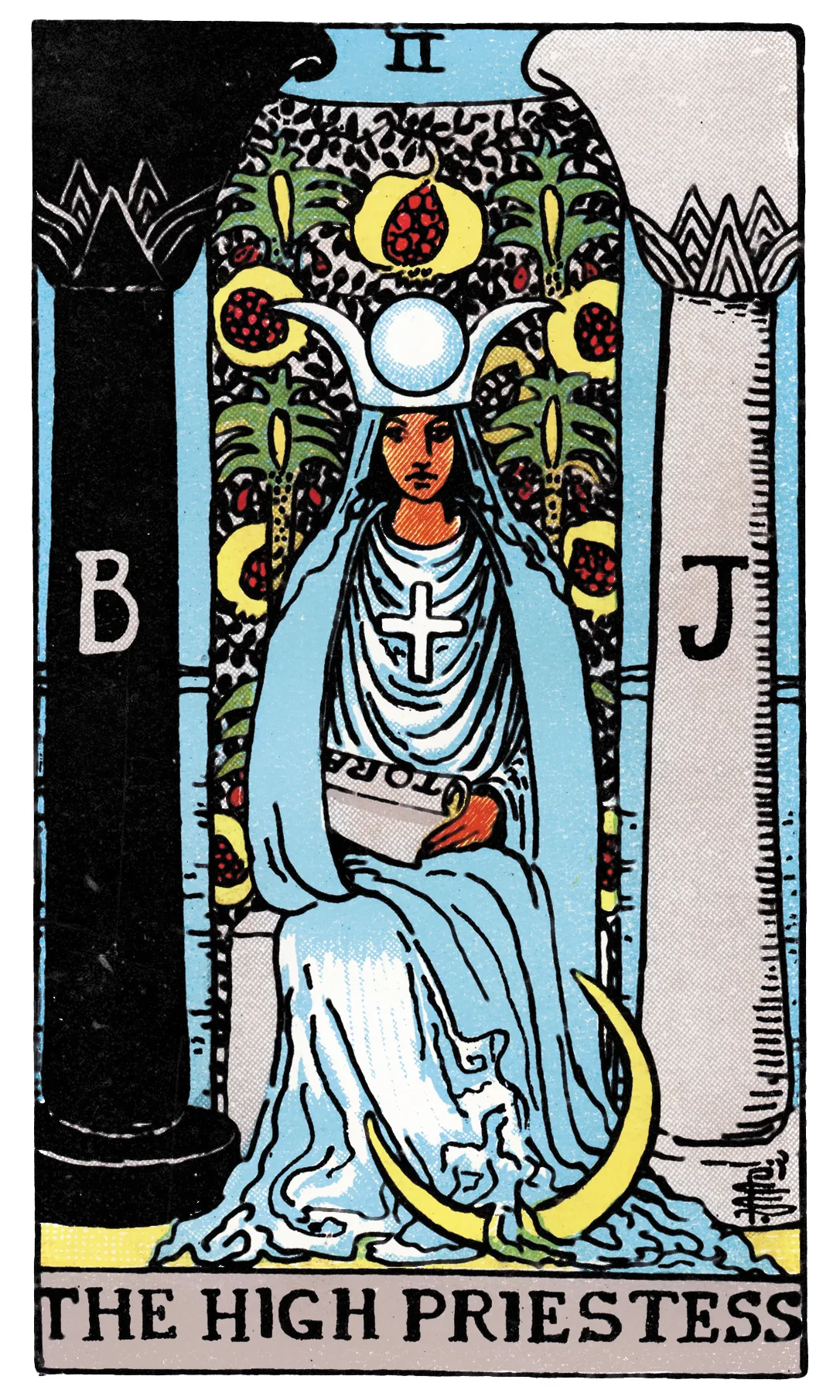
In love, intimacy and sexual-energy readings, the High Priestess is the card of hidden desire: intuition, mystery and the pull toward what has not yet been said.
There is a kind of desire that lives in silence. Not the passionate declaration, not the bold pursuit, but the quiet pull toward something you cannot quite name. You have felt it in the pause before a first kiss. In the glance that holds a beat too long. In the moment when you realize that what draws you most powerfully toward another person is not what they have shown you, but what they have not.
The High Priestess sits at the center of this mystery.
She is Card II of the Major Arcana, the veiled figure between two pillars, the guardian of thresholds. Arthur Edward Waite, who designed the most widely used Tarot deck in the English-speaking world, called her "the highest and holiest of the Greater Arcana." Of all the Tarot's twenty-two archetypal images, she may be the least obvious choice for a discussion of love and sexual energy. She is not the Empress, who celebrates the body. She is not the Lovers, who makes desire visible. She is not the Devil, who confronts desire's shadow.
The High Priestess is the one who knows what desire is before it has a name. And it is precisely this quality, this deep interior knowing, that makes her one of the most significant cards in any reading about love, intimacy, or the erotic life.
This guide draws on the original sources that shaped this card's meaning: Waite's Pictorial Key to the Tarot (1910), Carl Jung's writings on the anima and romantic projection, Aleister Crowley's Book of Thoth (1944), the Kabbalistic tradition of the Tree of Life, and the ancient goddess traditions from which the High Priestess descends. What follows is a complete exploration of what this card means when love is the question.
She began as La Papesse, the female pope, in the Visconti-Sforza and Marseille decks. Waite and Smith renamed her the High Priestess in 1909 and seated her between the pillars of Solomon's temple, and Crowley's Priestess is veiled light itself. For love, the card shifted from religious authority to the inner knowing that draws two people together.
Read for love, the pomegranate veil hides what is not yet ready to be shown, the pillars Boaz and Jachin mark the threshold of intimacy, and the crescent moon at her feet is the tidal pull of attraction moving beneath words.
On the Tree of Life the High Priestess is Path 13, Gimel ('camel'), the longest single path, crossing the Abyss from Kether (the Crown) to Tiferet (the heart), under the Moon. In intimacy she is the journey across that desert: the patient, deep connection that cannot be rushed. Full High Priestess meaning, history and symbolism.
The Sacred Feminine and the Origins of Desire
The High Priestess descends from a lineage of veiled goddesses, and understanding that lineage illuminates what this card means when desire is the question. These traditions are not the same, and they should not be collapsed into one another. But across them, we can trace recurring images of veiling, receptivity, sovereignty, and hidden wisdom.
The foundational image comes from Plutarch, writing in the late first century CE, who recorded an inscription on a goddess statue at the temple of Sais in Egypt: "I am all that has been and is and shall be; and no mortal has ever lifted my garment." Plutarch identified the goddess as Isis, though the statue originally honored Neith. The inscription has echoed through Western esotericism ever since, shaping our understanding of the divine feminine as something that cannot be fully revealed without destroying what is sacred about it.
This is not concealment as deception. It is concealment as the nature of the sacred itself.
But the High Priestess also carries a more provocative teaching, rooted in the ancient meaning of virginity. The Jungian analyst M. Esther Harding, in her 1935 work Woman's Mysteries: Ancient and Modern, argued that in the ancient world, "virgin" did not mean sexually abstinent. It meant "one-in-herself": whole, self-contained, belonging to no one. The virgin goddesses, Artemis, Athena, and Hestia, were not defined by what they refused. They were defined by their self-possession. Artemis roamed forests with her hunting dogs, fiercely defending her autonomy. Hestia tended the sacred flame, choosing stillness over the competitive dynamics of Olympian marriage. The Vestal Virgins of Rome were freed from all legal ties to their birth families and could own property, make wills, and testify in court without a guardian, a freedom virtually no other Roman woman possessed.
At the opposite end of the same tradition, some later esoteric and historical interpretations associate the priestesses (hierodules) of Ishtar with forms of consecrated sexuality, though the historical record is complex and debated. What is clearer is the principle: these women also "belonged to no one" in the personal sense. Their activity was consecrated to the goddess, not given to any human partner. Harding's framework suggests that both the celibate Vestal and the sexually active temple priestess were "virgins" in the original sense: self-possessed, serving the divine rather than a human master.
The High Priestess holds this paradox. She is the virgin who knows everything about desire. She sits between the pillars, belonging to neither. She is complete in herself, which is precisely what makes her magnetic.
The Erotic Power of Mystery
In a culture that often equates intimacy with full disclosure, the High Priestess offers a counter-teaching. She suggests that some of the deepest forms of connection come not from revealing everything, but from honoring the mystery that exists between two people.
This is not about playing games or withholding affection. It is about recognizing that no one, no matter how close, can or should be fully known. There is a part of every person that remains behind the veil. The High Priestess invites us to find that beautiful rather than threatening.
The veil itself has been an erotic symbol across Western esoteric traditions for centuries. The pomegranate veil on the High Priestess's card echoes the parochet in Solomon's Temple. It echoes the inscription on the statue of Isis. In each case, the veil does not hide nothing. It hides everything. The mystery behind it is not an absence but a fullness too vast for ordinary seeing.
In readings about love and attraction, the High Priestess often appears when the charge between two people comes from what has not yet been said or done. The tension of anticipation. The electricity of possibility. The felt sense that there is more here than the surface reveals. This is the card of the long glance across the room. The conversation that spirals into silence and neither person wants to break. The attraction that builds precisely because it has not yet been acted upon.
Receptivity as Power
The High Priestess is sometimes misread as passive. She sits still. She does not act. She waits.
But this waiting is not weakness. In the context of intimacy, the High Priestess represents the power of being fully present without performing, fully attentive without pursuing. She teaches that receiving is its own form of strength: the capacity to truly take someone in, to listen with the body, to let desire arrive rather than chasing it. This is a skill many of us have forgotten in a culture that rewards assertion and initiative in every domain, including love.
The Kabbalistic teaching reinforces this. Crossing the Abyss on Path 13 requires surrender, not effort. The adept who tries to fight their way across is destroyed. The one who surrenders, who lets the ego dissolve, arrives at the other side transformed. In the language of intimacy, this is the moment when you stop curating your presentation and allow yourself to simply be present. When the defenses dissolve, not because someone demanded it, but because the mystery invited you to.
The Inner Erotic Life
Perhaps the most distinctive thing the High Priestess brings to the intimacy conversation is her relationship to solitude. Unlike the Lovers (which requires a partner) or the Empress (which celebrates the external senses), the High Priestess is complete in herself. She does not need another person to activate her energy.
This connects to an aspect of sexual energy that is rarely discussed in Tarot: the inner erotic life. Fantasy, self-knowledge, the quiet relationship between a person and their own desire. The High Priestess suggests that understanding your own wanting, before bringing it to another person, is part of the work of intimacy. What do you actually desire, beneath the layers of conditioning and performance? What would you want if no one were watching?
Crowley saw this dimension clearly. In The Book of Thoth, he described the Priestess as clothed only in "the luminous veil of light" and wrote that even light itself is a veil that conceals ultimate reality. This is a startling idea: that illumination can conceal as much as darkness does. Applied to intimacy, it suggests that what we think we know about our own desires may itself be a veil, hiding deeper currents that the High Priestess invites us to explore.
The Anima and Romantic Projection
In Carl Jung's analytical psychology, the High Priestess embodies the anima: the unconscious feminine principle that exists within every psyche, regardless of gender. Understanding the anima is essential to understanding how this card operates in love readings, because it reveals the hidden machinery behind romantic attraction itself.
Jung described the anima as an inherited image, not of any particular woman, but of Woman as an archetype. Because this image is unconscious, it is always projected onto the beloved. This projection, Jung wrote, is one of the chief reasons for passionate attraction or aversion. We fall in love not with the actual person but with the anima image overlaid upon them. The beloved seems to embody everything missing from our conscious personality, everything mysterious and compelling about the unknown.
Jung identified four stages of anima development: Eve (the biological), Helen (the romantic ideal), Mary (the spiritual), and Sophia (wisdom that integrates all previous stages). The High Priestess corresponds to the Sophia stage: the most evolved form of the feminine archetype, where one encounters the mystery as a complete being rather than a projection.
The practical implication for love readings is profound. When the High Priestess appears, she may be indicating that what the querent feels for another person is partly projection: a genuine encounter with their own unconscious, wearing another person's face. This is not a dismissal of the feeling. Jung insisted that anima projection is also "a bridge to the unconscious," a genuine encounter with parts of the self that can only be reached through the intensity of romantic love. But it does ask: how much of what you feel is about them, and how much is about what they represent?
The cycle Jung describes runs through four stages: projection (falling in love with the image), idealization (the beloved seems to embody everything), withdrawal (the projection lifts, revealing the actual person), and finally either disillusionment or integration, where the individual chooses to love the real person while taking back the projected qualities as their own inner work. The High Priestess is the card that governs this entire cycle, because she is the veil between the conscious and the unconscious. She is the one who decides what gets projected and what gets integrated.
The High Priestess and The Empress: Veiled and Unveiled
No discussion of the High Priestess in love readings is complete without addressing her relationship to the Empress (Card III), because the two cards represent complementary aspects of the same principle.
An esoteric teaching holds that in her veiled aspect, the divine feminine is the High Priestess; in her unveiled aspect, she is the Empress. The Priestess is interior, intuitive, mysterious. The Empress is embodied, sensual, generative. The Priestess knows desire before it speaks. The Empress celebrates it after it arrives. One governs the inner world of wanting, the other governs the outer world of pleasure.
In love readings, the distinction matters. The High Priestess points to the hidden currents beneath the surface: unspoken feelings, intuitive knowing, the magnetic charge of what has not yet been revealed. The Empress speaks to the physical dimension: touch, sensation, creative fertility, the delight of being in a body alongside another body. When both cards appear in the same reading, they suggest a rare integration of inner depth and outer aliveness, intimacy that is both deeply felt and physically expressed.
Upright and Reversed in Love Readings
Trust your intuition about this relationship. Something important is not yet visible, but that does not mean it is absent. The High Priestess upright indicates a deep, soul-level connection that often feels intuitive or even telepathic. Patience with the unfolding of attraction. The erotic charge of anticipation. Self-possession as the foundation of intimacy. Deep inner knowing about what you want and what is true. For singles, this card advises knowing yourself before seeking partnership. For established relationships, it suggests deepening intimacy by honoring the mystery your partner still holds.
Waite gave a striking reversed meaning for this card: "Passion, moral or physical ardour, conceit, surface knowledge." The spiritual depth collapses into mere physical appetite or superficial understanding. The veil becomes a wall. Secrets create distance rather than depth. Withholding comes from fear rather than sacred choice. Disconnection from the body and its knowing. Over-intellectualizing desire. Ignoring intuition about a partner. The reversed High Priestess can indicate someone with a hidden agenda, or it can point to your own reluctance to hear what your inner voice is telling you.
- What do you hold back in intimacy, and is that withholding protective or fearful?
- Where in your life is mystery a gift, and where has it become a wall?
- What desires live beneath the surface that you have not yet named?
- How do you relate to the rhythms of wanting and withdrawing?
- When you are drawn to someone, how much of what you feel is about them, and how much is about what they represent?
- What would it mean to be "one-in-yourself" before meeting another?
To compare the High Priestess with the other twenty-one Major Arcana in love readings, upright and reversed, open the free Tarot love chart.
Card Pairings in Intimacy Readings
The High Priestess takes on specific dimensions when she appears alongside other cards in love and relationship spreads.
The veil parts. What was intuited becomes a conscious choice. This pairing often appears when a relationship is moving from unspoken attraction to deliberate engagement. The Lovers asks for a decision that the High Priestess has been silently preparing for.
The veiled and unveiled feminine together. This combination suggests intimacy that integrates inner depth with outer sensuality: the rare relationship where both mystery and physical pleasure coexist. One of the most powerful pairings for questions about sexual and emotional fulfillment.
What you desire but will not admit. This pairing suggests that something important is being kept in shadow, not necessarily harmful, but unacknowledged. The Devil brings the unconscious desire into stark relief; the High Priestess holds the key to understanding its origin. Together they ask: what would it mean to look honestly at what you want?
Two lunar cards together, both governing the unconscious. This combination can indicate confusion about feelings, illusion in a relationship, or a period where the truth is simply not yet available. It can also indicate a profoundly intuitive connection that defies rational explanation. Trust the process. Not everything needs to be understood immediately.
Two cards of solitude side by side. In intimacy readings, this may point to a season of withdrawal, not from the relationship, but into the inner work that deepens it. Both cards govern interior journeys. Together they can also describe a relationship where both people honor each other's need for sacred privacy.
Cards I and II together: will and intuition, action and receptivity, the conscious and the unconscious mind. In love readings, this pairing suggests a dynamic where one partner embodies active pursuit while the other draws through magnetic stillness. It can also indicate a moment when intention and intuition align, creating the conditions for something to manifest.
Both cards feature prominent nudity in the RWS tradition, but with different valences. The Star's nakedness is vulnerability after catastrophe; the High Priestess's robes are sacred concealment. Together, they suggest the arc of intimacy itself: from mystery, through the shattering of pretense, to radical openness.
The High Priestess walks Path 13 on the Kabbalistic Tree of Life, crossing the Abyss from divine source to the human heart. Evelynne Joffe's course explores all twenty-two paths and their connection to the Major Arcana.
Explore the PathsFor the psychological and archetypal dimensions of this card, Mary K. Greer's Jungian course explores the anima, shadow projection, and the unconscious forces that shape how we love.
Go deeper · explore our Tarot courses, or download the free 7 chakra chart to map the body's energy centres.
Frequently Asked Questions
What does the High Priestess mean in a love reading?
The High Priestess in a love reading indicates that there is more beneath the surface than what is currently visible. She represents intuitive connection, unspoken feelings, and the kind of deep attraction that builds through mystery rather than pursuit. Trust your intuition about the person or situation, be patient with the unfolding of attraction, and recognize that mystery is a natural and healthy part of intimate connection. She can also point to an important secret or unspoken feeling that has not yet surfaced.
Is the High Priestess a yes or no card for love?
The High Priestess is not a simple yes-or-no card. In love readings, she often suggests that something meaningful may be present, but not yet fully revealed. Rather than rushing the answer, she asks for patience, observation, and trust in what your deeper knowing is already sensing. The answer exists but is not yet ready to be spoken. Let your intuition guide you and allow the truth to emerge at its own pace.
Is the High Priestess a positive card for new relationships?
Generally yes, though she asks for patience. The High Priestess suggests that the connection has genuine depth, possibly a soul-level resonance that transcends ordinary attraction. But rushing to define or consummate it may miss the point. Let the relationship reveal itself at its own pace. The anticipation is part of the gift. This card often appears for connections that unfold slowly but prove to be among the most significant.
What does the High Priestess reversed mean in a love reading?
Reversed, the High Priestess can indicate that secrets are creating distance rather than depth. Someone may be withholding important information, or you may be disconnected from your own intuition about the relationship. Waite assigned the reversed meaning "passion, moral or physical ardour, conceit, surface knowledge," suggesting that the spiritual depth of the card collapses into mere appetite or superficial understanding. It can also suggest over-thinking intimacy at the expense of feeling it, or a fear of vulnerability that has become a barrier to connection.
How does the High Priestess differ from the Empress in love readings?
The Empress and the High Priestess represent complementary aspects of intimate experience. Esoteric tradition holds that they are the veiled and unveiled forms of the same divine feminine principle. The Empress is sensual, embodied, and celebratory, speaking to the pleasure of physical connection and creative abundance. The High Priestess is intuitive, mysterious, and interior, speaking to the inner knowledge that makes real intimacy possible. The Empress says "feel this." The High Priestess says "know this." A reading that contains both suggests a rare integration of inner depth and outer aliveness.
Does the High Priestess indicate sexual attraction?
Not in the direct, fiery way that the Ace of Wands or the Devil might. The High Priestess represents a subtler form of attraction: the magnetic pull of mystery, the desire to know what someone is not showing you, the sense that there is hidden depth worth exploring. In sacred sexuality traditions, this is the energy that precedes and deepens physical intimacy. It can be intensely compelling, even when it does not announce itself loudly. Jung would say it is the attraction of the anima: the unconscious recognizing something in another person that it has been searching for.
What does it mean when the High Priestess represents a person in a love reading?
When the High Priestess represents a person, she describes someone who is deeply intuitive, self-contained, and emotionally reserved in the best sense. This person processes feelings internally and may communicate through presence, attention, and symbolic gestures rather than direct words. They are drawn to depth and authenticity and will withdraw from anything that feels superficial or performative. They may seem mysterious or hard to read, but this is not evasion. It is the natural expression of someone whose inner life is rich and whose trust must be earned through patience and genuine interest.
What is the Kabbalistic meaning of the High Priestess?
In Kabbalah, the High Priestess corresponds to Path 13 on the Tree of Life, connecting Kether (the Crown, divine unity) to Tiferet (Beauty, the heart center). This is the longest single path on the Tree and crosses the Abyss, the great gap between the unknowable divine and the realm of human experience. The Hebrew letter is Gimel, meaning "camel," symbolizing the capacity to carry spiritual sustenance across vast inner distances. The path's Yetziratic title is "The Unity Directing Consciousness." Waite identified the High Priestess with the Shekinah, the feminine divine presence in Jewish mysticism.