The Eight Brocades (Ba Duan Jin) · The Complete Guide to All Eight Movements, Their Traditional Purpose, and a Free Chart
Nine centuries old, ten minutes long: the history, the eight movements one by one, what the research says, and how to begin
The Eight Brocades (Ba Duan Jin, 八段锦, also called the Eight Pieces of Brocade or Baduanjin) is a set of eight gentle Qigong movements whose written record goes back to the Song dynasty, some nine centuries ago. Standardised by China's Health Qigong Management Center in 2003, it is one of the most widely taught Qigong forms in the world and a frequent subject of clinical research.
Each movement has a name that reads like a line of verse, and each line carries its purpose inside it: two hands hold up the heavens to regulate the triple burner; sway the head and swing the tail to clear the fire of the heart. This entry in the Global Spiritual Studies Qigong Library sets out all eight, with their Chinese names, what you do, how the breath follows, what the tradition says each is for, and one caution for each, along with an illustrated chart of the full set that you can print and keep beside you.
There is something disarming about a practice named after cloth. Brocade was among the finest silks of old China, woven with raised patterns, and the name suggests something precious made from ordinary threads. That is a fair description of the form: eight plain movements, repeated with care, that people have kept practising, morning after morning, for nine hundred years.
A short history
The name Ba Duan Jin first appears in the twelfth century, in Hong Mai's story collection Yijian zhi, which describes the practice done both seated and standing (British Health Qigong Association; Chinese Wikipedia). Daoist health writings of the same era describe it too. The Daoshu, or Pivot of the Way, compiled by Zeng Zao around 1150, gives an early version, and the Xiuzhen shishu, a compendium of around 1300, illustrates all eight movements (Wikipedia). A 2020 review of Baduanjin research likewise dates the form to the Song dynasty (Zhou et al., PMC7603575).
Many teachers say the set was created by the Song general Yue Fei to keep his soldiers strong. That story is best treated as legend. It comes from nineteenth-century sources, and the historian Meir Shahar traces it to a 1624 preface of the Sinew Changing Classic that names Yue Fei as a lineage master (Wikipedia). The accurate answer to who created the Eight Brocades is that no one knows. The form grew over centuries, gathering variations, extra movements in some lineages, and by the late Qing dynasty clear printed charts.
The modern standard came in 2003, when the Health Qigong Management Center of China's General Administration of Sport "organized and edited Health Qigong including Baduanjin" and promoted it across the country (Zhou et al., 2020). The Chinese Health Qigong Association teaches that version internationally. Fixing one order, one set of movements and one pace made the form easy to teach, and easy to study: it is a large part of why so much research on Baduanjin followed.
The eight movements at a glance
Here are the eight in their traditional order. The Chinese names are the lines of the traditional chant as the Health Qigong standard gives them; each line names the movement and then what it is said to do.
| No. | Movement | Chinese name | What you do | Breath | What the tradition says it is for | Caution |
|---|---|---|---|---|---|---|
| 1 | Two Hands Hold Up the Heavens | Liang Shou Tuo Tian Li San Jiao (两手托天理三焦) | Interlace the fingers, float the palms up the centre line and press them gently toward the sky, then let the arms float down to the sides. | In as the hands rise; out as they lower. | Regulating the triple burner (San Jiao), Chinese medicine's picture of the torso as three linked spaces. | Keep the elbows soft; with shoulder problems, lift only as high as is comfortable. |
| 2 | Drawing the Bow to Shoot the Hawk | Zuo You Kai Gong Si She Diao (左右开弓似射雕) | In a wide, easy stance, one hand points out to the side while the other draws back across the chest as if pulling a bowstring; alternate sides. | In as you draw the bow; out as you return. | Opening the chest and shoulders; the chant itself names no organ, and schools differ on which one they link it with. | Keep the stance high and the knees tracking over the toes. |
| 3 | Separate Heaven and Earth | Tiao Li Pi Wei Xu Dan Ju (调理脾胃须单举) | One palm presses up above the head while the other presses down beside the hip, as if pushing sky and earth apart; alternate. | In as the hands separate; out as they return. | Regulating the spleen and stomach, the organs of digestion in Chinese medicine. | Keep the raised elbow soft and do not arch the low back. |
| 4 | Wise Owl Gazes Backward | Wu Lao Qi Shang Wang Hou Qiao (五劳七伤往后瞧) | With the arms lowered and the palms turning outward, slowly turn the head to look behind, then return; alternate. | In as you turn; out as you return. | Easing the "five weaknesses and seven injuries", classical names for kinds of exhaustion and strain. | Turn gently and never jerk the neck; with neck problems, keep the turn small. |
| 5 | Sway the Head and Shake the Tail | Yao Tou Bai Wei Qu Xin Huo (摇头摆尾去心火) | From a wide stance with the hands on the thighs, sweep the upper body in a low arc from one side to the other, head and tailbone moving in opposition. | Natural breathing; many teachers breathe out as the body sweeps low. | Clearing "heart fire", Chinese medicine's picture of restlessness, heat and agitation. | The most demanding for knees and back. Keep it small; with dizziness or high blood pressure, keep the head above the heart. |
| 6 | Two Hands Hold the Feet to Strengthen the Kidneys and Waist | Liang Shou Pan Zu Gu Shen Yao (两手攀足固肾腰) | Slide the hands down the back and the backs of the legs as you fold forward toward the feet, then rise with the arms reaching up. | Out as you fold; in as you rise. | Strengthening the kidneys and the waist. | Fold only as far as is comfortable with soft knees; take care with back, disc or bone conditions, glaucoma or high blood pressure. |
| 7 | Clench the Fists and Glare Fiercely | Zan Quan Nu Mu Zeng Qi Li (攒拳怒目增气力) | In a wide stance with fists at the waist, punch slowly forward one side at a time, eyes wide open, then draw the fist back. | Out as the fist extends; in as it returns. | Increasing qi and strength. | Slow and relaxed: this is intention, not force. Keep the shoulders down. |
| 8 | Bouncing on the Toes | Bei Hou Qi Dian Bai Bing Xiao (背后七颠百病消) | Rise onto the balls of the feet, then let the heels drop lightly to the floor, sending a gentle jolt up through the body. | In as you rise; out as the heels drop. | The chant says seven jolts behind the back make a hundred illnesses vanish: a traditional saying, not a medical promise. | Keep the drop light; with balance, ankle or bone concerns, hold a chair and lower the heels without the drop. |
English names vary widely between books; this table uses the most common ones. The Chinese Health Qigong Association's own translations are longer, for example "Holding the Hands High with Palms Up to Regulate the Internal Organs" for the first. The breathing shown is how the form is commonly taught, and natural breathing is always fine. "What the tradition says" gives each chant's own claim as tradition, not as medical fact.
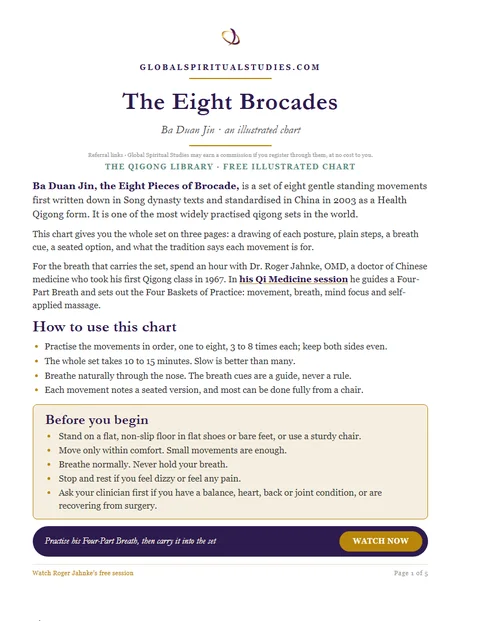 5 pages
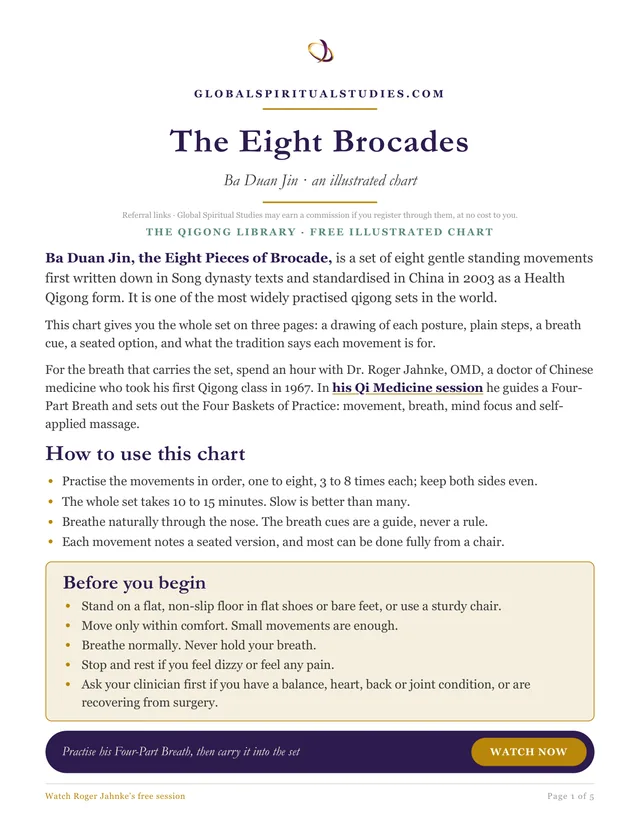
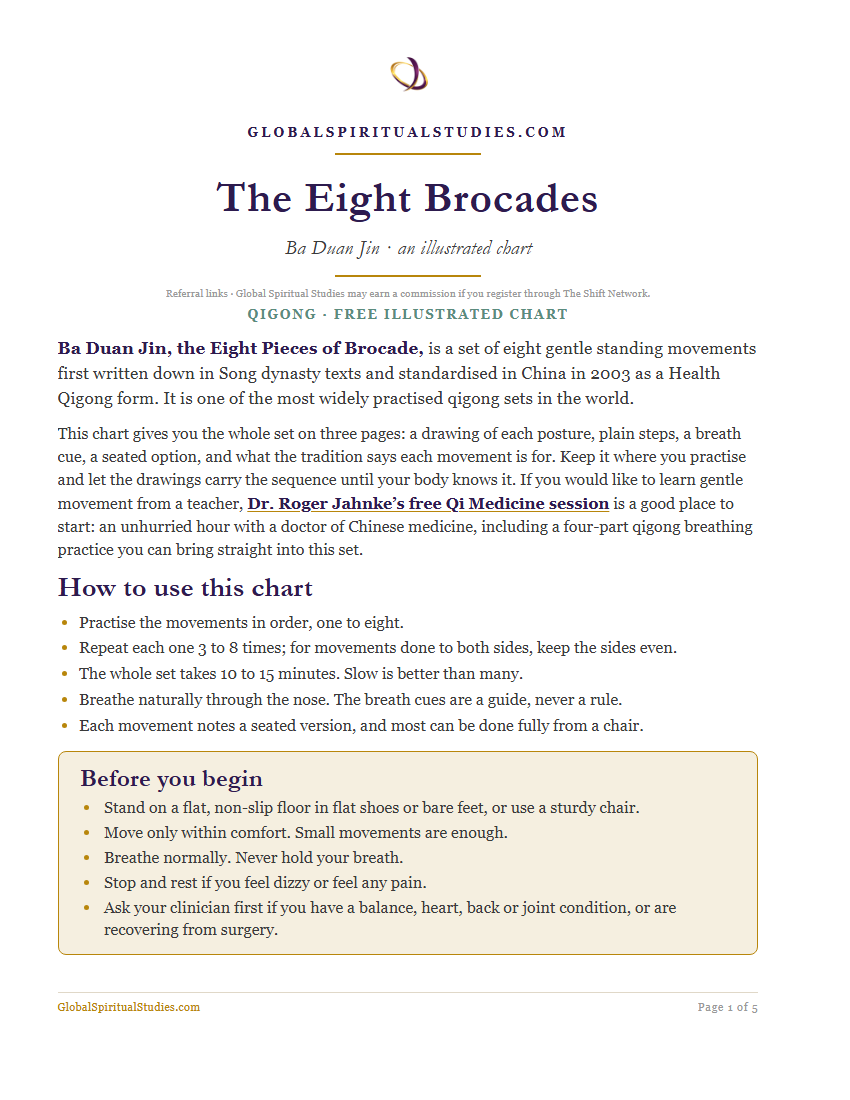
Free illustrated chart
The Eight Brocades
Ba Duan Jin, all eight movements illustrated, on five printable pages.
| What’s inside | |
|---|---|
| ✓ | All eight movements illustrated, with their Chinese names and the standard titles |
| ✓ | Step-by-step instructions for each movement, and how to open and close the set |
| ✓ | How to use the chart, with a Before you begin checklist |
| ✓ | Where the set comes from, from Song dynasty texts to the modern standard form |
Arrives in your inbox as a PDF · print it or keep it on your phone
The eight movements one by one
What follows are descriptions, not a substitute for a teacher. Read them as invitations: move slowly, stay well within comfort, and let the breath be easy. If anything hurts, stop.
1. Two Hands Hold Up the Heavens
Stand with your feet about hip-width apart and your knees soft. Let the hands meet in front of the lower belly, fingers loosely interlaced, palms up. As you breathe in, float them up the centre of the body; as they pass the face, turn the palms outward and upward and press gently toward the sky, as if lifting a light ceiling. Let your gaze follow the hands for a moment. Then separate the hands and let the arms float down to your sides as you breathe out. The chant names the triple burner, the Chinese medicine idea of the torso as three linked spaces.
Common errors: shrugging the shoulders toward the ears, locking the elbows, tipping the head far back.
Seated: it works well in a chair. Keep the back upright and lift only as high as your shoulders allow.
2. Drawing the Bow to Shoot the Hawk
Step out into a wide stance and sink a little, as if perching on a high stool. Cross the wrists in front of the chest. As you breathe in, one hand forms a pointing shape, index finger up, and pushes out to the side while the other draws back across the chest as if pulling a bowstring. Turn your head to look past the pointing hand. Breathe out as the hands come back, then draw the bow to the other side. The Chinese diao is a great bird of prey, which is why English books variously say eagle, hawk or vulture.
Common errors: sinking so low that the knees ache, letting the knees fall inward, pulling the back elbow so far that the shoulder pinches.
Seated: sit toward the front of the chair with your feet wide and draw the bow with the arms alone.
3. Separate Heaven and Earth
Return to a comfortable stance with the hands in front of the belly, palms up. As you breathe in, one hand rises up the centre line and turns to press toward the sky above your head while the other presses down beside the hip, as if gently pushing heaven and earth apart. Breathe out and bring both hands back to meet, then change sides. The chant says this movement regulates the spleen and stomach, the organs of digestion in Chinese medicine, and practitioners often describe a long, pleasant stretch along the side of the body.
Common errors: arching the low back, locking the lifted elbow, letting the lower hand hang limp instead of pressing lightly.
Seated: sit tall and alternate the lifted hand; the lower hand presses toward the seat of the chair.
4. Wise Owl Gazes Backward
Stand with the arms by your sides. As you breathe in, turn the palms outward and slowly turn the head, with a little of the upper spine, to look behind you over one shoulder, as unhurried as an owl. Breathe out and return to face forward, then turn to the other side. The chant speaks of the "five weaknesses and seven injuries", classical categories of exhaustion and strain, and teachers often use this movement to ease the neck and upper back after long hours at a desk.
Common errors: turning the whole body instead of the head and spine, forcing the turn, jutting the chin forward.
Seated: easy to do in a chair. With a neck condition keep the turn small and slow, and stop at the first sign of pain or dizziness.
5. Sway the Head and Shake the Tail
This is the most complex of the eight. From a wide stance with the knees bent, rest your hands on your thighs. Lean the upper body toward one side and let it sweep in a low arc across the front and up the other side, the head moving one way and the tailbone the other, like a fish turning its tail. Then sweep back the other way. The chant says the movement clears "heart fire", Chinese medicine's picture of restlessness, heat and agitation.
Common errors: dropping the head below the heart, sinking too deep, making the circle too large.
Take care: this movement asks the most of the knees and low back, so keep it small at first. With high blood pressure, dizziness or vertigo, keep the head up and the sway gentle, or leave it out.
Seated: a small side-to-side sway from the hips can stand in for it.
6. Two Hands Hold the Feet to Strengthen the Kidneys and Waist
Stand with the feet together or hip-width apart. Raise the arms overhead as you breathe in. As you breathe out, bring the hands down to the chest, slide them round to the back, and let them trace down the back and the backs of the legs as you fold forward toward the feet. Rest there a moment, then slide the hands forward and rise with the arms reaching up. The chant says the movement strengthens the kidneys and the waist, which in Chinese medicine hold the body's deep reserves.
Common errors: locking the knees, bouncing to reach further, rising too quickly.
Take care: fold only as far as is comfortable, with the knees soft. With a back or disc condition, osteoporosis, glaucoma or high blood pressure, ask your clinician first and keep the fold shallow, or skip it.
Seated: fold gently forward, letting the hands slide down the shins.
7. Clench the Fists and Glare Fiercely
Step into a wide stance and bring loosely clenched fists to the waist, palms up. As you breathe out, punch one fist slowly forward, turning it palm down, while your eyes open wide and look past it with a fierce but relaxed glare. Open the hand, turn it as if taking hold of something, and draw the fist back to the waist as you breathe in. Then the other side. The chant says this movement increases qi and strength, and there is something freeing about a glare you are allowed to practise.
Common errors: punching fast or hard, tensing the shoulders, holding the breath while the fist is out.
Seated: sit forward with your feet wide and punch with the arms alone.
8. Bouncing on the Toes
Stand with the feet together and the arms by your sides. As you breathe in, rise onto the balls of the feet, lengthening through the crown of the head. As you breathe out, let the heels drop to the floor with a light jolt that travels up through the body. The chant says seven jolts behind the back make a hundred illnesses vanish; read that as a traditional saying about the whole set, not a medical promise. The number is why the movement is commonly done seven times. It closes the form, shaking out whatever the other seven have stirred.
Common errors: slamming the heels down, leaning forward, locking the knees.
Take care: with balance concerns, rest a hand on a chair back; with ankle, foot or bone conditions, rise gently and lower the heels without the drop. Seated: lift and lower the heels in a chair.
Standing versus seated Eight Brocades
The Eight Brocades most people learn today is the standing set. But the tradition has always had two. Hong Mai's twelfth-century account already mentions the practice done seated as well as standing, and Wikipedia notes that Baduanjin "traditionally contains both a standing and seated set of eight postures each." The seated set is a separate sequence and is taught less often; its movements vary between sources, so this page keeps to the standing set.
If standing for ten minutes is not possible for you, the seated notes under each movement above let you practise the standing set in a chair. They are the library's adaptations, not the traditional seated set. For a complete routine designed for a chair, the free chair Qigong printable is built from Dr. Roger Jahnke's beginner practices, with safety notes for older adults, and the library's guide to chair Qigong and Tai Chi for seniors goes further.
How to practise
- Order. Practise the eight in order, from holding up the heavens to bouncing on the toes. Stand quietly for a few breaths before you begin and after you finish, hands resting on the lower belly.
- Repetitions. The standard version is commonly taught with each movement repeated six times, or three times to each side for the one-sided movements, and the heel drop done seven times, as the chant suggests. When you are new, fewer is fine. Two or three unhurried repetitions done well are worth more than six done in a rush.
- Time. The whole set commonly takes ten to fifteen minutes: short enough to fit before breakfast, which is when many people practise it, and long enough to feel.
- Breath. Let the breath follow the movement, in as the body opens or rises and out as it closes or lowers. If matching the two feels effortful, breathe naturally and let the movement lead. Never hold the breath. The library's entry on Qigong breathing covers the baseline.
- Pace. Slow, soft and continuous. The movements are simple; the practice lies in doing them attentively.
- Regularity. The trials described below usually asked people to practise several times a week for weeks or months. A little on most days is a reasonable aim.
If you are new to Qigong altogether, the Qigong for beginners guide offers a gentle ten-minute routine that includes the first brocade.
To keep the order and the steps beside you while you practise, the library's free chart illustrates all eight movements on five printable pages.
Get the chartArrives in your inbox as a PDF
What the research says
Baduanjin is probably the most studied Qigong form in clinical research. A 2020 review counted 810 clinical publications on it between 2000 and 2019, 614 of them randomised controlled trials, most often in diabetes, chronic obstructive pulmonary disease, high blood pressure and low back pain. The same review found that most studies were small and that the methodological quality of the trials was "generally low" (Zhou et al., 2020, PMC7603575). Quantity is not the same as certainty, and the reviews below are worth reading with that in mind.
- Mood. A 2018 meta-analysis of 29 studies with 2,286 people living with physical or mental illness found Baduanjin associated with lower depression and anxiety, with more practice linked to larger reductions; the authors caution that many studies had significant methodological limitations (Zou et al., 2018, PMC5858390).
- Balance in older adults. A 2022 meta-analysis of 17 randomised trials in 1,267 adults aged 60 and over found better scores on three common balance tests. The authors note that lower-quality trials were included, that only one trial came from outside China, and that more high-quality studies are needed (Guo, Liu and Yuan, 2022, PMC9650403).
- General health measures. A 2017 meta-analysis of 19 randomised trials with 1,535 healthy adults and people with chronic conditions found improvements in quality of life, sleep quality, balance, grip strength, trunk flexibility, blood pressure and resting heart rate, and rated the trials fair to good in quality (Zou et al., 2017, PMC5359459). NCCIH, looking at Qigong more broadly, describes the blood pressure evidence as not firm, so the sources do not fully agree there.
- Safety. NCCIH says Qigong "appears to be a safe form of activity," with many studies finding no negative side effects, including in older adults and people with chronic diseases, and reports that a 2019 survey of reviews found sufficient evidence to support Qigong for balance training and fall prevention (NCCIH).
A fair summary: the Eight Brocades is a gentle, much-studied form with encouraging, if imperfect, evidence for mood, balance and everyday well-being, and it is generally safe. It is not a treatment for any condition, and it does not stand in for medical care.
This guide is educational and is not medical advice. Qigong complements medical care; it does not replace it. Talk with your clinician before starting, especially if you are pregnant, recovering from surgery, or have balance, back or heart conditions.
Eight Brocades vs Tai Chi
People often ask whether the Eight Brocades is Tai Chi. It is not; it is Qigong. Tai Chi, in NCCIH's description, "originated as an ancient martial art in China" and is practised as a series of slow, gentle movements linked into a continuous form, usually a longer sequence that takes more time to learn. The Eight Brocades was a health exercise from its earliest records: eight separate movements, each repeated a few times, that most people can follow within a session or two.
The two have a great deal in common. Both are slow, both join breath and attention to movement, and both have been studied for balance in older adults. If you enjoy one, you will probably enjoy the other. Dr. Roger Jahnke's Tai Chi Easy deliberately blends the two into a simplified practice, and his free Qi Medicine session is the gentlest way to meet his approach. The library's comparison Qigong vs Tai Chi sets out the differences in full, and Qigong for health reviews the research condition by condition.
Where to learn
The Eight Brocades is best learned by following a teacher, in person or on video, with a chart to remind you of the order afterwards. Among the teachers in the Qigong Library, Master Faye Li Yip teaches this form itself, in its standard Health Qigong version, and Dr. Roger Jahnke is the authority on gentle movement practice more widely.
Master Faye Li Yip · the Health Qigong form, brocade by brocade
Master Faye Li Yip teaches the standard Health Qigong version of Ba Duan Jin, the form the Chinese Health Qigong Association released in 2003 and the one this page follows. She is the daughter and student of Professor Li Deyin, trained from childhood in Shaolin Quan, Xing Yi, Bagua and Taiji, and won gold and silver medals in Taiji and sword routines in China, per the Deyin Taijiquan Institute, the school she founded in the UK with her husband, Master Tary Yip. She co-founded the British Health Qigong Association and has taught full-time in the UK for more than 30 years, according to her course page. Her institute's YouTube channel carries the complete form in six-minute and fifteen-minute follow-along versions.
What sets her teaching apart is that every brocade is taught with an organ in mind, following the map of Traditional Chinese Medicine, and with a competitor's attention to the detail of the hands. In Posing as an Archer she forms the Bazi, the "eight-shaped" hand, with the index finger raised and the thumb out, and uses it to work along the lung meridian. In Clenching Fists & Glaring Eyes she closes the hand in the Wo Gu, the "healing fist" with the thumb tucked inside, and moves the gaze between soft and glaring. Every session closes by harvesting qi back to the dantian, the energy centre below the navel. Her English names differ from the ones above, which is usual for this form; the table sets them side by side.
| No. | Name on this page | Also called (Faye Li Yip's name) | Organ or focus she pairs it with | Where her course teaches it |
|---|---|---|---|---|
| 1 | Two Hands Hold Up the Heavens | Hold Up Heaven | San Jiao, the Triple Burner | Module 7, in the full flow |
| 2 | Drawing the Bow to Shoot the Hawk | Posing as an Archer | Lung qi; the Bazi hand | Module 2 |
| 3 | Separate Heaven and Earth | Pushing Arms Aloft | Spleen and stomach; the side of the body | Module 3 |
| 4 | Wise Owl Gazes Backward | Turn Gazing Backwards | Settling difficult emotions; neck, chest and sternum | Module 3 |
| 5 | Sway the Head and Shake the Tail | Swaying the Head & Wagging the Tail | The heart; balancing fire and water through sacral circles | Module 4 |
| 6 | Two Hands Hold the Feet to Strengthen the Kidneys and Waist | Both Hands Touching the Feet | The kidneys; the pathways of the legs and feet | Module 5 |
| 7 | Clench the Fists and Glare Fiercely | Clenching Fists & Glaring Eyes | Liver qi; the Wo Gu fist and the gaze | Module 6 |
| 8 | Bouncing on the Toes | Raising and Lowering the Heels | Circulation, leg strength and balance | Module 7, in the full flow |
Her names and pairings from the module outlines of her course; the organ pairings are those of Traditional Chinese Medicine, the tradition's language rather than medical claims. Different schools pair some movements with different organs, and none is the single correct one.
Her seven-module course, Healing With Ba Duan Jin Qigong, walks the brocades in that organ order. The first module maps the energy body and lays the foundations every later brocade relies on: grounding, stillness, smooth breathing and the visualisation of qi. Modules two to six each take the brocades she pairs with one organ system, the lungs, the spleen and stomach, the heart, the kidneys and the liver. The seventh joins all eight into one continuous flow, opening with Hold Up Heaven and closing with the heel raises, a practice that fits into a quarter of an hour on an ordinary morning. The modules are pre-recorded, about 90 minutes each, with MP3 audio, transcripts and exercises, and you take them at your own pace. Her twelve-module Advanced Ba Duan Jin Qigong Training follows for anyone who wants each brocade refined in its own session. The library's complete course guide sets out every module, and the Faye Li Yip profile covers her lineage and the other forms she teaches.
Her seven modules follow the organ order in the table above and end with all eight brocades as one continuous flow, taught brocade by brocade at your own pace.
Explore courseOpens the course page · every module, and the way to join
Dr. Roger Jahnke · movement and Tai Chi Easy
Dr. Roger Jahnke, OMD, founder of the Institute of Integral Qigong and Tai Chi and co-founder of the National Qigong Association, teaches movement as the first of his four practices, or "baskets," alongside breath, self-massage and meditation. His movement practices include one he calls Holding Up the Sky, and he developed Tai Chi Easy, a simplified blend of Tai Chi and Qigong taught by trained lay practice leaders. His free session, Discover the Power of Qi Medicine, is an introduction rather than a movement class: it lays out his Four Baskets and his view that "the most profound medicine is produced within," and teaches a four-part breathing practice. It opens onto his seven-module course, Qi Medicine with Roger Jahnke, whose third module is given to the movement and mindfulness baskets. The complete course guide covers the session and every module, and the Roger Jahnke profile covers his books and research.
His free session sets out the Four Baskets, movement among them, and teaches his four-part breathing practice.
Watch nowOpens the course page · the session is one click away
The other two masters in the Qigong Library
- Robert Peng's free session, Connect to Your Inner Joy Through Qigong's Xi Breathing, pairs a Qigong movement with his Xi breathing (course guide).
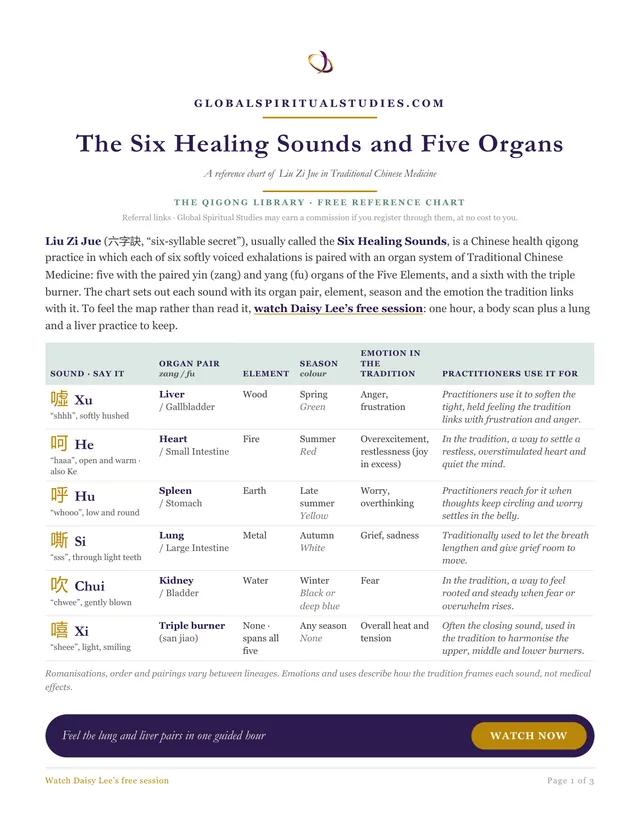
- Daisy Lee's free session, Qigong to Cleanse Your Organs for Better Health & Energy Flow, teaches two short organ practices, for the liver and the lungs (course guide).
Sources
History and names: Wikipedia, Baduanjin qigong; Chinese Wikipedia, 八段錦; British Health Qigong Association, "Origin of Ba Duan Jin"; Zhou et al., Characteristic of Clinical Studies on Baduanjin during 2000 to 2019, Evidence-Based Complementary and Alternative Medicine, 2020 (PMC7603575).
Research and safety: Zou et al., 2018 (PMC5858390); Guo, Liu and Yuan, Frontiers in Medicine, 2022 (PMC9650403); Zou et al., 2017 (PMC5359459); NCCIH, Qigong: What You Need To Know (February 2022) and Tai Chi: What You Need To Know (December 2023). Teachers: The Shift Network event pages and Dr. Roger Jahnke's Shift Network course pages (checked 30 September 2026); Faye Li Yip's Shift Network course pages for Healing With Ba Duan Jin Qigong and Advanced Ba Duan Jin Qigong Training and the Deyin Taijiquan Institute's biographies (checked 2 October 2026).
Printable · 5 pages
Keep the eight movements beside you
Every Brocade illustrated, step by step, on one printable chart.
Get the chartFrequently asked questions
What are the Eight Brocades?
The Eight Brocades, Ba Duan Jin in Chinese, are a set of eight gentle Qigong movements recorded since the Song dynasty and standardised in China in 2003. In order they are Two Hands Hold Up the Heavens, Drawing the Bow to Shoot the Hawk, Separate Heaven and Earth, Wise Owl Gazes Backward, Sway the Head and Shake the Tail, Two Hands Hold the Feet to Strengthen the Kidneys and Waist, Clench the Fists and Glare Fiercely, and Bouncing on the Toes.
Are the Eight Brocades Qigong or Tai Chi?
Qigong. Tai Chi began as a martial art and is practised as a longer continuous form, while the Eight Brocades is a health exercise of eight separate movements, each repeated a few times. The two share slow movement, attention and easy breathing, and many Tai Chi and Qigong classes teach both.
How long does the Eight Brocades take?
The whole set commonly takes about ten to fifteen minutes, depending on how many repetitions you do and how slowly you move. Many people practise it in the morning.
Can beginners do the Eight Brocades?
Yes. It is one of the most beginner-friendly Qigong forms: eight simple movements that most people can follow within a session or two. Start with fewer repetitions, stay well within comfort, and learn from a teacher or a good video if you can. If you have a health condition, talk with your clinician first.
Who teaches the Eight Brocades online?
Many teachers post the form on video. In the Qigong Library, Master Faye Li Yip, founder of the Deyin Taijiquan Institute and co-founder of the British Health Qigong Association, teaches the standard Health Qigong version: her institute's YouTube channel carries the complete form, and her seven-module self-paced course, Healing With Ba Duan Jin Qigong, teaches it brocade by brocade and organ by organ. The course guide sets out every module.
Can you do the Eight Brocades seated?
Yes. The tradition has long had a separate seated set as well as the standing one, and most of the standing movements can also be adapted to a chair: lifting, drawing the bow, turning the head, punching slowly and raising the heels all work seated. Keep the back upright and move within comfort.
What are the benefits of Baduanjin?
Baduanjin is one of the most studied Qigong forms. Meta-analyses have linked it with lower depression and anxiety in people living with illness, better balance in older adults, and improvements in quality of life, sleep quality and flexibility, but many of the trials are small or of limited quality. NCCIH describes Qigong as appearing safe. It complements medical care and is not a treatment for any condition.
How many repetitions of each movement?
The standard version is commonly taught with each movement repeated six times, or three times to each side, and the heel drop done seven times, as the traditional chant suggests. Beginners can do fewer. A few slow, attentive repetitions are better than many hurried ones.
Is there an Eight Brocades chart or PDF?
Yes. Global Spiritual Studies offers a free printable Eight Brocades chart that sets out all eight movements in order with their names and breath. You can request it with the button on this page, and the PDF arrives by email.
What does brocade mean in Eight Brocades?
Brocade is a rich silk fabric woven with raised patterns. Ba means eight, duan means section or piece, and jin means brocade, so Ba Duan Jin is the Eight Pieces of Brocade. The name suggests something precious and finely made, and some explain it as the silken quality the movements give the body.
Who created the Eight Brocades?
No one knows. The name first appears in the twelfth century in Hong Mai's Yijian zhi, and Daoist writings of the Song dynasty describe and illustrate the movements. The popular story that the general Yue Fei created it for his soldiers comes from nineteenth-century sources and is best treated as legend.
How do you pronounce Ba Duan Jin?
Roughly bah dwahn jin. You will also see it written as one word, Baduanjin, and translated as the Eight Brocades, the Eight Pieces of Brocade or the Eight Silken Movements.
How often should I practise the Eight Brocades?
A short practice on most days is a reasonable aim. Most research programmes asked people to practise several times a week over weeks or months. Regular gentle practice matters more than long sessions.
Learn the set from a master
Ba Duan Jin with Faye Li Yip
Healing With Ba Duan Jin Qigong teaches all eight brocades, one part of the body at a time, in seven self-paced video modules.
Healing With Ba Duan Jin Qigong
An on-demand course with Master Faye Li Yip
| What the course includes | |
|---|---|
| ✓ | Seven video modules of about 90 minutes each, also provided as MP3 audio |
| ✓ | A written transcript of every module, to review, print and highlight |
| ✓ | Optional exercises and reflection questions for each lesson |
| ✓ | Two bonus videos: Feel the Qi, Tai Chi for Health & Wellbeing, and Peng Qi Guan Ding |
| ✓ | Ongoing access with no live schedule; the first module assumes no previous Qigong |
On-demand video course
7 modules
All eight brocades, one part of the body at a time
Explore courseOpens the library's course page, with the session one click away.
- Open the course pageModules, bonuses and current details
- Learn at your paceOne module a week is a comfortable rhythm
- Step up when readyThe Advanced training builds on it
Pre-recorded · no live schedule to keep · return to any module whenever you need it.
Fine silk is woven one thread at a time · so, it seems, is a practice.