Chair Qigong and Tai Chi for Seniors · Twelve Seated Exercises, the Balance Evidence, and How to Begin After 60
Twelve gentle seated movements drawn from Dr. Roger Jahnke's beginner practices, a ten-minute routine, and exactly what a chair can and cannot do for your balance
Chair Qigong, often sold as chair Tai Chi, is a set of slow seated movements joined to easy breathing and a settled mind, practised by people who prefer or need to stay in a chair. It keeps the flowing, repeated quality of Qigong and Tai Chi while removing the need to stand, which makes it one of the gentlest ways for an adult over 60 to begin.
Beginning something new after 60 takes a quiet kind of courage. The body has a history by then: a knee that complains on the stairs, a shoulder that remembers an old fall, a balance that is not quite what it was. Many people who search for Tai Chi for seniors are really asking a simpler question. Is there something gentle I can do, today, without being afraid of getting it wrong?
There is. This entry in the Global Spiritual Studies Qigong Library sets out twelve seated movements drawn from the beginner practices of Dr. Roger Jahnke, OMD, creator of Tai Chi Easy, and from the common stock of seated Qigong, a ten-minute routine you can try this morning, a plain comparison of chair Tai Chi and chair Qigong, and a precise account of what the research says about balance and falls. It is written for older adults, for the people who care for them, and for anyone who simply wants to sit down and breathe well.
Why seated practice
Qigong has always had a seated side. The Eight Brocades, one of the best known Qigong sets, traditionally had both a standing and a seated version, even though the standing one is far more widely practised today. Dr. Jahnke's own free beginner guide, 7 Qigong Power Tools for Enthusiastic Citizens (2020), notes that several of its practices can be done sitting or even lying down. A chair is not a lesser place to practise. It is simply a different one.
Who it suits
- Adults over 60 who are new to movement practice and want a gentle first step that asks for no special clothes, mats or fitness.
- People with balance concerns or a fear of falling, who would rather learn the movements before trusting their feet with them.
- People recovering from illness or surgery, once their clinician has said gentle movement is welcome.
- People who use a wheelchair, for whom almost every upper-body movement here works as written, with the brakes locked.
- People with sore knees or hips who tire when standing for long, and people who sit most of the day at a desk or beside someone they care for.
What changes, and what does not
Sitting takes away some things. Standing Tai Chi is built on shifting the weight slowly from one foot to the other, and that constant, gentle challenge to balance is a large part of why it is studied for falls. In a chair, the legs do much less, and the balance challenge largely disappears. That matters, and the balance section below returns to it.
Sitting leaves a great deal in place. The breath is the same breath. The slow, unhurried arm movements are the same. The self-massage of the Qigong tradition, the quiet attention, the small smile Jahnke recommends at the start: none of it needs the legs. In the language of the tradition, the three things Qigong gathers together are posture, breath and mind, and all three are available in a good chair.
Twelve seated exercises at a glance
Sit near the front of a sturdy chair, feet flat and roughly hip-width apart. Do each movement slowly, three to eight times, and rest a breath or two between them. The first column tells you where each movement comes from: six are adapted from Dr. Jahnke's 2020 beginner guide, and six are common seated movements found in many gentle exercise and Qigong classes.
| Exercise | What you do | Breath | What it is for, in the tradition | Take care |
|---|---|---|---|---|
| 1 · Seated opening and the Three Intentful Corrections (Jahnke) | Sit tall, lift the crown gently, soften the breath, rest the mind on something simple and let a small smile come. | Slow in through the nose, an easy pause, a relaxed out-breath | Posture, breath and mind, which Jahnke calls common to all forms of Qigong | Never hold the breath; the pause is only a natural rest |
| 2 · Neck turns (common) | Turn the head slowly to look over one shoulder, return to centre, then the other side. | Out as you turn, in as you return | Echoes "Wise Owl Gazes Backwards", the fourth of the Eight Brocades | Small range; no tilting back; stop if dizzy |
| 3 · Shoulder rolls (common) | Lift the shoulders toward the ears, roll them back and let them drop; later reverse. | In as they lift, out as they drop | Loosening the joints before movement, a standard Qigong warm-up | Keep it smooth; skip any painful arc |
| 4 · Flowing Motion, arms only (Jahnke) | Arms float forward and up toward shoulder height, then sink back down beside you in an easy rhythm. | In as the arms rise, out as they fall | From Bu Zheng (Vitality Enhancement) Medical Qigong; practised for rhythm and ease | Stop below any shoulder pain |
| 5 · Earth and Sky, gently (Jahnke) | Hands rise as if holding up the sky, then come down into loose fists as you fold slightly forward. | In as you open, out as you fold | Opening and folding the spine, from the same Bu Zheng set | No backward arch; keep the forward fold small |
| 6 · Seated Cloud Hands (common) | One palm at chest height, the other at the belly; turn the upper body gently to one side as the hands pass and swap, like clouds drifting. | One easy breath per pass | A seated echo of Cloud Hands (Yun Shou), a movement in the standard 24-movement Tai Chi form | Turn from the waist a little, not the neck; keep the feet planted |
| 7 · Seated spinal twist (common) | Hands on the thighs, sit tall, turn the chest a little to one side, return, then the other. | Out as you turn, in as you return | Gentle turning of the waist, which Qigong teachers treat as the body's hinge | A small turn only; ask first if you have osteoporosis or a back condition |
| 8 · Ankle circles (common) | Lift one foot a little and draw slow circles with the toes; change direction, then change feet. | Natural | Loosening the joints from the ground up | Keep the other foot flat; hold the seat if needed |
| 9 · Seated heel raises (common) | Both feet flat, lift the heels so you rest on the balls of the feet, then lower them softly. | In as the heels lift, out as they lower | Recalls the heel-and-toe rocking of Jahnke's standing Flowing Motion and "Bouncing on the Toes", the last of the Eight Brocades | Stop if the calves cramp |
| 10 · Tracing the Qi Channels (Jahnke) | Warm the palms, wash the face, then stroke over the head, shoulders, arms and legs as far as is comfortable. | Full and unhurried | In Chinese medicine qi is said to flow in channels; tracing them is a Medical Qigong self-massage | Reach the legs only as far as you can without strain |
| 11 · Energizing the Organs (Jahnke) | Circle the palms over the lower ribs, then the chest and belly, then the low back; pause and hold. | Send thanks on each out-breath | Gratitude to organs that have served you all your life | Light pressure; avoid any tender or healing area |
| 12 · Gathering Breath and Sigh of Relief (Jahnke) | Arms gather in toward the body; then one deep breath and an audible sigh, a few times; rest the hands below the navel to close. | Gather in, sigh out | From the Shaolin Marrow Washing form; the classics call the breath "the handle" | Two or three sighs are plenty; stop if light-headed |
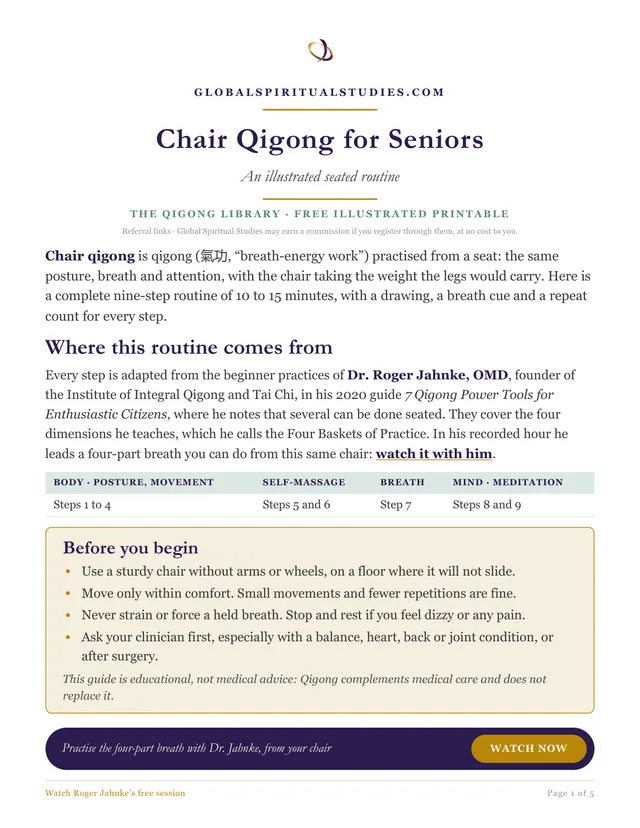
Rows marked Jahnke are paraphrased and adapted for a chair from Roger Jahnke's free guide 7 Qigong Power Tools for Enthusiastic Citizens (2020); the seated wording and the softer Earth and Sky are the library's adaptations. Rows marked common are widely used seated movements described in plain words by Global Spiritual Studies. The fourth column records what the tradition says, not medical outcomes.
 5 pages
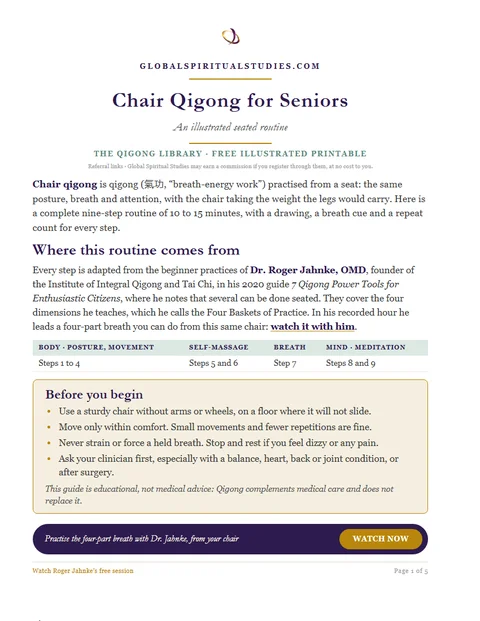
Free illustrated printable
Chair Qigong for Seniors
A complete seated routine, illustrated step by step, ready to print.
| What’s inside | |
|---|---|
| ✓ | Nine illustrated seated steps, from settling into the seat to the closing |
| ✓ | The breath for every movement, printed beside it |
| ✓ | Practices adapted from Dr. Roger Jahnke: the Three Intentful Corrections, Flowing Motion, Earth and Sky |
| ✓ | A Before you begin checklist, and where the routine comes from |
Arrives in your inbox as a PDF · print it for the kitchen table
A ten-minute seated routine
If you would like somewhere to start, try this. It is an invitation, not a prescription: take out anything that does not suit you, and stop whenever you have had enough. Ten minutes on most days will teach you more than an hour once a month.
- Arrive, one minute. Settle into the chair and move through the Three Intentful Corrections: tall spine, soft breath, quiet mind, a small smile.
- Loosen, two minutes. A few neck turns, a few shoulder rolls each way, and slow ankle circles on each foot.
- Flow, three minutes. Flowing Motion with the arms, then Earth and Sky, gently, then Seated Cloud Hands. Let the breath set the pace.
- Wake the legs, one minute. Seated heel raises, slow and soft.
- Self-massage, two minutes. Tracing the Qi Channels, then Energizing the Organs, finishing with the palms resting on the low belly.
- Settle, one minute. Two or three Gathering Breaths and one Sigh of Relief. Sit for a moment with the hands below the navel before you stand, and stand slowly.
You may notice very little the first time. That is usual. What people tend to describe, after a few weeks, is less a dramatic change than a small one: shoulders that sit a little lower, a breath that settles more quickly, a morning that begins with attention instead of hurry.
Chair Tai Chi vs chair Qigong
The names are used loosely, and that causes real confusion for beginners. Tai Chi originated as a martial art in China: a choreographed sequence of linked postures, with its documented beginnings in Chen Village in Henan during the Ming-Qing transition. Qigong is the older and broader family of movement, breath and meditation practices. The US National Center for Complementary and Integrative Health puts the relationship plainly: when Tai Chi is performed for health, it is considered a form of Qigong.
| Aspect | Chair Tai Chi | Chair Qigong |
|---|---|---|
| Origin | A seated adaptation of a Chinese internal martial art, traditionally practised standing | Seated forms belong to Qigong itself; the Eight Brocades had a seated set |
| Structure | Ideally a sequence of linked movements drawn from a Tai Chi form, flowing one into the next | Short, separate movements, each repeated several times with the breath |
| Learning curve | Moderate; the sequence has to be memorised | Gentle; one movement can be learned in a minute |
| Standing needed | None in the chair version, though full Tai Chi is a standing practice | None |
| Best for | People who enjoy learning a flowing sequence and may later move to standing Tai Chi | Complete beginners, people with limited energy or mobility, and anyone who wants a short daily practice |
Sources: NCCIH Tai Chi and Qigong pages; Wikipedia, Tai chi and Baduanjin qigong. The comparison of structure and learning curve summarises common teaching.
Here is the part most routines leave unsaid. Look closely at most seated routines sold as "chair Tai Chi for seniors" and you will find Qigong-style movements: a handful of slow arm patterns, each repeated with the breath, perhaps with a Tai Chi name such as Cloud Hands attached. That is no criticism. Repetition suits a chair, and it suits a beginner. It simply means that if you enjoy chair Tai Chi, you are already doing Qigong. The library's full comparison, Qigong vs Tai Chi, sets the two side by side in more detail.
Dr. Roger Jahnke bridged the two deliberately. His Tai Chi Easy is a simplified practice of Tai Chi and qi cultivation, built so that trained lay "practice leaders" could teach it in their own communities rather than everyone depending on a master. The idea came out of a 2005 National Expert Meeting on Qigong and Tai Chi that he co-convened, where experts named "exclusive dependence on masters or experts" as the main barrier to spreading these practices. The published evaluation of the programme describes it as a replicable Tai Chi and Qigong program for older adults.
Several movements on this page come from the teacher behind Tai Chi Easy, and his free session, Discover the Power of Qi Medicine, leads a four-part Qigong breath you can do from your chair.
Watch nowOpens the course page · the session is one click away
Balance and falls: what the evidence says
This is the question many readers care about most, so it deserves a careful answer rather than a hopeful one.
Tai Chi has the best evidence, and it is standing evidence. NCCIH (updated December 2023) summarises a 2019 review of studies in older adults. It found low-certainty evidence that Tai Chi may reduce the rate of falls by about 19 percent, and high-certainty evidence that it may reduce the number of people who fall by about 20 percent. In the same review, balance and functional exercise programmes reduced the rate of falls by about 24 percent, with high-certainty evidence. In other words, Tai Chi helps, and other well-designed balance training helps at least as much. Almost all of this research is on practice done on your feet.
Qigong has less research. NCCIH's Qigong page (updated February 2022) reports that a 2019 survey of reviews found sufficient evidence to support Qigong for balance training and fall prevention, while noting that the number of Qigong studies including older adults is limited. It describes Qigong as a safe form of activity, including for older adults.
Tai Chi Easy has been evaluated, modestly. In a 2010 study in Geriatric Nursing, Jahnke and colleagues trained lay practice leaders at 18 sites across the United States; the 330 older adults who completed the programme, average age 73, reported less perceived stress and better sleep and energy. There was no comparison group, so it is a programme evaluation, not proof. Two randomised trials he co-authored tested Tai Chi Easy for fatigue in breast cancer survivors: the 2015 trial found fatigue fell more than with a sham practice, and the larger 2025 trial found modest benefits, some also seen with the sham. Neither trial measured falls.
Seated routines have not been shown to prevent falls. A 2021 systematic review of chair-based exercise for older adults (PMC7920319; 25 studies, 1,388 participants) found improvements in arm strength and in the chair-stand test, a measure of leg function. It found no significant difference in balance scores or in people's confidence about not falling. No published trial shows that a seated-only routine reduces falls.
So here is the plain summary. A chair routine is a kind, safe way to begin, and it can build strength and confidence in the movements. If falls are your concern, the evidence points to balance work on your feet: standing Tai Chi, Qigong or balance exercises, done with support such as the back of a sturdy chair or a kitchen counter, and ideally in a class led by a physiotherapist or a trained leader who works with older adults. The chair can be your starting point, and later your handrail.
Safety in a chair
Before you begin
- Use a sturdy chair on a level floor, without wheels. If you use a wheelchair, lock the brakes first.
- Sit near the front edge with both feet flat and the knees roughly over the ankles.
- Move only within comfort. Smaller movements are fine; so is resting.
- Breathe normally. Never hold or force the breath.
- Stop if you feel dizzy, short of breath, faint or in pain, or if you feel any chest discomfort.
- If you have arthritis, osteoporosis or a joint replacement, follow any movement precautions your clinician or surgical team gave you, and keep bending and twisting small.
- Stand up slowly at the end, with a hand on the chair or a nearby surface.
- Ask your clinician first, especially if you have balance, heart, back or joint conditions, are recovering from surgery or are pregnant.
This guide is educational and is not medical advice. Qigong complements medical care; it does not replace it. Talk with your clinician before starting, especially if you are pregnant, recovering from surgery, or have balance, back or heart conditions.
Where to learn
A page can start you off. A teacher can see what a page cannot: the shoulder that lifts too high, the breath that tightens, the moment you are ready for more.
Dr. Roger Jahnke, OMD, has more than three decades of clinical practice in Chinese medicine. He founded the Institute of Integral Qigong and Tai Chi in Santa Barbara, co-founded the National Qigong Association and developed Tai Chi Easy, and several of the practices in his beginner guide come with seated variations. He co-authored two randomised trials of Tai Chi Easy, and the programme's published evaluation, in 330 older adults, had an average participant age of 73. His free hour-long session, Discover the Power of Qi Medicine, leads a four-part Qigong breathing practice, introduces the Four Baskets of movement, breath, mindfulness and self-massage, and shares his view that "the most profound medicine is produced within". It is a gentle, well-taught place to begin, and it opens onto his seven-module course, Qi Medicine with Roger Jahnke. The Roger Jahnke profile and the complete guide to his free event and Qi Medicine course explain what to expect.
Practise with the source
Learn from Roger Jahnke
The seated routine here adapts his practices. His recorded hour teaches the four-part breath, the foundation of Qi Medicine, and you can follow it from your chair.
Discover the Power of Qi Medicine
A recorded session with Dr. Roger Jahnke, OMD
| What the hour gives you | |
|---|---|
| ✓ | A little over an hour of teaching, recorded, to watch whenever it suits you |
| ✓ | The four-part breath, the foundation of Qi Medicine, practised with him three times |
| ✓ | The Four Baskets of Qigong practice, named and explained in his own words |
| ✓ | His map of how qi meets the body, from the protective field to the three Elixir Fields |
| ✓ | A tour of all seven course modules, so you know exactly what the course holds |
Recorded session
Free
A little over an hour · watch whenever it suits you
Watch nowOpens the library's course page, with the session one click away.
- RegisterA short form reserves your place
- Practise alongThe four-part breath, with him
- Decide laterThe course is presented at the end
No correct sensation to chase · the breath practice is yours to keep · decide about the course in your own time.
Close to home. Local options are worth asking about too. Many senior and community centres run chair-based or gentle Tai Chi and Qigong classes, and physiotherapists and hospital falls services often run balance classes built specifically for older adults. NCCIH suggests asking any Qigong instructor about their training and experience; it is also worth asking whether they regularly teach older adults. For the wider picture of what Qigong has and has not been shown to help, the library's entry on Qigong for health goes condition by condition, and Qigong for beginners offers a standing routine for when you are ready.
And if you would like the seated routine on paper, beside your chair:
Printable · 5 pages
Practise from your chair
All nine seated steps, illustrated, with the breath for each.
Get the printableSources
Jahnke R., 7 Qigong Power Tools for Enthusiastic Citizens, 2020 · NCCIH, Tai Chi: What You Need To Know (December 2023) and Qigong: What You Need To Know (February 2022) · Jahnke R.A., Larkey L.K., Rogers C., Geriatric Nursing, 2010 · Larkey L.K. et al., Annals of Behavioral Medicine, 2015, and Complementary Therapies in Clinical Practice, 2025 · Klempel N. et al., chair-based exercise review, International Journal of Environmental Research and Public Health, 2021 (PMC7920319) · Tai Chi Easy founder page (taichieasy.org) · Wikipedia, Tai chi and Baduanjin qigong · Checked 30 September 2026.
Further reading: Wikipedia, Baduanjin qigong · NCCIH, Tai Chi: What You Need To Know · Wikipedia, Tai chi · NCCIH, Qigong: What You Need To Know · Tai Chi Easy, founder page · PubMed 20682405 · PubMed 25124456 · PubMed 40651067.
Frequently asked questions
Is chair Tai Chi good for seniors?
For many older adults it is a gentle, safe way to begin. NCCIH describes Tai Chi and Qigong as safe forms of activity, and a 2021 review of chair-based exercise found gains in arm strength and in the chair-stand test. It is not a substitute for standing balance work if falls are a concern, and you should check with your clinician first if you have balance, heart, back or joint conditions.
Can you do Tai Chi sitting down?
Yes. Many Tai Chi and Qigong movements adapt well to a chair, especially the arm movements, the breathing and the self-massage. What a chair removes is the slow weight shift from foot to foot that standing Tai Chi is built on. The Eight Brocades, a classic Qigong set, traditionally had a seated version as well as a standing one.
How often should I practise chair Qigong or chair Tai Chi?
Little and often suits these practices best. Ten minutes on most days is a good aim, and a few minutes is still worthwhile. The chair-based exercise review cited on this page notes that guidelines suggest older adults do strength, balance and flexibility exercise at least twice a week.
Is chair Qigong safe if I have arthritis, osteoporosis or a hip replacement?
Ask your clinician first, because the answer depends on you. Keep every movement within a gentle, comfortable range, keep bending and twisting small, and follow any precautions your surgical team gave you after a joint replacement. For knee osteoarthritis, NCCIH notes that the American College of Rheumatology and the Arthritis Foundation strongly recommend Tai Chi.
Does chair Tai Chi help balance?
The balance evidence NCCIH reports is for Tai Chi practised standing. A 2021 review of chair-based exercise found better arm and leg function but no significant difference in balance scores. A chair routine can build strength and confidence, but standing balance work is where the evidence is.
Can a seated routine prevent falls?
It has not been shown to. The fall-prevention evidence is for standing Tai Chi and for balance and functional exercise programmes, which NCCIH reports can reduce the rate of falls by around a fifth to a quarter. If falls worry you, ask about a supervised balance class and use the back of a sturdy chair for support.
What is the difference between chair Tai Chi and chair yoga?
Chair yoga adapts yoga postures, breathing and relaxation from the Indian tradition, and often holds a stretch for several breaths. Chair Tai Chi and chair Qigong come from Chinese traditions and keep the body moving slowly and continuously with the breath. Both are gentle; the feel is different, so try each and see which you look forward to.
Is there a free printable chair Tai Chi or Qigong routine?
Yes. Global Spiritual Studies offers a free illustrated chair Qigong printable, a nine-step seated routine adapted from Dr. Roger Jahnke's beginner practices, sent by email as a PDF.
What is Tai Chi Easy?
Tai Chi Easy is a simplified practice of Tai Chi and Qigong developed by Dr. Roger Jahnke, designed to be taught by trained lay practice leaders rather than masters. A 2010 evaluation with 330 older adults reported less stress and better sleep and energy, but it had no comparison group, so it is not proof of effect.
Can I do chair Qigong in a wheelchair?
Many people do. Lock the brakes first, keep the movements within easy reach, and let the arm, breath and self-massage movements carry the practice. A clinician or therapist who knows you can advise on any limits.
Do I need any equipment?
Only a sturdy chair without wheels on a level floor, and clothes you can move in. Sit near the front edge with your feet flat. Many people like to practise at the same time each day, beside a window or somewhere quiet.
Is it too late to start Tai Chi or Qigong after 60?
No. Both are widely taught to older adults, and the Tai Chi Easy evaluation had an average participant age of 73. Starting seated is a sensible first step, and you can add standing practice with support later if your clinician agrees.
Sit tall, breathe softly, and let the smallest movement be enough.