The Major Arcana
There are 78 cards in a Tarot deck, but 22 of them carry a different weight.
These are the Major Arcana: the trumps, the triumphs, the archetypal forces that emerge in a reading when something larger than everyday circumstance is at work. They are the cards that make people pause. The Tower. Death. The Star. The Fool. When a Major Arcana card appears, the conversation shifts from what is happening to why it is happening, from circumstance to meaning, from the surface of life to its depths.
If you are beginning your study of Tarot, the Major Arcana is where the journey starts. If you have been reading for years, it is where the journey deepens. This guide covers all 22 cards, the narrative that connects them, and the frameworks that reveal their psychological and spiritual architecture.
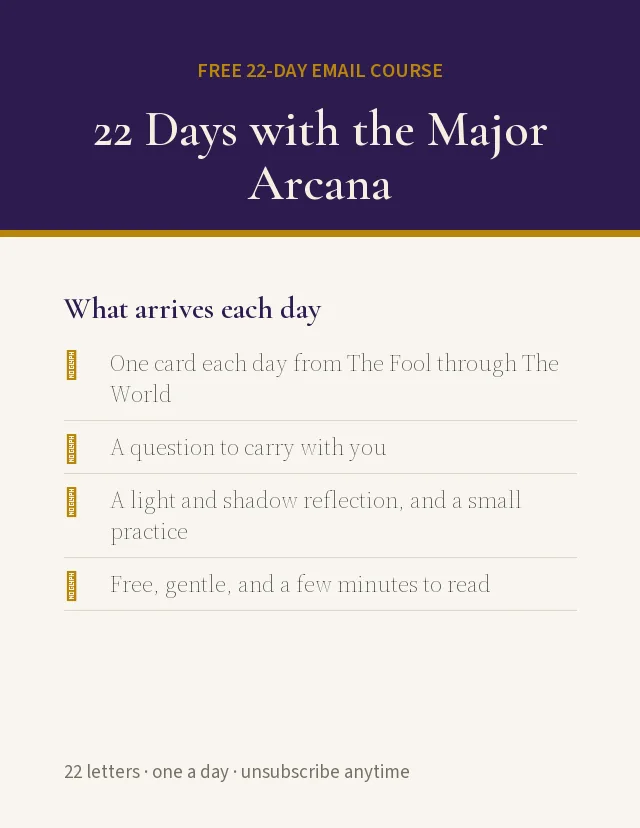
Ready to go beyond the page? You can learn Tarot online with our full faculty of published authors, one card at a time.
What Are the Major Arcana?
The Major Arcana (Latin for "greater secrets") are the 22 trump cards numbered 0 through 21. They are distinct from the 56 Minor Arcana (four suits of 14 cards each), which deal with everyday situations, practical matters, and the texture of daily life.
The Major Arcana deal with something else entirely. They represent archetypal forces: universal patterns of human experience that transcend culture, era, and individual circumstance. Birth and death. Authority and rebellion. Love and loss. Wisdom and folly. When these cards appear in a reading, they signal that the querent is engaging with forces larger than the personal ego: fate, destiny, soul-level growth, and the deep currents of psychological transformation.
The word "arcana" means secrets or mysteries. The Major Arcana are the Tarot's deepest mysteries, and they have been studied not only by card readers but by psychologists, mythologists, poets, and seekers of every tradition.
The Fool's Journey
The 22 Major Arcana are not a random collection. Arranged in sequence from 0 (The Fool) to 21 (The World), they tell a story: the Fool's Journey, a mythic narrative of the soul's passage from innocence through experience to wholeness.
The Fool is the protagonist, the everyman, the soul itself. Card by card, the Fool encounters each archetype in turn, and each encounter teaches a lesson that shapes the journey.
Act I: Building the Ego (Cards 0-VII)
The Fool begins as pure potential and encounters the forces that build identity and consciousness in the external world.
- The Fool (0) · The leap into the unknown. Pure potential before it takes form.
- The Magician (I) · Discovery of personal will and creative power.
- The High Priestess (II) · The hidden world of intuition and the unconscious.
- The Empress (III) · Abundance, nurturing, and creative expression.
- The Emperor (IV) · Structure, authority, and the law.
- The Hierophant (V) · Tradition, teaching, and collective wisdom.
- The Lovers (VI) · The first great choice. Love, values, and alignment.
- The Chariot (VII) · Triumph of will. The ego at the height of worldly mastery.
Act II: The Turning Inward (Cards VIII-XIV)
Having mastered the outer world, the Fool turns to face the inner world: instinct, solitude, fate, surrender, and transformation.
- Strength (VIII) · Taming the inner lion through compassion, not force.
- The Hermit (IX) · Withdrawal for reflection and inner illumination.
- Wheel of Fortune (X) · The cycles of fate. What goes up comes down.
- Justice (XI) · Truth, accountability, and karmic consequences.
- The Hanged Man (XII) · Willing sacrifice and the shift in perspective.
- Death (XIII) · The great transformation. The old self must die.
- Temperance (XIV) · The art of integration. Alchemy after crisis.
Act III: The Dark Night and Rebirth (Cards XV-XXI)
The Fool enters the deepest territory: shadow, destruction, healing, and the emergence into wholeness.
- The Devil (XV) · Confrontation with bondage, shadow, and unconscious patterns.
- The Tower (XVI) · The shattering revelation. False structures destroyed.
- The Star (XVII) · Hope, healing, and grace after the storm.
- The Moon (XVIII) · The dark night of the soul. Illusion and the deep unconscious.
- The Sun (XIX) · Rebirth into clarity, joy, and conscious wholeness.
- Judgement (XX) · The call to awakening. Resurrection and integration.
- The World (XXI) · Completion. The dancer at the centre of the mandala.
The World connects back to the Fool: the journey is a spiral, not a line. Each completion becomes a new beginning at a deeper level.
Three Rows of Seven: A Structural Framework
Beyond the narrative sequence, the Major Arcana can be arranged into three rows of seven (with the Fool standing outside as the animating spirit). This framework, refined by Paul Foster Case and other esoteric teachers, reveals deeper patterns.
Row 1: Conscious Awareness (I-VII) · The tools and powers available to the conscious mind. Will, intuition, creativity, structure, tradition, choice, and mastery.
Row 2: Subconscious and Moral Development (VIII-XIV) · The inner forces that test and transform the soul. Courage, wisdom, fate, accountability, surrender, transformation, and integration.
Row 3: Superconscious and Cosmic Forces (XV-XXI) · The transpersonal forces that shatter, heal, and complete the journey. Shadow, destruction, hope, illusion, clarity, calling, and wholeness.
Each column creates a meaningful vertical triad. For example, the first column (Magician, Strength, Devil) traces the arc of personal power from creative will through compassionate mastery to shadow-bondage. Understanding these patterns transforms how you read the cards in combination.
The Jungian Perspective
The Swiss psychologist Carl Jung regarded the Tarot as a kind of psychological laboratory in pictorial form. The Major Arcana, in particular, map directly onto Jung's model of the psyche and the process of individuation: the lifelong journey toward wholeness.
Each Major Arcana card corresponds to an archetype in the collective unconscious:
- The Fool is the Divine Child, the prima materia before differentiation
- The Magician is the ego discovering its creative power
- The High Priestess is the Anima, the soul-image
- The Empress and Emperor are the archetypal Mother and Father
- The Devil is the Shadow: everything the ego has denied
- The Tower is the shattering of the Persona
- The World is the Self realised: the mandala of wholeness
When Major Arcana cards dominate a reading, they signal that the querent is engaging with archetypal forces: the deep patterns of the collective unconscious rather than the surface events of daily life.
Mary K. Greer's course A Jungian Approach to the Tarot explores this dimension in depth, connecting each card's imagery to the individuation process.
Major Arcana vs Minor Arcana
Understanding when Major Arcana cards appear, and what their presence means, is one of the most important skills in Tarot reading.
| Major Arcana (22 cards) | Minor Arcana (56 cards) | |
|---|---|---|
| Scope | Archetypal, karmic, soul-level | Everyday situations and events |
| Agency | Forces larger than the ego | Personal choices and daily actions |
| Duration | Long-term, life-defining themes | Temporary situations and phases |
| In a reading | Signals major lessons and turning points | Describes circumstances and practical advice |
A reading dominated by Major Arcana suggests a period of significant personal transformation. A reading with mostly Minor Arcana indicates practical matters and navigable circumstances. A mix of both suggests the querent is grounding spiritual lessons in daily life.
Major Arcana meanings: all 22 cards
The table below gives the core meaning of every Major Arcana card in order, from 0 The Fool to 21 The World, with each card linked to its full guide.
The 22 Cards at a Glance
Each card links to a complete guide with upright and reversed meanings, Jungian archetype, love and career readings, Kabbalistic correspondences, card pairings, and the Fool's Journey position.
The Complete Printable Chart
All 22 Major Arcana cards on one page, in order from The Fool to The World, with upright and reversed keywords and key themes · free to read here or print and keep beside your deck.
| # | Card | Keywords |
|---|---|---|
| 0 | The Fool | Beginnings, innocence, spontaneity, freedom, faith |
| I | The Magician | Manifestation, will, skill, power, concentration |
| II | The High Priestess | Intuition, mystery, inner wisdom, patience, the unconscious |
| III | The Empress | Abundance, fertility, nurturing, creativity, sensuality |
| IV | The Emperor | Authority, structure, stability, leadership, discipline |
| V | The Hierophant | Tradition, teaching, institution, faith, conformity |
| VI | The Lovers | Love, choice, union, harmony, partnership |
| VII | The Chariot | Victory, willpower, determination, control, triumph |
| VIII | Strength | Courage, patience, compassion, inner strength, gentle mastery |
| IX | The Hermit | Introspection, solitude, wisdom, guidance, soul-searching |
| X | Wheel of Fortune | Cycles, fate, change, destiny, turning point |
| XI | Justice | Justice, truth, fairness, accountability, karma |
| XII | The Hanged Man | Surrender, new perspective, sacrifice, patience, letting go |
| XIII | Death | Transformation, ending, transition, release, rebirth |
| XIV | Temperance | Balance, moderation, patience, integration, alchemy |
| XV | The Devil | Bondage, shadow, addiction, materialism, temptation |
| XVI | The Tower | Upheaval, revelation, destruction, breakthrough, crisis |
| XVII | The Star | Hope, inspiration, healing, serenity, renewal |
| XVIII | The Moon | Illusion, fear, unconscious, confusion, dreams |
| XIX | The Sun | Joy, clarity, vitality, success, truth |
| XX | Judgement | Rebirth, calling, awakening, judgement, absolution |
| XXI | The World | Completion, wholeness, fulfilment, integration, celebration |
How to Read Major Arcana in Practice
A few practical guidelines for working with the Major Arcana in readings:
Count the Majors. In a spread, note how many Major Arcana cards appear. Three or more in a ten-card spread suggests archetypal forces are in play. One or none suggests the situation is primarily practical.
Read the narrative. When multiple Majors appear, consider where they fall in the Fool's Journey. A spread showing the Devil followed by the Star tells a clear story: bondage followed by healing. The Chariot followed by the Hermit: outward triumph followed by inward retreat.
Respect the weight. Major Arcana cards carry more interpretive weight than Minor Arcana cards in the same spread. They point to the underlying theme, the deeper current, the "why" beneath the "what."
Read reversals thoughtfully. A reversed Major Arcana card does not simply mean the opposite of its upright meaning. It may indicate a blocked or internalised version of the archetype, a lesson not yet learned, or a force operating below conscious awareness. Mary K. Greer's Reading Tarot Reversals explores twelve different approaches.
Use pairings. Major Arcana cards read powerfully in combination. Each card's individual guide includes detailed pairings with other Majors. The Lovers and the Devil. The Tower and the Star. The Fool and the World. These pairings reveal the dynamics of the reading at the deepest level.
The Kabbalistic Connection
In the Western esoteric tradition, each of the 22 Major Arcana cards corresponds to one of the 22 paths on the Kabbalistic Tree of Life, and to one of the 22 letters of the Hebrew alphabet. This correspondence system, developed by the Hermetic Order of the Golden Dawn in the late 19th century, adds a rich layer of meaning to every card.
Each card's individual guide includes its specific Kabbalistic correspondence, Hebrew letter, and the two Sephiroth it connects on the Tree, with links to the relevant pages in our complete Kabbalah series.
For a comprehensive overview of how every Major Arcana card maps to the Tree, see The 22 Paths: Complete Tarot Correspondence Guide.
Evelynne Joffe's courses Tarot on the Tree of Life and Living the Tree of Life: The Paths explore these correspondences in depth with guided meditations and practical exercises.
Sources & Tradition
The meanings and correspondences presented here follow the Rider-Waite-Smith tradition established by A.E. Waite in The Pictorial Key to the Tarot (1910), illustrated by Pamela Colman Smith, together with the esoteric framework of the Hermetic Order of the Golden Dawn, which fixed the Major Arcana’s astrological and Kabbalistic path attributions. The archetypal reading reflected here draws on Rachel Pollack’s Seventy-Eight Degrees of Wisdom (1980), Mary K. Greer’s work on Tarot and the psyche, and Sallie Nichols’ Jung and Tarot (1980) · approaches taught at Global Spiritual Studies.
Frequently Asked Questions
What are the 22 Major Arcana cards?
The 22 Major Arcana cards are, in order: 0 The Fool, 1 The Magician, 2 The High Priestess, 3 The Empress, 4 The Emperor, 5 The Hierophant, 6 The Lovers, 7 The Chariot, 8 Strength, 9 The Hermit, 10 Wheel of Fortune, 11 Justice, 12 The Hanged Man, 13 Death, 14 Temperance, 15 The Devil, 16 The Tower, 17 The Star, 18 The Moon, 19 The Sun, 20 Judgement, and 21 The World. Together they trace the Fool's Journey, the archetypal stages of a complete inner journey. Some older decks swap the positions of Strength and Justice.
What do the Major Arcana cards mean?
Each Major Arcana card carries a core archetypal meaning read both upright and reversed · The Fool for the leap into the unknown, The Magician for conscious will, The High Priestess for hidden knowing, The Empress for embodied creation, and so on through The World. Layered onto each card are astrological, Kabbalistic, and alchemical correspondences. Scholars like Rachel Pollack, Mary K. Greer, and Sallie Nichols show how the Majors map the deep forces of the psyche.
What is the difference between the Major and Minor Arcana?
The Major Arcana describes large archetypal forces and life lessons · the Minor Arcana describes the daily texture of how those lessons play out. A reading that draws mostly Majors usually points to a turning point; one that draws mostly Minors points to ordinary day-to-day matters.
How do I read the Major Arcana?
Begin by learning each card's core meaning upright and reversed, then study how the cards relate to one another in sequence. The Fool's Journey, elemental dignities, and astrological correspondences all give you scaffolding to read individual cards in context rather than in isolation.
Where should a beginner start with the Major Arcana?
Start with The Fool, The Magician, and The High Priestess · the three cards that open the deck and set up the dialogue between possibility, will, and inner knowing. Once you can hold those three together, the rest of the journey unfolds naturally.
Does the Death card mean someone will die?
No. The Death card represents transformation, endings, and the natural cycle of letting go so something new can emerge. It is one of the most misunderstood cards in the deck. In thousands of readings, the Death card points to the end of a relationship pattern, a career chapter, a belief system, or an identity, not to physical death.
What does it mean when a reading is mostly Major Arcana?
A reading dominated by Major Arcana cards signals that the querent is in a period of significant personal transformation. The forces at work are larger than everyday circumstances: fate, destiny, archetypal patterns, and soul-level growth are in play. Rachel Pollack's Major Arcana Only Readings explores how to work with the trumps exclusively.
Can I use only the Major Arcana for readings?
Yes. Reading with only the 22 Majors is a powerful technique that focuses entirely on archetypal themes and soul-level questions. It strips away practical detail and goes straight to the heart of the matter. Many experienced readers use Major-only readings for spiritual guidance, life-path questions, and deep psychological exploration.
What is my birth card?
Your Tarot birth card is calculated from your birth date and identifies the Major Arcana cards that are your lifelong companions. Mary K. Greer's Archetypal Tarot: Birth and Year Cards teaches how to calculate and interpret these personal cards.
Explore the Major Arcana with Expert Guidance
The Major Arcana reward a lifetime of study. These courses offer structured paths into the cards' symbolism, psychology, and practical application:
TarotNav: A GPS for Life with Linda Marson
One lesson per Major Arcana card, exploring symbolism, reading techniques, and personal applications. Includes TarotNav, Linda's signature reading framework.
A Jungian Approach to the Tarot with Mary K. Greer
Archetypal analysis and psychological depth through the Tarot. Connects each card to Jung's model of the psyche and the process of individuation.
Major Arcana Only Readings with Rachel Pollack
Reading techniques using only the 22 Trumps. Focuses on archetypal themes and soul-level questions.
Archetypal Tarot: Birth and Year Cards with Mary K. Greer
Calculate your personal birth and year cards. Understand the Major Arcana cards that are your lifelong companions.
Active Imagination and the Tarot with Mary K. Greer
Enter the card's imagery through guided meditation and active imagination. A contemplative approach to the Major Arcana.
For a comprehensive introduction to reading all 78 cards, see How to Read Tarot Cards: A Complete Guide.