
Kabbalah Tree of Life: A Complete Guide
A Complete Guide to the Sephirot, the Paths, and the Map of the Soul
The Kabbalah Tree of Life is a diagram of ten Sephirot joined by twenty-two paths: ten divine emanations, from Kether, the Crown, at the top to Malkuth, the Kingdom, at the base, linked by twenty-two paths that each carry a letter of the Hebrew alphabet. Known in Hebrew as Etz Chaim, it is the central symbol of Kabbalah, the mystical tradition within Judaism. Read from the top down, it maps how the Infinite descends into the physical world; read from the bottom up, it charts the soul's journey of return. In the Western Qabalah taught at Global Spiritual Studies, each of the twenty-two paths also corresponds to a Major Arcana card of the Tarot, which makes the Tree a working map of consciousness rather than a creed.
All 10 Sephirot and 22 paths on one page · plus the free Tree of Life quiz
The Kabbalah Tree of Life is not a belief system. It is a map. Mystics, psychologists, Tarot readers, and seekers of every tradition have found their way onto it and discovered that it describes something they already sensed but could not articulate: that consciousness has a structure, that the journey inward follows a pattern, and that the pattern can be learned.
This guide walks through the entire Tree, from its origins to its practical application. Whether you are encountering Kabbalah for the first time or deepening a study you began years ago, this is a place to orient yourself.
If you would like to walk the whole Tree with a teacher rather than on your own, Evelynne Joffe teaches it in Living the Tree of Life · The Ten Sephirot · eight self-paced classes climbing from Malkuth to Kether, with recordings of both live Q&A sessions in which she answered students’ own questions.
Featured Course · 2026 Cohort
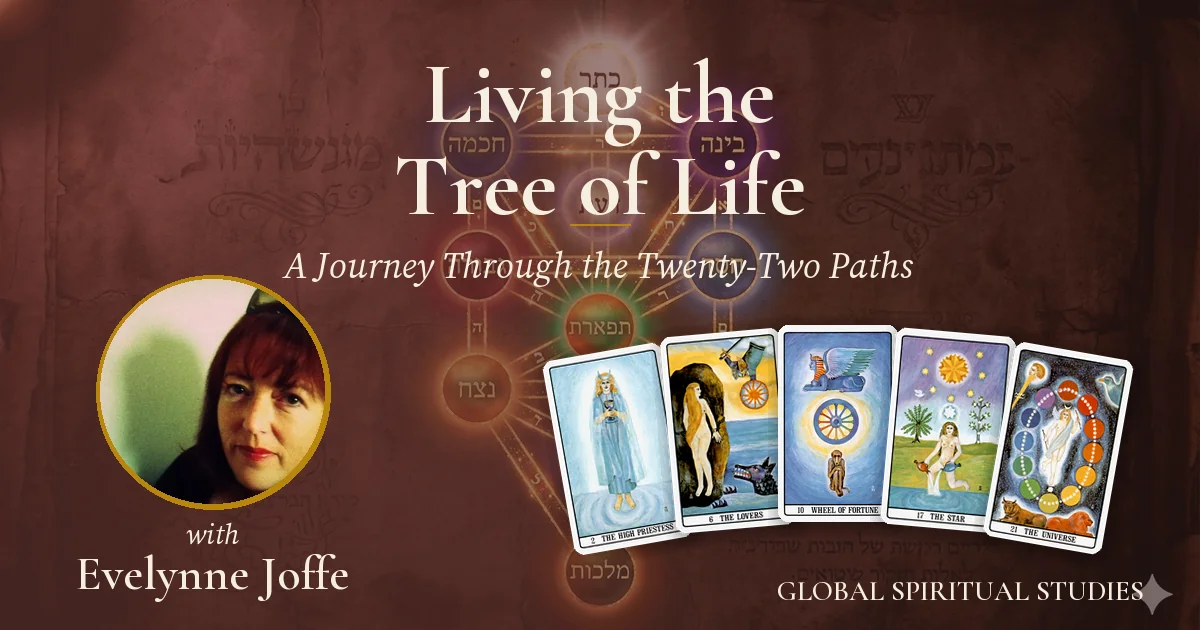
Living the Tree of Life · Part 2: The Paths
The 2026 Cohort · with Evelynne Joffe, Director of the Institute of Esoteric Studies
Across twenty classes Evelynne climbs all twenty-two Paths of the Tree, from Path 32 to Path 11, opening each one through its Hebrew letter and its Tarot card. The 2026 Cohort adds two live Q&A sessions with her on Zoom, dates announced soon, and both are recorded and added to the course. Part 1 or an equivalent grounding in the Sephirot is recommended before you begin.
- Twenty classes
- Two live Q&As
- Path 32 to Path 11
- 11.5+ hours of video
- Handouts & transcripts
- Subtitles
- Private course forum
- Quiz & certificate
- Lifetime access
What Is the Kabbalah Tree of Life? · Kabbalah Explained
Kabbalah is the mystical tradition within Judaism. The word comes from the Hebrew root meaning "to receive," and the tradition was originally understood as secret knowledge received directly, teacher to student, alongside the written Torah.
At its core, Kabbalah addresses four questions. How does the Infinite relate to the finite world? What is the structure of creation? What is the nature of the human soul? And how can human beings participate in restoring creation to wholeness?
The central symbol is the Tree of Life (Etz Chaim), a diagram of ten divine emanations connected by twenty-two paths. Everything else in Kabbalah radiates from this image.
A Note on Spelling
Three spellings reflect three distinct traditions:
| Spelling | Tradition | Focus |
|---|---|---|
| Kabbalah (K) | Jewish mystical tradition | Torah-based, rooted in Jewish learning |
| Cabala (C) | Christian adaptation | Renaissance scholars reading Kabbalah through Christian theology |
| Qabalah (Q) | Western Hermetic tradition | Integrates Tarot, astrology, alchemy, and depth psychology |
The courses at Global Spiritual Studies work primarily within the Western Qabalah tradition. This approach respects Kabbalah's Jewish origins while treating the Tree of Life as a universal map of consciousness, open to students of all backgrounds.
You will also meet these words as adjectives · a Kabbalistic diagram, a Qabalistic correspondence, the Kabbalistic Tree of Life. The adjective carries the tradition with it: Kabbalistic points to the Jewish mystical lineage, Qabalistic to the Western Hermetic one. The Tree itself is the same diagram in both.
History in Brief
The roots of Kabbalah reach back to the Merkabah mystics of the first centuries CE, who practised visionary ascent through heavenly palaces to the divine throne. The tradition crystallised in twelfth-century Provence and thirteenth-century Spain, where the Zohar, Kabbalah's most important text, was composed. In the sixteenth century, Isaac Luria revolutionised the system with his cosmology of divine contraction (Tzimtzum), shattering (Shevirat HaKelim), and repair (Tikkun).
Older than any of this is the Sefer Yetzirah, the Book of Formation · the terse work of Jewish mysticism in which the ten Sephirot and the twenty-two Hebrew letters are first named together as the thirty-two paths of wisdom, and which we cover in full in our complete guide to Sefer Yetzirah, the Book of Formation.
By the nineteenth century, the Hermetic Order of the Golden Dawn had woven the Tree of Life together with Tarot and Western esotericism, creating the synthesis that most modern seekers encounter today. Dion Fortune called Qabalah "the Yoga of the West." It is this tradition, grounded in the Golden Dawn synthesis and enriched by a century of depth psychology, that forms the basis of the Kabbalah courses at Global Spiritual Studies.
The Architecture of the Tree
The Tree of Life is a geometric diagram with three types of component:
The Ten Sephirot (singular: Sephirah) are divine emanations or attributes, arranged from the most abstract and unknowable at the top to the most concrete and physical at the bottom. They are the "what" of the Tree: states of being, qualities of consciousness, stages in the descent of energy from source to manifestation.
The Twenty-Two Paths connect the Sephirot. Each corresponds to a Hebrew letter and, in the Western tradition, to a Major Arcana card. The paths are the "how" of the Tree: the experiences of transitioning between one state and another, the inner work of moving from where you are to where you are becoming.
The Three Pillars organise everything vertically:
| Pillar | Position | Sephirot | Quality |
|---|---|---|---|
| Mercy | Right | Chokmah, Chesed, Netzach | Expansion, force, giving |
| Severity | Left | Binah, Geburah, Hod | Limitation, form, discipline |
| Equilibrium | Centre | Kether, Tiferet, Yesod, Malkuth | Balance, consciousness, integration |
The Tree can be read in multiple directions. Top to bottom: the descent of divine energy into matter (the "Lightning Flash"). Bottom to top: the soul's ascent back toward unity (the "Path of the Serpent"). Left to right: the dynamic tension between severity and mercy that generates all of life.
There is also a hidden element. Between the upper three Sephirot and the rest of the Tree lies the Abyss, a gulf separating intellectual understanding from direct experience. At its centre sits Da'at (Knowledge), the quasi-Sephirah that functions as both bridge and barrier. Crossing the Abyss requires the dissolution of ordinary ego-consciousness, a terrifying threshold that separates study from realisation.
The Ten Sephirot · All 10 Sephirot Explained
The Complete Printable Chart
All 10 Sephirot on one page with their Hebrew names, meanings, pillars, and Tarot, planetary, and colour correspondences · free to read here or print and keep beside the Tree.
| Sephirah | Meaning | Pillar | Tarot |
|---|---|---|---|
| 1 · Kether | Crown | Equilibrium (Middle) | Aces |
| 2 · Chokmah | Wisdom | Mercy (Right) | Twos & Kings |
| 3 · Binah | Understanding | Severity (Left) | Threes & Queens |
| 4 · Chesed | Mercy | Mercy (Right) | Fours |
| 5 · Geburah / Gevurah | Severity, Strength | Severity (Left) | Fives |
| 6 · Tiferet / Tiphareth | Beauty, Harmony | Equilibrium (Middle) | Sixes & Knights |
| 7 · Netzach | Victory | Mercy (Right) | Sevens |
| 8 · Hod | Splendour | Severity (Left) | Eights |
| 9 · Yesod | Foundation | Equilibrium (Middle) | Nines |
| 10 · Malkuth | Kingdom | Equilibrium (Middle) | Tens & Pages |
The Supernal Triad (Above the Abyss)
- 1. Kether (Crown) · The first emanation, closest to the Infinite. Pure being, undifferentiated unity. In psychological terms: the Self before ego.Pluto · White · Divine name: Eheieh ("I Am")
- 2. Chokmah (Wisdom) · The first flash of creative insight. Active, expansive, the spark before it takes form. The Logos principle.Uranus / Zodiac · Grey · Divine name: Yah
- 3. Binah (Understanding) · Form-giving intelligence. Where Chokmah is the lightning, Binah is the sky that gives it shape. The Great Mother.Saturn · Black · Divine name: YHVH Elohim
The Ethical Triad
- 4. Chesed (Mercy) · Expansive love, generosity without limit. The benevolent ruler who gives freely.Jupiter · Blue · Divine name: El
- 5. Geburah (Severity) · Necessary limitation, discipline, the courage to cut away what does not serve. The warrior.Mars · Red · Divine name: Elohim Gibor
- 6. Tiferet (Beauty) · The heart of the Tree. Where all forces meet in balance. Harmony, compassion, the centre of the soul. If there is one Sephirah to understand first, many teachers would name this one.Sun · Gold · Divine name: YHVH Eloah ve-Da'at
The Psychological Triad
- 7. Netzach (Victory) · Emotion, instinct, desire, nature. The feeling function. Where we respond before we think.Venus · Green · Divine name: YHVH Tzabaoth
- 8. Hod (Splendour) · Intellect, analysis, language, structure. The thinking function. Where we organise and articulate.Mercury · Orange · Divine name: Elohim Tzabaoth
- 9. Yesod (Foundation) · The subconscious, dreams, imagination. The reservoir through which all higher energies must pass before reaching the physical world.Moon · Violet · Divine name: Shaddai El Chai
The Kingdom
- 10. Malkuth (Kingdom) · Physical reality. The body, the earth, the manifest world. Where the soul's journey begins and, paradoxically, where it arrives. The Shekhinah, the divine feminine presence dwelling in matter.Earth · Citrine, olive, russet, black · Divine name: Adonai ha-Aretz
Explore the 10 Sephirot in depth with Evelynne Joffe · eight recorded classes walking from Malkuth to Kether through mythology, psychology, and daily practice.
The 22 Paths and the Hebrew Letters
The twenty-two paths are numbered 11 through 32 (the Sephirot occupy numbers 1 through 10). Each path is assigned one of the twenty-two Hebrew letters, and in the Western tradition, one of the twenty-two Major Arcana cards. If you are new to Tarot itself, our beginner's guide to reading Tarot will give you the foundation you need.
The paths are classified by their letter type:
Three Mother Letters
- Aleph, Mem, Shin · Correspond to the three elements (Air, Water, Fire) and to the Fool, the Hanged Man, and Judgement
Seven Double Letters
- Beth, Gimel, Daleth, Kaph, Peh, Resh, Tav · Correspond to seven planets and to cards from the Magician to the World
Twelve Simple Letters
- Heh through Qoph · Correspond to the twelve zodiac signs and the remaining Major Arcana cards
The Hebrew letter is, in Kabbalistic teaching, not merely a label. It is the path. The letters are the building blocks of creation, the means by which God spoke the universe into being. When you study a path, you study the letter: its shape, its name, its numerical value, and the word it spells are all entry points into the experience the path represents.
You do not need to learn Hebrew to work with the Tree. But learning the twenty-two letters deepens the experience considerably. Our Kabbalah path notes PDF includes all twenty-two correspondences as a study reference.
The thirty-two paths of wisdom themselves · the ten Sephirot and the twenty-two letters counted together · and how the later list of the Intelligences differs from what Sefer Yetzirah says, are covered in our guide to the 32 paths of wisdom.
Continue your study of the 22 paths · Evelynne Joffe guides you through each path's mythology, Hebrew letter, and Tarot connection across twenty recorded classes.
Kabbalah and Tarot
The connection between Kabbalah and Tarot is one of the most productive in Western esoteric tradition. In 1854, the French occultist Eliphas Levi first proposed that the twenty-two Hebrew letters correspond to the twenty-two Major Arcana. The Hermetic Order of the Golden Dawn developed this insight into a detailed system of correspondences that shaped every major Tarot deck created since, including the Rider-Waite-Smith and the Thoth.
The practical result: every Major Arcana card has a specific home on the Tree of Life. The Fool walks Path 11, from Kether to Chokmah. The High Priestess crosses the Abyss on Path 13, from Tiferet directly to Kether. The Devil occupies Path 26, connecting Hod to Tiferet.
This means that when you read Tarot with Kabbalistic awareness, each Major Arcana card carries not only its imagery and traditional meaning, but also a specific position on the map of consciousness. You know where the card sits on the Tree, which Sephirot it connects, and what transition it represents.
Evelynne Joffe's approach is distinctive. She teaches the Major Arcana not as the conventional "Fool's Journey" from card 0 to card 21, but as the soul's ascent up the Tree from Malkuth to Kether, reading the cards in reverse, from the World to the Fool. She calls this the "Hanged Man perspective," and her Tarot on the Tree of Life course presents this framework in a single focused session.
The sephirot and the seven chakras map remarkably parallel territory. Malkuth and the root chakra both ground the physical body. Tiferet and the heart chakra both bridge matter and spirit. Keter and the crown chakra both mark the threshold of transcendence. These are not arbitrary correspondences · they point to a shared recognition, across cultures, that the human energy body has an architecture. Our guide to chakras and the Tree of Life traces these parallels in detail.

Featured Course
The Energy Body in Tarot
A Guided Practice Through the Seven Chakras · with Philip Carr-Gomm & Steve Hounsome
Nine lessons exploring the hidden energy map in every Tarot deck. Guided meditations with original sound healing music, practical exercises for each chakra, and a transformative journey from root to crown.
- 12 video lessons
- 8 guided meditations
- 12 PDF handouts
- 7 bonus meditations
- Sound healing music
- Community forum
- Lifetime access
- Final quiz
- Certificate of completion
Kabbalah and Psychology
Carl Jung never studied Kabbalah systematically, but the parallels between his depth psychology and the Tree of Life are striking. The Sephirot map onto Jungian concepts with an uncanny precision: Kether as the Self (the totality of the psyche), Tiferet as the ego in right relationship with the unconscious, Yesod as the personal unconscious, and the Qliphoth (the shadow side of the Tree) as the collective shadow.
The process of climbing the Tree, from Malkuth upward through increasingly subtle states of awareness, mirrors individuation: the lifelong process of integrating unconscious contents into consciousness and becoming who you are meant to be.
This is not coincidence. Both systems describe the same territory from different vantage points. Kabbalah maps the soul's architecture through mystical revelation. Jungian psychology maps it through clinical observation and dream analysis. That they arrive at similar structures suggests they are both describing something real.
For students interested in this intersection, Mary K. Greer's Jungian Approach to Tarot explores the Major Arcana through a Jungian lens, and Evelynne Joffe's Tree of Life courses explicitly weave Jungian parallels into each Sephirah and path.
How to Read the Tree of Life · Your First Exercise
A Grounding Practice
Begin at the bottom. Malkuth is the Kingdom, the Sephirah of physical reality. It is where you already are.
Find a quiet place and sit comfortably. Close your eyes. Bring your attention to your body: the weight of it on the chair, the texture of your clothing, the temperature of the air. Notice the sounds around you, not to interpret them, but simply to register that they exist. Feel the ground beneath your feet.
This is Malkuth. Not a concept to understand, but a reality to inhabit fully.
Now ask: what in my life right now is asking me to be more present? Where am I living in abstraction when the situation calls for groundedness? Where have I been rushing past the physical reality of my experience?
Sit with whatever arises. There is no wrong answer. Malkuth is the starting point of the Tree because the journey upward begins with being fully here. If you're curious where your own energy centre focus lies, our free Tarot chakra quiz maps your dominant chakra to the Major Arcana.
When you are ready, open your eyes. You have just done your first piece of Kabbalistic practice.
Common Mistakes Beginners Make
Treating the Tree as Purely Intellectual
The Sephirot and paths are experiential, not encyclopaedic. Memorising the correspondences without sitting with the qualities they describe is like reading a cookbook without ever cooking. The information matters, but the practice is where transformation happens.
Rushing Upward
There is a natural temptation to skip Malkuth and Yesod and head straight for the more "spiritual" upper Sephirot. Resist this. The Tree is built from the bottom up. Each Sephirah prepares you for the next. Evelynne Joffe's teaching is emphatic on this point: if you cannot ground yourself in Malkuth, the upper Tree will remain abstract.
Confusing Traditions
The Tree of Life appears in Jewish Kabbalah, Christian Cabala, and Western Qabalah. These are related but distinct traditions with different emphases and sometimes different path attributions. Be aware of which tradition your source material comes from, and do not mix systems carelessly.
Ignoring the Pillars
Many beginners focus on the Sephirot individually and forget the three-column structure. The pillars are the dynamic engine of the Tree: mercy and severity in constant creative tension, with the middle pillar holding the balance. Without the pillars, the Sephirot are just a list.
From the Sephirot to the 22 Paths, our Kabbalah courses with Evelynne Joffe and Philip Carr-Gomm guide you through every stage of the Tree of Life.
Browse Kabbalah CoursesWhere to Begin Your Study
Eight recorded classes walking through all ten Sephirot from Malkuth to Kether. Mythology, psychology, and daily practice woven together. The foundation course for serious Tree of Life study.
Twenty classes covering all twenty-two paths. Hebrew letters, Tarot correspondences, Sefer Yetzirah texts, and practical guidance for each path. The most comprehensive path study available online.
A single master class reversing the conventional Fool's Journey. The soul ascends the Tree from the World to the Fool. Joffe's distinctive "Hanged Man perspective" on the Major Arcana.
Three traditions woven into one course by the former head of the Order of Bards, Ovates and Druids. Where the Celtic and Kabbalistic trees overlap, and how Tarot bridges them.
A focused exploration of the Devil card through the lens of Kabbalah, examining Path 26 on the Tree (Hod to Tiferet). Why the Kabbalistic tradition says the devil does not exist, and what the card actually represents.
For a printable reference to the Sephirot and paths, download our free Kabbalah Tree of Life path notes PDF.
The Tree of Life asks nothing of you except attention. Begin at the bottom. Work slowly. Let each Sephirah reveal itself in your own experience before moving to the next. The diagram has been waiting for three thousand years. It can wait for you to arrive at your own pace.
Explore the Complete Tree of Life
Every Sephirah and every path on the Tree has its own dedicated guide. The complete index below is the entry point for sustained study: each link opens a full discussion of the symbolism, correspondences, pathworking, and Tarot connection of that part of the Tree. This is the table of contents for the cluster as a whole.
The Ten Sephirot
The ten divine emanations, from Kether at the crown of the Tree to Malkuth at the foundation of physical existence.
The 22 Paths
The twenty-two paths between the Sephirot, each carrying a Hebrew letter and a Major Arcana card. Organised below into the three classes from the Sefer Yetzirah.
Three Mother Letters · Elements
Seven Double Letters · Planets
- Path 12 · Beth · The Magician
- Path 13 · Gimel · The High Priestess
- Path 14 · Daleth · The Empress
- Path 21 · Kaph · Wheel of Fortune
- Path 27 · Peh · The Tower
- Path 30 · Resh · The Sun
- Path 32 · Tav · The World
Twelve Simple Letters · Zodiac Signs
- Path 15 · Heh · The Emperor
- Path 16 · Vav · The Hierophant
- Path 17 · Zayin · The Lovers
- Path 18 · Cheth · The Chariot
- Path 19 · Teth · Strength
- Path 20 · Yod · The Hermit
- Path 22 · Lamed · Justice
- Path 24 · Nun · Death
- Path 25 · Samekh · Temperance
- Path 26 · Ayin · The Devil
- Path 28 · Tzaddi · The Star
- Path 29 · Qoph · The Moon
For the complete correspondence table on a single page, see the 22 Paths and Tarot Correspondences guide. For a printable PDF reference, download the free Kabbalah Tree of Life PDF guide.
Sources & Tradition
The framework presented here draws on the foundational texts and teachers of the Tree of Life · the Sefer Yetzirah (Book of Formation), the Zohar, the Sephirotic and path attributions codified by the Hermetic Order of the Golden Dawn, and Dion Fortune’s The Mystical Qabalah (1935). The living, practice-based reading of the Tree reflects Evelynne Joffe’s Living the Tree of Life courses taught at Global Spiritual Studies.
Go Deeper into the Tree
Seventeen companion references that expand on the Sephirot, the 22 paths, and how the Tree of Life relates to other systems:
- The 22 Paths of the Tree of Life · free chart & PDF
- The 22 Hebrew Letters · meanings, values & Tarot paths
- The Four Worlds of Kabbalah · Atziluth, Briah, Yetzirah, Assiah
- Da’ath · the hidden Sephirah in the Abyss
- Sephirot and Chakras · the Tree of Life on the body
- Divine Names, Archangels & Angelic Orders · free chart
- Liber 777 · Crowley’s master table of correspondences
- Planetary & Zodiac Correspondences of the Tree
- The Three Pillars · Mercy, Severity & the Middle Pillar
- The Lightning Flash & the Serpent of Wisdom
- Jacob’s Ladder · the four Trees joined
- Kabbalah for Beginners · where to start on the Tree
- The Sacred Texts of Kabbalah · Sefer Yetzirah, Zohar & more
- Sefer Yetzirah · free PDF edition of the Book of Formation
- Kabbalah, Qabalah or Cabala · the three spellings explained
- Gematria · the numeric values of the Hebrew letters
- Sephirotic Meditation · working with the Tree in practice
Frequently Asked Questions
What is the Kabbalistic Tree of Life?
The Kabbalistic Tree of Life is the central diagram of Kabbalah · ten divine emanations, the Sephirot, connected by twenty-two paths. It maps the flow of energy from the Infinite into the physical world and, read in the other direction, the soul's journey back toward wholeness. "Kabbalistic" and "Qabalistic" are simply the adjective forms of Kabbalah and Qabalah: the Kabbalistic Tree of Life names the diagram as it stands in the Jewish mystical tradition, while the Qabalistic Tree of Life usually signals the Western Hermetic reading that links the twenty-two paths to the Hebrew letters and the twenty-two Major Arcana of the Tarot. The diagram is the same in every case · only the lineage and the emphasis differ.
What are the 10 Sephirot of the Kabbalah Tree of Life?
The 10 Sephirot are Kether (Crown), Chokmah (Wisdom), Binah (Understanding), Chesed (Mercy), Geburah (Severity), Tiphareth (Beauty), Netzach (Victory), Hod (Splendour), Yesod (Foundation), and Malkuth (Kingdom). Each Sephirah is a distinct emanation of divine light and a stage in the descent of the infinite into the finite world.
What are the 22 paths of the Tree of Life?
The 22 paths are the lines that connect the 10 Sephirot. Each path is associated with a Hebrew letter and a Major Arcana card of the Tarot. Together the paths describe the soul's ascending journey from Malkuth back to Kether and the inner work that journey requires.
How is the Tree of Life used in Tarot?
The 22 Major Arcana correspond to the 22 paths, and the four suits of the Minor Arcana correspond to the four worlds of Kabbalah. Reading Tarot through the Tree of Life lets you see where a card sits in the larger map of consciousness and what kind of inner movement it describes.
Where did the Tree of Life come from?
The Tree grew out of Jewish mysticism. Its oldest foundation is the Sefer Yetzirah, the Book of Formation, where the ten Sephirot and the twenty-two Hebrew letters are first named together as the thirty-two paths of wisdom. The tradition crystallised in twelfth-century Provence and thirteenth-century Spain, where the Zohar was composed, and Renaissance scholars later read it through Christian theology. The Hermetic Order of the Golden Dawn refined the Tarot correspondences in the late nineteenth century, and that synthesis still shapes how the Tree is taught today.
Is "Kabbalah" the same as "Qabalah" or "Cabala"?
They are three transliterations of the same Hebrew root. "Kabbalah" usually marks the Jewish mystical tradition, "Qabalah" the Hermetic and Western magical tradition, and "Cabala" older Christian usage. The diagram is the same in all three; the lineage and emphasis differ.
How do I read the Tree of Life from top to bottom?
Read top to bottom for the Lightning Flash · the descent of the divine into matter through Kether, Chokmah, Binah, Chesed, Geburah, Tiphareth, Netzach, Hod, Yesod, and Malkuth. Read bottom to top for the path of return · the soul's climb back through experience, choice, and contemplation.
Do I need to be Jewish to study Kabbalah?
The courses and materials at Global Spiritual Studies work within the Western Qabalah tradition, which is open to students of all backgrounds. This tradition respects Kabbalah's Jewish roots while approaching the Tree of Life as a universal map of consciousness. You do not need any religious affiliation to study.

Featured Program · The Whole Tree
The Complete Tree of Life
Sephirot · Paths · Tarot on the Tree · with Evelynne Joffe
Three courses in one program: Part 1’s eight classes on the Ten Sephirot with their two recorded Q&As, Part 2’s twenty classes on the twenty-two Paths with the 2026 Cohort’s two live Q&As, and Tarot on the Tree of Life. You climb in order, the Sephirot first and then the Paths that join them.
- Three courses
- 29 classes
- Four Q&As (two recorded, two live)
- Three certificates
- Handouts & transcripts
- Lifetime access
About this article
Based on the teachings of Evelynne Joffe
Kabbalist, Tarot Counsellor & Dream Therapist · Director, Institute of Esoteric Studies
This article was written by the Global Spiritual Studies editorial team, drawing on Evelynne Joffe's Kabbalah teaching for Global Spiritual Studies. Evelynne directs the Institute of Esoteric Studies in Melbourne, Australia, and has spent more than thirty years teaching students to read the Tree of Life as a practical map for self-realization. In 1992 she co-founded the Tarot Guild of Australia.
Study this with her
Living the Tree of Life · Part 1: The Ten Sephirot
Living the Tree of Life · Part 2: The Twenty-Two Paths
The Complete Tree of Life
More from Evelynne Joffe →
