Sefer Yetzirah · Free PDF Edition with the 22 Hebrew Letter Table
Sefer Yetzirah, the Book of Formation, is a very short Hebrew text, some three thousand words, that describes the world as formed through ten numbers and the twenty-two letters of the Hebrew alphabet. This free edition gives the complete text in Isidor Kalisch's public-domain English translation of 1877, newly set as an 86-page book with an introduction, appendices, a glossary and a timeline, free to read here and free to download.
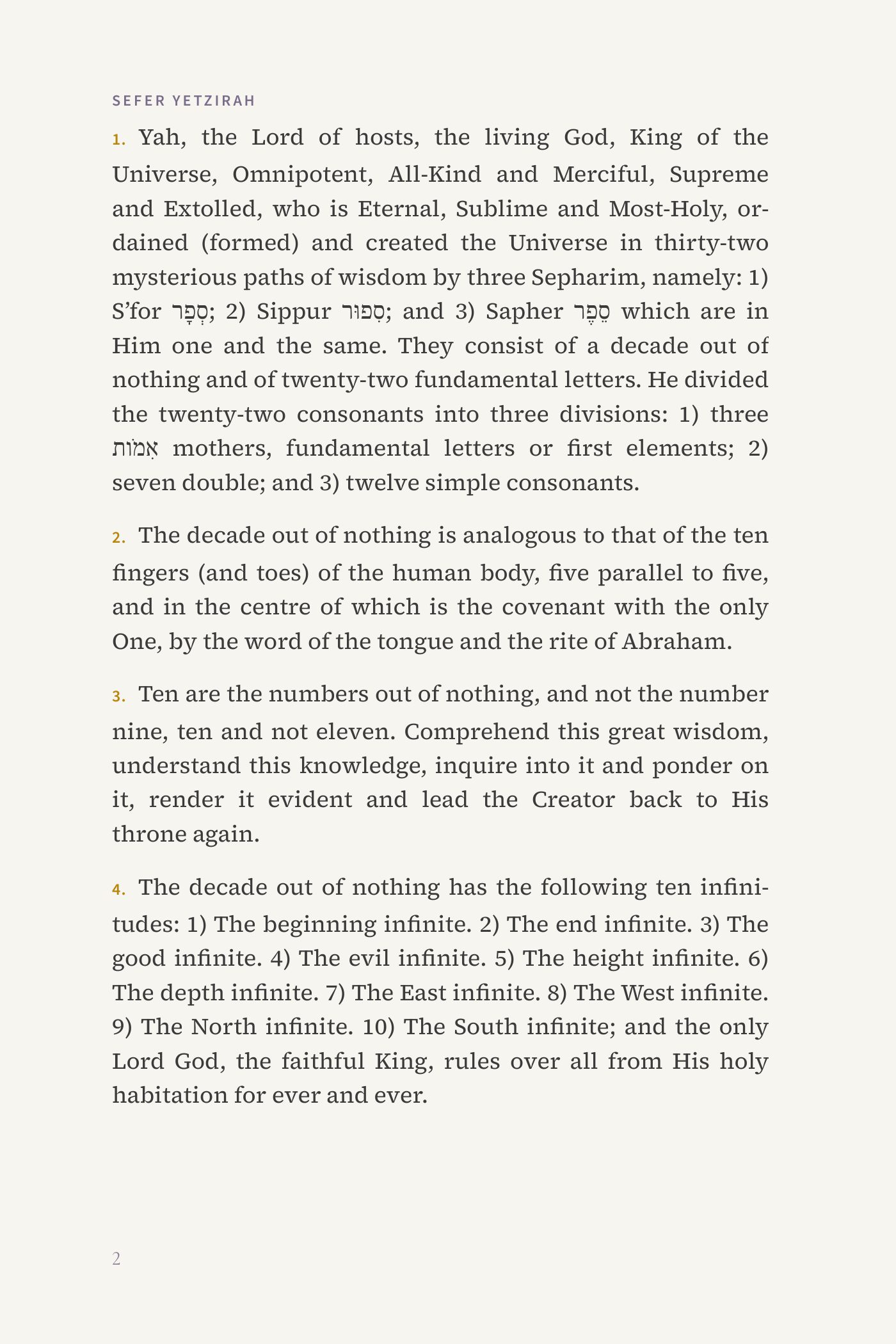
Sefer Yetzirah, the Book of Formation, is the earliest text that later Kabbalists treated as foundational: a very short text, some three thousand words, that describes the world as formed through ten numbers and the twenty-two letters of the Hebrew alphabet. This page carries the complete text in English, free of charge, in Isidor Kalisch's public-domain translation of 1877, newly set by Global Spiritual Studies as an 86-page book measuring six inches by nine, with an introduction, a pause for study after each of the six chapters, four appendices, a glossary, a historical timeline and a further-reading list. Below it you will also find the canonical table of the twenty-two letters and every correspondence the text itself assigns to them, section by section.
On this page
The free edition
 Request the free edition · sent to your inbox
86 pages, six by nine, complete and unabridged · opens a short form, and the PDF arrives by email.
The edition reproduces Kalisch's translation entire: all six chapters, all sixty-five sections, in his own numbering, with nothing omitted and nothing inserted. Everything written for this printing · the introduction, the note on the translation, the bridge chapter, the pauses, the appendices, the glossary and the timeline · is set apart from the translation in a different face, so that the reader can always see where the ancient text ends and a modern editor begins. Five diagrams were drawn as original vector artwork for the book. The typography uses Cormorant Garamond, Source Serif 4 and Source Sans 3, with Frank Ruhl Libre for Hebrew.
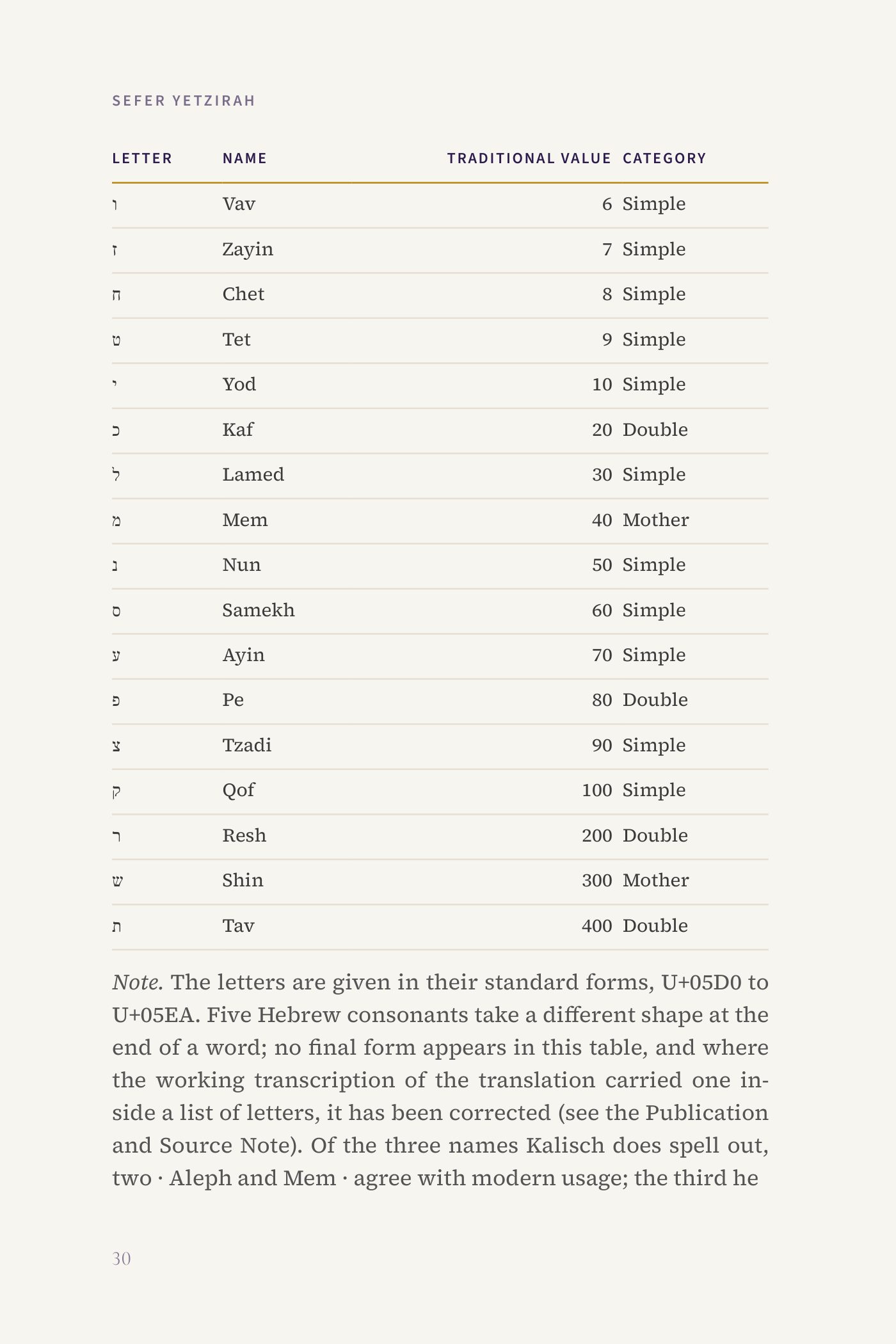
The 22 Hebrew letters in Sefer Yetzirah · complete correspondence table
Sefer Yetzirah divides the twenty-two consonants of the Hebrew alphabet into three groups: three mothers (Aleph, Mem, Shin), seven doubles (Bet, Gimel, Dalet, Kaf, Pe, Resh, Tav) and twelve simples (the remaining twelve). That division is the text's own, at I.1 and II.1. Each letter is then set over something in the world, something in the year and something in the human body · an element for the mothers, a planet for the doubles, a sign of the zodiac for the simples.
The table below gives every one of those assignments exactly as Kalisch's 1877 translation gives them, with the chapter and section number for each row so that you can check it against the text. Nothing has been supplied from any other system. Where the text says nothing, the cell is marked with a dash rather than filled in from a later source.
| Letter | Name | Kalisch's spelling | Value | Class | Kalisch's assignment | In the body | In the year | Section |
|---|---|---|---|---|---|---|---|---|
| א | Aleph | Aleph | 1 | Mother | Air · the air in the world | The breast | Moistness | III.6 |
| ב | Bet | not given | 2 | Double | The moon | Right eye | First day | IV.8 |
| ג | Gimel | not given | 3 | Double | Mars | Right ear | Second day | IV.9 |
| ד | Dalet | not given | 4 | Double | The sun | Right nostril | Third day | IV.10 |
| ה | He | not given | 5 | Simple | Aries, the Ram | Right foot | Nisan | V.5 |
| ו | Vav | not given | 6 | Simple | Taurus, the Bull | Right kidney | Iyar | V.6 |
| ז | Zayin | not given | 7 | Simple | Gemini, the Twins | Left foot | Sivan | V.7 |
| ח | Chet | not given | 8 | Simple | Cancer, the Crab | Right hand | Tamus | V.8 |
| ט | Tet | not given | 9 | Simple | Leo, the Lion | Left kidney | Ab | V.9 |
| י | Yod | not given | 10 | Simple | Virgo, the Virgin | Left hand | Elul | V.10 |
| כ | Kaf | not given | 20 | Double | Venus | Left eye | Fourth day | IV.11 |
| ל | Lamed | not given | 30 | Simple | Libra, the Balance | Gall | Tishri | V.11 |
| מ | Mem | Mem | 40 | Mother | Water · the earth, including land and sea | The belly | Coldness | III.7 |
| נ | Nun | not given | 50 | Simple | Scorpio, the Scorpion | Small intestines | Marcheshvan | V.12 |
| ס | Samekh | not given | 60 | Simple | Sagittarius, the Archer | Stomach | Kislev | V.13 |
| ע | Ayin | not given | 70 | Simple | Capricornus, the Goat | Liver | Teves | V.14 |
| פ | Pe | not given | 80 | Double | Mercury | Left ear | Fifth day | IV.12 |
| צ | Tzadi | not given | 90 | Simple | Aquarius, the Water-man | Esophagus | Schwat | V.15 |
| ק | Qof | not given | 100 | Simple | Pisces, the Fishes | Milt, that is the spleen | Adar | V.16 |
| ר | Resh | not given | 200 | Double | Saturn | Left nostril | Sixth day | IV.13 |
| ש | Shin | Sheen | 300 | Mother | Fire · heaven in the world | The head | Heat | III.8 |
| ת | Tav | not given | 400 | Double | Jupiter | The mouth | Seventh day | IV.14 |
Notes on the blank cells and the text's own disagreements
- Kalisch's spelling. Kalisch spells out only three letter names in the entire translation · Aleph, Mem and Sheen, the three mothers. The other nineteen he prints as bare Hebrew characters, which is why those cells are dashed. The names in the second column are therefore editorial throughout, except for those three. "Sheen" is his spelling of what is now usually written Shin.
- Numerical value. The text assigns no number to any letter and performs no calculation with them. The values above belong to the ordinary Hebrew system of letter-numerals, in use long before this book and long after, and are given because readers meet them everywhere else in Kabbalistic literature. They are not part of the text's argument.
- Directions. No letter is given a compass direction of its own. The twelve oblique points are listed as a group at V.2, and the ten "infinitudes" of chapter one include six directions, but neither list is matched letter by letter.
- The mothers disagree with themselves. III.5 says the head was created from fire, the breast from water and the body from air. Two sections later the per-letter assignments pair air with the breast (III.6) and water with the belly (III.7). Only fire and the head agree across both passages. The table follows III.6 to III.8, because those are the sections that assign letters; a reader working from III.5 would draw it differently. Kalisch does not reconcile them, and neither do we.
- The doubles disagree with themselves. IV.7 lists the seven planets in the descending order of ancient astronomy · Saturn, Jupiter, Mars, Sun, Venus, Mercury, Moon · but the per-letter assignments at IV.8 to IV.14 run in a quite different order. The table follows IV.8 to IV.14, the sections that do the assigning.
- The year is not four seasons. For the three mothers the "year" is three qualities, heat, coldness and moistness (III.4). No spring, summer, autumn or winter appears anywhere in the book.
Kalisch and the Golden Dawn · two different systems
Readers who come to the Hebrew letters by way of the Hermetic Order of the Golden Dawn and its descendants will find a different planet attached to each of the seven doubles. The two lists below are set side by side so the difference is visible at a glance. They are not rival readings of one tradition; they are a nineteenth-century translation of an ancient text on the one hand, and a nineteenth-century magical system with its own internal logic on the other.
| Double letter | Kalisch 1877 · IV.8 to IV.14 | Golden Dawn attribution |
|---|---|---|
| ב Bet | The moon | Mercury |
| ג Gimel | Mars | Moon |
| ד Dalet | The sun | Venus |
| כ Kaf | Venus | Jupiter |
| פ Pe | Mercury | Mars |
| ר Resh | Saturn | Sun |
| ת Tav | Jupiter | Saturn |
Not one of the seven agrees. Any chart showing Bet as Mercury or Resh as the Sun is following the Golden Dawn, not this text. Both systems are worth knowing; they should not be quietly merged. Resh is a double letter in Sefer Yetzirah, and this edition does not "correct" it.
What is in the edition
The book runs to 86 pages at six inches by nine. Beyond the translation itself it contains:
- A publication and source note · what is reproduced, what is not, and every change made to the working transcription.
- Before You Begin and an Introduction · what kind of book this is, and how it came to sit at the head of the Kabbalistic tradition.
- On This Translation · who Isidor Kalisch was, what his 1877 English does and does not do, and which modern translations to read next.
- From Sefer Yetzirah to the Living Tree of Life · a bridge chapter on how a text with no diagram in it became the diagram everybody knows.
- Six Pauses for Study · one after each chapter, a sentence or two of framing and three to five questions. They have no answers at the back.
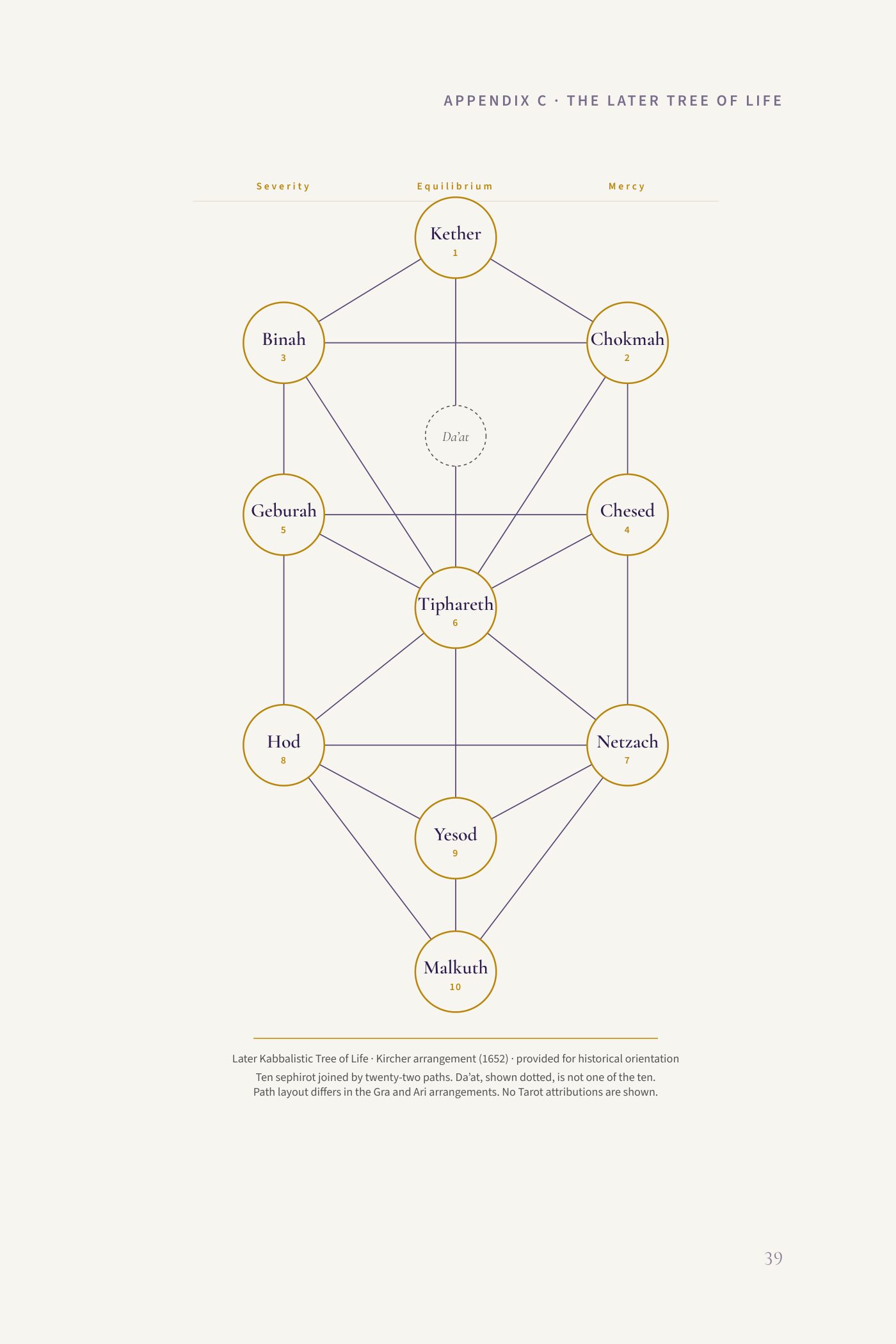
- Four appendices · A, the twenty-two letters; B, the correspondences given in the text, with the inconsistencies shown rather than resolved; C, the later Tree of Life; D, a note on the "Thirty-Two Paths of Wisdom" supplement, which is not part of this text.
- A glossary, a historical timeline and a further-reading list, followed by a colophon.
About this translation
Isidor Kalisch (1816 to 1886) was a rabbi, scholar and journalist, born in the Prussian province of Posen, educated in Germany and settled in the United States from 1849. He served congregations across the American Midwest and East and was among the early figures of American Reform Judaism. He was not an occultist. His translation, published in New York in 1877 under the title Sepher Yezirah: A Book on Creation; or, The Jewish Metaphysics of Remote Antiquity, was the work of a philologist arguing for the antiquity and philosophical dignity of a text his contemporaries were inclined to dismiss.
He translated from the Hebrew edition of Johann Friedrich von Meyer, published at Leipzig in 1830, which he names in his preface. Meyer's text is generally understood to follow the family now called the Short Recension, though Kalisch himself uses no recension terminology · the concept post-dates him · and neither he nor Meyer states the manuscript basis.
What was and was not modernised. His English is of 1877 and reads like it, and it has been left as he wrote it, inconsistencies included: "producibility" for a quality of Dalet, "milt" for the spleen, "Schevat" at V.4 against "Schwat" at V.15. One feature will surprise readers who arrive with later vocabulary in hand: Kalisch never writes "Sephiroth" in the translation, and never writes "belimah". Where the Hebrew has sefirot belimah he reaches for a fresh English paraphrase almost every time · "a decade out of nothing", "Ten are the numbers out of nothing", "the ten categories of existence out of nothing". His restlessness is itself informative.
Only the translation is reproduced. Kalisch's preface, his forty-four explanatory notes, his glossary and his Hebrew text are not, and their exclusion was editorial, not a matter of rights. The working transcription was proofed against two scans of the 1877 printing, and nine changes were made · four corrections where a superscript footnote numeral had been absorbed into the text as a word, four Hebrew letter-group strings normalised to standalone letters, and one list restored to numerical order. Every one of them is itemised in the editorial record for this edition, published openly alongside the proofed source text and the sources-and-licences note.
One more editorial choice, flagged as such: Kalisch called the book A Book on Creation. This edition is titled The Book of Formation, because yetzirah is conventionally rendered "formation" today.
How to read it
This is a short book. You could read it through in an hour. Almost nobody does. Sefer Yetzirah does not explain itself; it states. There are no parables here, no narrative, very little that we would recognise as instruction, and whole centuries of commentary exist because readers found the text had left them holding something they could not put down and could not quite open.
So a suggestion, offered lightly. Read one chapter, then stop. That is what the six Pauses are for · not comprehension checks, and there are no answers at the back, but a page of questions that stay close to what the chapter in front of you actually says. Let the difficult parts stay difficult. When Kalisch writes that the ten "run by His order like a whirlwind", the strangeness is not a flaw in the translation. It is what the book is doing.
Go further
For the text in its historical setting · its dating, its recensions, the ten and the twenty-two, and how it became the Tree of Life · see our complete guide to Sefer Yetzirah, the Book of Formation. Three shorter pieces go deeper on particular questions: the thirty-two paths of wisdom, and what the later supplement of that name added; the three mothers, seven doubles and twelve simples; and which translation of Sefer Yetzirah to read, from Kalisch and Westcott to Kaplan and Hayman.
If you are working on the Tree of Life itself rather than on this text, two free reference charts sit alongside this edition: the Kabbalah Tree of Life chart of the ten Sephirot and the chart of the twenty-two paths, which places the Hebrew letters on the Tree in the later manner.
To study the Tree as a practice rather than only as a text, Evelynne Joffe, Director of the Institute of Esoteric Studies in Melbourne, has taught it for more than thirty years, and approaches Kabbalah as a way of personal development and self-realization rather than as religious instruction. Her course on the ten stations is Living the Tree of Life · The Sephirot, which states that it is based on Sefer Yetzirah; her course on the twenty-two connecting paths is Living the Tree of Life · The Paths. Hers is one contemporary approach among many, a late and clearly identified layer resting on centuries of development, and not a recovery of what this text originally meant.
The complete Book of Formation, 86 pages · yours to keep, to print, and to return to.
Sources & Tradition
The text reproduced is the English translation from Sepher Yezirah: A Book on Creation; or, The Jewish Metaphysics of Remote Antiquity, translated by Isidor Kalisch, New York, 1877 · six chapters, sixty-five sections, 3,268 words, in Kalisch's own numbering. Kalisch's copy-text was the Hebrew edition of Johann Friedrich von Meyer, Leipzig 1830. The translation is in the public domain in the United States, having been published in 1877, and in life-plus-seventy jurisdictions, Kalisch having died in 1886; Sefaria carries the same translation labelled public domain, which corroborates that status independently.
The text was set from the Internet Sacred Text Archive transcription, proofed section by section against two archive.org scans of the 1877 printing. No text from any modern translation appears in the edition. Every correspondence in the table above is cited to Kalisch's chapter and section. Historical statements in the editorial matter rest on the standard scholarship listed in the book's further-reading pages, including Scholem, Idel, Dan and Hayman's 2004 critical edition. The proofed source text, the full list of changes, and the sources-and-licences note are published at the editorial record for this edition.
Frequently Asked Questions
Is the Sefer Yetzirah PDF really free?
Yes. The complete 86-page edition is free. Ask for it using the button on this page and it arrives by email at no charge, with no payment details required. The translation it reproduces is in the public domain, and Global Spiritual Studies set and produced the edition as a free resource for students of Kabbalah.
Is this the complete text of Sefer Yetzirah?
Yes. All six chapters and all sixty-five sections of Kalisch's translation are printed, in his own numbering, unabridged and with nothing inserted into them. What is not reproduced is Kalisch's own apparatus around the translation: his preface, his forty-four explanatory notes, his glossary and the facing Hebrew text. Those were left out editorially, not for any question of rights, and they can be read in the scanned original.
Which translation of Sefer Yetzirah is this?
Isidor Kalisch's English translation, published in New York in 1877 as Sepher Yezirah: A Book on Creation. Kalisch translated from Johann Friedrich von Meyer's Hebrew edition of Leipzig 1830, which belongs to the family now called the Short Recension. His English is of its century and has not been modernised. Readers who want a translation shaped by modern textual scholarship should go on to A. Peter Hayman's critical edition of 2004 or Aryeh Kaplan's widely used translation and commentary; the edition says so plainly and lists both.
Can I print the free Sefer Yetzirah edition?
Yes. The book is set for print at six inches by nine, which is a standard trim, with the margins and running heads of a real book rather than a screen document. Print it whole, or print the appendices alone as a reference. The underlying translation is public domain, so nothing stops you making a copy for your own study or for a study group.
Is Sefer Yetzirah a religious text?
It is a foundational text of Jewish mysticism, and Kabbalah is a Jewish mystical tradition, so the book comes out of a religious world and speaks of God throughout. But it is not liturgy and not law, and it asks nothing of the reader in the way of belief or observance. It is read today by Jewish students of Kabbalah, by historians, and by people working with the Tree of Life as a psychological map. This edition takes no position on which of those readings is the right one.
How is this different from the Tree of Life chart?
They cover different things. The Tree of Life chart sets out the ten named Sephirot of the later Kabbalah, with their Hebrew names, pillars, planets and Tarot correspondences, in the arrangement that reached us through medieval Kabbalah and the Golden Dawn. Sefer Yetzirah never names a single Sephirah, draws no diagram, and knows nothing of pillars, four worlds or Tarot. It counts ten and describes twenty-two letters, and the diagram came centuries afterwards. Read the chart to learn the Tree; read this edition to meet the text the Tree was eventually built on.
Is Sefer Yetzirah the same as the Zohar?
No. They are separate books, centuries apart and quite different in character. Sefer Yetzirah is the older and far shorter of the two, roughly three thousand words, terse and almost mathematical, concerned with the ten and the twenty-two letters. The Zohar is a vast mystical commentary on the Torah in Aramaic, associated with thirteenth-century Spain, narrative and expansive where Sefer Yetzirah is bare. Both are central to Kabbalah; neither is a version of the other.
What are the three mothers, seven doubles and twelve simples?
They are the text's own division of the twenty-two Hebrew letters. The three mothers are Aleph, Mem and Shin, set over air, water and fire. The seven doubles are Bet, Gimel, Dalet, Kaf, Pe, Resh and Tav, each given a planet, a day and an opening of the head. The twelve simples are the remaining twelve letters, each given a sign of the zodiac, a month of the Hebrew year and an organ of the body. The complete table on this page gives every one of those assignments with the section number it comes from.
A complete text, freely given · read it slowly, and more than once.