How to Read Tarot Cards
A Complete Beginner's Guide
Tarot reading is the practice of drawing and interpreting cards from a 78-card Tarot deck to gain insight into questions about life, relationships, and personal growth. This guide covers everything a beginner needs to know, from choosing a deck to performing your first reading.
You are holding a deck of Tarot cards for the first time. Perhaps someone gave it to you. Perhaps you bought it on impulse and it has been sitting on your shelf for weeks, waiting. You turn the cards over one by one, drawn to the images but unsure what to do with them. Where do you even begin?
Right here.
Learning to read Tarot is not about memorizing seventy-eight definitions or developing supernatural powers. It is about cultivating a relationship with a set of images that have been helping people reflect on their lives for over five hundred years. You already possess the most important tool you need: your own capacity for observation and honest reflection. The cards simply give that capacity a language.
This guide will walk you through everything you need to know to begin reading Tarot with confidence. We will explore the structure of the deck, introduce you to the cards themselves, and guide you through your very first reading. There is no test at the end, no right or wrong way to proceed. There is only the invitation to begin.
How do you read Tarot cards? Frame an open-ended question, shuffle the deck while holding it in mind, then draw one to three cards and interpret their imagery and traditional meanings in relation to your question. Here are the five steps every beginner can follow:
- Ask a clear, open-ended question.
- Shuffle the deck while holding your question in mind.
- Draw one to three cards and lay them out.
- Look at each card's imagery first and note your impressions.
- Interpret by layering in traditional meanings and reading the cards as one connected story.
What Is Tarot?
Tarot is a system of seventy-eight illustrated cards used for reflection, self-discovery, and guidance. While its origins are the subject of rich scholarly debate, we know that Tarot began as a card game in fifteenth-century Italy before evolving into the contemplative and divinatory practice we know today. Over the centuries, artists, mystics, psychologists, and spiritual seekers have all found meaning in its images.
A standard Tarot deck is divided into two main sections:
The Major Arcana consists of twenty-two cards numbered 0 through 21. These cards depict archetypal figures and universal experiences: The Fool setting out on a journey, The Hermit seeking solitude, The Tower crumbling under the weight of false structures. When Major Arcana cards appear in a reading, they tend to point toward significant life themes, deep psychological patterns, and moments of genuine transformation.
The Minor Arcana consists of fifty-six cards divided into four suits. These cards address the texture of everyday life: your relationships, your work, your inner emotional world, and the practical decisions you face each day.
Together, the Major and Minor Arcana form a complete map of human experience. Learning to read Tarot is learning to navigate that map.
The 78 Tarot Cards at a Glance
A Tarot deck contains 78 cards in three groups: the 22 Major Arcana, the 56 Minor Arcana (divided into four suits), and the 16 court cards that sit within those suits. This table shows the structure of the deck at a glance.
| Group | Cards | Structure | What It Governs |
|---|---|---|---|
| Major Arcana | 22 | Numbered 0 to XXI | Life's big archetypal lessons and turning points |
| Minor Arcana | 56 | Four suits, Ace to King | The texture of everyday life |
| Wands | 14 | Fire | Passion, creativity, ambition, willpower |
| Cups | 14 | Water | Emotions, relationships, intuition |
| Swords | 14 | Air | Thought, communication, conflict, clarity |
| Pentacles | 14 | Earth | Work, money, health, the material world |
| Court Cards | 16 | Page, Knight, Queen, King | People, personas, and ways of engaging with a suit |
The 16 court cards are part of the 56 Minor Arcana (four per suit) and are listed separately here because beginners often treat them as their own group.
Choosing Your First Deck
If you do not yet own a Tarot deck, the most widely recommended choice for beginners is the Rider-Waite-Smith (RWS) deck, first published in 1909. Illustrated by Pamela Colman Smith under the direction of Arthur Edward Waite, this deck established the visual language that most modern Tarot decks draw from.
There are good reasons why the RWS remains the teaching standard. Every card tells a story: unlike earlier decks where the Minor Arcana showed only patterned arrangements of suit symbols, the RWS gives each of the seventy-eight cards a unique illustrated scene. Most Tarot books and courses reference it, giving you a shared visual vocabulary. And it is widely available and affordable.
That said, the best deck is ultimately one whose images speak to you. Many beautiful modern decks, such as the DruidCraft Tarot, the Modern Witch Tarot, or the Light Seer's Tarot, maintain the RWS structure while offering fresh artistic perspectives. If a particular deck catches your eye and follows the standard seventy-eight-card structure, it will serve you well.
Understanding the Major Arcana
The twenty-two Major Arcana cards form the backbone of the Tarot. They represent the great archetypal forces that shape our lives: love, death, justice, transformation, wholeness.
One beautiful way to understand these cards is through the concept of The Fool's Journey. Card 0, The Fool, represents each of us at the beginning of a new chapter. As The Fool moves through the numbered cards, from The Magician (1) through The World (21), they encounter every essential human experience: the nurturing of The Empress, the structure of The Emperor, the crisis of The Tower, the renewal of The Star.
This is not a journey you take once. It is a pattern you live through again and again, in relationships, in careers, in creative projects, in spiritual growth. (In the Western esoteric tradition, these twenty-two cards also map onto the Kabbalah Tree of Life, connecting Tarot to an ancient system of self-knowledge.) Here are four Major Arcana cards to begin getting to know:
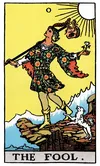
The Fool stands at the edge of a cliff, face turned toward the sky, a small dog at their heels. They carry a simple pack and a white rose. Everything about this image says: beginning.
In a reading, The Fool often signals a leap of faith, a fresh start, or the willingness to embrace the unknown. There is innocence here, but not naivety. The Fool chooses to step forward despite not knowing what lies ahead.
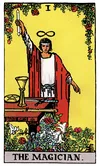
The Magician stands before a table bearing the symbols of all four suits: a cup, a pentacle, a sword, and a wand. One hand points to the sky, the other to the earth. This is the card of conscious creation: taking raw potential and channeling it into action.
The Magician reminds us that we have the tools we need. The question is whether we will use them with focus and intention.
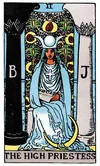
The High Priestess sits between two pillars, a crescent moon at her feet and a scroll in her lap. She represents receptive wisdom, intuition, the knowledge that comes from stillness rather than effort.
For Tarot beginners, she is a particularly important teacher. She reminds us that reading Tarot is not about forcing interpretations but about allowing meaning to surface.
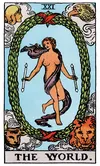
The final card of the Major Arcana shows a dancing figure surrounded by a laurel wreath, with the four creatures of the evangelists at the corners. This is completion, integration, wholeness.
The journey that began with The Fool's step into the unknown arrives here: not at a static endpoint, but at a moment of celebration before the cycle begins again.
To explore how these archetypes connect to your own life in a deeply personal way, Mary K. Greer's course Archetypal Tarot: Discover Your Birth and Year Cards offers a wonderful entry point. By calculating your personal birth and year cards, you discover which Major Arcana energies are most alive in your own story.
Understanding the Minor Arcana
While the Major Arcana speaks to life's great themes, the Minor Arcana addresses how those themes play out in daily experience. The fifty-six cards are divided into four suits, each associated with an element and a domain of life:
Passion, creativity, ambition, and the drive to pursue what matters. When Wands appear, the question concerns your creative energy and sense of purpose.
Emotions, relationships, intuition, and the full spectrum of human feeling. Cups invite you to attend to what you feel, not just what you think.
Thought, communication, decisions, and the sometimes painful process of seeing things clearly. Clarity, even when uncomfortable, is a gift.
Material life, finances, career, health, and the slow, patient work of building something that endures. The spiritual and material are not separate.
Within each suit, cards are numbered Ace through Ten, tracing an arc from the seed of potential (the Ace) through various stages of development to completion (the Ten). The court cards, Page, Knight, Queen, and King, can represent people in your life, aspects of your own personality, or particular ways of engaging with the suit's energy.
For a card-by-card exploration of all four suits, see our complete Minor Arcana guide, where we explore each of the fifty-six cards in detail.
Court cards are often the trickiest for beginners to interpret. If you find yourself drawn to deepening your understanding of these figures, Linda Marson's course Cracking the Court Card Code offers a clear and practical framework.
How to Read Tarot Cards: A Step-by-Step Guide
You have your deck. You have a basic understanding of its structure. Now it is time to read.
- Create a Quiet SpaceYou do not need candles, incense, or a special altar. What you do need is a few minutes of relative quiet and a surface to lay your cards on. The goal is to move from the pace of your busy mind into a more attentive, receptive state.
- Formulate a QuestionTarot works best with genuine, open-ended questions. Instead of "Will I get the job?" try "What do I need to understand about this career opportunity?" Open questions produce richer readings.
- Shuffle the CardsThere is no single correct way to shuffle. Riffle, swirl, cut and reassemble. What matters is that you handle the cards while holding your question in mind. Shuffle until you feel ready to stop. Trust that feeling.
- Draw Your CardsFor your first reading, draw one to three cards. Pull from the top, fan the cards face-down and choose, or cut the deck. There is no wrong method.
- Look Before You ThinkThis is the most important step. Before reaching for a guidebook, simply look at the card. What do you notice first? What is the figure doing? What colors stand out? Does anything remind you of your own life? Your first impressions are often the most valuable part of a reading.
- Layer in Traditional MeaningsAfter spending time with your own observations, consult a Tarot reference. Notice where your intuitive impressions align with the established meanings, and where they diverge. Both are valuable.
- Reflect and RecordConsider keeping a Tarot journal. After each reading, note the question, the cards, your impressions, and any meanings that resonated. Over weeks and months, patterns will emerge and your confidence will grow naturally.
Your First Tarot Spread: The Three-Card Draw
A "spread" is simply a pattern for laying out cards, where each position carries a specific meaning. The three-card draw is the most accessible spread for beginners, and many experienced readers return to it throughout their lives for its elegance and clarity.
Shuffle your deck while holding a question in mind. Draw three cards and lay them face-up in a row from left to right:

Creative stagnation. A figure sits beneath a tree, arms crossed, ignoring what is offered. What patterns from the past are still shaping the present?
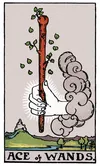
Fresh creative energy arriving. A hand from a cloud holds a living, budding wand. The spark is here. Where are you right now?
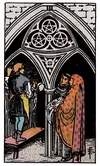
Collaboration and shared craft. Three figures work together inside a cathedral. Where are things heading?
Notice how the three cards tell a story when read in sequence: from stagnation to spark to collaboration. This is the heart of Tarot reading. Not isolated card definitions, but the narrative that emerges between the cards.
Beyond the Basics: Spreads for Growing Readers
The Daily Single Card. Many experienced readers begin each day by drawing a single card as a point of reflection. This is one of the most effective ways to deepen your relationship with the deck over time.
The Celtic Cross. This classic ten-card spread offers a comprehensive view of a situation, including hopes, fears, external influences, and likely outcome. Well worth learning once you feel grounded in the basics.
Relationship Spreads. Dedicated spreads for exploring dynamics between two people can bring remarkable clarity to interpersonal situations.
Freeform Reading. Some experienced readers move beyond fixed spreads entirely, drawing cards in a fluid, conversational style. Steve Hounsome explores this approach in his course Reading Tarot without Spreads.
For a thoughtful exploration of when structure helps and when freedom serves better, Linda Marson's course Layout or No Layout examines this question with the nuance it deserves.
The Chakra Spread. A seven-card layout that reads the body's energy system through Tarot. Each position corresponds to a chakra, revealing what each energy centre is holding. A powerful tool for readers who want to bring embodied awareness into their practice.

Featured Course
The Energy Body in Tarot
A Guided Practice Through the Seven Chakras · with Philip Carr-Gomm & Steve Hounsome
Nine lessons exploring the hidden energy map in every Tarot deck. Guided meditations with original sound healing music, practical exercises for each chakra, and a transformative journey from root to crown.
- 12 video lessons
- 8 guided meditations
- 12 PDF handouts
- 7 bonus meditations
- Sound healing music
- Community forum
- Lifetime access
- Final quiz
- Certificate of completion
Common Mistakes Beginners Make
Trying to Memorize All Seventy-Eight Cards Before Reading
It is tempting to think you need to know every card's meaning before you can do a reading. You do not. Start reading immediately, even if you need to consult a guidebook for every card. The meanings will take root through practice, not through rote memorization. A card you struggle to interpret in one reading will become an old friend after you encounter it in ten different contexts.
Fearing "Negative" Cards
The Death card does not mean someone is going to die. The Tower does not mean your life is about to collapse. Tarot's more intense images represent necessary processes: endings that make way for beginnings, structures that must fall so something more authentic can be built. Learn to approach these cards with curiosity rather than fear. They often mark the most important turning points in a reading.
Ignoring Your Own Responses
If a card gives you a strong feeling, pay attention to that feeling, even if it does not match what the guidebook says. Tarot is a conversation between you and the cards. Your lived experience, your associations, and your emotional responses are not noise to be filtered out. They are essential data.
Asking the Same Question Repeatedly
When you do not like the answer a reading gives you, the temptation is to shuffle and try again. Resist this. Sit with the reading you received. The discomfort it provokes may be precisely the message you need.
From your first card draw to professional-level readings, our library of Tarot courses with world-renowned instructors will meet you wherever you are on your journey.
Browse Tarot CoursesWhere to Begin Your Study
Reading this guide is a genuine first step. The next step is picking up your deck and drawing a card. Then another. Then another. The cards will teach you if you let them. And if you'd like to explore how Tarot connects to your energy body, our free Tarot chakra quiz is a fun three-minute starting point.
When you are ready for structured guidance, here are the courses we recommend:
The perfect companion for new readers. Built around the Major Arcana, TarotNav teaches you to use Tarot as a practical navigation tool for real-life questions.
A uniquely personal entry point. Calculate your birth and year cards to discover which archetypes are most active in your life.
Makes the sixteen court cards accessible and practical. The natural next step once you are comfortable with the basics.
Twelve distinct methods for interpreting reversed cards. Adds depth and nuance to every reading you give.
And if you study within a Tarot circle, guild, or association, many organizations now bring structured courses to their members as a group learning benefit · a lovely way to learn alongside others.
The Tarot has been a companion to seekers, artists, and thinkers for centuries. It has survived because it works: not as fortune-telling, but as a mirror. It reflects what you already know and helps you see what you have not yet been willing to look at. All it asks in return is your willingness to sit down, draw a card, and pay attention.
Your deck is waiting.
Sources & Tradition
The approach in this guide follows the Rider-Waite-Smith tradition, the teaching standard for modern Tarot, drawn from A.E. Waite's The Pictorial Key to the Tarot (1910) and the illustrated iconography of Pamela Colman Smith, whose fully-scened Minor Arcana transformed how the cards are read. The elemental attributions of the four suits follow the Hermetic Order of the Golden Dawn, and modern interpretive nuance draws on Rachel Pollack's Seventy-Eight Degrees of Wisdom (1980). These methods are taught at Global Spiritual Studies by Mary K. Greer, Linda Marson, and our faculty of Tarot instructors.
Frequently Asked Questions
How do you read Tarot cards?
To read Tarot cards, frame an open-ended question, shuffle the deck while holding it in mind, then draw one to three cards. Look at each card's imagery and note your first impressions before consulting traditional meanings, then read the cards together as one connected story rather than as isolated definitions. A simple one to three card draw is the best place for a beginner to start.
How do you do a 3 card Tarot reading?
A three-card Tarot reading uses three cards laid left to right, most often read as past, present, and future. Shuffle while holding your question, draw three cards, and interpret them in sequence so they tell a single story: the first card shows what led here, the second where you are now, and the third where things are heading.
What do the 78 Tarot cards mean?
The 78 Tarot cards divide into 22 Major Arcana cards, which represent life's big archetypal themes and turning points, and 56 Minor Arcana cards across four suits (Wands for fire, Cups for water, Swords for air, and Pentacles for earth), which describe everyday matters of creativity, emotion, thought, and material life. Sixteen of the Minor Arcana are court cards representing people and personas.
Can you read Tarot cards for yourself?
Absolutely. Self-reading is one of the most valuable and common applications of Tarot. The key is to approach your own readings with the same openness and honesty you would bring to reading for someone else. Be willing to see what the cards actually show rather than what you want them to show.
Do you need psychic ability to read Tarot cards?
No. While some readers describe intuitive impressions during readings, Tarot does not require any special abilities. It requires attentiveness, empathy, a willingness to engage with symbolic imagery, and practice. These are skills anyone can develop.
How long does it take to learn Tarot?
You can begin giving meaningful readings within your first week of study. Developing fluency with all seventy-eight cards typically takes several months of regular practice. Deepening your understanding of the cards is a lifelong process, and most experienced readers will tell you they are still learning after decades.
Do Tarot cards have to be gifted to you?
This is a popular myth with no historical basis. You are absolutely welcome to buy your own deck. In fact, choosing your own deck allows you to select one whose imagery resonates with you personally, which will make learning easier and more enjoyable.
What is the difference between Tarot and oracle cards?
Tarot decks follow a specific structure: seventy-eight cards divided into Major Arcana (22 cards) and Minor Arcana (56 cards across four suits). Oracle decks have no fixed structure and can contain any number of cards with any theme. Both are valuable tools. Tarot's established structure gives it a particular depth and internal coherence that rewards sustained study.
Are reversed Tarot cards important?
Reversed cards are an optional layer of interpretation. Some readers use them, others do not. If you are just starting out, it is perfectly fine to read all cards upright and add reversals later as your confidence grows. When you are ready to explore this dimension, Mary K. Greer's course on Reading Tarot Reversals is the definitive resource.
Is there a connection between Tarot and symbolism in art and culture?
Very much so. Tarot's imagery draws from and contributes to a deep well of Western symbolic traditions, including alchemy, astrology, Kabbalah, and Renaissance art. For a fascinating example, see our article on Sexual Symbolism and Meaning in Tarot.