Learn Dream Interpretation
Everything we teach about reading your dreams, gathered in one place · what the symbols mean, why some dreams repeat, how to keep a journal that works, and what kind of dreamer you are
☾ ✦ ☿ ✦ ☾
Dream interpretation is the practice of reading the images, feelings and stories that arise in sleep as meaningful communication from the subconscious mind rather than as random noise. It works by pairing what a symbol has traditionally meant with what that same symbol means in the dreamer’s own life, on the understanding that a dream is showing the dreamer something waking awareness has not yet taken in.
This page is the doorway to everything we publish on dreams. Global Spiritual Studies has taught dreamwork online since 2014, and dream interpretation here is taught by Victoria Belue · founder of AstroLogic Magazine, thirty years a student of dreams and Tarot, twenty of them sitting with clients and their dreams. What follows is a map: the questions people most often arrive with, the method we teach for answering them, the four ways people tend to dream, and the full library of free guides and printable references beneath it all.
Start Here · Find Your Question
Most people arrive at dream interpretation carrying one specific question. Find yours in the left-hand column and begin where it points.
| If You Are Asking | Where To Begin | What You Will Find |
|---|---|---|
| What does this symbol mean? | The Dream Symbols Chart | Sixty-five common dream images in ten themes, each with its traditional meaning and its psychological reading. Free to print. |
| How do I actually interpret a dream? | How To Interpret Your Dreams | The practical methods set out in full · symbols, archetypes and the language the unconscious prefers. |
| Why do I keep having the same dream? | Recurring Dreams | Why a dream returns, the four things repetition is usually processing, and what makes it stop. |
| Did my dream predict something? | Premonition Dreams | The diagnostic that separates an ordinary dream from a premonition or a visitation · and why you usually already know. |
| How do I remember my dreams? | How To Keep A Dream Journal | The intention that improves recall, what to record on waking, and how to build your own dictionary of symbols. |
| Can I be aware inside a dream? | Lucid Dreaming For Beginners | Waking up inside the dream · what the liminal state is, and how to move through it with intention rather than fear. |
| What kind of dreamer am I? | The Four Types Of Dreamers | The four ways people receive dream messages, and what each type should pay attention to first. |
| How do dreams relate to Tarot? | Dreams And Tarot | The Dream-Tarot Bridge · interpreting a dream, then pulling cards to illuminate what it left in shadow. |
| What about the parts I would rather not see? | Dreams, Shadow Work & The Inner Journey | The deeper Jungian work of meeting the disowned parts of yourself that a dream brings forward. |
Learn It Properly · The Language of Dreams
Everything on this page is free, and it will take you a long way. If you would rather be taught the whole method in order, by someone who has spent thirty years doing it, this is the course we built with Victoria Belue.
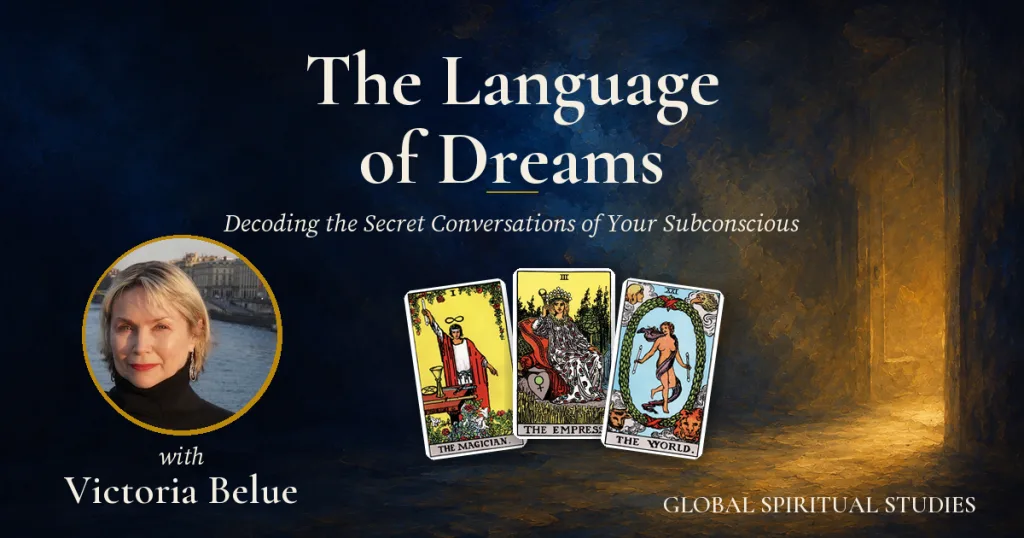
Featured Course
The Language of Dreams
Decoding the Secret Conversations of Your Subconscious · with Victoria Belue
Thirty years of dream work taught in full · the Reflect & Decode method that turns a symbol into a single next action, the four dreamer types, the diagnostic that separates an ordinary dream from a premonition, and the Dream-Tarot Bridge worked card by card on film.
- Ten filmed lessons
- 106 minutes of teaching
- 12 printable handouts
- 87-page course workbook
- The Reflect & Decode method
- The Dream-Tarot Bridge spread
- Live Q&A sessions
- Private course forum
- Subtitles in 11 languages
- Seven-day dream practice
- Certificate of completion
- Yours at your own pace
The Reflect & Decode Method
Reflect & Decode is the four-question framework Victoria Belue runs on every dream a client brings her, and it is the method taught in The Language of Dreams. It is deliberately not a lookup: a dictionary tells you what an image has meant to many people, and these questions ask what it is doing in your life. The four are a sequence rather than four ways of asking the same thing · each one only opens once the one before it has been answered honestly.
Begin with the dream. Always begin with the dream. Write it down first, before you interpret anything and before you pull a card. The energy is still present in the first minutes after waking, and that is when this works best. Do not edit, do not organise, and do not wait until it makes sense · follow every sensory thread you can find.
- What is happening in your life right now?Before the symbols, the situation. Every dream is speaking about a present circumstance, so name the circumstance first. Notice too which territory the dream belongs to · love and relationships, money and career, or agency, control and survival · because the category tells you where to look.
- What qualities does this symbol hold for you?Take the dominant figure or image in the dream and ask what it represents · not what a dictionary says, but what it means to you. Victoria’s example is a rock star who appears in a client’s dream: reckless, exciting, daring, mysteriously dangerous, talented, rich. Another dreamer might read the same figure entirely differently. As she puts it, it is a very personal thing, just like how you regard cats · you may love them, or be allergic to them and unable to be around them. If more than one figure or image appeared, do this for each of them.
- Is that quality present in your life now?This is the question that turns the dream from something symbolic into something usable. The dream has named a quality; now look honestly at your waking life and ask whether it is there, whether it is missing, or whether it is present in a form you have not been willing to name.
- What is the one action?Not a resolution and not a plan · one action, and a small one is entirely acceptable, that constitutes a genuine response to what the dream has shown you. It is the same phrase Victoria uses for the third card of her dream spread: the course of action called for. The dream has done its work, and what it needs from you now is movement rather than more thinking.
Each written dream entry in the course material closes with its own longer Reflect & Decode set · a bank of questions to draw on when the four have opened something and you want to go further. Those sets all begin with the same instruction: find a quiet moment, read each question slowly, and write whatever surfaces without editing yourself. And if you work with Tarot, this is the point at which to pull cards, not before. The dream is given its full hearing first, and then the cards illuminate what it revealed and name what it left in shadow.
“Our dreams are not random. They are not noise. They are the most honest conversations we will ever have with ourselves, and once we know how to listen, everything changes.” · Victoria Belue
The Four Types of Dreamers
Not all dreamers receive their messages the same way. Before you interpret a single dream it helps to know how you dream, because the way your subconscious prefers to speak determines where you should start. Victoria identifies four types.
The Premonition Dreamer
Your dreams have always felt like more than dreams. You have woken with a certainty that what you experienced in the night was not random, and you have likely been proven right more than once. You may have received visits from those who have passed, or carried a knowing into waking life you could not fully explain to anyone else. Your dream life is one of your most powerful intuitive channels, and the work for you is learning to tell a premonition from a processing dream · and to trust what you already knew on waking, when the daylight mind begins its campaign to talk you out of it.
The Emotional Mirror Dreamer
You do not always remember what happened in your dreams, but you always remember how they made you feel. You wake carrying grief, relief, anxiety, or a love so vivid it takes a moment to remember it was not real. Your subconscious is not speaking to you in symbols or premonition; it is speaking in the language of feeling, processing what your waking self has not had the time or the safety to fully experience. That is not a weakness · it is emotional intelligence working at the deepest level, and your dreams will not let you ignore what needs addressing.
The Symbolic Dreamer
Your dreams are cinematic. Vivid, layered, image-rich experiences that stay with you long after waking · a black wolf at the edge of a forest, a house with rooms you have never seen, water rising or receding. You are fluent in the language your subconscious prefers, which is the language of symbol and archetype, the same language Tarot has spoken for centuries. Once you learn to read it, you will find your dreams have been telling you what your Tarot cards have been showing you, in slightly different imagery.
The Lucid & Liminal Dreamer
You have always lived a little closer to the edge of the veil. You have known you were dreaming while still inside the dream, and you know the strange threshold between sleeping and waking where images appear unbidden and the boundary between inner and outer dissolves. Your dream life is not passive · you are not simply receiving, you are participating. The work for you is understanding what you are experiencing, moving through it with intention rather than fear, and beginning to use that access deliberately.
Which one are you?
Nine questions, about three minutes, and it names your dreamer type and tells you where to start.
Take the free dreamer quizThe Dream Library
Nine free guides, each one a complete treatment of its subject. Read them in any order · the table above suggests a starting point, but they stand alone.
How To Interpret Your Dreams
Symbols, archetypes and the unconscious · the practical methods of dream interpretation set out in full.
Free ReferenceThe Dream Symbols Chart
Sixty-five common dream symbols in ten themes, each with a traditional and a psychological reading.
Common QuestionRecurring Dreams
Why the same dream returns, what repetition is usually processing, and what makes it finally stop.
Common QuestionPremonition Dreams
Telling an ordinary dream from a premonition or a visitation · and why the knowing usually arrives first.
PracticeHow To Keep A Dream Journal
Better recall, what to capture on waking, and building your own dictionary of what each image means to you.
PracticeLucid Dreaming For Beginners
Waking inside the dream · the liminal state, sleep paralysis, and moving through both with intention.
Know YourselfThe Four Types Of Dreamers
Premonition, emotional mirror, symbolic, lucid and liminal · how you receive, and where to start.
Going FurtherDreams And Tarot
The Dream-Tarot Bridge · reading a dream, then pulling cards to illuminate what it left in shadow.
Going DeeperDreams, Shadow Work & The Inner Journey
The Jungian inner work of meeting the disowned parts of yourself that your dreams keep bringing forward.
Free Resources To Take With You
Three things worth having on paper beside your bed. All free, all printable.
The Dream Symbols Chart
Sixty-five symbols with traditional and psychological readings · read it on the page, or send the printable PDF to your inbox.
Printable PDFThe 7-Day Dream Journal
A week of guided pages from Victoria’s dream-tracking practice · one focus each morning, one reflection each night.
Course OutlineThe Language of Dreams Syllabus
Lesson by lesson, what the course covers and what you will be able to do at the end of each one.
Free QuizWhat Kind Of Dreamer Are You?
Nine questions and about three minutes · your dreamer type, your profile, and where to begin.
Sources & Tradition
The material on this page draws on two streams. The psychological reading of dreams follows the depth psychology of Carl Jung and the Jungian tradition, in which dreams are understood as purposeful, compensatory communications from the unconscious, expressed in symbol and image. The practical method · the Reflect & Decode framework, the four dreamer types, the dream diagnostic and the Dream-Tarot Bridge · is the work of Victoria Belue, drawn from thirty years of studying dreams and Tarot and twenty years of client practice, and is taught in full in her course The Language of Dreams. Traditional symbol meanings reflect the shared folk-symbolism of the Western dream tradition. All of it is offered as interpretive tradition rather than as a fixed key: the dreamer’s own associations take precedence over any general meaning.
Frequently Asked Questions
What is dream interpretation?
Dream interpretation is the practice of reading the images, feelings and narratives that arise in sleep as meaningful communication from the subconscious mind. It works by holding two things together: the traditional meaning a symbol has carried, and what that same symbol means in the dreamer’s own life. In the Jungian tradition a dream is understood as compensatory · it shows the dreamer what waking awareness has been ignoring or has not yet taken in. Interpretation is therefore less a matter of decoding a fixed message than of holding a conversation with a part of yourself that is more honest than your waking mind allows.
How do I start interpreting my own dreams?
Start by recording them. Dream memory is fragile in a way waking memory is not, so keep a pen and paper or a voice recorder beside the bed and capture everything the moment you wake, without editing or organising. Then work the dream with the four questions Victoria Belue teaches, in this order: what is happening in your life right now; what qualities does this symbol hold for you; is that quality present in your life now; and what is the one action the dream calls for. They are a sequence, not four ways of asking the same thing, and your own associations matter more than any dictionary meaning.
Why do I keep having the same dream?
A recurring dream is usually a message that has not yet been received. The subconscious sends a dream once; if the situation it is addressing is acknowledged and resolved in waking life, the dream does not need to return. If the message goes unheard, the dream comes back, and it keeps coming back until someone pays attention. Recurring dreams commonly process a loss of control over a situation, a loss of access to something you should have, or a loss of self · competence, direction, identity. They tend to shift or stop once the underlying situation is named or the pattern in waking life changes.
Can a dream predict the future?
Some dreamers report dreams that appear to contain foreknowledge of events that have not yet occurred, and in the tradition Victoria Belue teaches these are treated as real experiences worth recording rather than as things to be explained away. Such dreams are described as feeling categorically different from ordinary dreams: unusually vivid colour, a realistic scene without fantasy elements, a single consistent emotional tone, and a feeling on waking that persists rather than fading. The honest position is that the dreamer usually knows the difference immediately, and the useful response is to write the dream down in detail, date it, and return to it as events unfold.
How can I remember my dreams better?
Set a deliberate intention before sleep, repeated as many times as you need as you settle: I am going to remember my dreams. The subconscious responds to intention, and it is already listening before you are fully asleep. Then, on waking, record everything immediately and without judgement · do not wait for the dream to make sense, because waiting for sense means losing detail. Capture every sensory thread you can find, not only visuals and spoken words but emotions, textures, sounds and even taste. Each one is a doorway back into the dream.
Are dream dictionaries accurate?
Use one as a starting point, never as a final answer. A dream dictionary gives you the shared traditional meaning of a symbol, which can be a useful prompt, but the same image can mean opposite things to two different dreamers · a snake may frighten one person and heal another. Your own association is almost always more reliable than a universal meaning, which is why keeping a dream journal and building your own dictionary of what each image means in your life is the most trustworthy method of all.
What is the connection between dreams and Tarot?
Both speak in archetypal images, and in Victoria Belue’s work they are treated as two expressions of the same intelligence rather than two separate systems. The practice she calls the Dream-Tarot Bridge interprets the dream first, following it to its honest conclusion, and only then pulls cards · not to replace the interpretation but to illuminate it, confirming what the dream revealed or adding what it left in shadow. Symbolic dreamers, whose subconscious already prefers to speak in vivid imagery, tend to find the bridge opens most easily.
Can I learn dream interpretation online?
Yes. Everything on this page is free to read, and the nine guides in the library above cover symbols, recurring dreams, journalling, lucid dreaming and the relationship between dreams and Tarot. If you would rather be taught the whole method in order, The Language of Dreams with Victoria Belue is a self-paced online course of ten filmed lessons with printable handouts, a course workbook, a private discussion forum, live Q&A sessions and a certificate of completion.
Your dreams have been trying to tell you something for years · this is where you start listening.