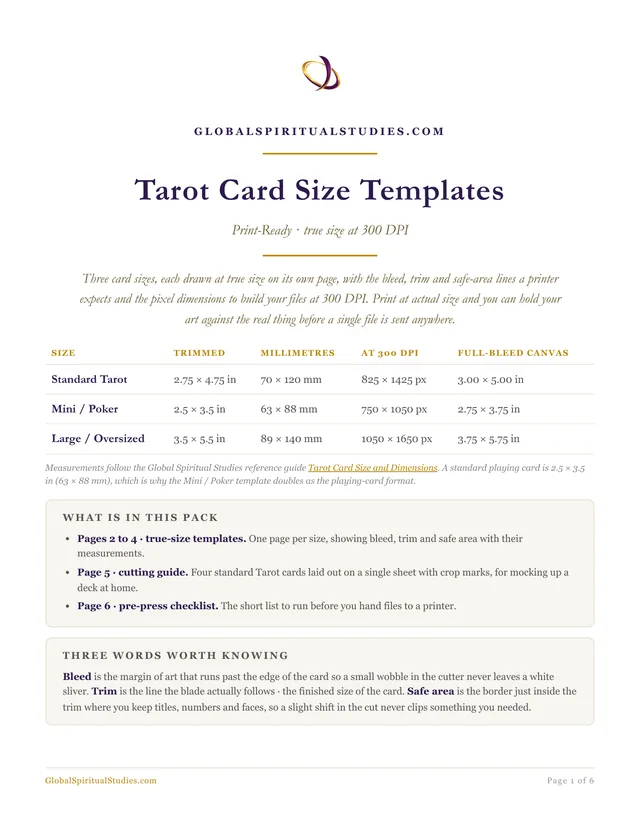
Free Tarot Card Size Template · Print-Ready PDF
Three card sizes drawn at true size, each with its bleed, trim and safe-area lines, the pixel dimensions at 300 DPI, and a cutting guide for mocking up a deck at home
A Tarot card size template is a print file laid out at the exact finished dimensions of a card, with three guide lines a printer expects: the bleed line (where artwork must extend past the edge), the trim line (where the blade actually cuts, the finished size of the card), and the safe area (the border inside the trim where titles and numbers stay clear of the cut). This free pack gives you all three, drawn at true size, for the standard Tarot card of 2.75 × 4.75 in (70 × 120 mm), the mini or poker size of 2.5 × 3.5 in (63 × 88 mm), and the large format of 3.5 × 5.5 in (89 × 140 mm), together with the pixel dimensions to build your files at 300 DPI.
Opens a quick form · we will email the print-ready PDF straight to your inbox.
Card size is the first decision of a deck, and every file you build afterwards is sized to it. Pamela Steele walks through that decision and every one that follows in her workshop, Creating Your Own Tarot Deck.
What Is in the Template Pack
Six pages, built to be printed at 100% and held against your art. Nothing in it is decorative: every line on the page is a line a printer will ask you about.
- Three true-size templates, one page per card size, each showing the bleed line, the trim line and the safe area with their exact measurements in inches and millimetres.
- Pixel dimensions at 300 DPI for both the trimmed card and the full-bleed canvas, so you can start a new document at the right size on the first try.
- A cutting guide sheet with four standard Tarot cards laid out at true size with crop marks, for printing a mock-up deck on your own printer.
- A pre-press checklist · the short list worth running before you hand any file to a printer.
- A plain-language note on bleed, trim and safe area, so the vocabulary stops being a barrier the first time a printer uses it.
Tarot Card Size Reference
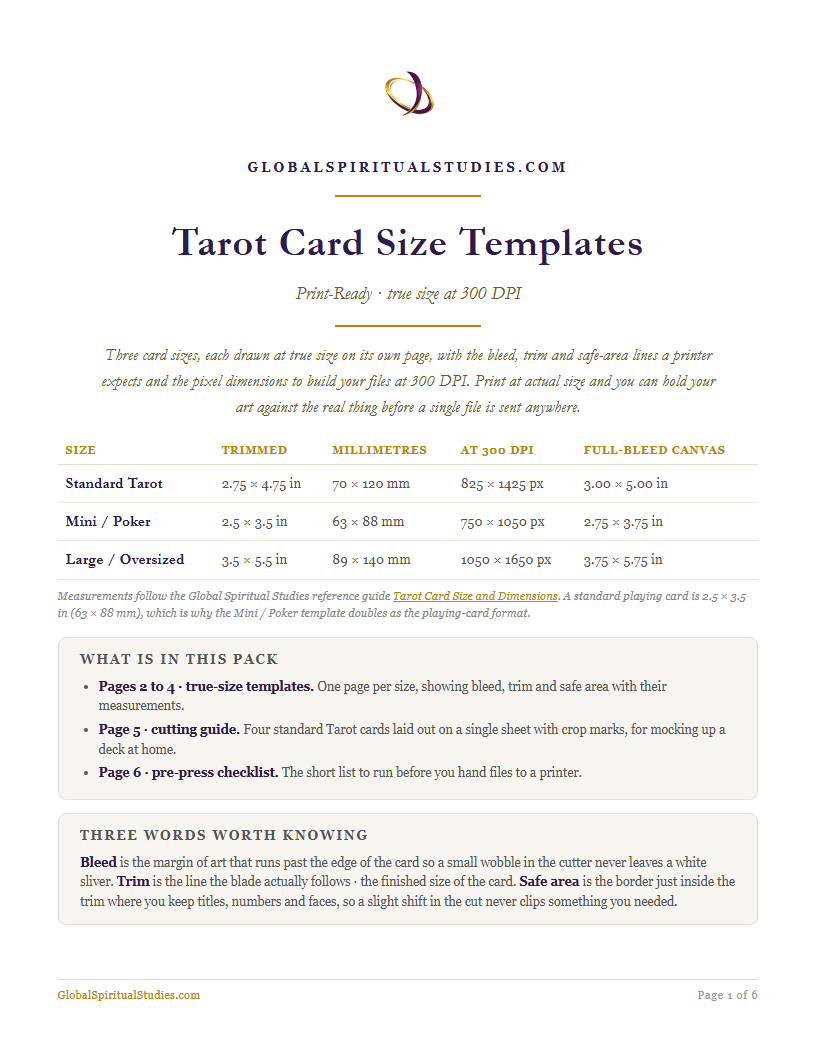
The three sizes in the pack, with the numbers you need for a print file. The trimmed figure is the finished card; the full-bleed canvas adds 0.125 in (3 mm) of bleed on every edge, which is what your printer actually cuts down.
| Size | Trimmed Size | Millimetres | At 300 DPI | Full-Bleed Canvas |
|---|---|---|---|---|
| Standard TarotWhat most published decks measure | 2.75 × 4.75 in | 70 × 120 mm | 825 × 1425 px | 3.00 × 5.00 in900 × 1500 px |
| Mini / PokerThe playing-card format | 2.5 × 3.5 in | 63 × 88 mm | 750 × 1050 px | 2.75 × 3.75 in825 × 1125 px |
| Large / OversizedFor decks meant to be laid out and studied | 3.5 × 5.5 in | 89 × 140 mm | 1050 × 1650 px | 3.75 × 5.75 in1125 × 1725 px |
Many printers quote the full-bleed canvas for a standard Tarot card as 2.99 × 4.99 in (897 × 1497 px), which is the same template rounded to their cutting tolerance. Either figure is safe: build to the bleed line and trim to 2.75 × 4.75 in. The mini or poker template doubles as the standard playing-card size, and the large family runs roughly 3 × 5 in up to the 3.5 × 5.5 in drawn here.
Free to keep · print at 100% and hold your art against the real thing.
How to Use the Templates
Print at actual size, never “fit to page”
The whole point of the pack is that the rectangles on the page are the card. In your print dialogue, choose 100% or Actual size and switch off any scaling. Then hold a sketch against the trim line, or cut the bleed rectangle out and use it as a physical window over your artwork.
Start your document at the full-bleed figure
In your art program, open a new file at the full-bleed canvas size for your chosen format, at 300 DPI. Background and colour run all the way out to the bleed line so a small wobble in the cutter never leaves a white sliver. The printer trims on the trim line, and anything you cannot afford to lose · titles, card numbers, your signature · stays inside the safe area.
Commit to one size for the whole deck
Every card, the card back, and any extra cards share a single trimmed size. Mixed sizes are one of the most common reasons a print run comes back wrong, and it is a mistake that only shows up after the money is spent.
Then confirm against your actual printer
Card size is standard across the industry; bleed, safe area and file format are not. Once you have chosen a printer, check the figures in this pack against their own specification sheet before you export. The template gets you building with confidence today; their sheet is the last word.
For the full story behind these numbers · why Tarot is taller than a playing card, how size shapes art and handling and cost, and how the dimensions feed into your print files · see our reference guide to Tarot card size and dimensions. It sits inside our complete guide to how to create your own Tarot deck, alongside guides to card stock and finishes and digitising your art for printing. When you reach the press, read how to print your own Tarot deck: print-on-demand, bulk or publisher and what a Tarot deck costs to make, then follow the whole journey in Pamela Steele’s Creating Your Own Tarot Deck.
Featured Course · New for 2026
Creating Your Own Tarot Deck
Card size is one early decision among many. In Creating Your Own Tarot Deck, Pamela Steele · Tarot Grand Master and creator of the Steele Wizard Tarot · walks you through the whole journey, drawing on more than forty years of designing, publishing and distributing her own decks: concept and deck structure, choosing your art medium, digitising for print, copyright and trademark, printers and print-on-demand, crowdfunding, the companion book, and getting your deck into readers' hands. Eight on-demand video classes, handouts for every lesson, a course community, two live Q&As with Pamela Steele, and a final quiz with a certificate of completion.
Explore the workshopThree true-size templates, a cutting guide, and a pre-press checklist.
Sources & Standards
The dimensions in this pack follow the Global Spiritual Studies reference guide Tarot Card Size and Dimensions, which reflects the formats the major Tarot publishers have settled on: a standard Tarot card of 2.75 × 4.75 in (70 × 120 mm), against the 2.5 × 3.5 in (63 × 88 mm) of a standard playing card. Bleed of 0.125 in (3 mm) and a matching safe-area inset are the common commercial card-printing convention; individual printers vary, so always confirm against the specification sheet of the printer you choose. The deckmaking guidance is drawn from Pamela Steele's workshop Creating Your Own Tarot Deck.
Frequently Asked Questions
What size should a Tarot card template be?
A standard Tarot card template is 2.75 × 4.75 inches (70 × 120 mm) trimmed, which is 825 × 1425 pixels at 300 DPI. Add 0.125 in (3 mm) of bleed on every edge and the working canvas becomes 3.00 × 5.00 in, or 900 × 1500 px; many printers round this to 2.99 × 4.99 in (897 × 1497 px). The free pack on this page also includes a mini or poker template at 2.5 × 3.5 in and a large template at 3.5 × 5.5 in.
How much bleed does a Tarot card need?
The common convention is 0.125 inches, or 3 millimetres, on every edge. Bleed is the margin of artwork that runs past the finished edge of the card so that a slight wobble in the cutting blade never leaves a white sliver along the border. Nothing important should live in the bleed: it is designed to be thrown away. Pair it with a matching safe area of about 0.125 in inside the trim line, where you keep titles, card numbers and signatures.
What resolution should I use for printing Tarot cards?
300 DPI is the print standard, and it is what every card printer will ask for. At 300 DPI a finished standard Tarot card is roughly 825 × 1425 pixels of trimmed artwork, and the full-bleed file is about 900 × 1500 pixels. Build at the finished pixel count for your chosen size from the start rather than enlarging a smaller file later, and you will never have to wonder whether the image is sharp enough.
Can I print my own Tarot cards at home with this template?
Yes, for a mock-up. The pack includes a cutting guide sheet with four standard Tarot cards laid out at true size with crop marks: print it at 100% on card stock, cut on the trim lines, and you have physical cards to shuffle and lay out. Home printing is the right way to test how your art feels in the hand and whether the size suits your deck. For a finished deck that holds up to years of shuffling, a commercial card printer and proper card stock are worth the step up.
Is the template free?
Yes. The template pack is a free resource from Global Spiritual Studies, an online school of Tarot, Lenormand, Kabbalah and the contemplative traditions that has been teaching for over fifteen years. Give us an email address and the print-ready PDF arrives in your inbox, yours to keep and print as often as you like.
Print it at actual size, hold your art against the trim line, and the deck stops being an idea and starts being an object.