Qigong · The Complete Guide to Qi, Its Forms, Its Teachers and How to Learn
The front door of the Global Spiritual Studies Qigong Library: what Qigong is, its history in five eras, the major forms in one reference table, the teachers whose work the library holds, and where to begin
Qigong (said roughly "chee gung") is a Chinese system of coordinated posture and movement, breathing and focused attention, practised for health, inner cultivation and, in some lineages, martial skill. The name joins qi, breath or vital energy, with gong, skill gained through steady work: Qigong is the patient cultivation of qi.
Walk through a park in a Chinese city early in the morning and you may see it before you know its name: a few dozen people moving slowly in unison, arms rising and sinking with the breath, or standing perfectly still under the trees as if listening for something. Nothing about it looks strenuous. Yet people return to it for decades, and many say the stillness is the part they would miss most.
The Global Spiritual Studies Qigong Library gathers the tradition and the teachings of four of its most respected living teachers, Dr. Roger Jahnke, OMD, Daisy Lee, Robert Peng and Master Faye Li Yip, into one place. This page is its front door. It defines the practice, sets out its history and its major forms in reference tables, introduces the teachers and their courses, and maps every guide, chart and tool in the library, including the free charts and printables you can download and keep beside your practice. Read it straight through, or go directly to what you need.
What Qigong is
The practices are old; the word, in its modern sense, is young. Wikipedia's overview, drawing on scholarly histories, describes Qigong as "a system of coordinated body-posture and movement, breathing, and meditation" used for health, spirituality and martial arts training, with roots in Chinese medicine, philosophy and the martial arts. The US National Center for Complementary and Integrative Health (NCCIH) describes it more simply as exercises that use regulated breath, gentle movement and mental focus. Both definitions point to the same thing: Qigong is not one routine but a way of training in which the body, the breath and the attention are brought into step with each other.
In practice that can look very different from one room to the next. Some forms are sets of slow movements repeated in time with the breath, such as the Eight Brocades. Some are still: standing in one posture for minutes at a time, or sitting with the attention resting in the lower belly. Some use sound, a soft vowel or syllable voiced on the out-breath. Many include self-massage, tapping and shaking. Chinese sources often sort these into moving practice (dong gong) and still practice (jing gong), and most teachers blend the two.
Qigong is also a family rather than a single school. A historical compendium cited by Wikipedia describes 75 ancient forms and 56 contemporary ones, and those are only the forms that were written down. Scholars usually group them into five traditions that grew up in China: medical, Daoist, Buddhist, Confucian and martial Qigong. Each has its own aims, from treating illness to spiritual attainment to strengthening a fighter's body, and each has its own lineages of teachers. There is no single governing body and no single correct version, which is why the same movement can carry different names, and why a good teacher always tells you where a practice comes from.
If the word qi itself is new to you, our guide to what qi is explains the idea, the three dantians and the meridians. For a first practice you can try today, start with Qigong for beginners.
Free email course
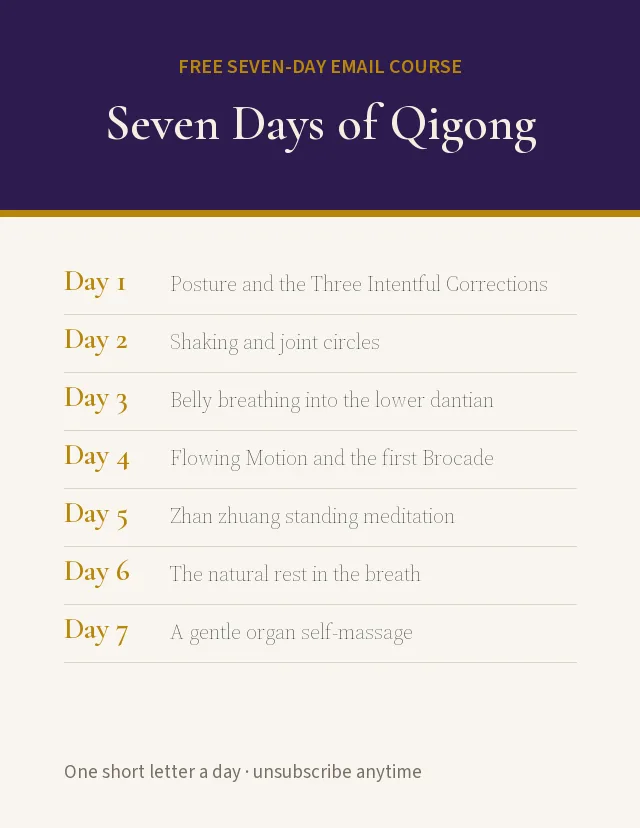
Seven Days of Qigong
A gentle first week of practice, one short email a day.
| What’s inside | |
|---|---|
| ✓ | Day 1 · Arrive: the Three Intentful Corrections |
| ✓ | Day 2 · Shake and loosen |
| ✓ | Day 3 · Breathing into the belly |
| ✓ | Day 4 · Move: Flowing Motion and Two Hands Hold Up the Heavens |
| ✓ | Day 5 · Standing like a tree |
| ✓ | Day 6 · The rest inside the breath |
| ✓ | Day 7 · Listening to the organs |
One short email a day for seven days · unsubscribe anytime
Pronunciation and spellings
In Mandarin the word is qìgōng (气功, traditional 氣功). The first syllable, qì, sounds close to the English "chee", spoken with a falling tone. The second, gōng, sounds roughly like "gung", held level. NCCIH writes the pronunciation as "chi gong". Either is understood.
The many spellings you see in books and on class timetables are not different practices. They are the same word written in different systems for turning Chinese into the Latin alphabet, and in English habits that grew up around them.
| Spelling | Where it comes from | Notes |
|---|---|---|
| qigong | Hanyu Pinyin, the official system in mainland China | The standard spelling today, used by NCCIH, research journals and most teachers |
| qi gong | Pinyin written as two words | Very common in English; means exactly the same |
| chi kung | Wade-Giles romanisation, ch'i kung, with the apostrophe dropped | Common in older books and in lineages that came West before Pinyin spread |
| chi gong, chigong | An English hybrid: the familiar "chi" with the Pinyin "gong" | Popular in searches and class listings; spells the sound most English speakers expect |
| chi gung | Yale romanisation | Less common; some teachers use it because it matches the sound closely |
Romanisations from Wikipedia's Qigong article; pronunciation guide from NCCIH. The "chi" in Tai Chi is a different Chinese word (極, "ultimate"), not the qi of Qigong.
We write "Qigong" with a capital Q throughout this library, as we do for the names of other practices, and use Pinyin for Chinese names, with older spellings in brackets where they help you find a book.
A short history in five eras
The history of Qigong is long and in places contested, and the name itself arrived late. Here it is in five short eras, with the dates that sources agree on. Our Eight Brocades and Six Healing Sounds guides tell the story of those two forms in more depth.
1 · Guiding and pulling: the ancient roots
Long before anyone said "Qigong", Chinese physicians and hermits practised daoyin, usually translated "guiding and pulling": stretching and breathing exercises to guide the qi and keep the body supple. A silk painting found in the Mawangdui tombs, dated to the 2nd century BCE, shows figures performing daoyin exercises. Wikipedia's overview puts the roots of Qigong in Chinese culture at more than 2,000 years, woven through early medicine, Daoist and Confucian thought, and later Buddhism and the martial arts.
2 · The classical forms: the Han to the Qing dynasties
Over the following centuries many of the forms still practised today were recorded. The Records of the Three Kingdoms credits the physician Hua Tuo, who lived around the late 2nd century CE, with the Five Animal Frolics: tiger, deer, bear, ape and bird. The Daoist scholar Tao Hongjing (456 to 536) left the first recorded version of the Six Healing Sounds. The name Eight Brocades appears in the 12th century, in the Song dynasty. The Yi Jin Jing, or Sinew Changing Classic, traditionally credited to Bodhidharma, was probably composed in 1624 according to the historian Meir Shahar. Through all these centuries the practices went by many names, daoyin, yangsheng ("nourishing life"), neigong ("internal work"), and passed privately within temples, monasteries, medical families and martial schools.
3 · A new name: 1949 to the 1970s
In 1949 Liu Guizhen established the term "qigong" for a system of life-preserving practices, and in the 1950s the new Chinese government tried to bring the scattered methods together into one coherent, health-focused system, largely setting their religious language aside. The approval did not last. In the mid-1960s, as the Cultural Revolution began, Qigong was criticised and banned along with much else rooted in tradition.
4 · Rehabilitation and the boom: 1979 to 1999
In 1979 Qigong's reputation was restored with the help of high-level supporters, and it was officially recognised as a component of Chinese medicine. The same year, in Shanghai, Lin Housheng is commonly credited with creating the Taiji Qigong Shibashi, eighteen movements drawn from Tai Chi. What followed was an extraordinary popular boom: by the 1990s estimates of the number of practitioners in China ranged from 60 to 200 million. Claims of extraordinary powers circulated but never produced replicable evidence, some groups grew into spiritual movements, and in 1999 the government moved against the spiritual groups that had grown out of the boom, banning Falun Gong among others.
5 · Health Qigong and the wider world: 2000 to today
In 2000 China established the Chinese Health Qigong Association to regulate practice around state-approved forms and certified instructors. In 2003 it introduced four standardised sets: the Yi Jin Jing, the Five Animal Frolics (Wu Qin Xi), the Six Healing Sounds (Liu Zi Jue) and the Eight Brocades (Ba Duan Jin). Fixing one version of each made them easy to teach and, just as important, easy to study, and a large body of clinical research followed. Outside China, Qigong spread through teachers who emigrated or trained abroad; in the United States the National Qigong Association was founded in 1996, and NCCIH now publishes a summary of the research. Today Qigong is taught in parks, community centres, hospitals, retreat centres and, increasingly, online.
The three regulations: body, breath, mind
For all its variety, nearly every form of Qigong shares one simple structure. Chinese sources describe the practice as coordinating three adjustments, or regulations: of the body, of the breath and of the mind. You regulate the body into an upright, relaxed posture; you let the breath become slow, smooth and unforced; and you gather the attention so that it rests with what you are doing. When the three come together, practitioners say, the qi flows. Whatever you make of that language, the experience of the three settling at once is recognisable, and it is what separates Qigong from simply waving your arms about.
| Regulation | Chinese | What it means in practice | Read more |
|---|---|---|---|
| Regulating the body | 調身 tiáo shēn | Crown lifting, knees soft, shoulders dropped, weight settled evenly; moving slowly within comfort, or standing still | Qigong for beginners |
| Regulating the breath | 調息 tiáo xī | Breath slow, smooth and unforced, often into the lower belly; never held or strained | Qigong breathing |
| Regulating the mind | 調心 tiáo xīn | Attention resting on the body, the breath, the lower dantian or a simple image; distraction noticed and let go | What is qi? |
The three regulations as named in Wikipedia's Qigong article. Roger Jahnke's Three Intentful Corrections (posture, breath, mind) follow the same pattern; he adds self-massage as a fourth practice.
Teachers put the three into their own words. Dr. Roger Jahnke, OMD, teaches what he calls the Three Intentful Corrections, adjusting the posture, deepening the breath and clearing the mind, and describes them as common to all forms of Qigong. Robert Peng teaches that "where your mind goes, your qi follows", which is the third regulation in a single line. Once you can see the three in any form, a new form stops looking like a list of movements to memorise and starts looking like a variation on something you already know. Jahnke's Qi Medicine course opens with the Three Treasures, which he frames as body, breath and mind, and Peng's Xi breathing course is built on the regulation of the breath.
The forms of Qigong: a reference table
A Qigong form is a named, teachable sequence of postures, movements, breaths or sounds, handed down within a lineage or standardised by an association. The table below sets out the thirteen forms you are most likely to meet in a class, a book or an online course, from the four Health Qigong sets standardised in 2003 to the systems taught by named living teachers. The "Origin" column records what historians and primary sources establish and marks traditional attributions as such; where a form comes to us through one teacher, the teacher is named. "Best for" describes what practitioners use each form for, not medical outcomes.
| Form | Chinese name | Type | Origin | Best for | Learn more |
|---|---|---|---|---|---|
| Eight Brocades | Ba Duan Jin 八段錦 | Movement (standing; a seated set also exists) | Named in 12th-century Song dynasty sources; the Yue Fei story is legend; standard version from the Chinese Health Qigong Association, 2003 | A first complete form; a daily 10 to 15 minute routine; stretching the whole body | The Eight Brocades · Faye Li Yip's course guide |
| Six Healing Sounds | Liu Zi Jue 六字訣 | Sound with breath (and gentle movement in the standard set) | First recorded by Tao Hongjing (456 to 536); sounds and organ pairings vary between lineages; standard set 2003 | A quiet, seated or standing practice linking breath, sound and the five organ systems | The Six Healing Sounds · Faye Li Yip (teaches the Health Qigong version) |
| Five Animal Frolics | Wu Qin Xi 五禽戲 | Movement | Credited to the Han-dynasty physician Hua Tuo in the Records of the Three Kingdoms: tiger, deer, bear, ape (monkey), bird (crane); standard set 2003 | Playful, varied movement; practitioners who enjoy imagery and a fuller range of motion | Daisy Lee (a lineage holder of Hua Tuo's Five Animal Qigong) |
| Sinew Changing Classic | Yi Jin Jing 易筋經 | Movement (stretching and strength) | Traditionally credited to Bodhidharma at Shaolin; the historian Meir Shahar dates the text to 1624; standard set 2003 | Practitioners wanting a more muscular, stretching form | Its history, in our Eight Brocades guide · Faye Li Yip (teaches the Health Qigong version) |
| Shibashi (Tai Chi Qigong 18) | Taiji Qigong Shiba Shi 太極氣功十八式 | Movement (flowing) | Commonly credited to Lin Housheng, Shanghai, 1979; built from Yang-style Tai Chi movements with Qigong breathing | A bridge for people drawn to Tai Chi; group classes; easy-to-follow flowing sequences | Qigong vs Tai Chi |
| Standing practice | Zhan Zhuang 站樁 | Standing (still) | From the internal martial arts; the modern method was shaped by Wang Xiangzhai, founder of Yiquan | Stillness, patience and posture; a few quiet minutes at the end of any routine | Standing meditation |
| Wuji Hundun Qigong | Wuji Hundun 無極混沌 | Movement (spirals and circles) | Daisy Lee learned it from Master Duan Zhi Liang of Beijing; Kripalu describes it as an 800-year-old family system (traditional attribution) | Experienced students interested in a flowing, circular form from a named lineage | Daisy Lee |
| Zang Fu Gong | Zang Fu Gong 臟腑功 | Movement with breath and self-massage | Organ-focused Qigong as taught by Daisy Lee, following the zang-fu organ pairs of Traditional Chinese Medicine | Practice built around the organs and the emotions Chinese medicine links to them | Daisy Lee's course guide |
| Tai Chi Easy | (English name) | Movement (a Tai Chi and Qigong blend) | Developed by Dr. Roger Jahnke, OMD, as a simplified approach that trained lay practice leaders can teach | Older adults, community groups, and anyone who finds full Tai Chi forms daunting | Chair Qigong for seniors · Dr. Jahnke's course guide |
| Xi Breathing and the 8 Cycles | Xi (Peng glosses it "break, or rest") | Breath with movement and sound | Taught by Robert Peng, who recounts learning Xi breathing during his training with the monk Xiao Yao; the 8 Cycles are his named movement set | A breath-centred practice; the three dantians; calm and inner quiet | Robert Peng's course guide |
| Medical Qigong | Medical Qigong (a branch, not one form) | Medical (self-practice and practitioner-led) | One of the five traditional branches; recognised in China as a component of Chinese medicine in 1979 | People who want Qigong framed as daily self-care alongside medical care, and those considering practitioner training | What is medical Qigong? |
| Radiant Lotus Women's Qigong | (English name) | Movement, sound (Tibetan tones) and self-massage | Developed by Daisy Lee, founder of Radiant Lotus Qigong, as a system "by women for women"; Omega reports it taught in 13 countries with more than 200 certified instructors | Women seeking a practice designed around women's lives and health concerns | Daisy Lee |
| Primordial and Wuji Qigong | Various | Movement | Names used by several modern teachers for different forms; distinct from Wuji Hundun; lineage accounts vary | Listed for completeness; ask the individual teacher for the form's source and lineage | · |
Sources: Wikipedia (Qigong, Hua Tuo, Yijin Jing, Baduanjin qigong, Zhan zhuang); the Chinese Health Qigong Association's four Health Qigong sets (2003) as listed by the British Health Qigong Association; Qi Journal on Shibashi; our sourced dossiers on Daisy Lee, Roger Jahnke, Robert Peng and Faye Li Yip. Romanisations and lineage accounts vary between schools.
How to choose a first form
If you want one complete form to learn on your own, the Eight Brocades is the usual first choice: eight movements, a standard version, and a great deal of free teaching material. If you would rather begin with the breath, the Six Healing Sounds or a simple dantian breathing practice will suit you. If you want stillness, standing practice asks for nothing but a few minutes and a quiet corner. And if you already know you want a teacher and a path, the teacher-specific systems in the lower half of the table are each taught as a complete seven-module course: Zang Fu Gong with Daisy Lee, Qi Medicine with Roger Jahnke and Xi Breathing with Robert Peng. Each begins with a free hour-long session, the easiest way to try a form with the teacher who carries it. If the Eight Brocades is your first form and you would like to learn it with a teacher from the start, Healing With Ba Duan Jin Qigong with Master Faye Li Yip teaches the standard Health Qigong version in seven self-paced modules, organ by organ.
A note on lineage
Qigong is full of stories about origins: generals, monks, secret family systems, masters who lived for centuries. Some are history, some are legend, and some are a teacher's honest account of their own training. The library keeps the three apart. Where scholars have tested a traditional attribution, as with the Yue Fei story of the Eight Brocades or Bodhidharma and the Yi Jin Jing, the guides report what they found. Where a lineage is carried by a living teacher, it is attributed to that teacher and to the published source, and nothing is added to it. A form does not need an ancient pedigree to be worth practising, and a good teacher will tell you plainly which parts of their story are which.
Is Qigong religious?
Qigong grew up inside Chinese religious and philosophical life, and it would be dishonest to pretend otherwise. Daoist inner cultivation, Buddhist meditation and Confucian self-discipline all shaped it, alongside Chinese medicine and the martial arts, and some lineages still teach it as a spiritual path. Words such as qi, dantian and shen ("spirit") come from that world.
Modern health Qigong, though, was deliberately framed in secular terms. When the term was established in 1949 and the forms were organised in the 1950s, religious language was largely set aside, and the four Health Qigong sets introduced in 2003 are taught in China as exercise. Most classes in hospitals, community centres and gyms follow that framing. Many people of every faith and none practise Qigong simply as a gentle movement and breathing discipline, without adopting any belief about qi.
Is Qigong OK for Christians? That is a question for your own conscience and, if you wish, your own tradition. The facts are these. Many Christians practise Qigong as exercise. The movements and the breathing do not require any belief or prayer. Some teachers use Daoist or Buddhist language, or speak of energy in ways some believers find uncomfortable, while others teach in plain physical terms. If this matters to you, try a free class or video first, notice the teacher's framing, and choose one whose approach sits well with your faith. Our comparison of Qigong with Tai Chi, yoga and Reiki may also help you place it.
Is Qigong safe?
For most people, yes. NCCIH, the US government's research centre for complementary health, says that "Qigong appears to be a safe form of activity" and that many studies report no negative side effects; when side effects do occur, they are usually minor aches or soreness. Its advice is sensible and short: do not use Qigong to put off seeing a health care provider about a medical problem, tell your providers about any complementary practice you use, and, if you are pregnant, talk with your provider first, because there is almost no research on Qigong in pregnancy (NCCIH).
NCCIH also notes that Qigong instructors do not have to be licensed and the practice is not regulated by the federal government or individual states. That makes it worth asking any teacher about their training and experience. Good teachers welcome the question.
A few simple habits keep practice safe. Move within comfort and never force a stretch. Keep the breath smooth; you never need to hold it. Stop and sit down if you feel dizzy or unwell. Choose seated versions if balance is uncertain. Traditional sources also warn of "Qigong deviation", distress linked to intense or improper practice, usually of advanced meditative methods; gentle beginner practice is a long way from that, and our guide to Qigong for health explains what is known about it and what the research shows condition by condition.
This guide is educational and is not medical advice. Qigong complements medical care; it does not replace it. Talk with your clinician before starting, especially if you are pregnant, recovering from surgery, or have balance, back or heart conditions.
Qigong and Tai Chi
The two are close relatives and often taught side by side. Tai Chi began as a martial art, a long sequence of connected movements first documented in Chen Village in Henan, while Qigong is the wider family of health and cultivation practices, most of them short and repetitive. NCCIH notes that when Tai Chi is practised for health it is considered a form of Qigong, and many teachers, Roger Jahnke among them, teach both and even blend them. In practice Qigong is usually quicker to begin: a single movement can be a whole practice, and nearly everything can be done seated. Our full comparison, Qigong vs Tai Chi, covers the differences, which to choose, and how yoga and Reiki compare.
The Qigong Library: every guide
The library is organised the way people learn: first the foundations, then the forms, then Qigong for health, then comparisons, and finally the teachers. Every guide is sourced, reviewed in October 2026 and free to read.
Start here
- Qigong for beginners · a 10-minute routine, standing or seated, the building blocks behind it, and how to keep going
- What is qi? · qi, the three dantians and the meridians explained, and the honest answer to "is qi real?"
- Qigong breathing · belly breathing into the lower dantian, reverse and embryonic breathing, and what Xi breathing is
Forms
- The Eight Brocades (Ba Duan Jin) · all eight movements, their traditional purpose, and a free chart
- The Six Healing Sounds (Liu Zi Jue) · the sounds, the organs, how to practise, and how the lineages differ
- Qigong for the organs · zang fu, the Five Elements, and the emotion each organ holds in Chinese medicine
Health
- Qigong for health · what the research shows condition by condition, and whether it is safe
- Qigong for lymphatic flow · movement, breath and self-massage, and what the evidence says
- Chair Qigong and Tai Chi for seniors · seated exercises, balance, and how to begin after 60
- What is medical Qigong? · how it differs from Qigong and Reiki, and how practitioners train
Compare
- Qigong vs Tai Chi · the differences, which to choose, and how yoga and Reiki compare
- The best online Qigong courses · the library's ranked recommendations, from free events to certification paths
- Is The Shift Network worth it? · an expert verdict on its free events, courses and refund policy
Teachers
- Dr. Roger Jahnke, OMD · medical Qigong, Tai Chi Easy, his books and how to learn with him
- Daisy Lee · Radiant Lotus Qigong, Zang Fu Gong, her lineage and how to learn with her
- Robert Peng · Xi breathing, The Master Key, his story as he tells it, and how to learn with him
- Master Faye Li Yip · Health Qigong, Ba Duan Jin and the Six Healing Sounds, her family lineage and how to learn with her
The teachers and their courses
The library is built around four living teachers, each the carrier of a distinct strand of the tradition. Dr. Roger Jahnke, OMD, founded the Institute of Integral Qigong and Tai Chi and co-founded the National Qigong Association; his work presents Qigong as self-care medicine. Daisy Lee is the 59th-generation lineage holder of Hua Tuo's Five Animal Qigong and the founder of Radiant Lotus Qigong; her organ practice follows the Five Elements of Chinese medicine. Robert Peng began a traditional apprenticeship at the age of eight under the monk Xiao Yao and teaches Xi breathing and the three dantians. Master Faye Li Yip, daughter and student of Professor Li Deyin, founded the Deyin Taijiquan Institute in the UK and co-founded the British Health Qigong Association; she teaches the standardized Health Qigong forms, above all Ba Duan Jin. Each teaches a seven-module, self-paced course. The courses of Jahnke, Daisy Lee and Peng open with a free, hour-long video session; Faye Li Yip's Ba Duan Jin course begins with its first module, and her institute's YouTube channel carries the complete form for anyone who wants to see her move first.
| Teacher | Strand of the tradition | Core teaching terms | Course |
|---|---|---|---|
| Dr. Roger Jahnke, OMD | Medical Qigong as daily self-care | The Four Baskets (movement, breath, self-massage, mindfulness) · the Three Treasures (jing, qi, shen) · the Three Intentful Corrections | Qi Medicine with Roger Jahnke |
| Daisy Lee | Organ Qigong and the Five Elements | Zang fu, the paired yin and yang organs · the emotion Chinese medicine links to each organ · Showering Qi, Swimming Dragon, lymph massage and shaking | Zang Fu Gong with Daisy Lee |
| Robert Peng | Breath and inner cultivation | Xi, "break, or rest" in the breath · the three dantians as Wisdom, Loving and Vitality Centers · the Central Meridian | Xi Breathing with Robert Peng |
| Master Faye Li Yip | Health Qigong: the standardized classical forms | The four CHQA Health Qigong sets · each brocade paired with an organ in Traditional Chinese Medicine · the Bazi hand and the Wo Gu "healing fist" · harvesting qi to the dantian | Healing With Ba Duan Jin Qigong with Faye Li Yip |
Credentials from the library's sourced research on each teacher (Omega Institute, Kripalu, Sounds True, the Deyin Taijiquan Institute, the teachers' own sites and their course pages). Teaching terms as each teacher uses them.
Each course guide in the library sets out the module-by-module syllabus, the teaching behind it, who it suits and who should choose another path, and ends with the way in: for Jahnke, Daisy Lee and Peng, register for the free hour, practise with the teacher, then decide; for Faye Li Yip, watch her form on her institute's channel, then begin the course at your own pace.
Medical Qigong · self-care
Qi Medicine with Roger Jahnke
Qigong as daily self-care, taught through Jahnke's four practices of movement, breath, self-massage and meditation, by the founder of the Institute of Integral Qigong and Tai Chi and co-founder of the National Qigong Association.
Watch nowOrgans · Five Elements
Zang Fu Gong with Daisy Lee
An organ-by-organ practice following the pairings and emotions of Chinese medicine, from the founder of Radiant Lotus Qigong and a lineage holder of Hua Tuo's Five Animal Qigong. "Cleanse" in the free session's title is a traditional term for moving stagnant qi, not a physical claim.
Start watchingBreath · the three dantians
Xi Breathing with Robert Peng
A breath-centred practice built around the three dantians and the Central Meridian, with the sounds Aung, Ahhh and Hong, from a teacher who began his apprenticeship at the age of eight and co-wrote The Master Key.
Watch nowHealth Qigong · the Eight Brocades
Ba Duan Jin with Faye Li Yip
The eight classic movements of Health Qigong in their standard order, each paired with an organ in Traditional Chinese Medicine, taught by the daughter of Professor Li Deyin and founder of the Deyin Taijiquan Institute, ending with all eight brocades as one flow. Her other courses teach the Six Healing Sounds (Revitalize & Restore Healthy Energy With Qigong's 6 Healing Sounds) and the Yi Jin Jing.
Explore courseChoosing between them is simpler than it looks. Come to Jahnke for the widest, most practical map of Qigong as self-care, and the gentlest entry for older bodies. Come to Daisy Lee for the organs, the emotions and the Five Elements. Come to Peng for the breath, stillness and the inner quiet. Come to Faye Li Yip for the Eight Brocades as a complete standard form, learned movement by movement with a competitor's precision. The Qigong Practice Finder matches a teacher to your goal in a minute, and the library's ranking of the best online Qigong courses sets these four beside the free options and the certification paths.
Free charts, printables and tools
The library's free resources turn the reference pages into practice. The charts and the email course arrive by email; the two finders work right on the page.
- The Six Healing Sounds and Five Organs chart · a one-page printable of the sounds, organs, elements, seasons and emotions
- Chair Qigong for seniors printable · an illustrated seated routine adapted from Dr. Roger Jahnke's beginner practices
- The Eight Brocades chart · all eight movements on one illustrated page, requested from our Eight Brocades guide
- Seven Days of Qigong · a free email course, one short practice a day for a week, requested from our beginners' guide
- The Organ-Emotion Finder · choose a feeling and see which organ Chinese medicine links it to, with a practice to try
- The Qigong Practice Finder · choose your goal, posture and minutes and get a short routine and the teacher who fits
If you are exploring energy practices more widely, our guide to energy centres across cultures sets the three dantians beside the chakras and other systems, and our energy healing courses page gathers related study at Global Spiritual Studies.
Sources
NCCIH, Qigong: What You Need To Know (updated February 2022) · Wikipedia: Qigong, Hua Tuo, Yijin Jing, Baduanjin qigong, Liu Zi Jue, Zhan zhuang, Tai chi · British Health Qigong Association, Health Qigong sets · Qi Journal, Taiji Qigong Shibashi and Lin Housheng · Wang F. et al., Evidence-Based Complementary and Alternative Medicine, 2013 (PMC3557628) · Global Spiritual Studies research dossiers on Roger Jahnke, Daisy Lee, Robert Peng and Faye Li Yip (Omega, Kripalu, Radiant Lotus Qigong, Sounds True, the Deyin Taijiquan Institute and The Shift Network pages) · Last reviewed October 2026.
Email course · 7 days
Begin a gentle first week
Seven short practices, one a day, from arriving to listening to the organs.
Start day oneFrequently asked questions
What is Qigong?
Qigong is a Chinese system of coordinated posture and movement, breathing and focused attention, practised for health, inner cultivation and, in some lineages, martial skill. The word joins qi, breath or vital energy, with gong, skill gained through steady work. It includes moving forms such as the Eight Brocades, still standing practice, seated breathing, healing sounds and self-massage.
How do you pronounce Qigong?
Say it roughly "chee gung". In Mandarin the first syllable, qi, sounds close to the English "chee" with a falling tone, and the second, gong, sounds roughly like "gung", held level. NCCIH writes the pronunciation as "chi gong", which is also understood.
Is it Qigong, qi gong, chi gong or chi kung?
All four are the same word. Qigong is the Pinyin spelling used in mainland China and in most research today, and qi gong is the same Pinyin written as two words. Chi kung comes from the older Wade-Giles romanisation, ch'i kung, and chi gong or chigong is an English hybrid. None of them names a different practice.
What is Qigong good for?
Most people practise Qigong for calm, steadier energy, flexibility, balance and a daily moment of stillness. NCCIH reports some research suggesting benefits for people with conditions such as fibromyalgia, COPD and Parkinson's disease, and reviews in PubMed Central find preliminary evidence of benefit for mood, though many studies are small. It complements medical care and does not replace it.
What are the main types of Qigong?
Scholars group Qigong into five traditions: medical, Daoist, Buddhist, Confucian and martial. In practice you will meet moving forms such as the Eight Brocades, Five Animal Frolics and Yi Jin Jing, sound practices such as the Six Healing Sounds, still standing practice called zhan zhuang, seated breathing and meditation, and teacher-specific systems such as Tai Chi Easy, Zang Fu Gong and Xi breathing.
Is Qigong the same as Tai Chi?
No, but they are close relatives. Tai Chi began as a martial art built on a long sequence of connected movements, while Qigong is the wider family of health and cultivation practices, most of them short and repetitive. NCCIH notes that Tai Chi practised for health is considered a form of Qigong, and many teachers teach both.
Is Qigong religious?
Qigong has roots in Daoism, Buddhism and Confucianism as well as Chinese medicine and the martial arts, and some lineages still teach it as a spiritual path. Modern health Qigong was deliberately framed in secular terms, and the standard Health Qigong sets are taught as exercise. Most classes today are secular, and people of many faiths and none practise it.
Is Qigong OK for Christians?
That is a question for your own conscience and tradition. Many Christians practise Qigong as gentle exercise, and the movements and breathing do not require any belief or prayer. Some teachers use Daoist or Buddhist language and others teach in plain physical terms, so if it matters to you, try a free class first and choose a teacher whose framing sits well with your faith.
Is Qigong safe?
NCCIH says Qigong appears to be a safe form of activity, with side effects, when they occur, usually minor aches or soreness. Move within comfort, never force or hold the breath, and stop if you feel dizzy. Do not use Qigong to put off medical care, and talk with your clinician first if you are pregnant, recovering from surgery, or have balance, back or heart conditions.
How often should you do Qigong?
Little and often works best. A few minutes every day teaches the body more than one long session a week, so many beginners start with five to ten minutes daily and let the practice grow. Tying it to a daily moment, such as after the morning kettle or before bed, helps it last.
Can you learn Qigong online?
Yes. Free videos and guides are a sensible way to learn your first movements, and structured online courses add a path, a teacher's lineage and a sequence of practices. Many online courses begin with a free session, which is a good way to judge a teacher before committing. Because Qigong instructors are not licensed, ask any teacher about their training.
Which Qigong form should a beginner learn first?
The Eight Brocades is the most common first form: eight simple movements with a standard version and plenty of free teaching. If you prefer stillness or the breath, standing practice or simple belly breathing are just as good a start. The best first form is the one you will practise regularly and enjoy.
Begin small, return often, and let the practice teach you. When you are ready for a teacher, Roger Jahnke, Daisy Lee and Robert Peng each offer a free first hour, and Faye Li Yip's Ba Duan Jin course begins whenever you do.