The Best Online Qigong Courses in 2026 · Ranked, With the Free Way to Try Each Teacher and Every Certification Path
The Qigong Library's recommendations: four courses ranked with the reasons, the free way to meet each teacher, the best free material, and the routes to teaching
An online Qigong course is structured teaching in Qigong, the Chinese practice of gentle movement, breath and focused attention, delivered by video, live or recorded, usually as a sequence of lessons with practice between them. The best online Qigong course is the one whose teacher, format and pace you will actually practise with, and the surest way to find it is to try a teacher free before paying for anything.
The ranking below rests on six criteria, the same ones an experienced teacher would use to judge a school. Teacher lineage: who taught the teacher, and can they tell you where a practice comes from. Live or recorded: a live course gives you a place to ask questions; a recorded one lets you practise at three in the morning. Practice time per session: how much of each lesson you spend moving and breathing rather than listening. Refund terms: whether the guarantee is stated plainly on the course page before you pay. Community: whether there is anyone to practise with or ask. And cost transparency: whether the price and what it includes are easy to find. Prices change often, so this page lists none; every provider shows its current figure on its own page.
The short answer. For most beginners the best online Qigong course is Qi Medicine with Roger Jahnke, the widest and most practical map of the practice. For calm and the breath, choose Robert Peng's Xi Breathing course. For the organs and the emotions, choose Daisy Lee's Zang Fu Gong. For the Eight Brocades learned as one complete standard form, choose Faye Li Yip's Healing With Ba Duan Jin Qigong. The first three each open with a free hour-long session, and Faye Li Yip's complete form is free to watch on her institute's YouTube channel, so the first step costs nothing.
The comparison table
This table puts the main routes side by side: the four self-paced courses the library ranks highest, its free email course, the teachers' free video channels, and the documented certification paths. Every row names a free way to try before committing.
| Course | Teacher | Format | Length | Best for | Free way to try | Where |
|---|---|---|---|---|---|---|
| Qi Medicine with Roger Jahnke | Dr. Roger Jahnke, OMD | On-demand video with audio and transcripts | 7 modules of about 90 minutes | Beginners who want the whole map, and Qigong as daily self-care | The free hour, Discover the Power of Qi Medicine | The Shift Network · complete course guide |
| Awaken Your Inner Power Through Qigong & Xi Breathing | Robert Peng | On-demand video and audio with transcripts | 7 modules of about 90 minutes | People who come to Qigong for the breath, calm and meditation | The free hour, Connect to Your Inner Joy Through Qigong's Xi Breathing | The Shift Network · complete course guide |
| Qigong to Renew & Rejuvenate Whole-Body Health (Zang Fu Gong) | Daisy Lee | Self-paced video with transcripts | 7 modules of about 90 minutes | Anyone drawn to the organs and emotions as Chinese medicine maps them | The free hour, Qigong to Cleanse Your Organs for Better Health & Energy Flow | The Shift Network · complete course guide |
| Healing With Ba Duan Jin Qigong | Master Faye Li Yip | Pre-recorded, self-paced video with MP3 audio and transcripts | 7 modules of about 90 minutes | Learning the Eight Brocades as one complete standard Health Qigong form, organ by organ | Her complete Ba Duan Jin on her institute's YouTube channel; a free recorded preview, Experience a Cascade of Healing With Ba Duan Jin Qigong | The Shift Network · complete course guide |
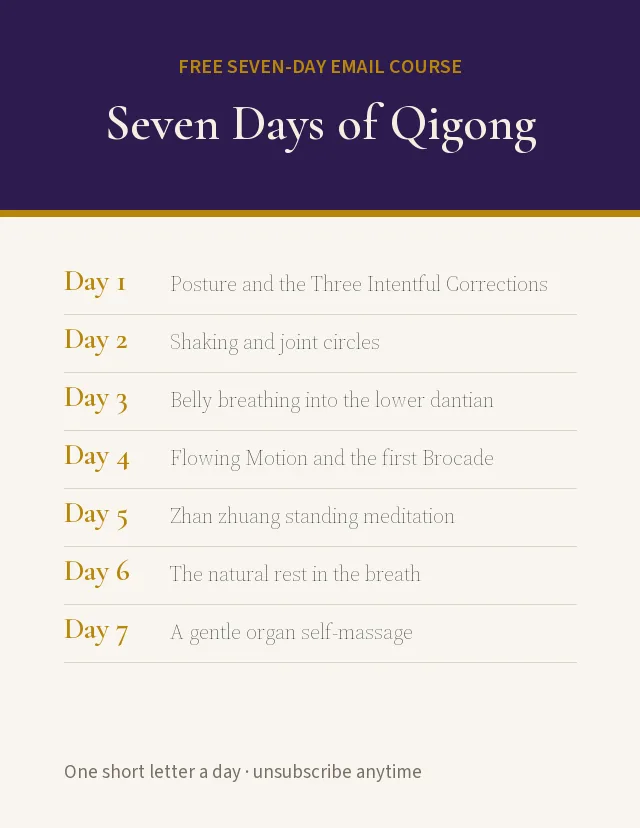
| Seven Days of Qigong | Global Spiritual Studies (practices drawn from the three teachers above) | Email course | Seven short daily practices | Complete beginners who want a gentle week before choosing anything | It is free | Global Spiritual Studies · start from the beginners' guide |
| Teachers' own YouTube channels | Roger Jahnke and his institute; Daisy Lee; talks with Robert Peng; Faye Li Yip's Deyin Taijiquan Institute | Free video | Single practices and talks | Sampling a teacher's voice and pace | Free | YouTube · channels listed below |
| Tai Chi Easy Practice Leader training | Institute of Integral Qigong and Tai Chi (founded by Roger Jahnke) | Practice-leader training (check the institute for current delivery) | 25 hours, as the institute describes it | People who want to lead simple group practice, not become masters | Meet the teaching in the free Qi Medicine hour first | The institute's own site · details below |
| 200-hour Integral Qigong and Tai Chi Teacher Certification | Institute of Integral Qigong and Tai Chi | Three levels of intensive training plus self-study | 200 hours in total | Aspiring Qigong and Tai Chi teachers | The free Qi Medicine hour | The institute's own site · details below |
| Radiant Lotus Women's Qigong certification | Daisy Lee | Level-based certification; an online route has been offered since 2023 | Varies by level; a past Level 2 ran for six months | Women who want to teach Radiant Lotus Qigong to women | Her free Zang Fu Gong hour and her YouTube channel | Radiant Lotus Qigong · details below |
Course names, formats and lengths are summarised from each provider's own pages as of October 2026 and may change. No prices are listed; see each provider for current details.
The four best courses, ranked
The four paid courses in the table share one way of working: for the first three, the teacher offers a free video event of about an hour, which teaches something real, and at the end presents a longer paid course. That model has one large advantage for a beginner. You can spend an hour with a teacher, practise with them, hear how they explain things, and decide whether their voice suits you before any money is involved. Faye Li Yip's Ba Duan Jin course is entered directly: you begin with its first module, and her institute's YouTube channel lets you watch her teach the complete form beforehand. The library's complete guide to each course sets out the way in, every module and who the course suits.
All four teachers are of the first rank, each with decades of study in a named lineage, so the ranking turns on fit. First comes the course that serves the widest range of beginners and gives the most complete map of the practice; second, the one that goes deepest into the breath; third, the one with the most specific focus, the organs; fourth, a single classical form taught in full. If your interest is already specific, read the third or fourth first.
Ranked first · the best first course
1 · Qi Medicine with Roger Jahnke
Why it ranks first. No other course here gives a beginner the whole of Qigong in one structure. Jahnke's Four Baskets turn a bewildering tradition into four clear kinds of practice, and his clinical background keeps every lesson tied to daily self-care.
Who it fits. Beginners who want to understand Qigong as a whole before specialising, people who think of practice as daily self-care, and anyone who likes clear, plain language. Dr. Roger Jahnke, OMD, is a Doctor of Oriental Medicine with more than three decades of clinical practice. He founded the Institute of Integral Qigong and Tai Chi in Santa Barbara, co-founded the National Qigong Association in 1996, and developed Tai Chi Easy, a simplified blend of Tai Chi and Qigong designed to be led by trained lay practice leaders. He was the lead author of a 2010 review of 77 randomised trials of Qigong and Tai Chi. His teaching organises Qigong into four practices, movement, breath, mind and self-applied massage, which he calls the Four Baskets, and returns again and again to his conviction that "the most profound medicine is produced within".
What you get. Seven recorded sessions of about 90 minutes each, which the course page describes as a 40-minute teaching, a 20-minute Qigong demonstration and 30 minutes of question and answer, with video streams, MP3 audio, seven PDF transcripts and exercises for each lesson. The modules move from the Three Treasures and the Four Baskets through the breath and self-massage to his Nine Phases of cultivation and a closing session on sustaining a practice. Two bonuses are listed on the current page: a five-part webinar on the ancient energetic roots of Qigong, and an audio conversation with Michael Gelb. The free hour that leads to it includes a four-part Qigong breathing practice.
What to know before you begin. This is a recording of an earlier live run, so the question-and-answer segments answer other students' questions, not yours. The free hour closes with Jahnke presenting this seven-module Qi Medicine course. The later modules on inner alchemy are more contemplative than the early ones, which some beginners love and others save for later.
Ranked second · best for the breath and calm
2 · Awaken Your Inner Power Through Qigong & Xi Breathing with Robert Peng
Why it ranks second. It is the most complete course on the breath in the library, built on a clear structure of the three dantians and the Central Meridian, from a teacher who trained in a traditional apprenticeship from childhood. It ranks behind Jahnke only because its focus is narrower.
Who it fits. People who come to Qigong for calm, anyone already drawn to meditation, and those who want the breath at the centre of practice. Robert Peng began an apprenticeship at the age of eight in Hunan, China, under the monk Xiao Yao, began teaching publicly in China, and is now based in New York; his course page says he has trained more than 150,000 students. Spirituality & Health named him one of its Top 10 Spiritual Heroes of 2013, and he has taught at Omega, Kripalu and Esalen. His teaching works with the three dantians, the upper, middle and lower energy centres, joined by the Central Meridian. Xi, he explains, "means break, or rest": a small, unforced pause in the breath.
What you get. Seven recorded sessions of about 90 minutes, as video and audio, with PDF transcripts, exercises and reflection questions. The modules give one session each to the upper dantian (wisdom), the middle dantian (love) and the lower dantian (vitality), then the Central Meridian, with a flowing movement set he calls the 8 Cycles taught across the course and a closing session on awareness. The listed bonuses include an audiobook of his account of a long retreat in his youth, titled on the page as 100 Days of Darkness & Night, and a conversation on the path of mastery with Daisy Lee.
What to know before you begin. Peng's framing is openly spiritual, drawn from Taoist and Buddhist training, and his account of his own training includes experiences many readers take as teaching stories. The exact mechanics of Xi breathing are taught inside the course rather than published, which is one good reason to learn it from him directly; approach any breath practice gently, never force or strain, and stop if you feel dizzy. Like the others, this is a recording of an earlier run.
Ranked third · best for the organs and emotions
3 · Qigong to Renew & Rejuvenate Whole-Body Health with Daisy Lee
Why it ranks third. It is the most thorough organ-focused course in the library, a full form taught one organ pair at a time by a lineage holder, and the clearest way to practise the Five Element map of Chinese medicine in the body. It ranks third only because its subject is specific; for anyone drawn to the organs and emotions, it is the first choice.
Who it fits. Anyone curious about how feelings and the organs connect in Chinese medicine, people who like a warm, embodied teaching style, and those who already practise a little and want a single organ-focused form. Daisy Lee founded Radiant Lotus Qigong, is the 59th-generation lineage holder of Hua Tuo's Five Animal Qigong as a disciple of Master Wang San Hua, learned Wuji Hundun Qigong from Master Duan Zhi Liang, and holds Level III Advanced Qigong Instructor and Clinical Practitioner certification from the National Qigong Association. She has been teaching for nearly three decades and was named 2020 Qigong Master of the Year by the World Qigong Congress.
What you get. Seven self-paced modules of about 90 minutes, with transcripts, exercises and reflection questions and ongoing access. The course teaches Zang Fu Gong, organ-focused Qigong, one organ pair at a time: lungs and large intestine with grief, heart and small intestine with a "happy heart" and boundaries, liver and gallbladder with anger, stomach and spleen with worry, kidneys and bladder with fear, then an integrated daily flow. The organ-emotion pairings come from Traditional Chinese Medicine. A Zang Fu Gong Flow Set is among the listed bonuses.
What to know before you begin. The course was first taught live in 2020, and the live-only extras of that run, such as group practice sessions and a community group, are not part of the self-paced version. "Cleanse" in the free event's title is meant in the traditional, energetic sense of moving stagnant qi; it is not a claim about physically cleaning the organs. And if you are looking for the Chinese Six Healing Sounds, note that Daisy Lee teaches Tibetan sound-healing tones instead; our guide to the Six Healing Sounds covers the Chinese set.
Ranked fourth · best for one complete classical form
4 · Healing With Ba Duan Jin Qigong with Faye Li Yip
Why it ranks fourth. It is the most complete course on a single standard form in the library: the Eight Brocades, Ba Duan Jin, taught in the Chinese Health Qigong Association's version, movement by movement and organ by organ, by a teacher trained from childhood in a family of martial artists. Ba Duan Jin is the form most beginners learn first, and no course here teaches one form more precisely. It ranks fourth only because it teaches one form rather than a whole approach to Qigong; for anyone who already knows they want the Eight Brocades, it is the first choice.
Who it fits. People who like clear structure, named movements and a recognised standard; anyone who wants a complete daily routine of about a quarter of an hour; and practitioners who have met the Eight Brocades in a class or on video and want to learn the inside of each movement. Master Faye Li Yip is the daughter and student of Professor Li Deyin, trained from childhood in Shaolin Quan, Xing Yi, Bagua and Taiji, and won gold and silver medals in Taiji and sword routines in China, per the Deyin Taijiquan Institute. She founded the Deyin Taijiquan Institute in the UK with her husband, Master Tary Yip, co-founded the British Health Qigong Association, and has taught full-time in the UK for more than 30 years, according to her course page. She teaches all four Health Qigong sets standardised in 2003.
What you get. Seven pre-recorded modules of about 90 minutes, streamed as video and provided as MP3 audio, with seven transcripts, optional exercises and questions for each lesson, and ongoing access. The first module maps the energy body and lays the foundations of grounding, stillness, smooth breathing and visualisation; the next five work through the brocades she pairs with the lungs (Posing as an Archer, with the Bazi hand), the spleen and stomach (Pushing Arms Aloft, with Turn Gazing Backwards), the heart, the kidneys and the liver (Clenching Fists & Glaring Eyes, with the Wo Gu "healing fist"); the seventh joins all eight brocades into one flow. Two bonuses are listed: Feel the Qi: Tai Chi for Health & Wellbeing and Peng Qi Guan Ding, a meditative practice of raising qi up and pouring it down.
What to know before you begin. This is a recording of a seven-week live course first taught in early 2024, so there is no live question time. The organ pairings come from Traditional Chinese Medicine and are the tradition's language, not medical promises. Several brocades ask for a lowered stance or a forward fold; she teaches each within your range, and anyone with back, knee or balance concerns should keep the movements small and talk with a clinician first. Her twelve-module Advanced Ba Duan Jin Qigong Training is the next step and includes this course. Her other courses teach the Six Healing Sounds and the Yi Jin Jing.
If you cannot choose, the free hours settle it. Watch two of them in the same week, or follow Faye Li Yip's Ba Duan Jin on her institute's channel, and notice which teacher you want to hear from again. That small pull is a better guide than any comparison table.
Free ways to learn Qigong online
You can learn a great deal of Qigong without paying anything, and a sensible path for most people is to spend a few weeks on free material before choosing a course. These are the best free sources.
The three free hours
Each of the three teachers above offers a free video session of about an hour, and these are the best free Qigong teaching online: real practice, not trailers. Roger Jahnke's includes a four-part breathing practice, Robert Peng's a movement and Xi breathing exercise, and Daisy Lee's a guided body scan and two Zang Fu Gong practices for the liver and lungs. Each ends with an invitation to the paid course, and registering adds you to the course provider's email list, which is frequent; you can unsubscribe at any time. Reach each one from its course guide: Jahnke's Qi Medicine hour, Peng's Xi breathing hour and Daisy Lee's Zang Fu Gong hour. Faye Li Yip's free material works differently: her free recorded preview, Experience a Cascade of Healing With Ba Duan Jin Qigong, which teaches the brocade Turn Gazing Backwards in stages, and her full course is described in the library's course guide.
The teachers' own channels
- Roger Jahnke: his institute's channel, IIQTC on YouTube, and Dr. Roger Jahnke on YouTube, with short seated practices that suit beginners and older adults.
- Daisy Lee: Daisy Lee Qigong on YouTube, including balancing movements and daily practice sessions.
- Robert Peng: talks and question-and-answer sessions on YouTube, such as Yi Jin Jing and Xi Breathing: A Q&A Session, and the interview The Making Of A Qigong Master.
- Faye Li Yip: her institute's channel, Deyin Taijiquan Institute on YouTube, with the complete Health Qigong Ba Duan Jin in six-minute and fifteen-minute follow-along versions, plus Liu Zi Jue and Yi Jin Jing.
Free resources from Global Spiritual Studies
- Qigong for beginners · a 10-minute routine, and the sign-up for Seven Days of Qigong, the library's free email course.
- Qigong Practice Finder · a 5, 10 or 20 minute routine for your goal and posture.
- The Eight Brocades · all eight movements, with a free illustrated chart.
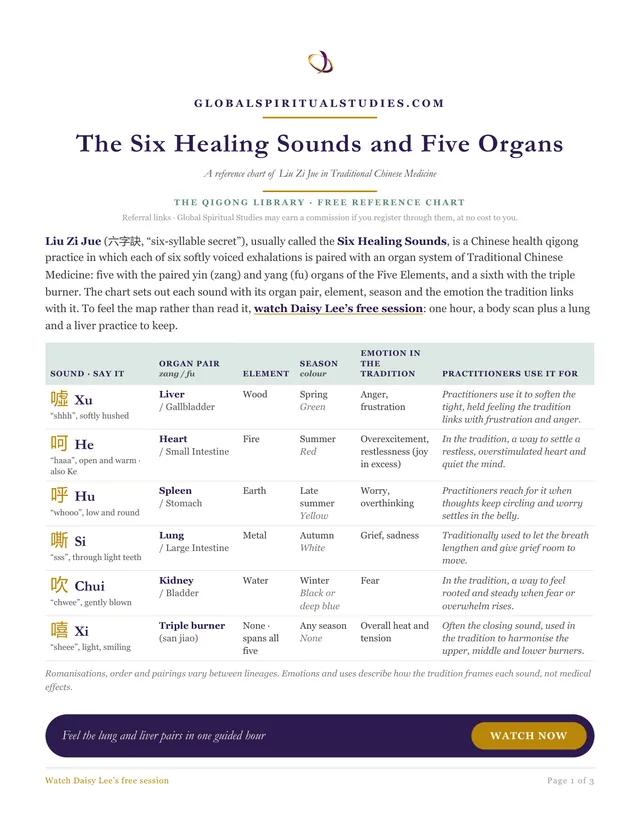
- The Six Healing Sounds chart · a free printable of the sounds and the five organs.
- Chair Qigong printable · a seated routine for older adults.
- Organ-Emotion Finder · which organ holds a feeling in Chinese medicine.
The standard health reference
Before starting any practice for a health reason, read the US National Center for Complementary and Integrative Health's plain-language page, Qigong: What You Need To Know. It summarises what the research shows, describes Qigong as appearing to be generally safe, and gives practical advice on choosing a teacher. The library's condition-by-condition summary is in Qigong for health.
Are free courses any good? Many are very good. What they rarely give is a path: practices introduced in an order, a teacher who explains why, and somewhere to take your questions. Free material is the right start; a structured course is the right next step for many people once a habit has formed.
Free email course
Seven Days of Qigong
A gentle first week of practice, one short email a day.
| What’s inside | |
|---|---|
| ✓ | Day 1 · Arrive: the Three Intentful Corrections |
| ✓ | Day 2 · Shake and loosen |
| ✓ | Day 3 · Breathing into the belly |
| ✓ | Day 4 · Move: Flowing Motion and Two Hands Hold Up the Heavens |
| ✓ | Day 5 · Standing like a tree |
| ✓ | Day 6 · The rest inside the breath |
| ✓ | Day 7 · Listening to the organs |
One short email a day for seven days · unsubscribe anytime
Certification and teacher training
Start with the plain fact: no single body licenses Qigong teachers. NCCIH notes that there is no national licensing or certification standard for Qigong instructors in the United States, so a certificate tells you that a person completed a particular school's training, not that they meet a legal standard. That does not make certification meaningless. A good programme gives hundreds of hours of supervised practice, teaching experience and feedback. It does mean you should ask any school what its certificate covers, how many hours it involves, and who assesses you. These are the documented routes.
Institute of Integral Qigong and Tai Chi (Roger Jahnke)
The institute Roger Jahnke founded trains teachers and practice leaders. On its own certification page it describes several tracks, including a Tai Chi Easy Practice Leader training of 25 hours, for people such as nurses, teachers and yoga instructors who want to share simple practices in their own settings, and a 200-hour Integral Qigong and Tai Chi Teacher Certification in three levels of intensive training plus self-study. The Qigong Institute has described the same 200-hour structure. Tai Chi Easy was built on the idea that trained lay practice leaders, not only masters, can bring these practices to many people. Check the institute directly for current dates and whether a given level is offered online.
National Qigong Association
The National Qigong Association, founded in 1996 with Roger Jahnke among its co-founders, is the main professional membership body for Qigong in the United States. It recognises members' training at defined levels, as its own site sets out; Daisy Lee's Level III Advanced Qigong Instructor and Clinical Practitioner certification is an example. NQA recognition is a membership credential that reflects documented study, not a government licence.
Radiant Lotus Women's Qigong (Daisy Lee)
Daisy Lee certifies teachers of Radiant Lotus Women's Qigong, her system taught by women for women. Omega reports it taught in 13 countries with more than 200 certified instructors. She offered the first online Radiant Lotus certification in 2023, a Level 1 training has run as a retreat at Kripalu, and a Level 2 teacher training, which required Level 1, ran for six months in 2025. Her site also lists a six-month online Wuji Hundun Qigong certification running from September 2026 to March 2027.
School of Robert Peng Qigong
Robert Peng's own school sells its courses directly, with Master Key Qigong, a 17-week on-demand training, as its foundation. His site lists a Teacher Training and a Professional Healer Training but, as of October 2026, publishes no details of length, format or certification. Ask his school directly before assuming what either includes.
Can you get a Qigong certification entirely online? Some schools now offer online routes, as Daisy Lee's does, and many combine online study with in-person intensives. A certificate of completion from a self-paced course is a record that you finished it; it is not a teaching credential, and none of the four self-paced courses above states that it certifies you to teach. If you care about the medical side of the practice, our guide to medical Qigong explains how practitioners train.
Other options worth knowing
These established schools sit outside the ranking because the library does not hold their teachings in depth. Each is a real option, and some readers will find their teacher among them.
- Holden QiGong · Lee Holden's school, with live and on-demand online classes and short follow-along routines.
- YOQI · Marisa Cranfill's blend of yoga and Qigong, a library of follow-along routines on its own site and on video platforms.
- Spring Forest Qigong · the system founded by Master Chunyi Lin, taught in numbered levels with self-study courses.
- Course marketplaces such as Udemy · many individual teachers and short courses; teacher backgrounds vary widely, so read the instructor's biography first.
- Qigong apps and general wellness apps · short guided sessions that are handy for building a daily habit, usually lighter on lineage and feedback.
- A local class · community centres, hospitals and Tai Chi schools often run Qigong groups, and nothing replaces a teacher who can see you move.
How the library ranks courses
The four ranked courses are the ones the Qigong Library holds in depth: each teacher's lineage, books, recorded teachings and free session, and each course's full module list, studied against the six criteria at the top of this page. Each was judged on the depth and clarity of the teaching, the practice time in each lesson, how well it serves a beginner, and whether free teaching lets you meet the teacher first. The order reflects how many readers each course serves well, and the other schools are named because a complete answer includes them.
The page quotes no prices, because they change and every provider shows its current figure. It makes no health promises: what teachers and traditions say is kept apart from what the research shows. Where two sources disagreed, the more conservative figure was used or the detail left out.
A note on health
This guide is educational and is not medical advice. Qigong complements medical care; it does not replace it. Talk with your clinician before starting, especially if you are pregnant, recovering from surgery, or have balance, back or heart conditions.
Sources
NCCIH, Qigong: What You Need To Know (updated February 2022) · The Shift Network course pages for Qi Medicine with Roger Jahnke; Awaken Your Inner Power Through Qigong & Xi Breathing; Qigong to Renew & Rejuvenate Whole-Body Health; Healing With Ba Duan Jin Qigong; and the three free event pages · Deyin Taijiquan Institute biographies of Master Faye and Master Tary Yip · Institute of Integral Qigong and Tai Chi, certification overview and faculty pages · Qigong Institute, Roger Jahnke and IIQTC · Jahnke R. et al., American Journal of Health Promotion, 2010 · National Qigong Association · Omega and Kripalu teacher pages for Daisy Lee and Robert Peng · radiantlotusqigong.com and radiantlotusqigongforwomen.com · robertpeng.com · Spirituality & Health, Top Ten Spiritual Heroes of 2013.
Further reading: IIQTC on YouTube · Dr. Roger Jahnke on YouTube · Daisy Lee Qigong on YouTube · Yi Jin Jing and Xi Breathing: A Q&A Session · The Making Of A Qigong Master · Deyin Taijiquan Institute on YouTube.
Email course · 7 days
Begin a gentle first week
Seven short practices, one a day, from arriving to listening to the organs.
Start day oneFrequently asked questions
What is the best online Qigong course for beginners?
The best course is the one whose teacher you will keep practising with, so try a free session first. For most beginners the best choice is Roger Jahnke's Qi Medicine course, which covers movement, breath, mind and self-massage in plain language. If you come for calm and the breath, Robert Peng's Xi Breathing course may suit you better; if the organs and emotions interest you, Daisy Lee's Zang Fu Gong course; and if you want to learn the Eight Brocades as one complete form, Faye Li Yip's Healing With Ba Duan Jin Qigong. The comparison table sets them side by side.
Can you learn Qigong online?
Yes. Qigong's movements are slow and simple enough to follow on video, and many experienced teachers now teach online. What you lose is a teacher who can see you move, so choose courses with clear demonstrations, move within comfort, and consider an occasional local class or workshop if one is near you.
Are free Qigong courses any good?
Many are very good, including the free hour-long sessions from Roger Jahnke, Robert Peng and Daisy Lee and the teachers' own YouTube channels, where Faye Li Yip's institute carries her complete Ba Duan Jin. What free material rarely gives is a path: practices in a deliberate order, a teacher who explains why, and a place to ask questions. Free is the right way to start; a structured course is a sensible next step once a habit has formed.
Is there a free Qigong course with a certificate?
Some free and low-cost courses issue a certificate of completion, but a completion certificate only records that you finished the course. It is not a teaching credential. If you want to teach, look at a school's teacher training, ask how many hours it involves and who assesses you, and remember that no single body licenses Qigong teachers.
Can you get a Qigong certification online?
Yes, some schools offer online routes. Daisy Lee has offered an online Radiant Lotus Women's Qigong certification since 2023, and her site lists an online Wuji Hundun certification for 2026 to 2027. Roger Jahnke's Institute of Integral Qigong and Tai Chi describes a 200-hour teacher certification in three levels and a 25-hour Tai Chi Easy Practice Leader training; check the institute for how each is currently delivered. No single body licenses Qigong teachers, so a certificate reflects a particular school's training.
Who certifies Qigong teachers?
Individual schools and teachers certify their own graduates, and the National Qigong Association recognises members' training at defined levels. NCCIH notes there is no national licensing or certification standard for Qigong instructors in the United States. Ask any teacher where they trained, for how long, and with whom.
Is The Shift Network legit?
Yes, The Shift Network is an established online education company that hosts courses by many well-known teachers, including the four Qigong teachers in this guide. Its free events are real teaching, and its emails after you register are frequent. The library's review of The Shift Network weighs its strengths and drawbacks in detail.
Are these online Qigong courses live or recorded?
The four Qigong courses in this guide are sold as on-demand or self-paced recordings of earlier live runs, each with seven sessions of about 90 minutes, transcripts and exercises. The question-and-answer segments are recorded, so they answer earlier students' questions. Live runs are offered from time to time; check each course page for its current format.
How much time does an online Qigong course take each week?
Plan on one lesson of about 90 minutes a week for the four courses here, plus a short daily practice of 10 to 20 minutes. The daily practice matters more than the lessons. A few minutes every day teaches the body more than one long session a week.
Do I need any equipment for an online Qigong course?
No. A clear space where you can reach out in every direction, loose clothes and flat shoes or bare feet are enough. A sturdy armless chair without wheels lets you practise seated, and almost every beginner practice has a seated version.
Is online Qigong safe?
NCCIH describes Qigong as appearing to be generally safe, with side effects, when they occur, usually minor aches or soreness. Move within comfort, never force or hold the breath, and stop if you feel dizzy. Talk with your clinician first if you are pregnant, recovering from surgery, or have balance, back or heart conditions.
Which is better, Roger Jahnke, Daisy Lee, Robert Peng or Faye Li Yip?
None is better in general; each carries a different strand of the tradition. Roger Jahnke teaches Qigong as daily self-care medicine through movement, breath, self-massage and meditation, and suits most beginners. Daisy Lee teaches organ Qigong along the Five Elements of Chinese medicine. Robert Peng teaches Xi breathing and the three dantians, and suits people who come for calm and meditation. Faye Li Yip teaches the standardised Health Qigong forms, above all the Eight Brocades, and suits people who like named movements and a clear standard. Watching two of their free sessions in the same week, or Faye Li Yip's form on her institute's YouTube channel, is the quickest way to choose.
Try a teacher for an hour. The one you want to hear from again is usually the right one.