The Six Healing Sounds (Liu Zi Jue) · The Complete Reference to Each Sound, Organ, Practice and Lineage
A complete reference to the six breathing sounds of Chinese Qigong · what each is for in the tradition, how it is voiced, and why the versions you meet do not always agree
The Six Healing Sounds, Liu Zi Jue (六字訣, the "six-character formula"), are a Chinese Qigong breathing practice in which six sounds are exhaled slowly, each paired in Traditional Chinese Medicine with an organ system: Xu with the liver, He with the heart, Hu with the spleen, Si with the lungs, Chui with the kidneys and Xi with the triple burner. First recorded by the Daoist scholar Tao Hongjing around the sixth century, the practice gained its movements in the Ming dynasty and became one of China's four standard Health Qigong forms in 2003. The free printable Six Healing Sounds chart sets all six sounds, with their organs, elements, seasons and emotions, on one page.
Most of us already know one of these sounds. The long sigh at the end of a hard day, the slow breath blown out before a difficult conversation: the body has its own ways of letting go. The Six Healing Sounds grew from noticing that the out-breath can take more than one shape, and from giving each shape a home in the body. Tao Hongjing put it simply: there is one way to breathe in, and six ways to breathe out.
This entry in the Global Spiritual Studies Qigong Library sets out what the tradition says about each sound, how it is voiced, the movement that accompanies it in the standard form, and exactly where the main lineages differ. It closes with what the research has found and the teachers who carry organ-focused Qigong today.
A short history
The earliest surviving record of the six sounds is in the Yangxing Yanming Lu, a collection on nurturing the mind and prolonging life compiled by Tao Hongjing (456 to 536), a leading figure of the Shangqing school of Daoism who was also versed in Chinese medicine. In his account the sounds are purely a breathing method: six ways of exhaling, with no movement at all.
The practice did not stay still. A 2020 history in the journal SAGE Open, by Juan Shi, Rou-Jia Wang and Feng-yan Wang, traces three stages: the creation of the sounds as a breathing regimen; a long transition in which the practice took on a meditative character and the relationship between each sound and its organ was redrawn; and a formalisation in which breath, attention and movement were brought together. Along the way, in the Song dynasty, Zou Pu'an wrote a treatise devoted to the six-character breathing method, and in the Ming dynasty writers including Hu Wenhuan and Gao Lian began to pair the sounds with movements of the body.
The version most widely taught today is Health Qigong Liu Zi Jue, one of four forms, alongside the Eight Brocades, the Five Animal Frolics and the Yi Jin Jing, that the Chinese Health Qigong Association introduced in 2003 under China's General Administration of Sport. It keeps the six sounds, fixes their order beginning with the liver, and gives each a simple standing movement. Most research trials use this form, which is why it anchors the table below. It is one version among several, and later in this guide we set it beside the others.
The Six Healing Sounds at a glance
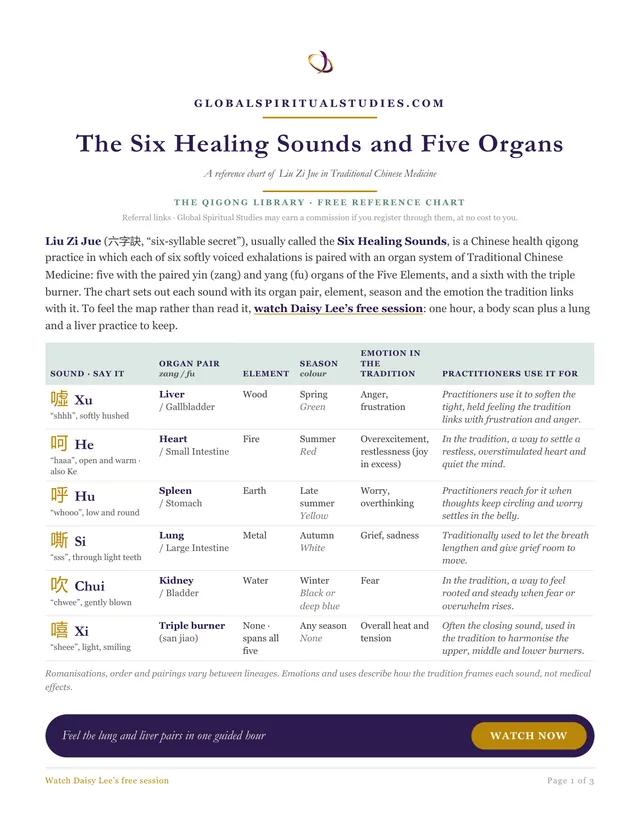
The six sounds in the order of the 2003 standard form, with the organ pair, element, season, colour and emotion that Traditional Chinese Medicine places beside each, and the movement that accompanies the sound in that form. The first five follow the Five Elements; the sixth, for the triple burner, stands a little outside that scheme.
| Sound | Character | Say it like | Organ pair | Element | Season | Colour | Emotion in TCM | Movement in the standard form |
|---|---|---|---|---|---|---|---|---|
| 1 · Xu | 噓 | "shoo", a soft hiss | Liver and gallbladder | Wood | Spring | Green | Anger, frustration | Each palm in turn reaches diagonally forward, then returns to the waist |
| 2 · He | 呵 | "huh", an open breathy sigh | Heart and small intestine | Fire | Summer | Red | Joy; in excess, overexcitement | Knees soften; the hands rise before the chest, turn palms down and press slowly down |
| 3 · Hu | 呼 | "hoo", lips rounded | Spleen and stomach | Earth | Late summer | Yellow | Worry, overthinking | Hands before the belly open forward in a rounded arc, then draw back |
| 4 · Si | 嘶 | "sss", breath through the teeth | Lungs and large intestine | Metal | Autumn | White | Grief, sadness | Hands rise to the chest, then the palms push forward |
| 5 · Chui | 吹 | "chway", as if blowing out a candle | Kidneys and bladder | Water | Winter | Blue or black | Fear | Hands circle from the belly round the waist, then press slowly down |
| 6 · Xi | 嘻 | "shee", a light, smiling exhale | Triple burner (San Jiao) | Fire, with the pericardium | None of its own | None assigned | No single emotion | Hands rise from the belly to head height, open outward, then lower |
Sounds, characters and organ purposes follow Wikipedia's Liu Zi Jue article; some editions write the lung sound 呬. Element, season, colour and emotion are the Five Element correspondences of Traditional Chinese Medicine. Movements are summarised from the 2003 standard form as described in published trials, and vary in detail between teachers. Pronunciation cues are approximate; He is also written Ke or voiced "haa".
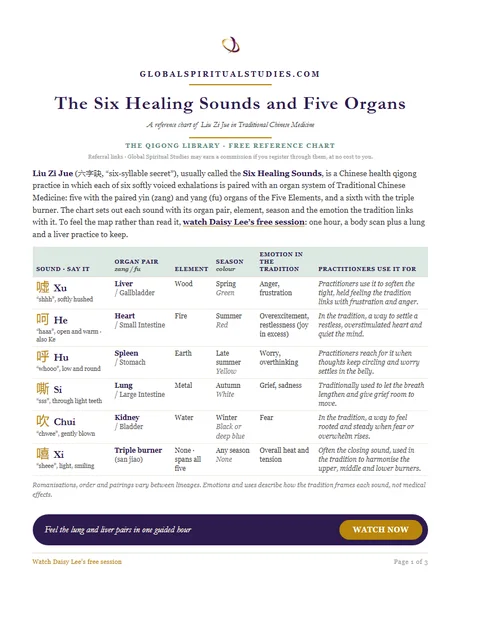 3 pages
Free printable chart
The Six Healing Sounds and Five Organs
The whole practice on three pages, for the wall, the mat or your phone.
| What’s inside | |
|---|---|
| ✓ | All six sounds with their characters, how to voice each one, and the organ, element, season and emotion the tradition pairs with it |
| ✓ | The five steps of a traditional round, from settling upright to six slow, soft repetitions |
| ✓ | The full Five Element table: organ pairs, seasons, colours, emotions, sense organs and tissues |
| ✓ | Where Daisy Lee's Tibetan tones differ from the Chinese six sounds |
Arrives in your inbox as a PDF · print it or keep it on your phone
The six sounds one by one
Each sound below follows the same pattern: what the tradition says about its organ, how the sound is shaped, the movement that goes with it in the standard form, and one way practitioners use it. The organ language is Traditional Chinese Medicine's, which describes functional systems of qi rather than anatomy.
Xu · the liver sound
In Traditional Chinese Medicine the liver belongs to Wood and to spring, and its work is to keep qi flowing smoothly through the body, the way a good gardener keeps water moving through a field. Its emotion is anger, and Wikipedia's Liu Zi Jue entry gives the purpose of Xu as levelling the liver qi. The sound is a soft, sustained "shoo", the lips slightly parted and the breath leaving slowly, like air escaping from a tyre that is in no hurry to empty. Nothing is pushed. In the standard form each palm in turn reaches diagonally forward on the out-breath, then returns to the waist. Practitioners often reach for Xu when frustration has nowhere useful to go: a few long "shoo" breaths at the end of a tense day, they say, let the jaw and the ribs soften. In the tradition's terms, that is anger given a slow and harmless way out.
He · the heart sound
The heart is the sovereign of the organs in Chinese medicine. It belongs to Fire and to summer, governs the blood and vessels, and houses the shen, often translated as mind or spirit. Its emotion is joy, and what the tradition sees as troubling the heart is joy in excess: overexcitement, restlessness, a mind that will not settle. He, sometimes written Ke or voiced "haa", is an open, breathy "huh", like a warm sigh with the mouth relaxed and the throat wide. In the standard form the knees soften as the hands rise before the chest, turn palms down and press slowly downward on the out-breath. Practitioners describe He as a settling sound. After an overstimulated day, or when thoughts are racing towards bedtime, a few slow He breaths are said to bring the warmth down out of the head and back into the body. The tradition calls this supplementing the heart qi.
Hu · the spleen sound
The spleen and stomach belong to Earth and to late summer, the ripe pause between growing and harvest. In Chinese medicine the spleen transforms food and drink into qi and blood and carries them where they are needed, and it is said to be weakened by damp and by overthinking. Hu is a deep, round "hoo", the lips shaped as if about to whistle, the sound rising from low in the belly rather than from the throat. In the standard form the hands rest in front of the abdomen, then open forward in a rounded arc, as though holding a large ball, and draw back as the breath finishes. Practitioners often turn to Hu when they notice they have been going round in circles, turning the same worry over and over. A slow "hoo", they find, brings attention down from the head into the centre of the body. The tradition calls it cultivating the spleen qi.
Si · the lung sound
The lungs belong to Metal and to autumn, the season of letting go. Chinese medicine says they govern qi and respiration, and it places grief with them, which many people find makes immediate sense: grief lives in the chest and catches in the breath. Si is a thin, even "sss", the teeth almost closed and the tip of the tongue resting just behind them, so that the breath leaves slowly through a narrow gap. Some editions write the character 呬 rather than 嘶, and most lineages agree on the sound itself. In the standard form the hands rise to the chest and the palms push gently forward as the sound is voiced. Practitioners describe Si as a sound that makes room for sadness without being swept away by it. There is something about a long, controlled out-breath that lets feeling move without flooding. The tradition calls it supplementing the lung qi.
Chui · the kidney sound
The kidneys belong to Water and to winter. In Chinese medicine they store jing, the essence behind growth, reproduction and ageing, and they are the root of yin and yang for the other organs. Their emotion is fear; in health, the tradition says, the same energy shows up as will and determination. Chui is a blowing sound, "chway", made as if blowing out a candle with the lips gently rounded. Wikipedia notes that while the other sounds are usually sustained, this one may be voiced more quickly and forcefully, though most teachers still keep it soft. In the standard form the hands move from in front of the belly around the sides of the waist, then press slowly down as the knees bend. Practitioners describe Chui as grounding. When anxiety pulls everything upward into the chest and shoulders, the downward movement and the blown breath seem to settle them back into the legs and feet.
Xi · the triple burner sound
The sixth sound belongs to no single organ. The triple burner, San Jiao, is Chinese medicine's name for the three spaces of the trunk and the way qi and fluids move through them: an upper burner around the heart and lungs, a middle burner around the stomach, spleen and liver, and a lower burner around the kidneys and bladder. It has no Western anatomical equivalent, and even within the tradition its nature has long been debated. Xi is a light, smiling "shee", the corners of the mouth lifted as though about to laugh; the character itself means mirthful. In the standard form the hands rise from the belly to head height, open outward and then float slowly down. Most lineages place Xi last, and practitioners describe it as a smoothing sound, evening out the whole trunk after the five organ sounds, the way you might smooth a sheet after making a bed.
How to practise
You do not need any experience to begin, and there is no wrong way to start. What follows is the common outline shared by most lineages, offered as a place to begin rather than a set of rules.
Posture. Stand with your feet about hip-width apart, knees soft, shoulders easy, the crown of the head lifting as though a thread drew it gently up. Or sit near the front of a steady chair with your feet flat on the floor and your back upright but not stiff. Both are traditional; the standard form is taught standing, and many teachers offer the sounds seated.
Breath. Breathe in quietly through the nose. Breathe out through the mouth on the sound, slowly and evenly, without squeezing the last of the air out. Between sounds, take a natural breath or two and let the body settle. If the breath itself is new territory, the library's entry on Qigong breathing covers the gentle belly breathing most forms build on.
Order. Choose one lineage's order and keep to it. The standard form runs liver, heart, spleen, lungs, kidneys, then the triple burner. Look closely and you will see that the first five follow the generating cycle of the Five Elements: Wood feeds Fire, Fire makes Earth, Earth bears Metal, Metal gathers Water. Mantak Chia's order follows the seasons from autumn instead.
Repetitions. Research trials of the standard form commonly use three repetitions of each sound before moving to the next, about fifteen minutes in all. Many teachers suggest three to six. Fewer, slower breaths are better than many hurried ones.
Voiced or silent. Health Qigong teaching describes three stages: voicing the sound aloud to learn its shape, then voicing it only slightly, then breathing it out silently, the mouth still shaping the sound. Beginners usually start aloud, softly. The sound is never meant to be loud. If you feel light-headed at any point, stop, breathe normally and rest.
A ten-minute session
If you would like to try the whole cycle, here is one gentle way through it. Take it as an invitation, and adjust anything that does not suit your body today.
- Arrive (about one minute). Stand or sit. Feel your feet on the floor. Let three ordinary breaths come and go without changing them.
- The five organ sounds (about six minutes). Voice Xu, He, Hu, Si and Chui in turn, three slow breaths each, with or without the movements. Take a quiet breath between sounds. If it helps, picture the organ, or the season, as you exhale.
- Xi (about one minute). Three light, smiling breaths for the whole trunk, the hands rising and floating down if you are using the movements.
- Rest (about two minutes). Place your hands over the lower belly and breathe without sound. Notice what has changed, and what has not. Both are worth knowing.
The lineages, and why versions differ
If you have compared two videos of the Six Healing Sounds and found that they disagree, you have not misunderstood anything. There is no single version. The sounds have been practised for some fifteen centuries across many schools, and even the pairing of sounds with organs was redrawn during the practice's long transition, as the SAGE Open history describes. Here are the versions you are most likely to meet.
| Version | Order of the organs | Sounds as written | How it is practised |
|---|---|---|---|
| Tao Hongjing's early record (Yangxing Yanming Lu, around the sixth century) | Not fixed in the surviving sources | Six ways of breathing out | A breathing method only, with no movement |
| Ming dynasty versions (Hu Wenhuan, Gao Lian and others) | Varied between writers | Six sounds, spellings varied | The first versions to pair the sounds with body movements |
| Health Qigong Liu Zi Jue (Chinese Health Qigong Association, 2003) | Liver, heart, spleen, lungs, kidneys, triple burner | Xu, He, Hu, Si, Chui, Xi | Standing, one movement per sound, with opening and closing postures; voiced aloud at first, then softer, then silent |
| Mantak Chia (Universal Healing Tao) | Lungs, kidneys, liver, heart, spleen, triple warmer, following the seasons from autumn | "sss", "choo" (his site gives a candle-blowing "whooo"), "shhh", "haw", "whoo", "hee" | A mix of standing and seated postures, the triple warmer lying down; each organ paired with a quality to grow, such as courage for the lungs and kindness for the liver |
| Robert Peng's Yin & Yang Qigong course (as described on its course page) | Lung, spleen and stomach, heart, kidney, pericardium and triple energizer, liver | Si, Hoo, Ha, Chuay, Xi, Shoo | One sound within each organ-pair module of a longer course |
Health Qigong order and movements from the 2003 standard form as described in published trials; Mantak Chia's order, sounds and postures from his own site, which describes the kidney sound as a candle-blowing "whooo" while many of his students write it "choo"; Robert Peng's sounds from his course description.
No single version is "correct". They share the idea of six breaths for the organ systems and most of the pairings, and they differ in order, spelling, posture and detail. That is how living traditions tend to look from the outside. If you learn from a teacher, follow their version. If you practise alone, choose one and stay with it long enough for it to become familiar.
Six Healing Sounds and Tibetan tones
If you have come here from Daisy Lee's teaching, you will have met a different set of sounds. In her Radiant Lotus Women's Qigong she teaches Tibetan sound-healing tones, four of which are named in her public course descriptions: ONG, AHH, LU and MEE. They belong to a separate tradition and are not the Chinese Liu Zi Jue under another name. The Daisy Lee profile explains her system and its lineage. What the two traditions share is the organ-and-emotion map of Traditional Chinese Medicine, which the library's entry on Qigong for the organs sets out organ by organ.
| Six Healing Sounds (Liu Zi Jue) | Daisy Lee's Tibetan tones | |
|---|---|---|
| Tradition | Chinese Daoist breathing practice, standardised in 2003 | Tibetan sound healing, taught within Radiant Lotus Women's Qigong |
| Sounds | Xu, He, Hu, Si, Chui, Xi | ONG, AHH, LU, MEE among those named publicly |
| Shared ground | The organ-and-emotion map of Traditional Chinese Medicine | |
What the research says
Liu Zi Jue has been studied most in one setting: rehabilitation for people with stable chronic obstructive pulmonary disease (COPD). Two meta-analyses of randomised trials, by Xiao and colleagues (BMC Complementary Medicine and Therapies, 2020, 14 trials, 920 patients; PMC7557061) and Gao and colleagues (Medicine, 2021, 16 trials, 1,039 patients; PMC8519198), found that practising Liu Zi Jue alongside usual care was associated with better lung function, walking distance and quality of life in stable COPD. Both describe much of the underlying evidence as low in quality, drawn from small trials with a risk of bias, and nearly all the trials in the second review were published in Chinese.
That is the honest scope: evidence for this specific practice as an add-on in COPD rehabilitation, alongside medical care. It is not evidence about healthy people, about any individual organ, or about the Tibetan tones some teachers use.
For Qigong more broadly, a 2013 systematic review and meta-analysis found Qigong was associated with reduced symptoms of depression and anxiety compared with usual care, while calling for better-quality trials (PMC3557628), and a 2024 systematic review found it helpful for stress, anxiety and depression, noting how much the studies varied (PMC11641396). The US National Center for Complementary and Integrative Health describes tai chi and Qigong as generally safe, with minor aches possible, and notes that Qigong has been studied less than tai chi (NCCIH).
This guide is educational and is not medical advice. Qigong complements medical care; it does not replace it. Talk with your clinician before starting, especially if you are pregnant, recovering from surgery, or have balance, back or heart conditions.
Keep the chart where you practise
The free printable chart puts the reference table from this page on paper: all six sounds with their pronunciation cues, organ pairs, elements, seasons, colours and emotions, and a short note on practising gently. Many people find it easiest to learn the sounds with the chart propped up beside them for the first few weeks. More about it is on the Six Healing Sounds chart page.
Printable · 3 pages
Keep the six sounds where you practise
Every sound, organ and practice step on one printable chart.
Get the chartWhere to learn
The Six Healing Sounds are easiest to learn from a person. Many tai chi and Qigong clubs teach the Health Qigong Liu Zi Jue form, and a teacher can show you in a few minutes what a paragraph cannot: how soft the sound is meant to be, and how little effort the movements need.
Among the teachers in the Qigong Library, Master Faye Li Yip teaches exactly this form. The founder of the Deyin Taijiquan Institute in the UK and co-founder of the British Health Qigong Association, she teaches the Chinese Liu Zi Jue as a Health Qigong form, in the standard order: Xu for the liver, Her for the heart, Hoo for the spleen, Si for the lungs, Chui for the kidneys and Xi for the San Jiao, each with its own mouth shape, breath and accompanying movement. Her spellings Her and Hoo are the sounds this page writes He and Hu. Her seven-module course, Revitalize & Restore Healthy Energy With Qigong's 6 Healing Sounds, gives one module to each sound and a seventh to the whole sequence, which she calls the journey of the six healing sounds. Her profile in the library sets out her lineage and the other Health Qigong forms she teaches, and her institute's YouTube channel carries her Liu Zi Jue.
If what draws you is the wider art of working with the organs and the feelings the tradition places in them, Daisy Lee is the teacher to know. She is a 59th-generation lineage holder of Hua Tuo's Five Animal Qigong, was named 2020 Qigong Master of the Year by the World Qigong Congress, and teaches an organ-focused form called Zang Fu Gong. In her own sound work she uses Tibetan tones rather than the Six Healing Sounds, and her organ practice follows the same Five Element map of organs and emotions, and her free session teaches two Zang Fu Gong practices, one for the liver and one for the lungs. The complete guide to her Zang Fu Gong course walks through the session and all seven modules.
Daisy Lee's free session teaches a practice for the liver and one for the lungs, the two rows of this chart you can feel most quickly.
Watch nowOpens the course page · the session is one click away
If you would rather begin from a feeling than from a sound, the Organ-Emotion Finder takes you from an emotion to the organ, element, season and healing sound the tradition associates with it.
Sources
Wikipedia, Liu Zi Jue · Shi J., Wang R.-J., Wang F.-Y., Mind-Body Health Technique Liu Zi Jue: Its Creation, Transition, and Formalization, SAGE Open, 2020 · Chinese Health Qigong Association, Health Qigong Liu Zi Jue (2003) · Mantak Chia, Six Healing Sounds · Wikipedia, Wuxing and San Jiao · Xiao L. et al., BMC Complementary Medicine and Therapies, 2020 · Gao P. et al., Medicine, 2021 · PMC3557628 · PMC11641396 · NCCIH, Tai Chi and Qi Gong · The Shift Network, Revitalize & Restore Healthy Energy With Qigong's 6 Healing Sounds (course page, module list) · Deyin Taijiquan Institute, Master Faye Yip.
Further reading: PMC7557061 · PMC8519198.
Frequently asked questions
What are the Six Healing Sounds?
The Six Healing Sounds, Liu Zi Jue in Chinese, are a Qigong breathing practice in which six sounds are exhaled slowly, each paired in Traditional Chinese Medicine with an organ system: Xu with the liver, He with the heart, Hu with the spleen, Si with the lungs, Chui with the kidneys and Xi with the triple burner. The practice was first recorded by Tao Hongjing around the sixth century and was issued as a standard modern form in China in 2003.
Which organ goes with which healing sound?
In the standard Chinese form, Xu goes with the liver, He with the heart, Hu with the spleen, Si with the lungs, Chui with the kidneys and Xi with the triple burner. Spellings vary between lineages, and the heart sound is also written Ke or Haa.
What is the liver sound in Qigong?
The liver sound is Xu, a soft, sustained 'shoo' like air escaping slowly. In Traditional Chinese Medicine the liver belongs to Wood and spring, and its emotion is anger. Mantak Chia's version writes the liver sound 'shhh'.
What is the lung sound in Qigong?
The lung sound is Si, a thin, even 'sss' made with the teeth almost closed. The lungs belong to Metal and autumn in Traditional Chinese Medicine, and the tradition places grief with them. Most lineages agree on this sound.
What is the kidney sound in Qigong?
The kidney sound is Chui, a blowing 'chway', as if blowing out a candle. The kidneys belong to Water and winter in Traditional Chinese Medicine, and their emotion is fear. Mantak Chia's version writes it 'choo', and his own site describes a candle-blowing 'whooo'.
What order are the Six Healing Sounds practised in?
The standard Chinese form runs Xu, He, Hu, Si, Chui, Xi: liver, heart, spleen, lungs, kidneys, then the triple burner, which follows the generating cycle of the Five Elements. Mantak Chia's version begins with the lungs and follows the seasons from autumn. If you learn from a teacher, follow their order.
Should the sounds be voiced aloud or silently?
Both are traditional. Health Qigong teaching describes three stages: voicing the sound aloud to learn its shape, then voicing it only slightly, then breathing it out silently. Beginners usually start aloud and soft. The sound never needs to be loud or forced.
How long should I practise the Six Healing Sounds?
There is no fixed rule. Research trials of the standard form often use three repetitions of each sound, about fifteen minutes in all, and many teachers suggest three to six repetitions of each. A short, unhurried practice done regularly suits the tradition better than a long, effortful one.
Are the Six Healing Sounds the same as Daisy Lee's Tibetan tones?
No. Daisy Lee teaches Tibetan sound-healing tones in her Radiant Lotus Women's Qigong, four of which are named publicly: ONG, AHH, LU and MEE. The Six Healing Sounds are the Chinese Liu Zi Jue, a separate tradition. What they share is the organ-and-emotion map of Chinese medicine.
What are the benefits of the Six Healing Sounds?
In the tradition each sound is said to settle the qi of its organ and the emotion that goes with it, and practitioners often describe feeling calmer and more at ease afterwards. The research is narrower: two meta-analyses in people with stable COPD found Liu Zi Jue alongside usual care was associated with better lung function, exercise capacity and quality of life, while rating much of the evidence low in quality. That evidence does not tell us about healthy people.
Can I do the Six Healing Sounds seated?
Yes. Many teachers offer the sounds as a seated practice. Sit upright near the front of a steady chair with your feet flat on the floor, and make the arm movements smaller or leave them out.
Are the Six Healing Sounds safe?
The US National Center for Complementary and Integrative Health describes qigong as generally safe, with minor aches possible. Keep the breath natural and the sounds soft, and stop and breathe normally if you feel light-headed. If you are pregnant, recovering from surgery, or have a heart, lung, balance or back condition, talk with your clinician first.
Is there a Six Healing Sounds chart or PDF?
Yes. Global Spiritual Studies offers a free printable Six Healing Sounds and Five Organs chart: the six sounds of the Liu Zi Jue beside the organ, element, season and emotion the tradition links with each, with a short guide to practising them. You can request it with the button on this page, and the PDF arrives by email.
From the sounds to the organs
Feel the map with Daisy Lee
The liver and lung rows of this chart, taught as practice. Daisy Lee's hour gives you a Zang Fu Gong form for each, a body scan to begin and a grounding practice to close.
Qigong to Cleanse Your Organs
A recorded session with Daisy Lee
| What the hour gives you | |
|---|---|
| ✓ | About an hour of guided practice, recorded, to watch whenever it suits you |
| ✓ | Vertical alignment, her grounding body scan from the feet to the crown |
| ✓ | A lung practice for clearing and strengthening, with the breath and the hands |
| ✓ | A liver practice, facing a tree, for releasing what has settled there |
| ✓ | Practices that adapt to a chair, so you can repeat them at home or at a desk |
Recorded session
Free
About an hour · three practices to keep
Watch nowOpens the library's course page, with the session one click away.
- RegisterA short form reserves your place
- Practise alongThe body scan, lungs and liver
- Decide laterThe full course is presented at the end
A complete small practice in itself · decide about the course in your own time.
Six sounds, one breath at a time · a practice that asks only that you breathe out a little more slowly than usual.