Qigong Breathing · The Complete Guide to Dantian Breathing, the Classical Techniques and Xi Breathing
Natural and dantian breathing, every named technique from the Daoist classics to today's master teachers in one reference table, what the research shows, and a gentle five-minute practice
Qigong breathing is slow, relaxed, attentive breathing, usually through the nose and into the lower belly, used as the bridge that joins movement, attention and qi. Beyond that common foundation, the lineages teach named techniques of their own, from reverse breathing and the Six Healing Sounds of the Daoist classics to Robert Peng's Xi breathing and Dr. Roger Jahnke's Gathering Breath.
The US National Center for Complementary and Integrative Health puts the common ground simply: in Qigong the breath is "slow, long, and deep," and patterns "may switch from abdominal breathing to breathing combined with speech sounds" (NCCIH). This entry in the Global Spiritual Studies Qigong Library sets out that common ground first, then every named technique in one reference table with its lineage and its caution, then what the research shows, and closes with the teachers who teach each breath best. Along the way there is a five-minute practice to try today, and the five-day Breath of Qi email course to carry it on.
Many of us carry an idea of breathing exercises from a gym class or a stressful afternoon: breathe in hard, hold it, blow it out. Read the Qigong classics beside today's master teachers and the striking thing is how little they ask of the breath. Most of the work is letting go of the effort we bring to it.
Natural and abdominal breathing
Almost every Qigong form begins in the same place. The breath comes in and goes out through the nose, quietly, at its own pace. As you breathe in, the belly softens outward; as you breathe out, it settles back. The chest stays easy and the shoulders stay down. Teachers call this natural breathing, or abdominal breathing, and it is less a technique than a return to the way a relaxed body already breathes. Watch a sleeping child and you will see it.
Where does attention go while this happens? In most Chinese traditions it rests in the lower dantian, the energy centre of the lower belly, a little below the navel. Wikipedia's summary of the classical sources calls the lower dantian "the focal point of breathing technique as well as the centre of balance and gravity." You do not need to picture anything elaborate. It is enough to let your attention settle low in the body, like a stone coming to rest on the bed of a clear pool. For the larger map, the library entry What Is Qi? explains the three dantians, and Energy Centers Across Cultures sets them beside the chakras and other maps of the subtle body.
Two of the leading teachers in the West put the same point in their own words. Dr. Roger Jahnke, OMD, writes that the breath is "the most powerful tool for gathering Qi" and also "the easiest to practice" (7 Qigong Power Tools, 2020). Robert Peng's published guidance points the same way: breathe smoothly and let the breath extend, but never force it (his question-and-answer archive).
An invitation to try it, seated
If you would like to feel it now, sit toward the front of a steady chair with your feet flat on the floor and your spine easy. Rest one hand on your lower belly. Close your mouth gently and let the breath come and go through the nose. There is nothing to achieve. Notice whether your hand rises a little as you breathe in and settles as you breathe out. If it does not, that is all right; many of us have learned to breathe high in the chest, and the belly remembers slowly. Stay with it for a few breaths, then let your hand rest in your lap.
That is the baseline. Every named technique below is a variation on it, and most teachers will ask you to come back to it whenever something feels strained.
Qigong breathing techniques at a glance
These are the breathing methods you are most likely to meet in Qigong books, classes and courses, with the lineage or teacher each comes from, when it is used, and the caution that goes with it. Techniques a teacher transmits only in class are named here and taught by that teacher.
| Technique | What it is | Lineage or teacher | When it is used | Caution |
|---|---|---|---|---|
| Natural (abdominal) breathing | Slow, quiet breathing through the nose; the belly softens outward on the in-breath and settles on the out-breath, with the chest and shoulders easy. | The common ground of almost every Qigong form; NCCIH describes Qigong breath as slow, long and deep. | The default for standing, moving and seated practice, and the place to return to whenever anything feels strained. | None beyond comfort. Let depth come by itself; never push the belly out. |
| Reverse abdominal breathing | The belly draws gently in as you breathe in and releases as you breathe out, the opposite of natural breathing. | Daoist and martial traditions; some schools pair it with the Six Healing Sounds. | Advanced practice and martial training, after natural breathing has become easy. | Learn it in person from a teacher. Robert Peng advises against it in his published guidance. |
| Dantian breathing | Natural breathing with attention resting in the lower dantian, the energy centre a little below the navel. | Shared by most Daoist-derived schools; the classical sources treat the lower dantian as the focal point of breathing. | Standing meditation, and at the opening and close of a session. | It is a matter of attention, not muscular effort. Do not clench or push the belly. |
| Embryonic breathing (taixi) | A Daoist ideal of breathing like an embryo in the womb: a breath so quiet and fine it is hardly felt. | Daoist sources, from Ge Hong's Baopuzi (early fourth century) to Tang-dynasty texts such as the Taixi jing. | A description of deep meditative stillness, which arises by itself; not a technique to practise directly. | Early practitioners used long breath holds, later abandoned as dangerous. Never try to reach it by holding the breath. |
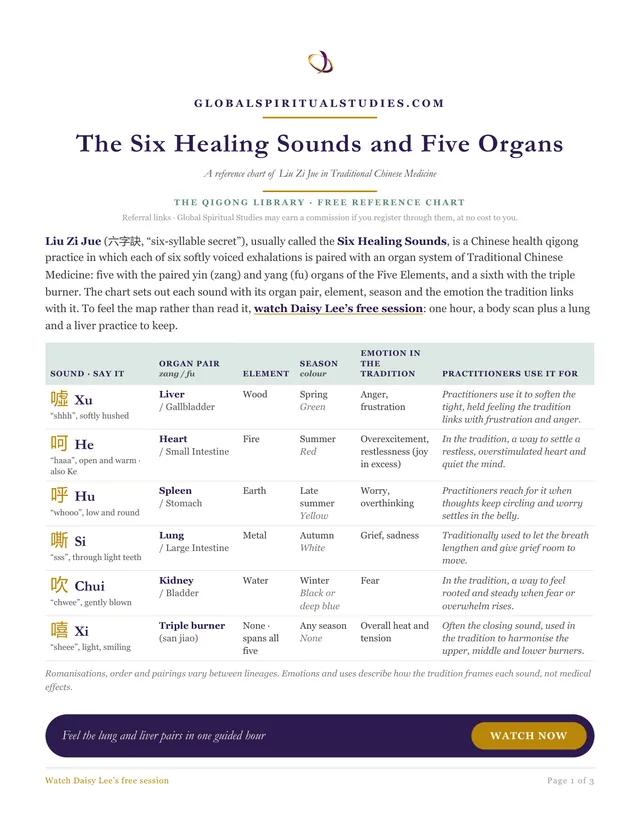
| The Six Healing Sounds (Liu Zi Jue) | Six sounds breathed softly on the out-breath, each paired with an organ: Xu liver, He heart, Hu spleen, Si lungs, Chui kidneys, Xi triple burner. | First named by Tao Hongjing (fifth to sixth century); many modern lineages, including Mantak Chia's. | Exhale-led organ practice, often slow and seated or with simple movements. | Soft, never forced. Spellings, sounds and organ pairings vary between lineages. |
| Gathering Breath | The hands gather toward the body with the in-breath, with the image of qi stored in the bone marrow; may face each direction with its season. | Dr. Roger Jahnke, OMD, adapted from Shaolin Marrow Washing (his 2020 guide). | Part of his beginner practice, often after gentle movement. | Keep the breath comfortable; the image is an invitation, not a physiological claim. |
| Sigh of Relief | A full, easy in-breath followed by an audible, sighing out-breath, repeated until tension shifts. | Dr. Roger Jahnke, OMD (his 2020 guide). | Letting go of tension, at the start of practice or during a hard day. | A few sighs are plenty; stop if you feel lightheaded. |
| Xi Xi Hu Breath | A named breath in Jahnke's teaching, transmitted in his courses rather than in print. | Dr. Roger Jahnke, OMD (his course pages). | Taught within his courses. | Not the same as Robert Peng's Xi breathing or the Xi healing sound. |
| Xi breathing | "Xi means break, or rest": smooth, extended breathing with a small, unforced rest in it, taught with the three dantians and the sounds Aung, Ahhh and Hong. | Robert Peng (his course pages and Q&A archive). | His free session and course, and daily practice afterwards. | Peng publishes no counts or timing. Never strain or hold the breath. |
| Ocean Whisper | A coherence breathing practice; Peng's FAQ calls it a simple breathing technique that helps focus. | Robert Peng (his Xi breathing course). | Early in his course, as a foundation for Xi breathing. | Mechanics are taught in the course, not published; keep any breathing smooth and unforced. |
Compiled from NCCIH; Wikipedia's articles on the dantian, conscious breathing, taixi and Liu Zi Jue; Dr. Roger Jahnke's 2020 guide 7 Qigong Power Tools and his course pages; and Robert Peng's course pages, FAQ and question-and-answer archive. Romanisations and organ pairings for the Six Healing Sounds vary between lineages.
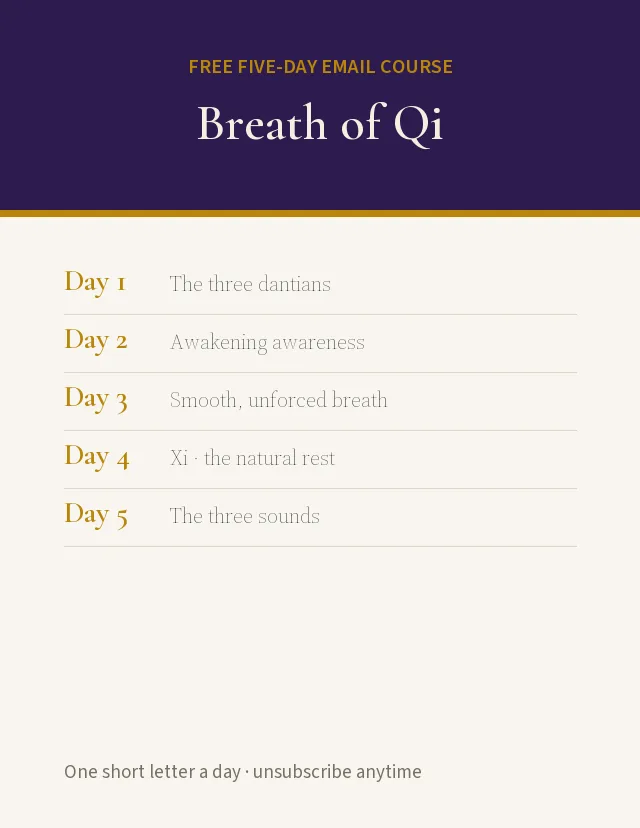
Free email course
Breath of Qi
Five short lessons on Qigong breathing, one a day.
| What’s inside | |
|---|---|
| ✓ | Day 1 · What qi is, and the three centres |
| ✓ | Day 2 · Awakening awareness: where your attention goes |
| ✓ | Day 3 · Smooth, unforced breath |
| ✓ | Day 4 · Xi means rest |
| ✓ | Day 5 · Three sounds for the three centres |
One short email a day for five days · unsubscribe anytime
Reverse and embryonic breathing, read carefully
Reverse abdominal breathing
In reverse breathing the belly draws gently inward as you breathe in and releases as you breathe out, the opposite of natural breathing. It belongs mainly to Daoist and martial traditions, where it is, in Wikipedia's words, "believed to activate healing and protective qi," and where martial artists use it to protect the inner organs. Some schools also pair it with the Six Healing Sounds; one recent stroke-rehabilitation trial describes Liu Zi Jue as combining its mouth shapes with reverse abdominal breathing (PMC13254186).
It is not a beginner's practice. Robert Peng advises against reverse breathing in his published guidance, and most teachers introduce it, if at all, only once natural breathing has become easy. If you want to learn it, learn it in person from a teacher who can watch you breathe.
Embryonic breathing (taixi)
Embryonic breathing, taixi, is the most mysterious phrase in the Qigong vocabulary. In Daoist sources it means breathing like an embryo in the womb, "without using nose or mouth," as Wikipedia summarises it. The alchemist Ge Hong, writing in the Baopuzi in the early fourth century, said the most important thing is simply to breathe like an embryo. Tang-dynasty writers, including the short Taixi jing, or Scripture of Embryonic Breathing, turned the idea inward, from air drawn in from outside to the inner circulation of qi.
Early practitioners tried to reach this state by holding the breath for long periods, and later practitioners abandoned the method because of its dangers (Wikipedia, Taixi). It is worth reading that twice. Embryonic breathing is best understood as a meditative ideal: a breath grown so quiet and fine that it is hardly felt, which arises by itself in deep stillness. It is not a technique to force, and nothing on this page asks you to hold your breath.
Xi breathing is different
Xi breathing is the signature practice of the Qigong master Robert Peng, and it is easy to confuse with other things spelled the same way. His own definition is brief: "The Chinese word Xi means break, or rest. Through a small pause during your breath, you can bathe in the void of consciousness." The practice places a small, unforced rest in the breath and pairs it with the three dantians, the centres of the head, the chest and the lower belly, and with three sounds, Aung, Ahhh and Hong.
It helps to know the ground Xi breathing grows from. Every breath already has natural moments of rest in it, quiet turning points you do not have to create, only notice. Peng's practice works with that rest; where he places the pause, and how, is taught in his own sessions.
Peng transmits the method itself as a living teaching, breath by breath with his students, rather than as counts on a page; versions online that print a timing for the pause are not his. His published principles are clear: smooth, extended breathing, never forced; no reverse breathing; and natural breathing whenever coordinating breath and movement begins to strain. To learn Xi breathing as he teaches it, begin with Robert Peng's free Xi breathing session. The complete guide to his Xi breathing course sets out the session and all seven modules, and the Robert Peng profile tells his story.
Three things called Xi
Xi breathing is Robert Peng's practice of resting in the breath. The Xi sound is the sixth of the Six Healing Sounds, breathed out for the triple burner; the Six Healing Sounds entry sets out all six. The Xi Xi Hu Breath is a named breath in Dr. Roger Jahnke's teaching. Same spelling, three different practices.
Breathing for sleep and for calm
Many people come to Qigong breathing because they cannot sleep, or cannot settle. The research here is precise, and narrower than the claims you will meet online.
No published study yet tests a named Qigong breathing technique on its own, for sleep or for anything else. What exists is research on slow breathing in general. A 2018 systematic review found that slowing the breath was associated with increased heart rate variability, more alpha activity in the brain, and better self-reported emotional state in healthy people, while noting the limits of the studies (Zaccaro et al., 2018, PMC6137615). A 2023 randomised trial found that five minutes a day of cyclic sighing, a breathing practice with a long exhale, improved mood more than mindfulness meditation over a month, though no group showed a significant change in heart rate variability (Balban et al., 2023, PMC9873947). Neither study looked at Qigong.
For Qigong as a whole practice, movement and breath together, NCCIH notes studies suggesting better sleep in people with fibromyalgia and in people with cancer-related fatigue, from studies that are often small (NCCIH).
You will also see Qigong breathing described as stimulating the vagus nerve. That is how the event page for Robert Peng's free session describes Xi breathing, and it is the page's framing rather than a tested finding. Slow breathing is associated with changes in heart rate variability that researchers often read as a sign of parasympathetic activity; no published study tests whether Xi breathing, or any named Qigong breath, stimulates the vagus nerve.
A fair summary: slow, relaxed breathing is the kind of practice researchers have linked with calmer mood, and many people find a few quiet minutes of it a kind way to end the day. Peng teaches a bedtime practice he calls Nourishing Qi, resting awareness in the lower dantian, and the five-minute practice below works as well lying in bed as sitting in a chair. If sleeplessness persists, talk with your clinician.
Common mistakes
- Forcing the breath. Breathing more deeply is not the same as breathing better. If you are pulling the breath in or pushing it out, ease off. Smooth and never forced is a good rule for every technique on this page.
- Holding the breath. Deliberate breath holds belong to other practices. Classical embryonic breathing once used them, and later practitioners abandoned them. The small natural pause at the end of a breath is one thing; a held breath is another, and it has no place in this practice.
- Reverse breathing without a teacher. It can feel awkward and effortful, and it is easy to learn badly from a page or a video. Master natural breathing first, and learn reverse breathing, if you want it, in person.
- Breathing too fast or too hard. Rapid, heavy breathing can leave you lightheaded, tingling or anxious. That is a signal to stop and breathe normally, not to push through.
- Shoving the belly out. Abdominal breathing lets the belly soften; it does not push it forward. The movement should be small.
- Chasing a sensation. Some people expect warmth, tingling or a felt sense of qi, and strain to find it. The practice goes better when whatever you feel is allowed to be enough.
Please read
Never strain the breath and never hold it. If you feel dizzy, lightheaded or short of breath, stop and breathe normally. Do not practise breathing exercises in or near water, or while driving.
This guide is educational and is not medical advice. Qigong complements medical care; it does not replace it. Talk with your clinician before starting, especially if you are pregnant, recovering from surgery, or have balance, back or heart conditions.
A five-minute breathing practice
Here is an invitation rather than a routine. There are no counts to keep and no pattern to match. Sit, or lie on your back with your knees bent if that is easier.
- Arrive. Sit near the front of a steady chair with your feet flat and your spine easy, hands resting on your thighs. Let your eyes close, or soften your gaze toward the floor.
- Let the breath be. For a minute or so, change nothing. Notice the air at the nostrils, a little cool as it comes in, a little warmer as it leaves.
- Hands on the lower belly. Rest your hands just below the navel. Notice the belly soften outward as you breathe in and settle as you breathe out. If the breath wants to slow and lengthen, let it. If not, leave it as it is.
- Notice the rest. At the end of each breath there is a moment where nothing needs to happen. Do not hold it or stretch it. Notice it, and let the next breath arrive in its own time.
- Let attention settle low. Let your attention rest in the lower belly, as if the breath were being gathered there. When thoughts come, and they will, return to the feeling under your hands.
- Close gently. Let your hands rest, open your eyes, and notice how you feel, whatever that is, before you stand.
That is the whole of it. Practised on most days, it becomes a place you can return to: in a waiting room, before a difficult conversation, or in bed before sleep. It asks nothing of you but a few minutes and a little kindness toward your own breath.
Where to learn
Breath is learned by following someone. Two of the most respected Qigong teachers working in English each teach a free session built around the breath, and each is the authority on a different door into it.
Robert Peng · Xi breathing
Robert Peng's free session, Connect to Your Inner Joy Through Qigong's Xi Breathing, explains what Xi means, how to awaken and align the three dantians and the Central Meridian that joins them, and leads a seated round of Xi breathing; the hour teaches no movement, which is left for the course. Peng began his apprenticeship at the age of eight under the monk Xiao Yao in Hunan, and has taught more than 150,000 students, according to his course page. His authority is a lineage apprenticeship begun in childhood and decades of teaching. The free hour opens onto his seven-module course, Awaken Your Inner Power Through Qigong & Xi Breathing.
If Xi breathing is the thread you want to follow, the clearest way in is that seated round with Peng himself, in his free hour.
Breathe alongOpens the course page · the complete course guide covers what follows
Dr. Roger Jahnke · the four-part breath
Dr. Roger Jahnke, OMD, founder of the Institute of Integral Qigong and Tai Chi and co-founder of the National Qigong Association, teaches breath as one of four practices, or "baskets," alongside movement, self-massage and meditation. His free session, Discover the Power of Qi Medicine, includes a four-part Qigong breathing practice that his course page calls the foundation for activating Qi Medicine, together with his view that "the most profound medicine is produced within." The session opens onto Qi Medicine with Roger Jahnke, seven on-demand modules. The Roger Jahnke profile covers his books and his research.
Xi breathing, from its teacher
Breathe with Robert Peng
His recorded hour teaches the three dantians, the Central Meridian and a guided, seated round of Xi breathing, at a pace you set.
Connect to Your Inner Joy Through Qigong's Xi Breathing
A recorded session with Robert Peng
| What the hour gives you | |
|---|---|
| ✓ | About sixty minutes with Robert Peng, recorded, to watch whenever it suits you |
| ✓ | The three dantians, where each sits and what each is said to hold |
| ✓ | The Central Meridian and the Four Golden Wheels of vitality, love, wisdom and harmony |
| ✓ | A guided, seated round of Xi breathing, at a pace you set |
| ✓ | A tour of the seven-module course and its bonuses |
Recorded session
Free
About sixty minutes · a breath practice to keep
Watch nowOpens the library's course page, with the session one click away.
- RegisterA short form reserves your place
- Breathe alongA seated round of Xi breathing
- Decide laterThe course is presented at the end
Seated, no movement needed · decide about the course in your own time.
Email course · 5 days
Learn the breath, one day at a time
Five short lessons, from the three centres to the three sounds.
Start day oneSources
Health and research: NCCIH, Qigong: What You Need To Know (updated February 2022); Zaccaro et al., Frontiers in Human Neuroscience, 2018 (PMC6137615); Balban et al., Cell Reports Medicine, 2023 (PMC9873947); Liu Zi Jue stroke-rehabilitation trial (PMC13254186), cited for the practice description only.
Tradition: Wikipedia, Dantian; Conscious breathing; Taixi (embryonic breathing); Liu Zi Jue. Teachers: Robert Peng on The Shift Network (Connect to Your Inner Joy Through Qigong's Xi Breathing; Awaken Your Inner Power Through Qigong & Xi Breathing) and robertpeng.com (Q&A archive, FAQs); Dr. Roger Jahnke, 7 Qigong Power Tools for Enthusiastic Citizens (2020) and The Shift Network (Discover the Power of Qi Medicine; course pages). Checked 30 September 2026.
Frequently asked questions
What is Qigong breathing?
Qigong breathing is slow, attentive breathing used as the bridge between body and mind in Qigong practice. Most forms use relaxed abdominal breathing through the nose, with attention resting in the lower belly, and several traditions add named techniques such as reverse breathing, the Six Healing Sounds, Robert Peng's Xi breathing and Roger Jahnke's Gathering Breath.
How do you breathe in Qigong?
Most Qigong begins with natural breathing: slow, quiet and through the nose, with the belly softening outward as you breathe in and settling as you breathe out, the chest and shoulders easy. The breath is never forced or held. In moving forms the breath usually follows the movement, in as the body opens or rises and out as it closes or lowers, and natural breathing is always fine if coordinating the two feels effortful.
Should I breathe into my belly or my chest in Qigong?
Into the belly, gently. Abdominal breathing, in which the belly softens outward on the in-breath, is the baseline for almost every Qigong form, and attention usually rests in the lower dantian a little below the navel. The chest is not held still, but it stays relaxed. Do not push the belly out; the movement should be small.
What is reverse breathing in Qigong?
Reverse abdominal breathing draws the belly gently inward on the in-breath and releases it on the out-breath, the opposite of natural breathing. It comes from Daoist and martial traditions and is an advanced practice. Learn it in person from a teacher, after natural breathing has become easy. Robert Peng advises against it in his published guidance.
What is embryonic breathing?
Embryonic breathing, taixi in Chinese, is a Daoist ideal of breathing like an embryo in the womb, so quietly and finely that the breath is hardly felt. It appears in Ge Hong's Baopuzi in the early fourth century and in Tang-dynasty texts. Early practitioners used long breath holds to pursue it, a method later abandoned as dangerous. It is best understood as a state of deep stillness that arises by itself, not a technique to force.
What is Xi breathing?
Xi breathing is a gentle practice taught by the Qigong teacher Robert Peng, who explains that the Chinese word Xi means break, or rest. It places a small, unforced rest in the breath and is taught with the three dantians and the sounds Aung, Ahhh and Hong. Peng publishes no counts or timing for it; the method is taught in his free session and course. It is different from the Xi sound of the Six Healing Sounds and from Roger Jahnke's Xi Xi Hu Breath.
What is Xi Xi Hu breathing?
The Xi Xi Hu Breath is a named breath in Dr. Roger Jahnke's Qigong teaching, listed on his course pages. He transmits its method in his courses rather than in print. It is a different practice from Robert Peng's Xi breathing.
Is there a Qigong breathing PDF?
The Qigong Library's free breathing resource is Breath of Qi, a five-day email course: one short email a day on qi and the three centres, awareness, smooth and unforced breathing, the natural rest in the breath, and the three sounds, each with a few minutes of gentle practice. You can request it with the button on this page.
Does Qigong breathing help with sleep?
No study has tested a named Qigong breathing technique for sleep. Research on slow breathing in general links it with calmer mood, and NCCIH notes studies suggesting Qigong as a whole practice may improve sleep in people with fibromyalgia or cancer-related fatigue, though many studies are small. Many people find a few minutes of slow belly breathing a kind way to end the day. If sleeplessness persists, talk with your clinician.
Does Qigong breathing stimulate the vagus nerve?
That claim has not been tested. The event page for Robert Peng's free session describes Xi breathing as stimulating the vagus nerve, but no published study tests Xi breathing or any named Qigong breath for that effect. Slow breathing in general is associated with changes in heart rate variability that researchers often read as parasympathetic activity, and a 2023 trial of a different slow-breathing practice found better mood without a significant change in heart rate variability.
Can I do Qigong breathing lying down?
Yes. Natural abdominal breathing works well lying on your back with the knees bent and a hand resting on the lower belly, and some teachers offer bedtime practices, such as Robert Peng's Nourishing Qi, that rest attention in the lower dantian. Seated or standing practice keeps you more alert; lying down suits winding down before sleep.
Is Qigong breathing safe?
Gentle, natural Qigong breathing is generally safe, and NCCIH describes Qigong as appearing to be a safe form of activity. Never strain or hold your breath, stop and breathe normally if you feel dizzy or lightheaded, and never practise breathing exercises in or near water or while driving. If you are pregnant, recovering from surgery, or have heart, lung, balance or back conditions, talk with your clinician first. Qigong complements medical care; it does not replace it.
The breath has been with you all along · Qigong only asks you to notice it, and to stop pushing.