Energy Centers Across Cultures
Beyond the seven chakras · how the world's traditions map the body's vital energy
The idea that the human body contains distinct centres of vital energy is not unique to South Asia. Across the world, from the mountains of Tibet to the poetic and initiatory traditions of early Ireland, from the Taoist monasteries of China to the ceremonial traditions of the Andes, cultures separated by vast geography and historical distance developed intriguingly similar maps of the subtle body. Nearly all organise around a three-tiered structure: a lower centre governing physical vitality, a middle centre governing emotion and relationship, and an upper centre governing wisdom and spiritual connection. The convergence invites a question worth sitting with: what is it about human experience that leads such different traditions to the same essential geography?
In Brief
- - The Hindu-Buddhist seven-chakra model is the best-known energy map in the West, but it is one system among many
- - Taoist tradition works with three dantian (energy reservoirs) rather than seven spinning centres · a difference in practice, not just terminology
- - The Celtic Three Cauldrons of Poesy, from a seventh-century Irish poem, offer one of Europe's oldest body-energy maps
- - Tibetan Buddhism uses a distinct five-chakra system oriented toward dissolving winds into the heart centre
- - Nearly every tradition converges on the same three-tiered pattern: lower (vitality), middle (emotion), upper (wisdom)
The Hindu-Buddhist Chakra System · The Familiar Map
Most readers will arrive here already knowing the seven-chakra system: Root, Sacral, Solar Plexus, Heart, Throat, Third Eye, Crown. Seven centres arranged along the spine, each governing a distinct range of physical, emotional, and spiritual functions. This is the map that appears in yoga studios, wellness books, and guided meditations worldwide. It serves as useful common ground.
What is worth noting before we step into other traditions is that the modern Western version of this system is itself a synthesis. The rainbow colour associations (red for the root, violet for the crown) were introduced by Christopher Hills in the 1970s. The psychological meanings (self-esteem for the solar plexus, communication for the throat) are largely Western contributions, not features of the original tantric texts. The Sat-Cakra-Nirupana, the sixteenth-century Bengali text most often cited as the source, describes six chakras plus the thousand-petalled Sahasrara above them. Other Hindu and Buddhist texts describe five, eight, nine, twelve, or twenty-one.
None of this diminishes the seven-chakra model. It has proven remarkably useful as a contemplative tool. But knowing it is one map among many frees us to look at the atlas with wider eyes. The traditions that follow are not alternatives to the chakra system. They are cousins, each carrying unique wisdom from its cultural soil, each illuminating something the others do not.
For a full exploration of the seven chakras, their correspondences, and healing practices, see our complete guide to the seven energy centers.
Taoist Three Dantian
Where the Hindu-Buddhist model maps seven spinning gateways along the spine, the Taoist tradition works with three dantian · broad energy fields, each functioning as a reservoir where vital energy is cultivated, stored, and refined. The word dantian translates roughly as "elixir field," reflecting the alchemical nature of Taoist internal practice.
The Three Fields
The Lower Dantian (Xia Dantian) sits about three finger-widths below the navel and slightly inward toward the spine. It stores Jing · generative essence, the most dense and physical form of vital energy. This is the body's foundational reservoir, the centre that governs physical vitality, sexual energy, and the raw material of life force. It parallels the Root and Sacral chakras in function.
The Middle Dantian (Zhong Dantian) resides at the centre of the chest, near the heart. It holds Qi · vital energy, the breath of life that animates all function. Emotional balance, relational harmony, and the capacity for compassion flow from this centre. It parallels the Heart chakra and, in some systems, the Solar Plexus as well.
The Upper Dantian (Shang Dantian) lies between the eyebrows, extending inward toward the centre of the skull. It houses Shen · spirit, awareness, luminous consciousness. This is the seat of insight, clarity, and the capacity for spiritual perception. It parallels the Third Eye and Crown chakras.
A Different Way of Working
The key difference between dantians and chakras is not merely the number of centres but the nature of the practice. Chakras are described as spinning wheels through which energy flows · gateways that open and close, that can become blocked or overactive. Dantians are reservoirs that fill and empty, fields to be cultivated over time like a garden. Taoist cultivation refines energy sequentially · Jing is transformed into Qi, Qi into Shen · in the practice the tradition calls neidan, or internal alchemy. Jing, Qi and Shen are themselves the Three Treasures: the substances being refined, rather than a name for the refining.
The meridians that acupuncture works with serve as the energy channels connecting and feeding these centres, parallel to the nadis of yogic energy anatomy. Where yogic practice counts 72,000 nadis, traditional Chinese medicine maps twelve primary meridians and eight extraordinary vessels. The comparison of prana, qi, and jing reveals not just different words for vital energy but different ways of classifying it, each shaped by centuries of practice.
| Dantian | Location | Energy Stored | Function | Chakra Parallel |
|---|---|---|---|---|
| Lower (Xia) | Below navel | Jing (essence) | Physical vitality, generative power | Root + Sacral |
| Middle (Zhong) | Centre of chest | Qi (vital energy) | Emotional balance, relational harmony | Heart |
| Upper (Shang) | Between brows | Shen (spirit) | Clarity, insight, spiritual awareness | Third Eye + Crown |
To see how the three fields are cultivated in practice today, start with our guide to what qi is and the three dantians, then try Robert Peng's Xi breathing, which works each dantian in turn.
The Celtic Three Cauldrons of Poesy
One of Europe's oldest surviving body-energy maps comes from an unlikely source: an Irish poem dated to about the seventh century on linguistic grounds, surviving in a sixteenth-century manuscript. The attribution to Amergin is a modern convention rather than a claim the text makes for itself. The Cauldrons of Poesy describes three cauldrons within the body, each governing a distinct dimension of human capacity. It is a text that most readers of energy literature have never encountered, yet it articulates a framework as sophisticated as anything found in Asia.
The Three Cauldrons
The Cauldron of Warming (Coire Goiriath) sits in the belly and pelvis. It governs physical vitality, health, and the raw energy of being alive. This is the only cauldron that is upright at birth in every person · the body's baseline gift of life force. It parallels the Root and Sacral chakras in function and location.
The Cauldron of Motion (Coire Ermai) rests in the chest, near the heart. It governs emotion, creative skill, and the capacity for relationship · everything that moves within us and between us. In most people, this cauldron begins on its side, neither fully active nor dormant. It turns upright through the joys and sorrows of lived experience. It parallels the Heart and Solar Plexus chakras.
The Cauldron of Wisdom (Coire Sois) resides in the head. It governs wisdom, spiritual insight, and what the Irish tradition calls imbas · prophetic inspiration, the poetic fire. In most people, this cauldron is inverted at birth. Turning it upright is the work of a lifetime, requiring both intellectual cultivation and direct spiritual experience. It parallels the Third Eye and Crown chakras.
Upright, On Its Side, Inverted
What makes this system distinctive is the cauldron-orientation metaphor. Each cauldron can be upright (full potential expressed), on its side (partially active), or inverted (dormant). The Cauldron of Warming is upright at birth · we arrive in the world with physical vitality. The Cauldron of Motion turns through emotional experience · grief, love, longing, and creative struggle all serve as the heat that rights it. The Cauldron of Wisdom turns only through what the poem calls "the two fires of art" · the fire of inspiration and the fire of suffering transformed into insight.
This is a developmental model. Where the chakra system describes centres that can be balanced at any time through practice, the Celtic model suggests a natural progression · a slow turning of the inner vessels that unfolds across a life. The Druidic concept of nwyfre (life force) is explicitly equated with qi and prana in modern Druid teaching, particularly in the work of Philip Carr-Gomm and the Order of Bards, Ovates and Druids (OBOD).
| Cauldron | Location | Governs | Birth State | Chakra Parallel |
|---|---|---|---|---|
| Warming (Coire Goiriath) | Belly / pelvis | Physical vitality, health | Upright | Root + Sacral |
| Motion (Coire Ermai) | Chest / heart | Emotion, creative skill, relationship | On its side | Heart + Solar Plexus |
| Wisdom (Coire Sois) | Head | Spiritual insight, poetic inspiration | Inverted | Third Eye + Crown |
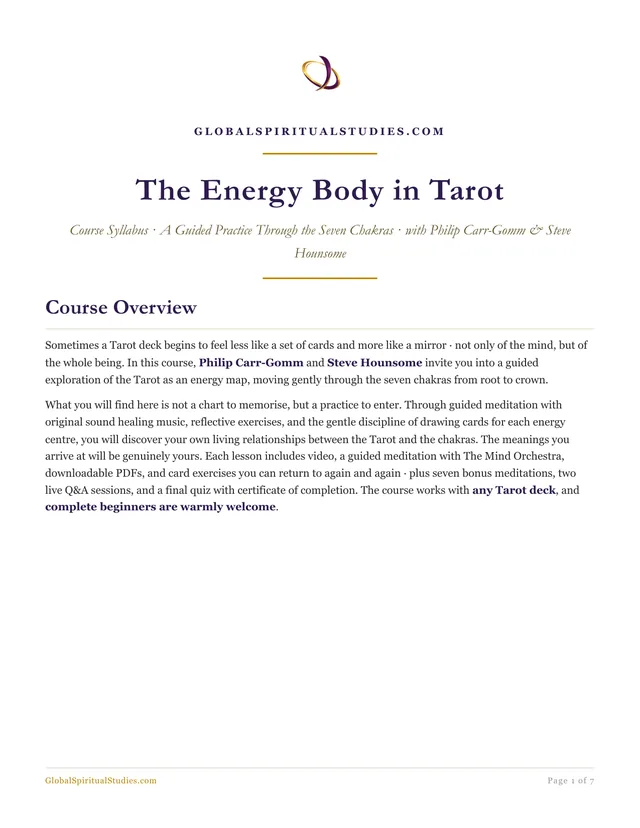
Carr-Gomm brings this Celtic energy wisdom into conversation with the chakra tradition in his course The Energy Body in Tarot, co-taught with Steve Hounsome, which guides students through each energy centre using Tarot archetypes, guided meditation, and original sound healing music.
Tibetan Buddhist Five-Chakra System
Tibetan Buddhism developed its own energy-body model independently from the Hindu system, and the differences are more than cosmetic. Where the Hindu tradition describes seven primary chakras, the Tibetan Vajrayana system works with five, each with a different number of "spokes" (channel petals) and a different orientation of practice.
The Five Centres
| Tibetan Centre | Location | Spokes | Hindu Parallel | Hindu Petals |
|---|---|---|---|---|
| Crown (Great Bliss) | Top of head | 32 | Sahasrara | 1,000 |
| Throat (Enjoyment) | Throat | 16 | Vishuddha | 16 |
| Heart (Dharma) | Centre of chest | 8 | Anahata | 12 |
| Navel (Emanation) | Below navel | 64 | Manipura | 10 |
| Secret (Holding Bliss) | Base of torso | 32 | Muladhara / Svadhisthana | 4 / 6 |
The Throat centre is the only point where the two systems agree exactly on the number of spokes. Every other centre differs, sometimes dramatically: the Tibetan Navel centre has 64 spokes compared to the Hindu Manipura's 10 petals, reflecting different understandings of how energy organises in that region of the body.
A Different Direction of Practice
The most significant difference is directional. In the Hindu kundalini model, the practitioner awakens dormant energy at the base of the spine and guides it upward through each chakra to the crown, where individual consciousness merges with the universal. The path moves from root to crown.
In the Tibetan system, the orientation is different. The goal of highest yoga tantra practices like tummo (inner fire) is to dissolve the "winds" (lung, equivalent to prana) into the central channel at the heart centre · not the crown. The heart is considered the seat of the very subtle mind, the indestructible drop where consciousness resides at the moment of death and from which it transitions to the next life. Enlightenment, in this framework, is realised at the heart.
This is not merely a technical distinction. It reflects a different understanding of where ultimate awareness lives · at the crown of the head or at the centre of the chest. Both traditions might respond that the distinction dissolves at the highest levels of practice, but the path to that dissolution differs in ways that shape the entire contemplative life of the practitioner.
Shamanic Three-Worlds Model
Across widely separated cultures, from Siberia to South America, from West Africa to Polynesia, practitioners of what scholars call shamanic traditions have worked with a three-worlds cosmology that maps naturally onto the body. This is not a single unified system but a recurring pattern, emerging independently in different cultural contexts.
The Three Worlds in the Body
The Lower World corresponds to the belly, pelvis, and legs. It is earthy, primal, and receptive, the domain of ancestral memory, instinct, and the raw power of the physical body. In practice, the lower world is accessed through journeying "downward," often through visualised openings in the earth. It parallels the Root and Sacral chakras.
The Middle World corresponds to the heart and solar plexus. It is the domain of present-moment awareness, dynamic balance, and relationship with the living world. The middle world is where the practitioner stands, the bridge between earth and sky. It parallels the Heart and Solar Plexus chakras. Some contemporary practices enter that relationship through plants: in Flower Essence Shamanism, herbalist Gina Kearney meets each of the four elements through a flower, first in meditation and then in shamanic journey.
The Upper World corresponds to the head and crown. It is expansive, luminous, and transcendent, the domain of spiritual vision, connection with guiding forces, and the larger patterns that shape existence. It parallels the Third Eye and Crown chakras.
Diverse Expressions
Soul retrieval, one of the most widespread healing techniques in shamanic practices, can be understood as restoring vital energy to depleted centres, particularly the heart and crown. When a person loses a piece of their soul through trauma, grief, or shock, the healer journeys to find and return it. The language differs from chakra work, but the embodied geography is strikingly similar.
Alberto Villoldo, drawing on the Q'ero tradition of Peru, describes a nine-centre system: the seven body-based centres familiar from the Hindu model, plus an eighth centre (Wiracocha) above the head, representing the soul's connection to the cosmos, and a ninth at the heart of the universe itself, representing the source from which all energy flows.
Many Native American traditions, while not systematising the body into numbered centres, work with energy through holistic frameworks. The Navajo (Dine) concept of "Walking in Beauty" describes health as a state of harmony · balanced relationship between the individual, the community, and the land. The Medicine Wheel, found in various forms across Plains and Plateau cultures, organises experience into four directions, each carrying qualities that roughly parallel the lower-to-upper progression: physical, emotional, mental, and spiritual.
A note of respect is warranted here. Many indigenous practitioners prefer that specific ceremonial teachings remain within their communities, transmitted through proper relationship and initiation rather than published in books or websites. We reference these traditions to honour the breadth of human wisdom about the energy body, not to claim authority over teachings that belong to living cultures. Readers drawn to these practices are encouraged to seek out indigenous teachers and community-based learning.
The Universal Three-Tier Pattern
Step back far enough and a striking pattern emerges. Nearly every tradition that developed a body-centred energy model arrived at some version of the same three-tiered structure.
- Lower centre (belly / pelvis): physical vitality, generative power, grounding in the material world
- Middle centre (chest / heart): emotion, relationship, the capacity to give and receive, creative expression
- Upper centre (head / crown): wisdom, spiritual insight, connection to something larger than the self
This pattern appears in the Hindu chakra groups (lower three, heart bridge, upper three), the Taoist three dantian, the Celtic three cauldrons, the shamanic three worlds, and the Tibetan five-chakra clusters (which group naturally into lower, middle, and upper). The consistency across unrelated cultures and historical periods is remarkable.
| Body Zone | Hindu | Taoist | Celtic | Tibetan | Shamanic |
|---|---|---|---|---|---|
| Lower (belly / pelvis) | Root + Sacral | Lower Dantian (Jing) | Cauldron of Warming | Secret + Navel | Lower World |
| Middle (chest / heart) | Solar Plexus + Heart | Middle Dantian (Qi) | Cauldron of Motion | Heart | Middle World |
| Upper (head / crown) | Throat + Third Eye + Crown | Upper Dantian (Shen) | Cauldron of Wisdom | Throat + Crown | Upper World |
It would be a mistake to conclude that these systems are "all the same." They are not. The Taoist practitioner cultivating Jing in the lower dantian is doing something quite different from the kundalini yogi awakening energy at Muladhara. The Celtic poet working to turn the Cauldron of Wisdom is engaged in a process that does not map neatly onto Tibetan tummo practice. Each tradition carries its own vocabulary, its own methods, its own cultural context, and its own understanding of what the energy body ultimately is.
What the convergence does suggest is that this three-tiered energy anatomy (belly, heart, head) may be a fundamental structure of human awareness, something the body recognises before any tradition teaches it. You have felt it: the gut-level instinct that precedes thought, the heart that opens or closes in the presence of another person, the clarity that sometimes arrives at the crown of the skull like light through a window. The traditions do not create this experience. They give us language for what is already there, and then they offer practices for working with it more skillfully.
The invitation, for those drawn to more than one tradition, is not to flatten these systems into a single map but to let each tradition illuminate the others. Study the chakras and the dantian. Read the Cauldrons of Poesy alongside the Tibetan tantric texts. Let the differences teach you as much as the similarities. The body's wisdom is larger than any single tradition's account of it.
Explore the Chakras

Featured Course
The Energy Body in Tarot
A Guided Practice Through the Seven Chakras · with Philip Carr-Gomm & Steve Hounsome
Nine lessons exploring the hidden energy map in every Tarot deck. Guided meditations with original sound healing music, practical exercises for each chakra, and a transformative journey from root to crown.
- 12 video lessons across nine sessions
- 15 guided meditations
- 12 PDF handouts
- Sound healing music
- Community forum
- Lifetime access
- Final quiz
- Certificate of completion
Printable Reference
Want every chakra in one chart? See our free 7-chakra reference chart · the complete correspondence table with colours, elements, and seed (bija) sounds, plus a printable PDF to keep beside your practice.
Related reading · Some traditions meet the elements through living plants rather than energy centers. Explore the four elemental flowers · Earth, Air, Fire and Water · or begin with our complete guide to flower essences.
Frequently Asked Questions
Are chakras and meridians the same thing?
No. Chakras are energy centres · concentrated points where vital energy gathers and can be worked with directly. Meridians are energy channels · pathways through which energy flows between centres and throughout the body. In yogic anatomy, the equivalent of meridians are the nadis. Chakras and dantian are the reservoirs; meridians and nadis are the rivers that connect them.
Do Celtic traditions have chakras?
Not by that name, but the Celtic tradition has its own body-energy system: the Three Cauldrons of Poesy, described in a seventh-century Irish poem. The Cauldron of Warming (belly), the Cauldron of Motion (heart), and the Cauldron of Wisdom (head) parallel the three-tiered structure found in the chakra system. Modern Druid teachers, including Philip Carr-Gomm of OBOD, explicitly connect the Celtic concept of nwyfre (life force) with prana and qi.
What is the difference between a dantian and a chakra?
The most important difference is functional. Chakras are described as spinning gateways through which energy flows · they can open, close, or become blocked. Dantians are reservoirs where energy is stored and cultivated over time, like fields being tended. Taoist practice refines energy sequentially through the three dantians (Jing to Qi to Shen), while chakra practice may work with any centre at any time depending on what needs attention.
Can I work with more than one energy system?
Yes, and many practitioners do. A person might practise chakra meditation, study qigong to cultivate the dantian, and draw on the Celtic cauldron framework for creative and poetic development. The key is to approach each tradition on its own terms rather than blending them into a single homogenised system. Let each map teach you something the others do not, and honour the cultural context each comes from. If you'd like to discover where to begin, our free Tarot chakra quiz uses the Tarot's archetypal language to reveal which energy centre is calling you.
Are there energy centre systems in African or Indigenous American traditions?
Yes. Many African and Indigenous American traditions work with the body as an energy system, though they may not use numbered centres in the way the Hindu or Taoist models do. The Navajo (Dine) concept of Walking in Beauty describes health as balanced energy flowing through the whole person in relationship with the land and community. The Medicine Wheel organises experience into physical, emotional, mental, and spiritual dimensions. Many of these teachings are transmitted within community and ceremony rather than through published texts, and practitioners of these traditions often prefer they remain in that context.
This guide is part of our comprehensive resource on the energy body. Return to Chakras · A Complete Guide to the Seven Energy Centers
Many traditions describe the body as a layered field of energy, and the world's healing arts have independently found ways to honour that knowledge.