Kundalini Energy
The serpent path from root to crown
Kundalini is the name given in the Hindu tantric tradition to a form of primal energy understood to lie dormant at the base of the spine, coiled like a serpent around the root chakra. When awakened through practice, intention, or sometimes spontaneously, this energy is said to rise through the central channel of the body, passing through each of the seven chakras in turn until it reaches the crown, where individual consciousness merges with something universal. The journey from root to crown is the oldest map of spiritual transformation in South Asian tradition, and versions of it appear in nearly every contemplative lineage on earth.
The Sanskrit word kundalini derives from kundala, meaning "coiled." The energy is personified as Shakti, the feminine creative force of the universe, sleeping at the base of the spine until she is called to rise and reunite with Shiva, pure consciousness, at the crown. This is not merely a physiological claim. It is a creation myth told through the body: the separation of matter and spirit, and their eventual reunion through disciplined inner work.
This guide traces the kundalini concept from its roots in the tantric traditions through its striking parallels in Kabbalah, Taoism, and Celtic mysticism. It covers what the awakening process involves, what practitioners report experiencing, and what safety considerations are essential for anyone drawn to this work.
In Brief
- - Kundalini is understood as dormant creative energy coiled at the base of the spine, personified as Shakti in the Hindu tradition
- - When awakened, it rises through the seven chakras via the central channel (sushumna nadi) toward union with pure consciousness at the crown
- - The Kabbalah tradition describes a nearly identical process: the Shekhinah (feminine divine presence) ascending the Tree of Life from Malkuth to Keter along the Path of the Serpent
- - Kundalini awakening can produce intense physical, emotional, and perceptual experiences · preparation and grounding practices are essential
What Kundalini Is
In the tantric traditions of Hinduism and certain schools of Buddhism, kundalini is described as a latent form of creative energy stored at the base of the spine, in the region of the root chakra (Muladhara). The classical texts describe it as coiled three and a half times around a svayambhu linga (self-born symbol of Shiva) at the base of the central channel. It is not a muscle, a nerve, or a gland. It is understood as the body's reserve of the same energy that creates and sustains the universe, concentrated at the densest point of the physical form.
The earliest detailed descriptions appear in the Dhyanabindu Upanishad (a medieval Yoga Upanishad, roughly twelfth to fifteenth century), the Yoga Kundalini Upanishad, and the Hatha Yoga Pradipika (fifteenth century CE). The most influential synthesis is the Sat-Cakra-Nirupana of 1577 CE by Purnananda Swami, translated into English by Sir John Woodroffe as The Serpent Power in 1918. Woodroffe's translation became the primary source through which the Western world encountered kundalini, and it remains the standard reference.
The energy is called "serpent power" because of its coiled nature and because its movement upward through the body follows a serpentine path, weaving between the left and right energy channels as it ascends. This serpentine movement is not just a metaphor. It describes the experiential quality that practitioners report: a sense of energy spiralling upward through the core, passing through each chakra like a wave moving through still water.
The Shiva-Shakti Creation Story
The theology behind kundalini is a love story told in the language of cosmology. In the Shaiva Tantra tradition, the universe is created through the interplay of two principles: Shiva (pure consciousness, formless awareness) and Shakti (creative power, the energy that gives rise to form). They are not two separate beings but two aspects of a single reality, the way heat and light are two aspects of a single flame.
In the act of creation, Shakti descends from union with Shiva at the summit of consciousness and becomes the manifest universe · matter, sensation, thought, individuality. At the densest point of this descent, she comes to rest at the base of the body, coiled and dormant. She has become the world, but in doing so, she has forgotten her origin.
The spiritual path, in this framework, is Shakti's journey home. Through practice, devotion, or grace, the dormant energy awakens and begins to ascend through the chakras, each one representing a stage of remembering. At each centre, some portion of the forgetting dissolves. When she reaches the crown and reunites with Shiva, the practitioner experiences what the tradition calls samadhi · the dissolution of the boundary between individual and universal consciousness.
This is not presented as a one-time event. It is a process that unfolds across a lifetime of practice, with partial awakenings, setbacks, and gradual deepening. The reunion at the crown is understood as both the goal and the natural state that was never truly lost.
Kundalini and the Chakras
The seven chakras are the stations of kundalini's ascent. Each centre acts as both a gateway and a transformer: as the energy passes through, it activates that centre's qualities and integrates them into the practitioner's expanding awareness.
| Chakra | What Kundalini Activates Here | Experience |
|---|---|---|
| Root · Muladhara | Survival instincts, relationship to the physical body | Grounding, a felt sense of being fully in the body |
| Sacral · Svadhisthana | Creativity, sexuality, emotional fluidity | Waves of feeling, creative surges, sensual awareness |
| Solar Plexus · Manipura | Personal power, will, identity | Heat, a burning away of self-doubt, clarity of purpose |
| Heart · Anahata | Compassion, love, the bridge between body and spirit | Profound openness, grief release, a sense of universal love |
| Throat · Vishuddha | Truth, authentic expression | Clarity of voice, a feeling that speech arises from a deeper source |
| Third Eye · Ajna | Intuition, inner vision, command centre | Visual phenomena, heightened perception, access to insight |
| Crown · Sahasrara | Unity consciousness, dissolution of the ego boundary | Bliss, stillness, the sense of merging with everything |
The ascent is not always linear. Energy may rise to one centre and hold there for months or years while the practitioner integrates the lessons of that level. It may recede and need to be coaxed upward again. In some cases, it bypasses lower centres and erupts at a higher one, producing intense experiences that require grounding work to stabilise. The classical texts are clear: kundalini has its own intelligence and does not always follow the practitioner's preferred schedule.
The Three Nadis
Kundalini travels through a network of subtle energy channels called nadis. The yogic texts describe 72,000 nadis in the body, but three are central to kundalini's ascent.
Sushumna is the central channel, running along the spine from the root to the crown. Kundalini rises through the sushumna. When this channel is clear, energy flows unimpeded and the chakras activate in sequence. Most yogic practice is ultimately aimed at clearing the sushumna.
Ida runs along the left side of the sushumna. It carries lunar, cooling, receptive energy. It is associated with the feminine, the parasympathetic nervous system, and the left nostril.
Pingala runs along the right side. It carries solar, heating, active energy. It is associated with the masculine, the sympathetic nervous system, and the right nostril.
Ida and Pingala weave around the sushumna in a double-helix pattern, crossing at each chakra. When the two channels are balanced · equal flow through both nostrils, neither the active nor the receptive mode dominant · the conditions arise for kundalini to enter the central channel and begin its ascent. This is why Nadi Shodhana (alternate nostril breathing) is such a foundational practice: it directly balances the two lateral channels.
The caduceus of Hermes · two serpents winding around a central staff, crowned by wings · is sometimes cited as a Western echo of this anatomy. Whether the parallel is historical or archetypal, the image is remarkably precise: two spiralling energies around a central axis, meeting at the crown.
The Path of the Serpent in Kabbalah
The Kabbalah tradition describes a process strikingly parallel to kundalini, using different language and a different map but tracing the same trajectory: feminine creative energy ascending from the densest point of creation to reunion with the divine at the summit of consciousness.
On the Tree of Life, the Shekhinah · the feminine indwelling presence of God · resides at Malkuth (Kingdom), the lowest sephirah, which corresponds to the physical world and the root chakra. The Path of the Serpent is the winding route the Shekhinah takes as she ascends through all ten sephirot to reunite with the divine at Keter (Crown).
The structural parallels between the two systems are detailed in our guide to chakras and the Tree of Life, but the kundalini-specific correspondences deserve particular attention:
| Hindu System | Kabbalistic Parallel |
|---|---|
| Kundalini (Shakti) | Shekhinah (feminine divine) |
| Dormant at Muladhara (root) | Dwelling at Malkuth (Kingdom) |
| Rises through sushumna (central channel) | Ascends the Middle Pillar (Pillar of Equilibrium) |
| Reunites with Shiva at Sahasrara (crown) | Reunites with Ein Sof at Keter (Crown) |
| Ida nadi (lunar, left, feminine) | Pillar of Severity (Boaz, left, feminine) |
| Pingala nadi (solar, right, masculine) | Pillar of Mercy (Jachin, right, masculine) |
The Hebrew word Nachash (serpent) has a gematria value of 358 · the same numerical value as Mashiach (Messiah). In the Kabbalistic reading, this is not a coincidence but a teaching: the serpent energy that was condemned in the Garden narrative is ultimately the same force that redeems. The kundalini that must be subdued is also the kundalini that liberates. Mark Stavish explored this connection in detail in his essay "Secret Fire," which traces the relationship between kundalini, the Kabbalistic Middle Pillar exercise, and alchemical transformation.
Dion Fortune, one of the most influential Western esotericists of the twentieth century, called the Qabalah "the Yoga of the West." The kundalini-Shekhinah parallel is perhaps the most compelling evidence for that claim.
Parallels in Other Traditions
The pattern of dormant energy at the base of the body, ascending through centres to reach the summit of consciousness, is not limited to Hindu and Kabbalistic traditions.
Taoist Inner Alchemy
In Taoist practice, the refinement of energy follows a three-stage process through the dantian (energy reservoirs). Jing (essence) at the lower dantian is refined into Qi (vital energy) at the middle dantian, which is further refined into Shen (spirit) at the upper dantian. The Microcosmic Orbit meditation circulates energy up the spine (governing vessel) and down the front of the body (conception vessel) in a continuous loop · a practice that some scholars consider functionally equivalent to kundalini cultivation, differing primarily in that it circulates rather than raises.
Celtic Three Cauldrons
The seventh-century Irish poem The Cauldron of Poesy describes three energy vessels along the body's axis. The Cauldron of Warming (belly) provides physical vitality, the Cauldron of Motion (chest) holds emotion and creative power, and the Cauldron of Wisdom (head) grants poetic inspiration and spiritual insight. Each cauldron can be upright (active), on its side (partially active), or inverted (dormant). The process of turning the cauldrons upright through life experience and practice mirrors the sequential activation of energy centres across cultures.
Tibetan Buddhism
The Vajrayana tradition describes the dissolution of winds (lung) into the central channel at the heart chakra as the mechanism of enlightenment. Rather than energy rising from root to crown (as in the Hindu model), the Tibetan system emphasises the gathering of subtle winds at the heart centre, where they dissolve into the clear light of awareness. The direction is different, but the principle is the same: awakening depends on energy entering the central channel.
Signs of Kundalini Awakening
Kundalini awakening is described across traditions as one of the most intense experiences available to the human nervous system. The signs fall into three categories.
Physical Signs
- Heat or burning sensations along the spine, particularly at the base and between the shoulder blades
- Involuntary movements (kriyas): trembling, shaking, rocking, spontaneous yoga postures
- Tingling or electrical sensations, especially at the crown, hands, and feet
- Pressure between the eyebrows or at the top of the head
- Changes in breathing patterns, sometimes including breath retention that arises spontaneously
Emotional Signs
- Waves of intense emotion: ecstasy, grief, fear, or overwhelming compassion
- Resurfacing of buried memories or unprocessed trauma
- A feeling of ego dissolution · the sense that "I" is a construct, not a fixed reality
- Periods of heightened sensitivity to other people's emotional states
Perceptual Signs
- Inner light: seeing colours, geometric patterns, or luminous fields with closed eyes
- Inner sound: hearing humming, ringing, rushing water, or music with no external source
- Altered time perception: experiences that feel timeless or vastly expanded
- Heightened intuition or moments of knowing that arrive without reasoning
These experiences are well-documented in the yogic literature and in modern clinical accounts. They are not pathological, but they can be destabilising, especially if they arrive without preparation or context. The next section addresses why grounding practices are not optional.
Safety Considerations and Grounding Practices
Kundalini awakening is not a goal to rush toward. The classical texts are unanimous on this point: premature or forced awakening · pushing energy upward before the body and psyche are prepared · can produce sustained physical discomfort, emotional instability, and what modern practitioners call a kundalini crisis or spiritual emergency.
Work with a teacher. This is the single most important safety consideration. A teacher who has experienced kundalini awakening can recognise what is happening, normalise the experience, and guide the process. Self-guided kundalini work from books or videos carries real risk, not because the energy itself is dangerous, but because the integration process requires support that a text cannot provide.
Ground before rising. The root chakra must be stable and open before energy can safely ascend. This means attending to the basics: physical health, emotional stability, secure living circumstances, and a consistent meditation practice. Attempting to force energy to the upper chakras while the lower centres are unaddressed is the most common source of difficulty.
Grounding practices when overwhelmed:
- Bring all attention to the root chakra and breathe slowly into the belly
- Place your hands on the earth or floor and feel the contact
- Eat grounding food: warm, heavy, simple meals (soup, root vegetables, bread)
- Walk barefoot on grass or soil
- Reduce or pause meditation temporarily if symptoms are intense
- Physical exercise, particularly anything that brings attention to the legs and feet
Distinguish from medical conditions. Some symptoms of kundalini awakening overlap with neurological and psychiatric conditions. If you experience persistent physical symptoms, consult a healthcare provider. The two frameworks are not mutually exclusive · a spiritual process can coexist with a condition that benefits from medical attention.
Preparation Practices
The traditional preparation for kundalini is not a specific technique but a way of life. The classical texts describe a multi-layered foundation.
Yoga in its original sense is not exercise but preparation of the body to hold increased energy. The postures (asana) open the joints and spine. The breath practices (pranayama) clear the nadis. The ethical precepts (yama and niyama) stabilise the psyche. All of these create the conditions under which kundalini can rise safely.
Sequential chakra meditation familiarises the body with the feeling of energy moving through the centres. Regular practice builds the capacity to sustain attention at each chakra without forcing energy to move before it is ready.
Breathwork is the most direct preparation. Nadi Shodhana (alternate nostril breathing) balances the lateral channels. Ujjayi (ocean breath) steadies the mind. Kapalabhati (skull-shining breath) generates heat at the solar plexus. These should be practised daily for months or years before any specific kundalini techniques are attempted.
Study and devotion provide context for the experiences that arise. Reading the classical texts, working with a teacher, and cultivating a devotional practice all create a framework within which intense experiences can be understood rather than feared.

Featured Course
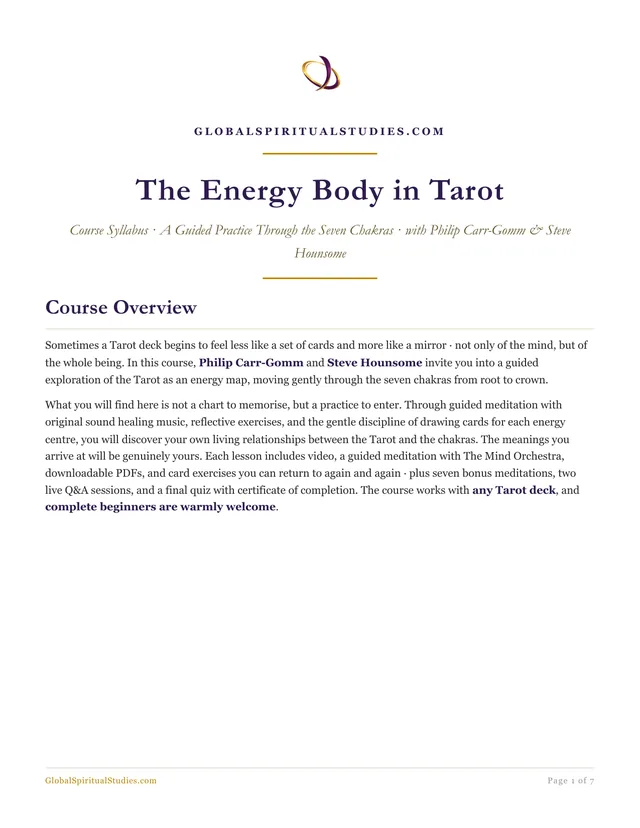
The Energy Body in Tarot
A Guided Practice Through the Seven Chakras · with Philip Carr-Gomm & Steve Hounsome
Nine lessons exploring the hidden energy map in every Tarot deck. Guided meditations with original sound healing music, practical exercises for each chakra, and a transformative journey from root to crown.
- 12 video lessons across nine sessions
- 15 guided meditations
- 12 PDF handouts
- Sound healing music
- Community forum
- Lifetime access
- Final quiz
- Certificate of completion
For a broader introduction to the seven energy centres, our complete chakra guide covers the full system. If you are drawn to the Kabbalistic parallels explored above, our guide to chakras and the Tree of Life maps the sephirot-to-chakra correspondences in detail. And for those interested in how other traditions understand the ascending energy process, our guide to energy centres across cultures traces the three-tier pattern from Taoist dantian to Celtic cauldrons to Tibetan lung dissolution.
Living the Tree of Life · The Sephirot
Evelynne Joffe
A contemplative journey through the ten sephirot, exploring the Kabbalistic path of inner development from Malkuth to Keter.
Mary Phelan
Develop your awareness of the energy body, learn to sense the aura, and build practical skills for energy-based healing work.
Printable Reference
Want every chakra in one chart? See our free 7-chakra reference chart · the complete correspondence table with colours, elements, and seed (bija) sounds, plus a printable PDF to keep beside your practice. For hands-on energy work, our free EFT tapping points chart maps all nine points and their meridians.
Frequently Asked Questions
What does kundalini awakening feel like?
Kundalini awakening is commonly described as a sensation of energy rising along the spine, often accompanied by heat, tingling, or a feeling of electricity. Physical experiences may include involuntary movements, pressure at the crown of the head, and changes in breathing. Emotionally, practitioners report waves of intense feeling, ranging from ecstasy and overwhelming compassion to the surfacing of old grief or fear. Perceptual shifts such as inner light, inner sound, and altered time perception are also well documented across traditions.
Is kundalini awakening dangerous?
Kundalini awakening is not inherently dangerous, but it can be destabilising if it occurs without adequate preparation or support. Premature or forced awakening may produce sustained physical discomfort, emotional instability, or what modern practitioners call a spiritual emergency. The classical texts consistently recommend working with an experienced teacher, building a stable foundation through regular meditation and breathwork, and ensuring the lower chakras are grounded before pursuing practices that activate kundalini directly.
What is the difference between kundalini and chakra meditation?
Chakra meditation is a gentle practice that brings focused awareness to each of the seven energy centres in sequence. It is suitable for beginners and carries minimal risk. Kundalini practices are specifically designed to awaken dormant energy at the base of the spine and guide it upward through the chakras, which produces more intense experiences and requires more preparation. Chakra meditation is often recommended as a foundation practice before undertaking kundalini work, as it familiarises the body with the energy centres without forcing energy to move. If you're curious which centre to begin with, our free Tarot chakra quiz can reveal your dominant chakra and the three Major Arcana cards connected to it.
Does Kabbalah have a form of kundalini?
The Kabbalistic tradition describes a closely parallel process. The Shekhinah, or feminine divine presence, dwells at Malkuth (the lowest sephirah on the Tree of Life, corresponding to the root chakra) and ascends through the Path of the Serpent to reunite with the divine at Keter (Crown). The three pillars of the Tree of Life parallel the three nadis of the yogic system: the Pillar of Mercy (right, solar) parallels Pingala, the Pillar of Severity (left, lunar) parallels Ida, and the Pillar of Equilibrium (central) parallels Sushumna. The Hebrew word for serpent, Nachash, has the same numerical value as Mashiach (Messiah), encoding the teaching that serpent energy is ultimately redemptive.
How long does kundalini awakening take?
There is no standard timeline. Some practitioners report spontaneous awakenings that arrive without warning. Others describe a gradual process unfolding over years or decades of sustained practice. The classical texts suggest that preparatory practices such as yoga, breathwork, and meditation may need to be maintained for months or years before the conditions arise for kundalini to enter the central channel. Partial awakenings, where energy activates to a certain chakra and stabilises there, are more common than the full root-to-crown experience described in the classical literature.
Part of our complete guide: Chakras · A Complete Guide to the Seven Energy Centers
The serpent sleeps until you are ready. And then it wakes on its own terms.