Chakras and the Tree of Life
Two maps, one journey · sephirot and chakra correspondences
The Kabbalah Tree of Life maps ten divine attributes, the sephirot, onto a structure that bears striking resemblance to the chakra column of tantric yoga. Dion Fortune called Qabalah "the Yoga of the West," and the comparison, while syncretic rather than historically indigenous to either tradition, reveals a structural kinship that has drawn seekers to study these two maps side by side for over a century. Both systems chart consciousness onto the body. Both describe an ascending path from dense physical existence to luminous spiritual unity. And both insist that the journey is not away from the body but through it.
In Brief
- - The ten sephirot of the Kabbalah Tree of Life can be mapped onto the seven chakras by pairing the lateral sephirot on the left and right pillars
- - The Tree's three pillars · Mercy, Severity, and Equilibrium · parallel the three primary nadis of yogic anatomy: pingala, ida, and sushumna
- - The Kabbalistic Path of the Serpent and the yogic ascent of kundalini both describe feminine energy rising from base to crown in a serpentine path
- - This comparison is a Western esoteric synthesis, not a claim that the traditions are identical · traditional Jewish Kabbalah does not use an energy-body framework
Two Maps of Consciousness
The chakra system and the Kabbalah Tree of Life emerged from entirely different cultures, separated by thousands of miles and centuries of independent development. The chakras were codified in the tantric traditions of South Asia, most recognisably in the 16th-century Sat-Cakra-Nirupana. The Tree of Life took shape in medieval Jewish mysticism, reaching its most elaborate expression in the Zohar (13th century) and the writings of Isaac Luria in 16th-century Safed.
They were not meant to be compared. And yet, when Western esotericists encountered both systems · particularly through the Hermetic Order of the Golden Dawn in the late 19th century and later through Dion Fortune, Aleister Crowley, and the Theosophical tradition · many practitioners found the structural parallels compelling. Both systems arrange a series of spiritual centres along a vertical axis. Both describe energy flowing through lateral channels that must be balanced. Both culminate in a crown state of divine unity.
A word of scholarly honesty is important here. The chakra-sephirot comparison belongs to the Western esoteric and New Age traditions. It is not indigenous to either Hindu tantra or Jewish Kabbalah. Traditional Jewish Kabbalists do not work with an energy-body framework, and traditional tantric practitioners have no concept of the sephirot. What follows is a map drawn by those who have studied both traditions and found genuine resonance between them · not a claim that they are, or were ever, the same system.
With that understanding, the correspondences are rich enough to reward careful study.
The Sephirot-to-Chakra Correspondence Table
The fundamental challenge in mapping the Tree of Life onto the chakra column is arithmetic: there are ten sephirot but only seven chakras. The solution, adopted by most Western esoteric writers, is to pair the lateral sephirot, those on the left and right pillars of the Tree, into single functional levels, matching them to the chakras that govern similar themes.
| Chakra | Sephirot | Shared Theme | Consensus |
|---|---|---|---|
| Root · Muladhara | Malkuth (Kingdom) | Physical existence, grounding, the material world | Widely agreed |
| Sacral · Svadhisthana | Yesod (Foundation) | Generative power, the subconscious, dreams | Widely agreed |
| Solar Plexus · Manipura | Hod + Netzach | Intellect and feeling balanced into personal will | Common but debated |
| Heart · Anahata | Tiferet (Beauty) | Harmony, compassion, the central balance point | Widely agreed |
| Throat · Vishuddha | Geburah + Chesed | Judgement and mercy expressed as creative will | Common but debated |
| Third Eye · Ajna | Binah + Chokmah | Understanding and wisdom as intuitive perception | Common but debated |
| Crown · Sahasrara | Keter (Crown) | Pure consciousness, divine unity | Widely agreed |
Where the Mapping Holds Firm
Four correspondences enjoy broad agreement. Malkuth and Muladhara both represent the densest level of manifestation: the physical body, the earth, the kingdom of matter itself. Yesod and Svadhisthana share the domain of generative and sexual energy, the subconscious mind, and the lunar realm of dreams and imagination. Tiferet and Anahata are perhaps the most elegant parallel: both sit at the exact centre of their respective systems, both govern compassion and harmony, and both serve as the pivot point where lower and upper energies meet. Keter and Sahasrara need little argument · they even share the word "crown."
Where the Mapping Requires Interpretation
The paired levels are more nuanced. At the solar plexus, Hod (intellectual analysis, form, Mercury) and Netzach (emotional passion, desire, Venus) combine into something like Manipura's fire of personal will · the place where thinking and feeling must be integrated before they can fuel action. At the throat, Geburah (severity, discipline, the power to set limits) and Chesed (mercy, generosity, expansive love) together form the capacity for authoritative speech · the throat's domain. At the brow, Binah (contemplative understanding, the great mother) and Chokmah (flashing wisdom, the great father) merge into the intuitive vision of Ajna.
The Question of Da'at
Da'at, the "hidden" sephirah sometimes called Knowledge, complicates every mapping. It sits on the Middle Pillar between Tiferet and Keter, in roughly the position of the throat. Some writers place Da'at at Vishuddha, arguing that it represents the "abyss" one must cross through truthful speech. Others assign it to Ajna, seeing it as the threshold of higher consciousness. Still others treat Da'at as belonging to no single chakra but as the veil between personal and transpersonal awareness · which may be the most honest interpretation.
Three Pillars, Three Nadis
Beyond the vertical correspondence of individual centres, the two systems share a striking three-channel architecture. The Tree of Life is structured around three pillars. Yogic anatomy describes three primary nadis · energy channels · that weave through the chakra column. The parallels between them can feel remarkably resonant.
| Tree of Life | Yogic Anatomy | Quality | Side |
|---|---|---|---|
| Pillar of Mercy (Jachin) | Ida Nadi | Lunar, receptive, cooling | Body's left · the viewer's right on the diagram |
| Pillar of Severity (Boaz) | Pingala Nadi | Solar, active, heating | Body's right · the viewer's left on the diagram |
| Pillar of Equilibrium | Sushumna Nadi | Central channel, balance, consciousness | Centre |
It is worth stating the convention plainly, because the sides depend on where you are standing. The Tree is drawn from the standpoint of the figure within it, so on almost every diagram the Pillar of Mercy descends the viewer's right and the Pillar of Severity the viewer's left. When you back into the Tree and wear it on your own body the sides swap: Mercy falls on your body's left, where the lunar ida nadi rises, and Severity on your body's right, where the solar pingala rises. These symbolic polarities describe energetic qualities rather than fixed gender identities. The central channel, whether called the Middle Pillar or the Sushumna, is the path of balanced consciousness, the route through which awakening travels.
In Kabbalistic practice, the Middle Pillar Exercise · developed by Israel Regardie from Golden Dawn ritual · involves drawing light downward through the central sephirot from Keter to Malkuth. The practitioner breathes and visualises energy descending along the body's midline. The resemblance to a chakra meditation ascending the sushumna is unmistakable, though the direction of flow differs: the Kabbalistic exercise typically begins at the crown and descends, while chakra meditation most often begins at the root and ascends.
Both traditions agree on the essential principle: the lateral energies must be balanced before the central channel opens fully. In yoga, when ida and pingala are harmonised through practices like nadi shodhana (alternate-nostril breathing), prana enters the sushumna and the chakras awaken. In Kabbalah, when mercy and severity are reconciled, the Middle Pillar becomes the path of direct ascent to the divine.
The Path of the Serpent and Kundalini
This is perhaps the most evocative parallel between the two traditions. In Kabbalah, the "Path of the Serpent" (Nachash) traces an ascending route from Malkuth to Keter that winds back and forth across the Tree, touching every sephirah. It is associated with the Shekhinah · the feminine indwelling presence of the divine · ascending from her exile in the material world to reunion with the Ein Sof, the infinite.
In tantric yoga, kundalini · often depicted as a coiled serpent sleeping at the base of the spine · is Shakti, the feminine creative power. When awakened, she rises through the sushumna, piercing each chakra in turn, until she reaches the crown and unites with Shiva, pure consciousness. This union of Shakti and Shiva at the sahasrara is described as the highest spiritual attainment.
Both traditions, then, describe a feminine energy ascending a serpentine path from base to crown, seeking reunion with the divine masculine at the summit. Both use serpent imagery. Both describe the ascent as a process of progressive purification and awakening. And both regard the reunion at the crown as the culmination of the spiritual journey.
The Kabbalistic gematria adds a layer of meaning: Nachash (serpent) has a numerical value of 358, which is identical to Mashiach (Messiah). In this reading, the serpent energy is not fallen or corrupt · it is redemptive. The same force that descends into matter is the force that, when consciously directed, leads the soul back to its source. This resonates deeply with the tantric understanding of kundalini as a sacred, not dangerous, energy when approached with preparation and reverence.
Mark Stavish, in his essay Secret Fire, offers perhaps the most detailed treatment of the connection between kundalini, the Middle Pillar exercise, and alchemical transformation. He argues that all three traditions · yoga, Kabbalah, and Western alchemy · describe the same interior process of refining consciousness through the body's own energetic architecture.
Caroline Myss and the Modern Synthesis
For many readers, the first encounter with the chakra-sephirot connection comes through Caroline Myss's Anatomy of the Spirit (1996). Myss mapped the seven chakras, the sephirot (grouped into seven levels), and the seven Christian sacraments onto a single developmental framework. Each level represents a stage of spiritual maturation, from tribal belonging (root/Malkuth) through personal power (solar plexus/Hod-Netzach) to divine union (crown/Keter).
The book became a touchstone for a generation of seekers because it made the abstract structures of Kabbalah and yoga accessible through the language of personal development. Myss argued that illness often corresponds to the developmental stage where unresolved issues linger, and that, in her framing, the body encodes spiritual biography.
This synthesis is modern, syncretic, and controversial among traditionalists of all three systems. Kabbalistic scholars note that reducing the ten sephirot to seven levels and pairing them with chakras flattens the Tree's complexity. Hindu practitioners point out that the psychological meanings Myss assigns are largely Western additions to the chakra system. Christian theologians question whether the sacraments function as developmental stages at all.
These criticisms are valid. And yet Anatomy of the Spirit remains the most widely referenced introduction to the structural kinship between these traditions. Its value lies not in scholarly precision but in the intuition that animates it: that the great wisdom traditions, when set beside one another, illuminate aspects of the human journey that no single tradition captures alone. The correspondences are not perfect. But they are, for many practitioners, genuinely useful · a way of triangulating inner experience using more than one map.
A Practice for Two Maps
If these correspondences speak to you, here is a contemplative exercise that brings both maps into lived experience. It requires no special training · only a willingness to sit quietly and observe.
Begin by settling into a comfortable seated position. Close your eyes. Take several slow breaths, allowing the body to soften.
Bring your awareness to the base of your spine · the domain of Muladhara and Malkuth. Feel whatever is there: density, warmth, the weight of the body against the earth. Silently hold both names. Notice which image arises more naturally · the spinning red wheel of the root chakra, or the kingdom at the base of the Tree. Rest with whatever comes.
Move your attention upward to the lower belly · Svadhisthana and Yesod. The realm of water, dreams, the generative unconscious. Again, hold both maps lightly and notice which one illuminates this space more clearly for you today.
Continue ascending through the solar plexus (Manipura · Hod and Netzach), the heart (Anahata · Tiferet), the throat (Vishuddha · Geburah and Chesed), the brow (Ajna · Binah and Chokmah), and the crown (Sahasrara · Keter). At each level, spend several breaths simply noticing. There is nothing to fix, nothing to force open. The practice is one of recognition.
When you reach the crown, rest there. Then allow your awareness to descend slowly back through each centre, carrying the quality of the crown with you as you return to the ground.
This is not about choosing one system over the other. It is about letting two ancient maps illuminate the same territory from different angles · and discovering, in the overlap, something that neither map quite captures on its own.
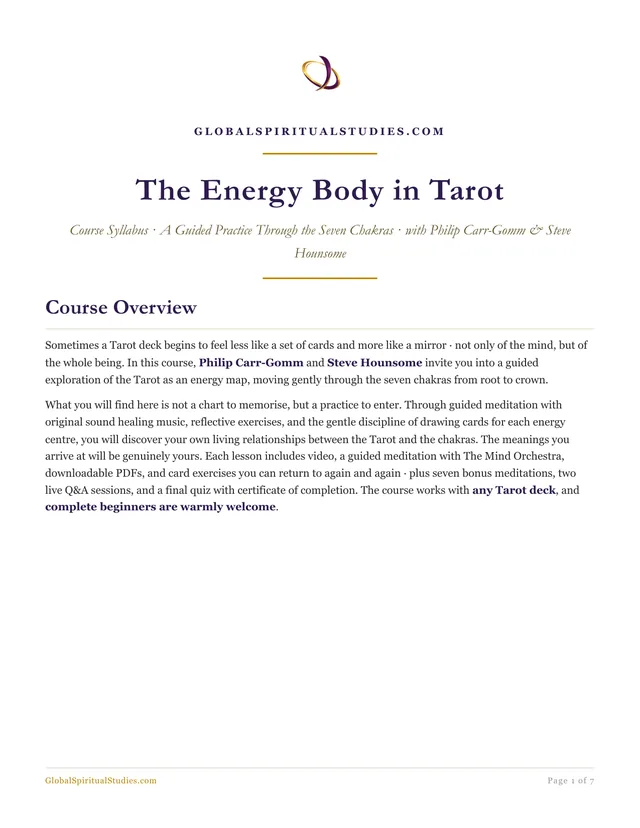
Those drawn to working with both the chakra and Tarot dimensions of this map may find a guided pathway in Philip Carr-Gomm and Steve Hounsome's The Energy Body in Tarot, which leads students through each energy centre using Tarot archetypes, guided meditation, and original sound healing music.
For a broader exploration of the Kabbalah Tree of Life · its history, the 22 paths, and the full system beyond its connections to the chakras · see our Kabbalah Tree of Life complete guide.
Explore the Chakras

Featured Course
The Energy Body in Tarot
A Guided Practice Through the Seven Chakras · with Philip Carr-Gomm & Steve Hounsome
Nine lessons exploring the hidden energy map in every Tarot deck. Guided meditations with original sound healing music, practical exercises for each chakra, and a transformative journey from root to crown.
- 12 video lessons across nine sessions
- 15 guided meditations
- 12 PDF handouts
- Sound healing music
- Community forum
- Lifetime access
- Final quiz
- Certificate of completion
Printable Reference
Want every chakra in one chart? See our free 7-chakra reference chart · the complete correspondence table with colours, elements, and seed (bija) sounds, plus a printable PDF to keep beside your practice.
Frequently Asked Questions
Are the chakras and the sephirot the same thing?
No. The chakras originated in South Asian tantric traditions and the sephirot in Jewish mystical Kabbalah. They developed independently in different cultures over many centuries. The structural parallels are real and worth studying, but the comparison is a modern Western esoteric synthesis · not a claim that the two systems share a common origin or are interchangeable.
Does traditional Kabbalah recognise chakras?
Traditional Jewish Kabbalah does not use an energy-body framework or recognise chakras. The sephirot are understood as divine attributes or emanations, not as bodily energy centres. The practice of mapping sephirot onto the body comes primarily from the Western esoteric tradition · particularly the Hermetic Order of the Golden Dawn and later writers like Dion Fortune and Israel Regardie.
Where does Da'at fit in the chakra-sephirot mapping?
Da'at is the "hidden" sephirah that sits between Tiferet and Keter on the Middle Pillar. Some writers place it at the throat chakra (Vishuddha), others at the third eye (Ajna). Because Da'at represents the "abyss" between personal and transpersonal consciousness, it may be most accurately understood as a threshold that does not correspond neatly to any single chakra.
Can I use both systems in my personal practice?
Many practitioners find that working with both systems enriches their understanding. The contemplative exercise of superimposing the Tree of Life and the chakra column · moving awareness through each correspondence · can reveal aspects of inner experience that neither map captures alone. The key is to approach both traditions with respect and to understand that using them together is a syncretic practice, not a traditional one in either lineage. You might also take our free Tarot chakra quiz to discover which energy centre resonates most strongly for you right now.
What is the best book on chakras and Kabbalah?
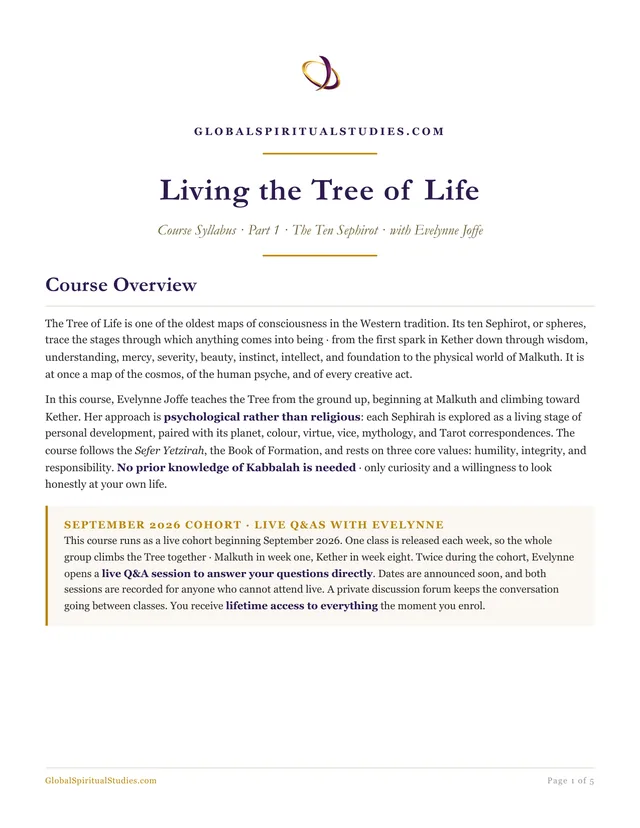
Caroline Myss's Anatomy of the Spirit (1996) remains the most widely read introduction to the chakra-sephirot-sacrament parallel. For deeper Kabbalistic study, Dion Fortune's The Mystical Qabalah provides the Western esoteric foundation. Mark Stavish's essay Secret Fire offers the most detailed exploration of kundalini and Kabbalistic practice. For a course-based approach, Evelynne Joffe's Living the Tree of Life guides students through the sephirot with direct experiential practice.
This guide is part of our comprehensive resource on the energy body. Return to Chakras · A Complete Guide to the Seven Energy Centers
Two maps, drawn centuries apart on different continents, each attempting to describe the mysterious movement of consciousness through the human experience.
About this article
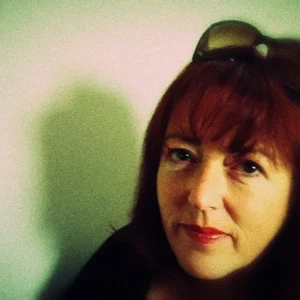
Based on the teachings of Evelynne Joffe
Kabbalist, Tarot Counsellor & Dream Therapist · Director, Institute of Esoteric Studies
This article was written by the Global Spiritual Studies editorial team, drawing on Evelynne Joffe's Kabbalah teaching for Global Spiritual Studies. Evelynne directs the Institute of Esoteric Studies in Melbourne, Australia, and has spent more than thirty years teaching students to read the Tree of Life as a practical map for self-realization. In 1992 she co-founded the Tarot Guild of Australia.
Study this with her
Living the Tree of Life · Part 1: The Ten Sephirot
Living the Tree of Life · Part 2: The Twenty-Two Paths
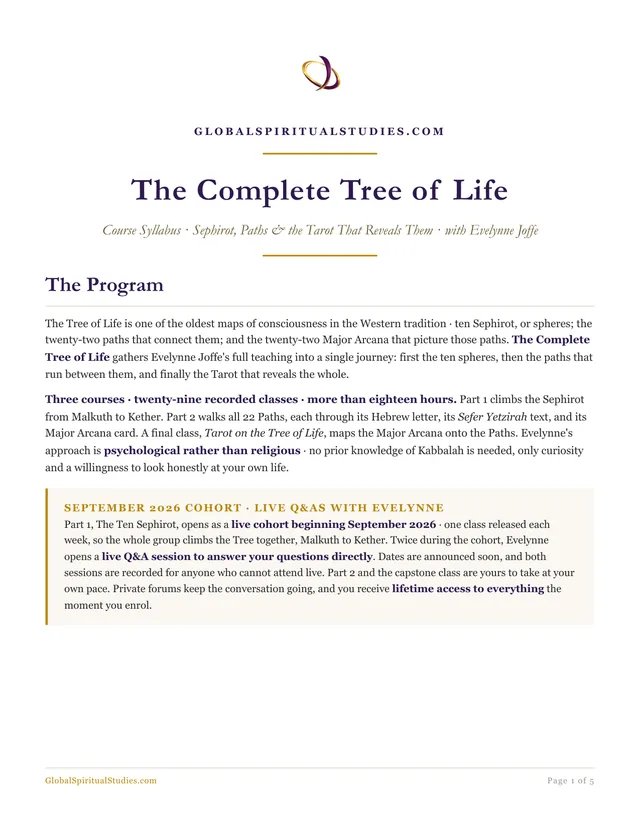
The Complete Tree of Life
More from Evelynne Joffe →