The Sacral Chakra
Svadhisthana and the waters of creation
The sacral chakra, known in Sanskrit as Svadhisthana, is the second energy centre in the seven-chakra system. Located just below the navel, it governs the body's relationship with creativity, emotion, pleasure, and the capacity to feel. Sva means self; adhisthana means dwelling place or seat. This is the centre where you come home to your own feeling life · the place where desire, creativity, and emotional truth reside before the mind gets hold of them.
Where the root chakra asks "Am I safe?", the sacral chakra asks "What do I feel? What do I want? What wants to be created through me?" It is associated with the water element, the colour orange, and the reproductive glands. Its domain is everything that flows: emotion, sexuality, creative expression, and the capacity to experience pleasure without guilt.
This guide explores the sacral chakra in depth: what it governs, how blockage and overactivity manifest, healing techniques, and the cross-tradition correspondences that illuminate this centre's role in Tarot, Kabbalah, and the world's contemplative lineages.
In Brief
- - Sanskrit: Svadhisthana · Element: Water · Colour: Orange · Bija mantra: VAM
- - Location: Lower abdomen, below the navel · Gland: Gonads (ovaries/testes)
- - Governs: Creativity, emotion, sexuality, pleasure, adaptability, relationship with desire
- - Tarot: Wheel of Fortune (X) · Kabbalah: Yesod (Foundation) · Crystals: Carnelian, Moonstone
What the Sacral Chakra Governs
The sacral chakra's domain is everything that moves and flows in the inner life. While the root establishes that you exist, the sacral determines how richly you experience that existence. It governs the full spectrum of feeling · from grief to joy, from desire to contentment · and the creative impulse that turns inner experience into outer expression.
Physical domain: The sacral chakra is associated with the reproductive organs, kidneys, bladder, and lower back. It governs the body's relationship with fluidity: circulation, hydration, the flow of hormones, and the health of the pelvic region. Chronic tension in the hips is one of the most common physical markers of sacral constriction.
Emotional domain: This is the feeling centre. The sacral holds the capacity for emotional range · the willingness to feel fully without being overwhelmed. It governs the ability to experience pleasure, to grieve, to desire, and to create. It also holds the body's relationship with sensuality and sexuality, which in this framework are understood not as separate from spiritual life but as expressions of the same creative energy.
Creative domain: Every form of creation · art, music, writing, cooking, problem-solving, making a home, conceiving a child · draws on sacral energy. When this centre is open, ideas flow and creative work feels natural. When it is blocked, the creative well runs dry and the world feels flat. Jung's concept of the anima · the unconscious feminine principle that mediates between the ego and the deeper psyche · operates in precisely this territory. The sacral is where the rational mind yields to the imaginal, where symbols rise before words can form them. In Jungian terms, creative blocks are not a failure of will but a failure of relationship with the unconscious · and the sacral chakra is where that relationship lives.
Developmental window: In Caroline Myss's framework, the sacral chakra corresponds to ages seven through fourteen · the period when personal desires, preferences, and creative identity begin to differentiate from the tribal identity formed at the root. The child discovers what they want, as distinct from what the family wants. Sacral wounds often originate here: shaming of desire, punishment of creativity, or early experiences that teach a child that feeling is dangerous.
Signs of Blockage
A blocked sacral chakra manifests as a withdrawal from feeling and creative life. The inner world narrows.
Physical signs:
- Chronic hip tightness or pain
- Lower back pain, particularly below the waistline
- Reproductive or urinary issues
- Low libido or numbness in the pelvic area
- Dehydration, dry skin, or poor circulation
Emotional and behavioural signs:
- Creative blocks · the feeling that the well is dry
- Emotional numbness or a flat affect
- Guilt or shame around pleasure, desire, or sexuality
- Difficulty setting boundaries in relationships
- Fear of change or an inability to adapt to new circumstances
- Codependency · defining self-worth through others' needs
- A pervasive sense that joy is inaccessible or undeserved
Sacral blockage is particularly common in people raised in environments where emotional expression was discouraged, where sexuality was shamed, or where creative pursuits were dismissed as impractical. The centre that should have learned to flow was taught instead to dam.
Signs of Overactivity
An overactive sacral chakra produces an excess of feeling and desire that overwhelms the other centres.
- Emotional volatility · extreme highs and lows with little middle ground
- Compulsive pleasure-seeking: overindulgence in food, sex, substances, or spending
- Enmeshment in relationships · poor boundaries, excessive emotional fusion
- Obsessive attachment to people, experiences, or outcomes
- Creative restlessness · starting many projects, finishing few
- Using sexuality as a substitute for emotional intimacy
- Manipulative behaviour driven by unexamined desire
Overactivity at the sacral often pairs with underactivity at the solar plexus. Where the sacral generates desire, the solar plexus provides the discipline to channel it. When the solar plexus is weak, sacral energy floods the system without direction.
Healing Techniques for the Sacral Chakra
Meditation
Sacral meditation works with the quality of water. Sit or lie down, bring attention to the space below the navel, and visualise warm orange light pooling there like water in a basin. Allow the light to move · not still like a sphere, but fluid, shifting, gently swirling. The seed mantra VAM supports this centre. Chant it on a slightly higher pitch than the root's LAM, feeling the vibration in the lower belly. The breath should be soft and full, emphasising the expansion of the lower abdomen on the inhale.
Yoga Poses
- Bound Angle Pose (Baddha Konasana): Opens the hips and brings attention to the pelvic floor.
- Pigeon Pose (Eka Pada Rajakapotasana): A deep hip opener that often releases stored emotion. Tears during pigeon pose are common and welcomed.
- Goddess Pose (Utkata Konasana): Wide-legged squat with turned-out feet. Activates the sacral centre and builds strength in the inner thighs.
- Reclined Butterfly (Supta Baddha Konasana): Passive hip opening. Especially effective with a Carnelian stone placed on the lower belly.
Crystals
Carnelian is the primary sacral chakra stone · warm, vitalising, and creative. It carries the fire-within-water quality that the sacral centre needs: warmth without burning, activation without aggression. Orange Calcite is gentler and works well for emotional healing. Moonstone supports the sacral's connection to cycles, intuition, and the feminine. Place any of these on the lower abdomen during meditation.
Sound
The bija mantra VAM directly activates this centre. In modern sound healing practice, the Solfeggio frequency 417 Hz is often associated with the sacral, though the historical basis for these specific frequency assignments remains debated. Water sounds · rain, rivers, ocean waves · are natural sacral healing: they remind the body of its own fluid nature.
Embodied Practices
- Dance, especially free-form movement without choreography · let the body move as it wants
- Swimming or bathing · full immersion in water activates the sacral's element
- Creative expression without product: painting, journaling, singing, or playing music with no goal other than the experience itself
- Eating orange foods: mangoes, oranges, sweet potatoes, carrots, apricots
- Spending time near water: rivers, lakes, the ocean, even a fountain
Tarot Correspondences
A note on two maps. The correspondences that follow use the planetary system, which seats The Wheel of Fortune at the sacral, through Jupiter. Philip Carr-Gomm and Steve Hounsome's The Energy Body in Tarot teaches a different arrangement · the Three Septenaries, a 7x3 grid that gives every numbered Major Arcana card both a chakra and a realm of Body, Mind or Spirit. There The Wheel of Fortune belongs to the solar plexus at the level of Mind, and the sacral is held by The High Priestess, The Hermit and The Tower. Both are working maps rather than doctrine, and the one worth keeping is the one that opens the cards for you.
In the planetary system, the sacral chakra is associated with Jupiter and its Major Arcana card, The Wheel of Fortune (X). Jupiter is the planet of expansion, abundance, and the cycles of fortune · qualities that mirror the sacral's domain of creative abundance and emotional flux. The Wheel speaks to the constant movement that the sacral governs: the turning of feelings, the ebb and flow of desire, the cyclical nature of creativity. Nothing at the sacral is static. Everything turns.
The sacral's suit correspondence is Cups (water element). Cups in a Tarot chakra spread at the sacral position are entirely at home: the reading is engaging the centre's native element. Cups speak of emotion, relationship, intuition, and the flow of feeling · precisely the sacral's territory.
The sacral also has a particular relationship with The High Priestess (II) · the Moon card · who sits between the two pillars with a body of water behind her, embodying the receptive, intuitive, lunar quality that the sacral centre holds. In the Three Septenaries framework explored in Philip Carr-Gomm and Steve Hounsome's Energy Body in Tarot course, this relationship between the lower Major Arcana and the sacral energy takes on a systematic significance.
The Kabbalah Parallel · Yesod
Yesod (Foundation) is the ninth sephirah on the Tree of Life and the widely agreed correspondence for the sacral chakra. The name is significant: Yesod is called Foundation because it is understood as the channel through which all divine energy passes on its way into physical manifestation at Malkuth. Everything that becomes real in the material world first moves through Yesod.
Yesod is associated with the Moon, sexuality, dreams, the astral plane, and the unconscious. It governs the realm of images, imagination, and the generative power that brings form out of formlessness. In Kabbalistic psychology, Yesod holds the same creative-sexual energy that the sacral chakra holds in the yogic system: the force that generates both physical life and artistic creation.
The Kabbalistic tradition connects Yesod to the biblical figure of Joseph, who is called Yesod Olam (Foundation of the World) and is traditionally associated with sexual righteousness · the capacity to channel creative energy with integrity rather than being overwhelmed by it. This resonates directly with the sacral chakra's central challenge: how to honour desire and creativity without being ruled by them.
Cross-Cultural Perspectives
The sacral chakra's creative and emotional territory resonates across energy systems worldwide, each tradition illuminating a different facet of this centre's watery nature.
Taoist tradition places the sacral's domain within the Lower Dantian, which stores Jing (essence). Jing includes sexual energy, reproductive vitality, and the body's foundational creative reserves. The Taoist emphasis on preserving and refining Jing rather than depleting it through excess mirrors the yogic teaching that sacral energy is precious and should be channelled consciously.
Celtic tradition maps the sacral to the lower portion of the Cauldron of Warming, the centre that feeds the Cauldron of Motion sitting higher in the chest. The transition between these two cauldrons · from basic life force to emotion and creative power · mirrors the transition from root to sacral in the chakra system. The Cauldron of Motion is turned upright through joy, sorrow, and deep feeling: the sacral's own medicine.
Shamanic traditions associate the sacral's territory with the deeper layers of the Lower World, where one encounters spirit animals, ancestral energies, and the primal creative forces that precede thought. Water spirits and serpent energies are common Lower World allies, both deeply connected to the sacral's fluid, creative nature.
Tibetan Buddhism maps this region to the Secret Chakra (Chakra of Holding Bliss), which combines what the Hindu system separates into root and sacral. The Tibetan emphasis on this centre's bliss-holding quality underscores a teaching that both systems share: the sacral is not merely about desire. It is about the capacity for joy.
Guided Sacral Chakra Practice
This ten-minute practice combines water visualisation, breath, and the seed mantra.
- Lie down or sit comfortably with your hands resting on your lower abdomen, just below the navel. Feel the warmth of your hands through the skin.
- Close your eyes and take five slow breaths, letting the belly rise and fall under your hands. Allow each breath to be slightly deeper than the last.
- Visualise warm orange light pooling in the space beneath your hands. Unlike the root's steady sphere, let this light be fluid · shifting, swirling, moving like water catching sunlight.
- On each inhale, imagine drawing water from a deep well up into this space. On each exhale, let the water spread through your hips and lower back, softening anything that is held tightly.
- Begin chanting VAM (rhymes with "calm" but with a V) in a soft, resonant tone. Feel the vibration directly beneath your hands. One chant per exhale.
- Continue for seven rounds, then release the mantra and simply rest with the sensation of fluidity in the lower belly.
- Ask one question: What wants to move through me today? Do not try to answer it with the mind. Let the sacral respond in its own language: images, feelings, impulses, colours.
- Spend two minutes in stillness, then gently bring your awareness back to the room. Open your eyes slowly.
If the sacral is a centre that consistently needs attention, consider pairing this practice with hip-opening yoga and free-form creative expression. The combination of movement, meditation, and creation is the sacral's natural rhythm.

Featured Course
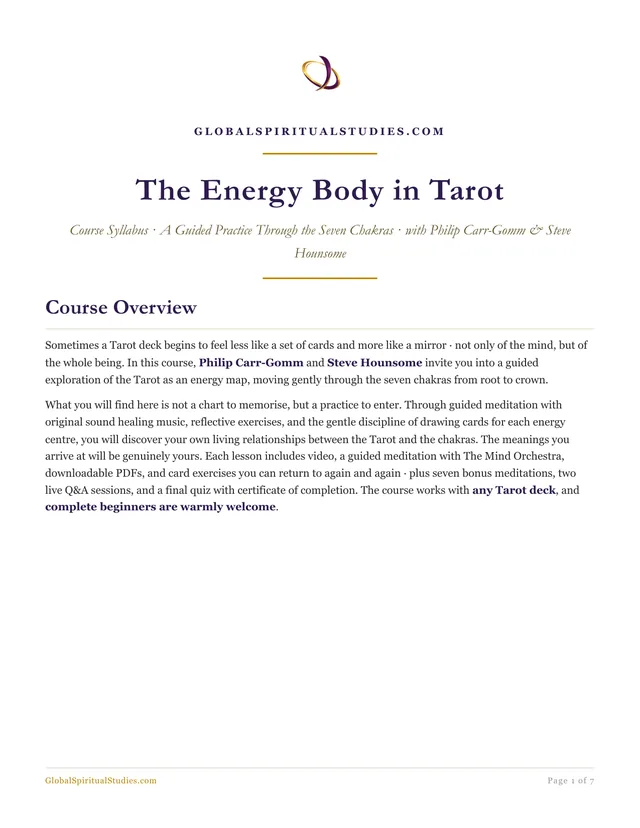
The Energy Body in Tarot
A Guided Practice Through the Seven Chakras · with Philip Carr-Gomm & Steve Hounsome
Nine lessons exploring the hidden energy map in every Tarot deck. Guided meditations with original sound healing music, practical exercises for each chakra, and a transformative journey from root to crown.
- 12 video lessons across nine sessions
- 15 guided meditations
- 12 PDF handouts
- Sound healing music
- Community forum
- Lifetime access
- Final quiz
- Certificate of completion
For a broader view of all seven energy centres, return to our complete chakra guide. For more on the sacral chakra's relationship with sexuality and Tarot, see our guide to sexual symbolism in Tarot. Continue up the energy body with our solar plexus chakra guide, or return to the root chakra to strengthen the foundation beneath.
Printable Reference
Want every chakra in one chart? See our free 7-chakra reference chart · the complete correspondence table with colours, elements, and seed (bija) sounds, plus a printable PDF to keep beside your practice.
Frequently Asked Questions
What does the sacral chakra control?
The sacral chakra (Svadhisthana) governs creativity, emotional expression, sexuality, pleasure, and the capacity to feel. It is associated with the water element, the reproductive organs, kidneys, and bladder. Emotionally, it holds the ability to experience the full range of feeling, to adapt to change, and to desire without guilt. It is considered the seat of creative energy in the yogic tradition.
How do I know if my sacral chakra is blocked?
Common signs of sacral chakra blockage include creative blocks, emotional numbness or flatness, guilt or shame around pleasure and sexuality, chronic hip tightness, lower back pain, low libido, difficulty setting boundaries in relationships, fear of change, and a pervasive sense that joy is inaccessible. Codependency and difficulty adapting to new circumstances are also associated with an underactive sacral centre.
What crystals are best for the sacral chakra?
Carnelian is the primary sacral chakra crystal, known for warmth, vitality, and creative activation. Orange Calcite is gentler and works well for emotional healing and softening. Moonstone supports the sacral's connection to cycles, intuition, and the feminine. These stones can be placed on the lower abdomen during meditation or carried throughout the day.
What Tarot card represents the sacral chakra?
In the planetary correspondence system, the sacral chakra is associated with Jupiter and the Wheel of Fortune card (X), which represents cycles, expansion, and the constant turning of fortune. The suit of Cups (water element) is the Minor Arcana correspondence for the sacral chakra, governing emotion, relationships, intuition, and the flow of feeling. The High Priestess (II) also has a strong sacral connection through her lunar, receptive, water-associated qualities.
How do I heal my sacral chakra?
The most effective sacral chakra healing practices work with fluidity and creative expression. Daily meditation with the seed mantra VAM, hip-opening yoga poses like Pigeon and Bound Angle, dance and free-form movement, spending time near water, and creative expression without concern for the product are all effective. Carnelian crystal placement on the lower abdomen during meditation deepens the practice. The key principle is flow: anything that helps energy and emotion move through rather than stagnate supports sacral healing. Wondering whether the sacral centre is where your energy body needs attention? Take our free Tarot chakra quiz to find out.
Part of our complete guide: Chakras · A Complete Guide to the Seven Energy Centers
Water does not push. It finds the opening and flows through.