Chakra Meditation for Beginners
A guided practice from root to crown
Chakra meditation is a contemplative practice that moves attention through the body's seven energy centres, from the base of the spine to the crown of the head, using breath, visualisation, and focused awareness to invite each centre into balance. It is one of the oldest and most widely practised forms of energy work, rooted in the tantric traditions of South Asia and adapted across centuries into the form most people encounter today.
The practice does not require belief in a particular model of subtle anatomy. What it does require is a willingness to sit quietly with your own body and notice what happens when you bring attention to specific places along the spine. For many people, that simple act of noticing is where the real work begins.
This guide walks through a sequential chakra meditation from root to crown, with visualisation techniques, seed mantras, and breathwork pairings for each centre. Whether you are entirely new to meditation or an experienced practitioner exploring energy work for the first time, the practice here is designed to be followed as written and adapted as you develop your own relationship with the seven centres.
In Brief
- - Chakra meditation moves attention sequentially through the seven energy centres from root (base of spine) to crown (top of head)
- - Each centre has a colour, element, seed mantra (bija), and breathwork pairing that supports the meditation
- - A complete beginner session takes 20–25 minutes · about three minutes per chakra
- - Common experiences include warmth, tingling, emotional release, and a sense of expansion · all are normal responses to sustained inward attention
What Chakra Meditation Is and Why It Works
The word chakra comes from the Sanskrit cakra, meaning wheel or disc. In the system most widely practised today · drawn primarily from the Sat-Cakra-Nirupana of 1577 CE and transmitted to the West through Sir John Woodroffe's 1918 translation The Serpent Power · the seven chakras are understood as focal points where consciousness and the body meet. Each governs a distinct range of physical, emotional, and spiritual experience.
Chakra meditation works by bringing sustained attention to each of these centres in turn. The mechanism is not mystical in the way it might first appear. When you focus your awareness on a specific area of the body, blood flow to that region increases, muscular tension releases, and the nervous system shifts toward its parasympathetic mode. When that attention is paired with breath, sound, and imagery, the effect deepens. What the tradition calls "opening a chakra" might equally be described as restoring full awareness to a part of yourself that has been held too tightly or neglected too long.
The practice is found, with variations, across nearly every contemplative tradition. The Taoist nei gong moves energy through the three dantian. The Celtic tradition of the Three Cauldrons of Poesy works with three energy vessels along the body's axis. Tibetan Buddhist meditation engages five chakras and the dissolution of winds into the central channel. The seven-centre sequential meditation offered here draws primarily from the Hindu-yogic framework, which remains the most detailed and widely taught system for individual practice.
Preparing for Practice
Choose a quiet space where you can sit undisturbed for at least twenty minutes. The practice works equally well on a cushion, a chair, or the floor · what matters is that your spine is upright and your body is comfortable enough to sustain stillness.
Set a simple intention. This is not a goal or an affirmation. It is more like a direction: I am sitting to listen to my body's energy. An intention gives the mind something to return to when it wanders.
Timing matters less than you think. Morning practice catches the nervous system before the day's demands arrive. Evening practice offers a way to process what the day has stirred. Neither is better. Consistency is more important than timing · the same slot, most days, allows the practice to deepen.
Close your eyes and take three slow, full breaths. Let each exhale be slightly longer than the inhale. Feel the weight of your body settling into the seat. When you are ready, bring your attention to the base of your spine.
The Sequential Meditation · Root to Crown
The meditation moves upward through the seven centres, spending roughly three minutes at each. The instructions below are a framework, not a script · let your own felt sense guide how long each centre needs.
1. Root · Muladhara
Bring your awareness to the base of your spine, the perineum area. Visualise a sphere of deep red light pulsing slowly there. With each inhale, the light grows brighter. With each exhale, it sends warmth downward through your legs and into the earth. This is your ground · the place where your body meets the world. Stay here until you feel a sense of weight, solidity, or stability.
2. Sacral · Svadhisthana
Move your attention to the space just below your navel. The colour shifts to warm orange. Imagine the quality of water here · fluid, adaptive, moving. Allow your breath to become slightly softer, slightly deeper. This centre holds creativity, emotion, and the capacity for pleasure. Notice what is present without trying to change it.
3. Solar Plexus · Manipura
Bring your focus to the upper abdomen, just above the navel. The light becomes bright yellow, radiating warmth like a small sun. This is the centre of personal power, will, and identity. The breath here can be stronger · feel the belly expand fully on the inhale and draw inward on the exhale. Notice where your sense of self feels solid and where it feels uncertain.
4. Heart · Anahata
Move to the centre of the chest, between the breasts. The colour is green · or, in some traditions, rose-pink. This is the bridge between the lower three centres (physical, emotional, personal) and the upper three (expressive, intuitive, spiritual). Let your breath be gentle and even. The heart centre often carries both love and grief. Let whatever is there simply be present. There is nothing to fix.
5. Throat · Vishuddha
Bring attention to the throat, at the hollow where the collarbones meet. The colour is clear blue, like sky. This centre governs communication, authentic expression, and truth. On the inhale, imagine cool blue light gathering at the throat. On the exhale, let it flow outward as if you were about to speak something true but have not yet found the words. Notice any tightness or constriction.
6. Third Eye · Ajna
Move to the space between your eyebrows, slightly above the bridge of the nose. The colour is indigo or deep violet-blue. This centre governs intuition, insight, and inner vision. The breath becomes subtle here · almost as if the breath itself is watching. Let the eyes, behind closed lids, soften completely. If images or impressions arise, observe them without following their narrative.
7. Crown · Sahasrara
Finally, bring your awareness to the very top of the head. The colour is violet or luminous white. This centre connects individual consciousness to something larger · however you understand that. The breath may feel as though it is barely moving. Some practitioners experience a gentle tingling or a sense of openness at the crown. Rest here for a few breaths. Then slowly expand your awareness to include all seven centres at once, like a single column of light running from the base of your spine to the top of your head.
When you are ready, take three grounding breaths. Feel your weight on the seat. Open your eyes slowly.
Visualisation Techniques and Seed Mantras
Each chakra has a bija (seed) mantra · a single syllable that is traditionally chanted or silently repeated to activate that centre. These are not "chakra mantras" in the way they are sometimes marketed. They are element mantras, connected to the element that governs each centre, and they appear in texts like the Dhyanabindu Upanishad, a medieval Yoga Upanishad of roughly the twelfth to fifteenth century.
| Chakra | Colour | Element | Bija Mantra | Visualisation |
|---|---|---|---|---|
| Root | Red | Earth | LAM | Glowing red sphere · stable, heavy, warm |
| Sacral | Orange | Water | VAM | Orange crescent moon · fluid, shifting |
| Solar Plexus | Yellow | Fire | RAM | Golden sun · radiant, expanding |
| Heart | Green | Air | YAM | Green light · open, spacious, breathing |
| Throat | Blue | Ether | HAM | Blue sky · clear, vibrating |
| Third Eye | Indigo | Light | OM | Indigo eye · still, watchful |
| Crown | Violet / White | Thought | Silence (or OM) | Thousand-petalled lotus · luminous, open |
To work with the mantras, silently repeat the syllable as you hold your attention at each centre. The repetition gives the mind something to do while the body does its quieter work. Some practitioners chant the mantras aloud in a low, resonant tone · this adds a vibrational quality that many find helpful, particularly at the lower three centres where the body responds to sound most readily.
The colour visualisations listed above follow the Western rainbow mapping popularised by Christopher Hills in 1977. Traditional tantric texts do not assign these colours consistently. If a different colour arises spontaneously during your practice, work with what appears rather than overriding it with the "correct" assignment. The body often knows things the chart does not.
Breathwork Pairings by Chakra
Different breathing techniques support different energy centres. These pairings are not rigid rules · they are starting points drawn from yogic pranayama traditions.
- Root and Sacral: Deep belly breathing. Inhale through the nose, letting the lower abdomen expand fully. Exhale slowly. This activates the lower centres and calms the nervous system.
- Solar Plexus: Kapalabhati (skull-shining breath). Short, forceful exhales through the nose with passive inhales, pumping the belly. Twenty to thirty rounds. This generates heat and activates the fire centre. Use with care if you are new to breathwork.
- Heart: Nadi Shodhana (alternate nostril breathing). Close the right nostril with the thumb, inhale through the left. Close the left with the ring finger, exhale through the right. Alternate. This balances ida and pingala, the two energy channels (nadis) that rise from Muladhara and cross at the heart on their way to Ajna, where they converge.
- Throat and Third Eye: Ujjayi (ocean breath). A slight constriction at the back of the throat creates a soft, audible sound on both inhale and exhale. This focuses awareness at the upper centres and produces a meditative rhythm.
- Crown: Natural breath, approaching stillness. The less you do, the more the crown centre can open on its own.
Timing Your Practice
Beginners: Start with 20–25 minutes total. Spend about three minutes at each chakra, with a few minutes at the beginning for settling and a few at the end for integration. If three minutes feels too long at any centre, move on. If you want to linger somewhere, linger. The sequential structure is a container, not a clock.
Intermediate: Extend to 30–40 minutes. Spend five minutes per chakra. Add the bija mantras and breathwork pairings. You may find that some centres consistently need more time than others · that pattern is information worth noting.
Experienced: A full practice of 45–60 minutes allows space for deeper work at individual centres, extended mantra repetition, and time to rest in the unified awareness at the end. Some practitioners at this stage spend an entire session on a single chakra, returning to sequential practice only occasionally.
Regardless of duration, end every session with at least two minutes of simply sitting with whatever arose. The integration period is not optional · it is where the practice consolidates.
What You May Experience
Chakra meditation can produce a range of physical and emotional responses, particularly in the early weeks of practice. None of these require alarm. All are well-documented in the contemplative literature.
- Warmth or tingling at specific centres, especially the root, heart, and crown. This is the most commonly reported sensation and typically indicates that attention is reaching the area effectively.
- Emotional release · unexpected tears, laughter, or a wave of feeling that seems to come from nowhere. The heart and sacral centres are particularly likely to produce this. Let it move through without trying to interpret it in the moment.
- Involuntary movement · swaying, rocking, or a gentle pulsing sensation. These are often called kriyas in the yogic tradition and are considered a normal part of energy moving through areas of tension.
- Visual impressions · colours, shapes, or images appearing behind closed eyes, especially at the third eye centre. These are not hallucinations. They are a common response to sustained inward attention and will typically settle as practice matures.
- Difficulty at specific centres. If you find it hard to bring attention to a particular chakra · the mind skips past it, or the area feels numb · that is usually the centre that needs the most patient work. Do not force it. Return gently, session after session.
If a session feels overwhelming, bring your attention back to the root centre and focus on grounding for as long as you need. The downward return is always available.

Featured Course
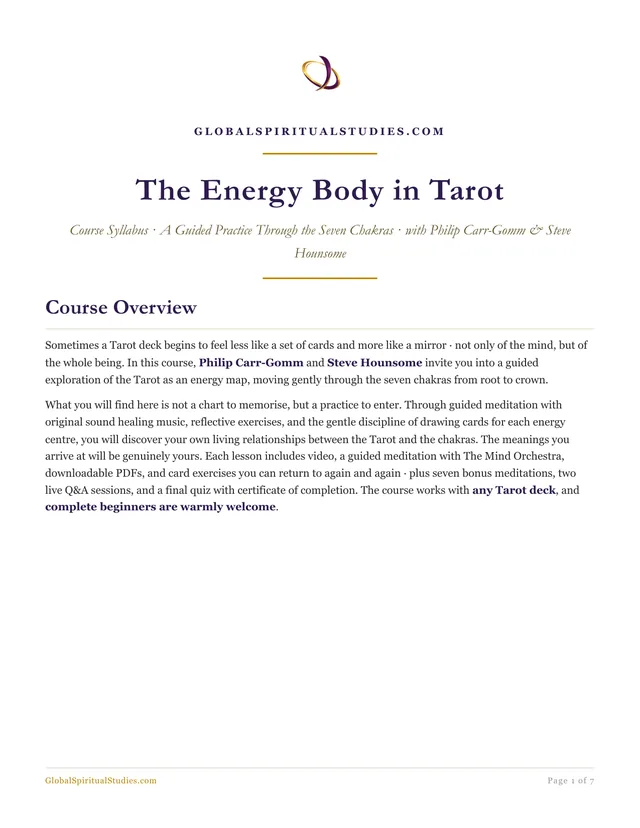
The Energy Body in Tarot
A Guided Practice Through the Seven Chakras · with Philip Carr-Gomm & Steve Hounsome
Nine lessons exploring the hidden energy map in every Tarot deck. Guided meditations with original sound healing music, practical exercises for each chakra, and a transformative journey from root to crown.
- 12 video lessons across nine sessions
- 15 guided meditations
- 12 PDF handouts
- Sound healing music
- Community forum
- Lifetime access
- Final quiz
- Certificate of completion
For a broader introduction to the seven energy centres · their meanings, blockage signs, and healing techniques beyond meditation · our complete chakra guide covers the full system. If you are drawn to the connection between chakra work and Tarot, our Tarot chakra spread guide offers a seven-card reading framework that maps one card to each energy centre. And for those interested in how different cultures map the body's vital energy, our guide to energy centres across cultures traces the parallels from the Taoist dantian to the Celtic cauldrons to the Tibetan five-chakra system.
Printable Reference
Want every chakra in one chart? See our free 7-chakra reference chart · the complete correspondence table with colours, elements, and seed (bija) sounds, plus a printable PDF to keep beside your practice.
Related reading · Once a sitting practice feels steady, you may be curious about its close relative. Explore meditation and journey · how a shamanic journey differs from meditation, and where the two meet.
Frequently Asked Questions
How long does a chakra meditation take?
A complete beginner session takes 20 to 25 minutes, spending roughly three minutes at each of the seven energy centres with a few minutes for settling and integration. Intermediate practitioners typically extend to 30 to 40 minutes, while experienced meditators may practise for 45 to 60 minutes. Even a focused 10-minute session working with just three or four centres can be beneficial when time is limited.
Do I need to chant the mantras out loud?
No. The seed mantras (LAM, VAM, RAM, YAM, HAM, OM) work whether chanted aloud, whispered, or repeated silently. Vocal chanting adds a vibrational element that some practitioners find helpful, particularly for the lower three chakras where the body responds to sound more readily. Silent repetition works well for the upper centres and for practising in shared spaces. Experiment with both approaches and work with whichever deepens your concentration.
What if I cannot feel anything at a particular chakra?
This is common, especially in the early weeks of practice. Some energy centres respond to attention quickly while others take time. A centre that feels numb or difficult to reach is often the one that needs the most patient work. Rather than forcing sensation, simply bring your awareness to the area and breathe gently. Over sessions, sensitivity develops on its own. Many practitioners report that the centres that were hardest to access eventually become the most vivid.
Is chakra meditation safe for beginners?
Yes. Sequential chakra meditation as described in this guide is a gentle, well-established practice suitable for beginners. The key is to work at your own pace and not force energy to move. If a session produces overwhelming emotion or physical discomfort, bring your attention back to the root centre and focus on grounding breaths until you feel stable. Practices that specifically target kundalini awakening involve more intensity and are best approached with guidance from an experienced teacher.
Can I combine chakra meditation with crystal healing or Tarot?
Yes, and many practitioners do. Placing a corresponding crystal at each chakra position during meditation adds a tactile element that can deepen focus. Drawing a Tarot card for each centre before meditating gives the session a reflective structure, revealing which centres may need particular attention. You can also take our free Tarot chakra quiz to discover which energy centre is calling you. Philip Carr-Gomm and Steve Hounsome's course The Energy Body in Tarot combines chakra meditation with Tarot archetypes and original sound healing music across nine guided lessons.
Part of our complete guide: Chakras · A Complete Guide to the Seven Energy Centers
The breath carries you to the centre. The centre carries you to yourself.