The Lenormand Cards
A Complete Guide to the 36-Card Oracle
Lenormand cards are a 36-card oracle system named after the French fortune-teller Marie Anne Lenormand, used for divination through card combinations rather than individual card meanings. Unlike Tarot, Lenormand readings rely on pairing adjacent cards to form precise, practical messages about everyday life.

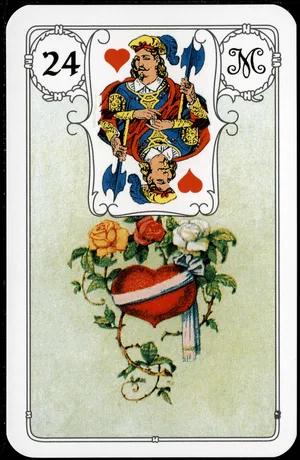
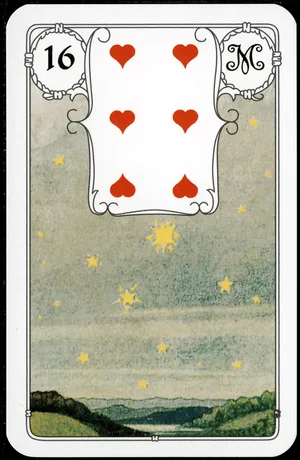
Lenormand cards are a 36-card divination deck in which each card carries a single fixed, everyday symbol · a ship, a key, a fox, a ring · paired with one clear, practical meaning. Unlike Tarot, Lenormand cards are read in combinations rather than singly, so two or more cards sit side by side to form a phrase and answer concrete questions with unusual directness.
All 36 cards with meanings, timing and combinations · jump to the 36-card table
The 36 Lenormand cards
Tap any card for its full meaning, combinations and timing.
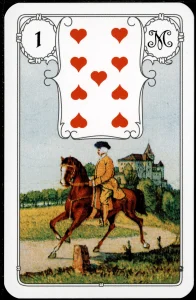 1 · Rider
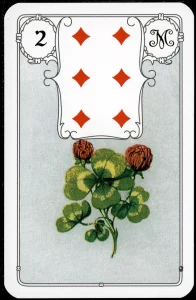 2 · Clover
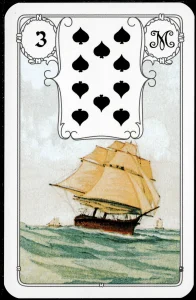 3 · Ship
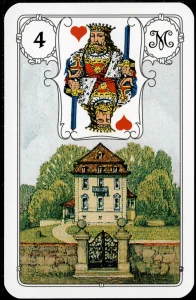 4 · House
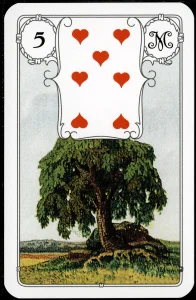 5 · Tree
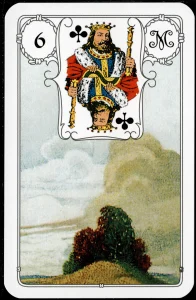 6 · Clouds
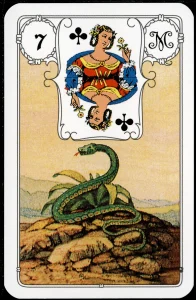 7 · Snake
 8 · Coffin
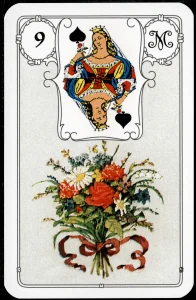 9 · Bouquet
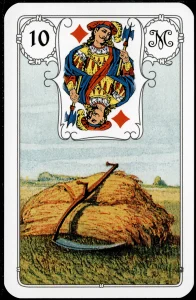 10 · Scythe
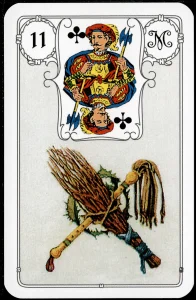 11 · Whip
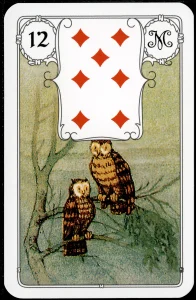 12 · Birds
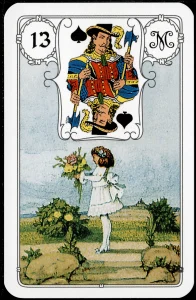 13 · Child
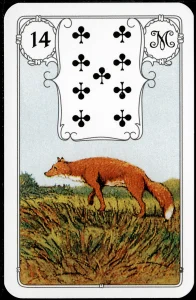 14 · Fox
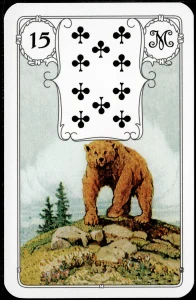 15 · Bear
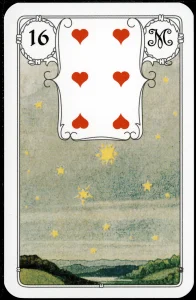 16 · Stars
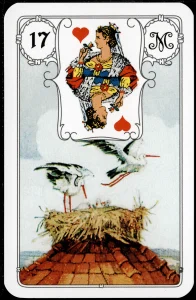 17 · Stork
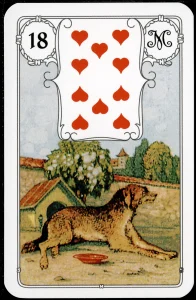 18 · Dog
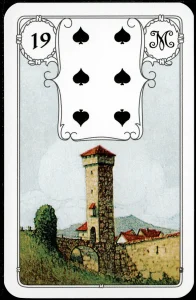 19 · Tower
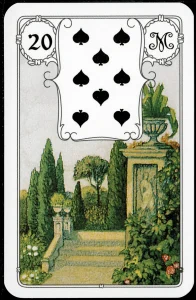 20 · Garden
 21 · Mountain
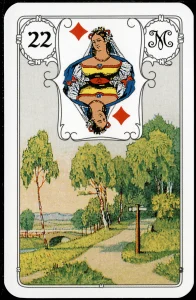 22 · Crossroads
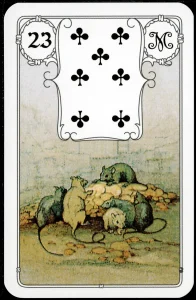 23 · Mice
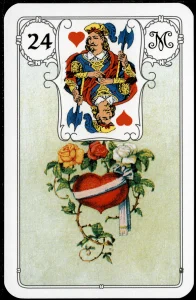 24 · Heart
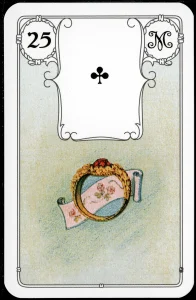 25 · Ring
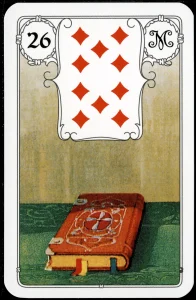 26 · Book
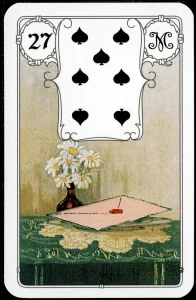 27 · Letter
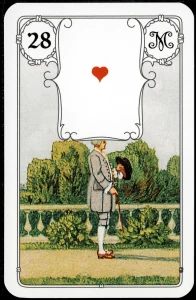 28 · Gentleman
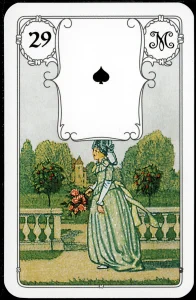 29 · Lady
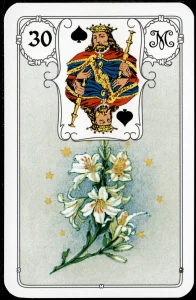 30 · Lilies
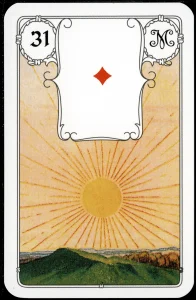 31 · Sun
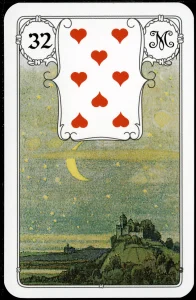 32 · Moon
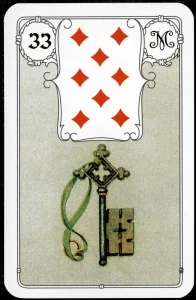 33 · Key
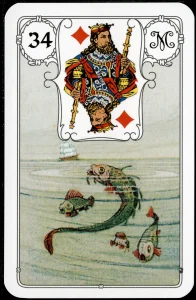 34 · Fish
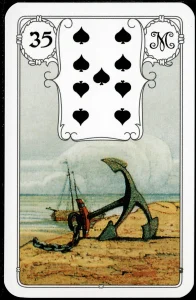 35 · Anchor
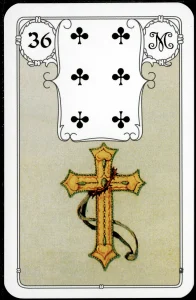 36 · Cross
There is a deck of 36 cards sitting quietly in the shadow of Tarot's fame. It has no High Priestess, no Tower struck by lightning, no sprawling cast of archetypal figures. Its images are simple: a ship, a bouquet of flowers, a key, a fox. They look almost like illustrations from a nineteenth-century parlour game.
And yet, for over two hundred years, these cards have been answering questions with a directness that surprises people who come to them expecting mystery. The Lenormand oracle does not speak in riddles. It speaks in sentences.
If you have been curious about Lenormand cards, if someone mentioned them and you were not quite sure how they differ from Tarot, or if you have a deck in a drawer and no idea what to do with it, this guide is for you. We will walk through all 36 cards, explain the combination method that makes Lenormand unique, and give you everything you need to lay down your first reading.
What Is Lenormand?
The Petit Lenormand is a 36-card oracle system used for divination and practical guidance. It is named after Marie Anne Lenormand (1772-1843), the most celebrated fortune-teller in French history, a woman who reportedly read cards for Empress Josephine and navigated the political upheavals of revolutionary Paris with uncanny foresight.
Here is an irony worth noting: Mlle Lenormand almost certainly never used the deck that bears her name. The Petit Lenormand was published after her death, created by enterprising card makers who traded on her legendary reputation. The system itself draws on an older tradition of German card games and fortune-telling decks, particularly the Game of Hope, advertised in 1799 with the surviving copies dating to about 1800.
None of this diminishes the system. What matters is that the Petit Lenormand, whatever its origins, became one of the most widely practiced cartomantic traditions in continental Europe. While Tarot dominated the English-speaking world, Lenormand flourished in France, Germany, Belgium, Brazil, and beyond. It was the card reading system of grandmothers, market-day fortune-tellers, and practical-minded seekers who wanted clear answers to concrete questions.
Since roughly 2010, Lenormand has experienced a remarkable revival among English-speaking readers. Many discover that Lenormand fills a gap they did not know existed: it offers precision where Tarot offers depth, directness where Tarot offers nuance. The two systems are not competitors. They are colleagues.
The 36 Cards: A Quick Overview
Every Lenormand deck contains the same 36 cards, numbered 1 through 36. Unlike Tarot, there is no division into Major and Minor Arcana, no suits in the traditional sense. Each card carries a single, concrete image and a core meaning rooted in everyday life.
The Complete Printable Chart
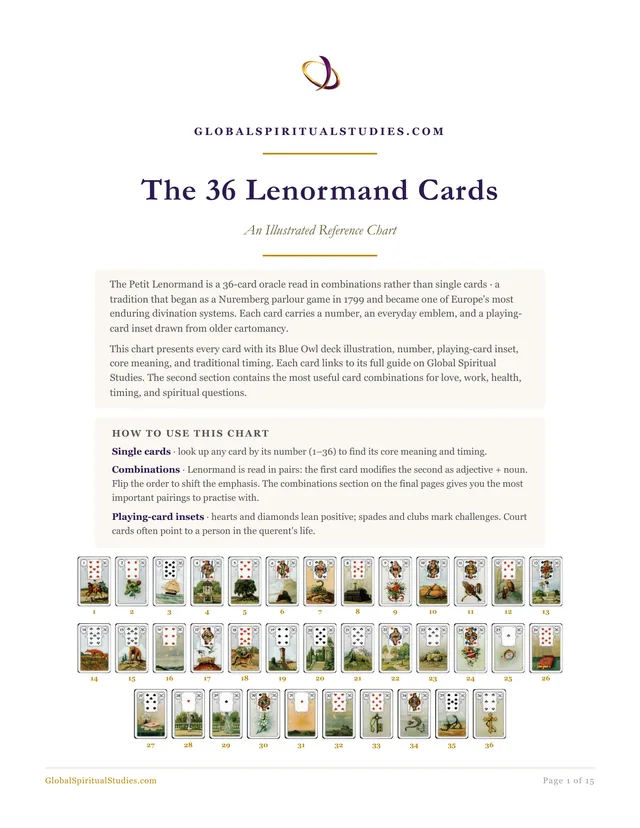
Every card with its playing-card inset, core meaning, and traditional timing, plus a cheat sheet of the most useful combinations · free to read on the page or print and keep beside your deck.
| No. | Card | In a Reading |
|---|---|---|
| 1 | The Rider | news arriving, a message, a visitor |
| 2 | The Clover | luck, a small fortune, brief opportunity |
| 3 | The Ship | travel, distance, journeys, commerce |
| 4 | The House | home, family, domestic life, stability |
| 5 | The Tree | health, growth, deep roots, long duration |
| 6 | The Clouds | confusion, uncertainty, something unclear |
| 7 | The Snake | complications, detours, a winding path |
| 8 | The Coffin | endings, closure, something put to rest |
| 9 | The Bouquet | gifts, invitations, beauty, appreciation |
| 10 | The Scythe | sudden cuts, danger, sharp decisions |
| 11 | The Whip | conflict, repetition, heated discussion |
| 12 | The Birds | conversations, nervous energy, a pair of things |
| 13 | The Child | new beginnings, innocence, something small |
| 14 | The Fox | work, cunning, self-interest, alertness |
| 15 | The Bear | strength, authority, finances, a powerful figure |
| 16 | The Stars | hope, guidance, inspiration, clarity |
| 17 | The Stork | change, improvement, relocation, progress |
| 18 | The Dog | friendship, loyalty, a trusted companion |
| 19 | The Tower | institutions, authority, solitude, boundaries |
| 20 | The Garden | public gatherings, social life, community |
| 21 | The Mountain | obstacles, delays, blockages |
| 22 | The Crossroads | choices, alternatives, a decision point |
| 23 | The Mice | loss through erosion, worry, small anxieties |
| 24 | The Heart | love, passion, the emotional centre |
| 25 | The Ring | commitment, contracts, cycles, partnership |
| 26 | The Book | secrets, education, hidden knowledge |
| 27 | The Letter | documents, written communication, official news |
| 28 | The Gentleman | the male querent or a significant male figure |
| 29 | The Lady | the female querent or a significant female figure |
| 30 | The Lilies | maturity, peace, wisdom, sensuality |
| 31 | The Sun | success, vitality, warmth, happiness |
| 32 | The Moon | emotions, recognition, reputation, inner life |
| 33 | The Key | certainty, solutions, something important |
| 34 | The Fish | money, abundance, flow, independence |
| 35 | The Anchor | stability, perseverance, long-term security |
| 36 | The Cross | burden, suffering, duty, fate |
Each card above links to its complete guide · full meaning, key combinations, love and career readings, and its place in the Grand Tableau.
How Lenormand Differs from Tarot
If you are coming to Lenormand from a Tarot background, the single most important shift is this: in Lenormand, individual cards are words, not sentences. A single Lenormand card tells you almost nothing. Two cards together begin to speak. Three cards tell a small story. And when you lay out all 36 in a Grand Tableau, you are reading a novel.
| Tarot | Lenormand | |
|---|---|---|
| Deck size | 78 cards | 36 cards |
| Card meaning | Archetypal, layered, psychological | Concrete, specific, practical |
| Reading unit | Individual cards | Card combinations |
| Reversals | Often used | Not used |
| Typical question | "What do I need to understand?" | "What is going to happen?" |
| Signature spread | Celtic Cross (10 cards) | Grand Tableau (all 36 cards) |
| Strength | Depth, nuance, self-reflection | Clarity, directness, practical detail |
Neither system is superior. They serve different needs. Many experienced readers keep both a Tarot deck and a Lenormand deck on their table. If you already read Tarot, our complete guide to reading Tarot cards offers a parallel starting point.
Reading Lenormand Cards: The Combination Method
The combination method is the heart of Lenormand reading. Every card modifies the cards beside it, creating composite meanings that neither card holds alone.
Think of it this way. The word "blue" and the word "bird" each mean something on their own. But "bluebird" means something new: not just any bird, not just the colour, but a specific creature with its own associations. Lenormand combinations work the same way.
Two-Card Combinations
Draw two cards and read them as a single phrase, with the first card as the subject and the second as the modifier:
Notice that the order matters. The first card sets the topic; the second colours it.
Three-Card Combinations
With three cards, the middle card becomes the focus, modified by the cards on either side:
As you practise, the combinations begin to feel less like translation and more like listening. The cards develop a voice.
Common Lenormand Card Combinations
Certain pairings recur so often that experienced readers know them almost by heart. The table below gathers a dozen classic combinations to read as short phrases · a compact reference to keep beside your deck as you practise. For the historical reading approach these pairings grew out of, explore the traditional method of reading Lenormand with Mary K. Greer.
| Combination | Meaning |
|---|---|
| Rider + Letter | News arriving in writing · a message or document on its way. |
| Ring + Heart | A loving commitment · an engagement or a deepening partnership. |
| Fox + Book | Hidden work matters · a concealed job agenda or workplace study. |
| Ship + Anchor | A journey that leads to lasting settlement · stability found far from home. |
| Snake + Mice | A complication that steadily erodes · a deception causing gradual loss. |
| Key + Sun | A certain, successful outcome · the right solution bringing happiness. |
| Coffin + Rider | News of an ending · word that something has closed or been laid to rest. |
| Heart + Ring | Love formalized · romance moving toward commitment or marriage. |
| Clover + Fish | A lucky turn in money · a small, fortunate financial opportunity. |
| Tower + Book | An institution's secret · official records or hidden bureaucratic knowledge. |
| Dog + House | A trusted friend close to home · loyalty within the family or household. |
| Scythe + Letter | A sudden, cutting message · abrupt news or a document that severs something. |
Your First Lenormand Spread: The Three-Card Line
The three-card line is the simplest and most common Lenormand spread. It is where every Lenormand reader begins.
1. Formulate a clear question. Lenormand works best with specific, practical questions. Not "What is the meaning of my life?" but "What do I need to know about my job situation this month?"
2. Shuffle your deck until it feels done.
3. Draw three cards and lay them in a line from left to right.
4. Read the combination. The centre card is your focus. The left card describes what leads into it. The right card describes where it leads.
A Sample Reading
Question: "What do I need to know about a work opportunity I've been offered?"
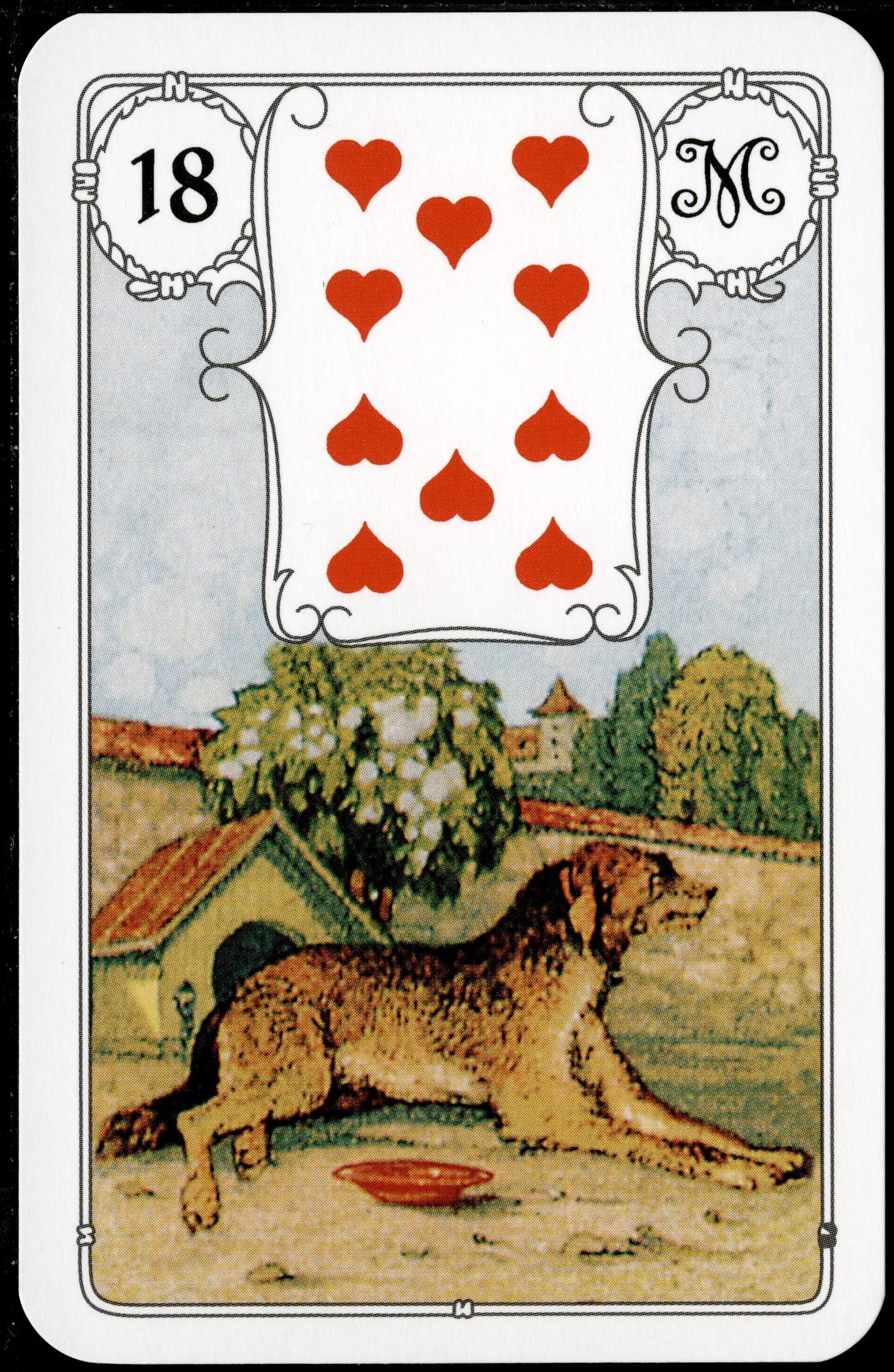
A trusted contact or loyal colleague is involved.

A positive change, improvement, genuine progress.
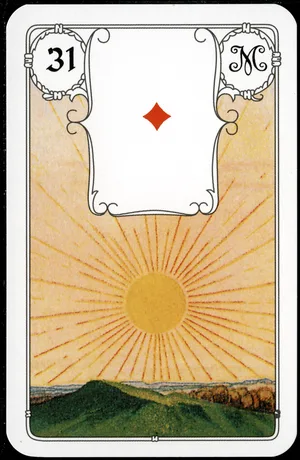
Success, warmth, happiness. The outlook is bright.
Loyalty brings change brings success. That is Lenormand: not isolated definitions, but a flowing sentence read across the cards.
The Grand Tableau: Reading All 36 Cards
If the three-card line is a sentence, the Grand Tableau is an entire chapter of someone's life laid out on the table.
In a Grand Tableau, all 36 cards are dealt face-up in a grid, typically four rows of eight cards with four remaining cards forming a bottom row. The entire spread is read as an interconnected map of the querent's life.
The Grand Tableau allows you to examine any area of life within a single reading. Want to know about love? Find the Heart card and examine what surrounds it. Career? Look for the Fox. Health? Find the Tree. Each card's position relative to the Gentleman or Lady card tells you whether that theme is approaching, receding, close at hand, or distant.
Additional techniques layer meaning further: houses (each position corresponds to a card's domain), mirroring and knighting (geometric relationships reveal hidden connections), and near and far (proximity to the querent's significator indicates urgency).
The Grand Tableau is not a beginner technique. But it is worth understanding from the start, because it represents the full potential of the Lenormand system. Everything you learn with three-card lines builds toward this. Mary K. Greer's Advanced Lenormand course devotes focused attention to unravelling Grand Tableau stories.
Timing in Lenormand Readings
One of Lenormand's quiet strengths is its ability to suggest when, not only what. Several traditional approaches attach timing to the cards · a card's number can indicate a count of days or weeks, while certain cards carry their own seasonal or temporal associations, such as the Lily for winter, the Bouquet for spring, the Snake for delay, and the Rider for something arriving soon.
In practice, a reader might treat the Clover as a matter of days and the Anchor as something lasting months or longer. If the Rider falls beside the Ship, for instance, you might read news arriving from a distance, and fairly quickly · the Rider lending its sense of swift movement to the timing of the answer.
Timing is a nuanced skill, and readers develop their own systems with practice. For a deeper treatment of the methods and their history, see A Guide to Timing in Lenormand Readings with Caitlín Matthews.
Common Mistakes Beginners Make
Reading Single Cards as Complete Answers
This is the most common mistake, especially for readers coming from Tarot. The Coffin alone is incomplete. Coffin + Bouquet (ending leads to a pleasant surprise) tells a very different story than Coffin + Mountain (ending meets an obstacle). Always read in combination.
Importing Tarot Meanings
The Snake in Lenormand is not "temptation" in the biblical sense. The Tower is not a catastrophic collapse. Each Lenormand card has its own vocabulary, developed over two centuries of practice. Give yourself permission to learn the system on its own terms.
Overthinking Symbolism
Lenormand rewards a light touch. The Ship means travel, distance, foreign things. You do not need to meditate on what type of ship it is or what the water represents symbolically. Stay close to the surface meaning and let the combinations do the interpretive work.
Neglecting the Question
Because Lenormand is so concrete, vague questions produce vague readings. "What should I expect regarding my apartment search in the next two months?" gives the cards something to work with. The more precise your question, the more precise the answer.
From your first three-card line to the Grand Tableau, our Lenormand courses with Mary K. Greer and Caitlin Matthews will guide you through every stage of learning this remarkable oracle.
Browse Lenormand CoursesWhere to Begin Your Study
A single-session course covering all 36 cards, the Grand Tableau structure, and foundational reading techniques. The perfect starting point.
Five sessions from basic card combinations through advanced Grand Tableau interpretation. The most thorough Lenormand course in our catalogue.
Sophisticated reading methods: the ripple technique, house analysis, chaining, and narrative synthesis. For readers comfortable with combinations.
Where Lenormand came from and where it is going, placing the system in its full historical and cultural context.
How to speak card combinations aloud, develop narrative fluency, and let the oracle's voice emerge naturally through articulation. A distinctive approach to deepening your Lenormand practice.
If you are part of a Lenormand study circle or divination guild, you can also bring courses to your whole group · member organizations enroll together at a group rate.
Lenormand does not ask you to decode arcane symbolism or unlock layers of hidden meaning. It asks you to learn 36 concrete images, understand how they speak to each other, and then listen. The system is elegant, direct, and remarkably generous with its answers once you learn its language.
Start with three cards. Ask a simple question. Read the combination as a sentence. Then draw three more. The 36-card oracle has been answering questions for over two centuries. Yours is next.
Sources & Tradition
The 36-card system descends from Das Spiel der Hoffnung (The Game of Hope), a parlour game designed by Johann Kaspar Hechtel and advertised in 1799; the surviving copies are later, about 1800. The earliest surviving instruction sheet for the 36-card deck is the 1846 "Philippe Lenormand" sheet published by Reiff of Coblenz · "Philippe" is a publisher's label rather than a documented person. The sheet appeared after the death of the celebrated Parisian cartomancer Marie-Anne Lenormand (1772-1843), whose name the deck took posthumously · she never used these cards herself. The meanings presented here follow that documented tradition as taught at Global Spiritual Studies by Mary K. Greer and Caitlín Matthews.
Frequently Asked Questions
Do I need a special deck to start reading Lenormand?
Any standard Petit Lenormand deck will work. Unlike Tarot, where deck imagery significantly influences interpretation, Lenormand meanings are largely standardized across decks. Choose one whose images are clear and uncluttered.
Can I read Lenormand cards for myself?
Absolutely. Many experienced Lenormand readers do daily draws for themselves. The system's concrete nature actually makes self-reading easier in some ways, because the answers tend to be less ambiguous than Tarot's layered symbolism.
Do Lenormand cards use reversals?
No. Lenormand cards are always read upright. Challenging meanings are already built into certain cards (Coffin, Mice, Clouds, Mountain, Cross), and combinations handle nuance without the need for reversed positions.
How long does it take to learn Lenormand?
You can begin reading simple three-card lines within a few days. The basic vocabulary of 36 cards is smaller and more concrete than Tarot's 78, so the initial learning curve is gentler. Mastering combinations and the Grand Tableau typically takes six months to a year of regular practice.
Is Lenormand more accurate than Tarot?
Lenormand tends to be more specific about events and circumstances. Tarot tends to be more insightful about motivations and inner experience. Accuracy depends on the reader's skill, the clarity of the question, and the appropriateness of the tool. Many readers use both systems for different types of questions.
Can I mix Lenormand and Tarot cards in a single reading?
It is best not to. The two systems operate on different principles, and combining them usually muddies both. Use one system per reading. Over time, you may find that certain questions naturally call for Lenormand and others for Tarot.
Global Spiritual Studies offers courses in Lenormand, Tarot, Kabbalah, and related traditions, taught by world-class instructors including Mary K. Greer and Caitlin Matthews. Browse our full course catalog.