The Cross
The Cross (Card 36) is a Lenormand oracle card representing burden, fate, and spiritual trials. As the deck’s final card, it signals suffering, karmic duty, religious themes, and the weight of responsibility that tests but ultimately deepens faith.
This is the card no one wants to draw and everyone needs to understand.
Card thirty-six is the last card in the Lenormand deck, and it carries the weight of that finality. The Cross is the card of suffering, burden, fate, and the spiritual trials that cannot be avoided, only endured. It is the card that arrives when the universe is not interested in making things easy · when the lesson is the difficulty itself, and the only way through is through.
Every deck needs a card like this. A system of divination that promised only sunshine and good fortune would be useless, because life is not only sunshine and good fortune. The Cross honours the part of human experience that hurts · the loss, the obligation, the duty that nobody volunteers for, the grief that arrives uninvited and stays longer than anyone thinks is fair. And within that honesty lies the Cross's strange gift: it does not pretend. It does not soften. It simply says, this is hard. And because it says it plainly, it earns the trust that allows the rest of the deck's messages to be believed.
At a Glance

| Attribute | Detail |
|---|---|
| Card Number | 36 |
| Playing Card | 6 of Clubs |
| Element | Fire |
| Polarity | Negative |
| Core Keywords | Burden, suffering, fate, duty, karma, religion, trials, sacrifice, spiritual lessons, destiny |
| Timing | 36 days/weeks/months. The end of a cycle. A period marked by trials, obligations, or spiritual reckoning. The Cross often signals events that feel fated or unavoidable. |
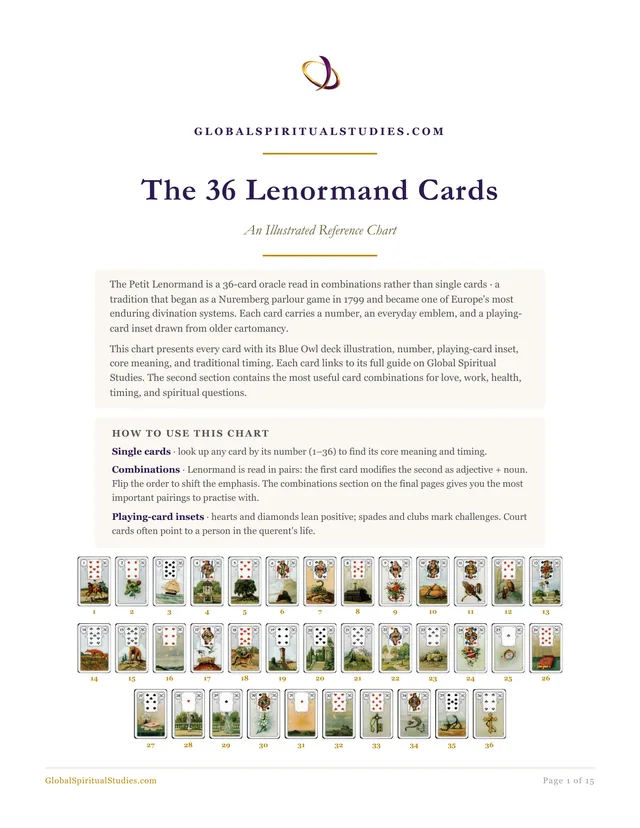
Free printable chart: see the complete 36-card Lenormand chart · every card with its playing-card inset, core meaning, and timing, plus a cheat sheet of the most useful combinations.
Origins and History
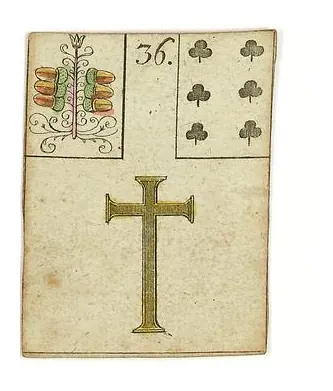
In Hechtel's Das Spiel der Hoffnung (The Game of Hope), the Cross occupied Square 36 · the last square on the board, but not the goal. The game was won at 35, the Anchor, which the leaflet calls the most important sheet of the whole game: the player who comes to rest there takes the whole cashbox. Square 36 is what happens when you overshoot it. The leaflet says that so near to the luckiest field the player is cheated, forced against his will one step too far to the figure of the Cross, where he must remain until another player takes the burden off him or he throws a double.
So the Cross is not a finish line. It is a trap set just past the prize, and one of only three holding squares in the game, with the Coffin at 8 and the Mountain at 21. That is a striking fit for a card whose divinatory meaning is burden and stuck suffering · though the fit is retrospective, and the leaflet claims nothing about symbolism at all.
The 1846 instruction sheet gives the Cross two clauses and no religion at all: it is always a bad sign, and if it lies very near the significator the querent may hope that the misfortune will not last long. Suffering is original, and so is that unexpected consolation. Burden, duty and religious or spiritual significance are later readings of the symbol rather than of the text, however naturally they follow from the picture.
Across Lenormand traditions, the Cross carries the heaviest interpretations in the deck, though with cultural variations. German readers emphasise fate, duty, and the concept of one's "cross to bear" · a burden that is both personal and inescapable. French tradition gives additional weight to religion, spiritual practice, and the trials that refine the soul. Brazilian readers within the Baralho Cigano tradition often connect the Cross to karma, ancestral debts, and the spiritual work required to clear patterns inherited from previous generations.
The Blue Owl (Blaue Eule) edition depicts a wooden cross, simple and unadorned, set against the 6 of Clubs. The image is stark · no gold, no decoration, no attempt to beautify what is fundamentally an instrument of suffering. The 6 of Clubs adds an everyday quality, grounding the Cross's cosmic significance in the mundane reality of daily burdens and ordinary endurance.
The Cross's position as the final card in the deck gives it a summarising quality that no other card possesses. It is the end of the journey, the last word, the conclusion toward which all other cards are travelling. Modern readers use this positional significance in Grand Tableau readings, where the Cross's house represents the ultimate spiritual lesson of the spread · the burden that gives the entire reading its deepest meaning.
What the Cross Means
The Cross is fundamentally a card of burden and spiritual reckoning. When it appears, the reading touches something heavy · a responsibility that cannot be delegated, a suffering that must be endured, a karmic pattern that is completing its arc. The Cross does not offer escape. It offers meaning.
This is the card's greatest challenge and its greatest gift. The Cross says that suffering is not random · that the burdens we carry have purpose, even when that purpose is invisible. This is not the same as saying suffering is good. It is saying that suffering, when met with consciousness and courage, can become the material from which wisdom is built. The Cross does not promise that the burden will be lifted. It promises that carrying it with awareness will change you · and that the change, however painful, is the point.
Positive Aspects
Faith that endures through trial. Spiritual lessons that transform suffering into wisdom. The purification that comes from bearing difficulty with grace. A sense of purpose and destiny · the understanding that your path, however hard, is the right one. Karmic resolution · old debts paid, old patterns completed. The deep peace that sometimes follows the deepest pain.
Negative and Shadow Aspects
Suffering without redemption. A burden that crushes rather than refines. Guilt imposed by religion or culture. Martyrdom · suffering not because it is necessary but because the sufferer has confused pain with virtue. Fanaticism and dogmatic thinking. The inability to release a burden that was never yours to carry. A difficult fate that feels inescapable.
How Surrounding Cards Shift the Meaning
The Cross adds weight, spiritual significance, and a quality of burden or destiny to whatever card it touches. The Cross + Heart describes love as both blessing and trial · a relationship that is fated and heavy. The Cross + Sun suggests success that comes with enormous responsibility · or joy earned through suffering. The Cross + Key is a destined resolution · an answer that carries the weight of fate.
As the final card in the Lenormand deck, the Cross carries a summarising energy. It closes cycles, completes karmic arcs, and brings things to their spiritual conclusion. Whatever it touches, it deepens · and whatever it deepens, it also burdens.
The Cross as a Person
The Cross represents a person weighed down by duty, suffering, or spiritual obligation · a priest, a nun, a spiritual director, a caretaker burdened by the needs of others, or anyone whose life has been shaped more by what they must do than by what they want to do. This is the person who carries more than their share and rarely complains about it.
Physically, the Cross person may show the marks of their burden · tired eyes, a heavy bearing, the posture of someone who has been carrying weight for a long time. In relationships, the Cross person brings depth and seriousness but also a gravity that can be difficult to sustain. They may be devoted but exhausting, or spiritual but unable to separate their personal life from their sense of cosmic obligation.
Occupational associations include clergy, chaplains, social workers, hospice volunteers, human rights advocates, and anyone whose vocation involves shouldering the suffering of others. The Cross person is often drawn to work that is meaningful but punishing · the kind of work that matters precisely because it is difficult.
Timing
36 days/weeks/months. The end of a cycle. A period marked by trials, obligations, or spiritual reckoning. The Cross often signals events that feel fated or unavoidable.
The Cross in Love, Work, and Health
Love and Relationships
In love readings, the Cross introduces the theme of destined love · relationships that feel preordained, connections that carry the weight of karma or spiritual significance. Combined with the Heart, the Cross describes love that is both profound and painful · a bond that teaches through its difficulty, a connection that the soul requires even when the personality would prefer something easier.
For those in relationships, the Cross can indicate a partnership going through a trial · a period of suffering that will either strengthen the bond or reveal its weaknesses. Combined with the Ring, it points to a commitment maintained through duty and obligation, a vow honoured even when love alone is not enough to sustain it.
For those who are single, the Cross suggests that romantic suffering has a purpose · that the heartbreak, the loneliness, the difficulty of the search is not random but part of a larger pattern. The card does not promise that love will be easy. It promises that love, when it arrives, will carry meaning.
Career and Finances
In career readings, the Cross points to work that is demanding, duty-driven, and often draining · but meaningful. It favours careers in ministry, social work, healthcare, human rights, and any field where the professional burden is heavy but the purpose is clear. The Cross in career readings asks whether the work is a calling or merely a punishment · and whether the querent is sustaining themselves or sacrificing themselves.
Financially, the Cross warns of burdens · debts, obligations, financial sacrifices made for others, or the cost of doing the right thing. Combined with the Fish, it indicates financial suffering. Combined with the Bear, it suggests that someone in authority is placing excessive burdens on the querent's finances.
For students drawn to the precision of Lenormand, Caitlín Matthews's course Petit Lenormand · Past and Future traces the Lenormand tradition from its 18th-century origins to contemporary practice across global traditions.
Health and Wellbeing
The Cross's health associations are among the most serious in the deck. The card can indicate chronic pain, conditions that are endured rather than cured, and the physical toll of sustained stress, grief, or spiritual crisis. The Cross in health readings acknowledges that some suffering cannot be eliminated · only managed, understood, and borne with as much grace as possible.
The Cross also connects to mental health through the lens of existential suffering · depression that has a spiritual dimension, grief that asks questions about the meaning of life, and the psychological weight of carrying burdens that feel fated or inescapable. The card suggests that healing may require spiritual resources · faith, community, ritual, meaning-making · as much as medical ones.
Cross Combinations · All 35 Pairs
Lenormand cards speak in combinations · pairs and triplets that build meaning the way words build sentences. The Cross takes on different qualities depending on its neighbours.
All thirty-five partners appear below with the Cross first. Leading makes the burden the subject rather than a shadow over something else, and each second card names what the weight is attached to.
Cross + Rider (36+1): Difficult news arriving. A message carrying burdens. The start of a challenging journey.
Cross + Clover (36+2): A small relief from suffering. A lucky break during a difficult period. Grace in miniature. · full Clover and Cross guide
Cross + Ship (36+3): A burden carried some distance. Duty that takes you away. Pilgrimage.
Cross + House (36+4): A burden located at home. Obligation belonging to the family.
Cross + Tree (36+5): Suffering through illness. A health burden carried over years. Karmic health patterns.
Cross + Clouds (36+6): A weight whose edges are not visible. An obligation that is definitely heavy while its origin and its endpoint are both out of view. · full Clouds and Cross guide
Cross + Snake (36+7): Suffering caused by deception. A painful complication. The karmic consequences of betrayal. · full Snake and Cross guide
Cross + Coffin (36+8): The end of suffering. A karmic cycle completing. Deep grief finding its resolution. · full Coffin and Cross guide
Cross + Bouquet (36+9): A burden softened by kindness. Weight arriving with something graceful attached.
Cross + Scythe (36+10): A burden ended abruptly. Suffering cut short by one decisive act.
Cross + Whip (36+11): A burden that recurs. Duty expressed as conflict. Hardship repeating.
Cross + Birds (36+12): A burden talked about. Worry spoken aloud. Difficulty put into words.
Cross + Child (36+13): A burden in its early stage. Small hardship. Obligation toward a child.
Cross + Fox (36+14): A burden of conscience at work. Duty weighed against self-interest.
Cross + Bear (36+15): A heavy responsibility. Duty carrying real financial or institutional weight.
Cross + Stars (36+16): A burden that carries meaning. Faith tested and deepened by hardship.
Cross + Stork (36+17): A burden shifting. Hardship entering a new phase rather than ending.
Cross + Dog (36+18): A burden shared with a friend. Duty held together. Loyalty under strain.
Cross + Tower (36+19): A burden that builds structure. Duty owed to an institution. Authority through endurance.
Cross + Garden (36+20): A hardship that is visible. Difficulty carried in front of other people.
Cross + Mountain (36+21): Enormous obstacles as spiritual trials. Blocked paths requiring faith and patience. · full Mountain and Cross guide
Cross + Crossroads (36+22): A burden that must be chosen. Duty presenting more than one path.
Cross + Mice (36+23): A burden that wears away at you. Duty draining more than expected.
Cross + Heart (36+24): A burden shared, or carried for somebody else. Devotion under strain · one person holding something up for both, or a duty kept out of loyalty to people rather than to the task. · full Heart and Cross guide
Cross + Ring (36+25): A binding obligation. A commitment maintained through duty. A vow carried as a burden.
Cross + Book (36+26): A burden kept private. Hardship not spoken of. Duty carried out of sight.
Cross + Letter (36+27): A burden set down in writing. Difficulty documented. Obligation on paper.
Cross + Gentleman (36+28): A burden belonging to a particular man. The duty is his.
Cross + Lady (36+29): A burden belonging to a particular woman. The weight rests with her.
Cross + Lilies (36+30): A burden borne over many years. Hardship that has matured into wisdom.
Cross + Sun (36+31): Success earned through sacrifice. Joy after suffering. Responsibility accompanying achievement. · full Sun and Cross guide
Cross + Moon (36+32): Emotional suffering. The weight of public reputation. Fame as a burden.
Cross + Key (36+33): A fated resolution. The answer arriving through spiritual means. A destined breakthrough. · full Key and Cross guide
Cross + Fish (36+34): Financial burdens. Money worries as a persistent trial. Business obligations weighing heavily.
Cross + Anchor (36+35): Enduring through trials. Perseverance as a spiritual practice. Stability maintained through suffering. · full Anchor and Cross guide
Note that card order matters in Lenormand. "Cross + Clover" carries a slightly different emphasis than "Clover + Cross." The first card acts as the noun, the second as the modifier. For each of these pairs read at length, and in both orders, turn to our comprehensive guide to card pairings.
In the Grand Tableau · House 36
In the Grand Tableau · Lenormand's signature spread using all 36 cards · each card occupies a numbered position called a "house." House 36 is the House of the Cross, and it is the final house in the system · the position where everything comes to its spiritual conclusion. Any card landing here takes on the quality of burden, fate, karma, spiritual trial, and the weight of destiny.
If the Heart lands in House 36, love carries a burden · a relationship that is fated but demanding. If the Sun lands here, success comes with heavy responsibility. If the Key falls in the Cross's house, the solution requires spiritual surrender · the answer lies in accepting what cannot be changed.
The House of the Cross answers the question: What is my burden? Whatever card occupies this position reveals the area of life where fate is most active, where spiritual lessons are being administered, and where the querent must carry their cross · not because it is easy, but because it is theirs.
For a complete guide to Grand Tableau reading, including the house system and advanced techniques like the ripple method, explore Mary K. Greer's Mastering the Grand Tableau: Advanced Lenormand Techniques.
Related Cards
Suffering and trial cards · cards that share the Cross's theme of difficulty and the lessons within it:
- Coffin · Card 8 · Endings, loss, the transformation that comes through grief
- Mountain · Card 21 · Obstacles, blockages, the challenges that test endurance
- Clouds · Card 6 · Confusion, doubt, the darkness before clarity returns
Spiritual and destined cards · cards connected to the Cross's quality of fate, meaning, and higher purpose:
- Stars · Card 16 · Hope, faith, spiritual guidance through difficulty
- Key · Card 33 · Destiny, certainty, the answer that arrives when suffering has done its work
- Moon · Card 32 · Emotional depth, the subconscious, the inner life where spiritual lessons are processed
Explore Lenormand Further
The Cross is one of 36 voices in the Lenormand vocabulary · and meaning emerges when voices combine. If you are drawn to the system's precision and directness, these courses offer a guided path from first reading to Grand Tableau mastery.
Recommended courses:
- The Complete Lenormand: From Card Pairs to Grand Tableau · From card pairs to the Grand Tableau, master every Lenormand reading technique · Taught by Mary K. Greer
- Mastering the Grand Tableau: Advanced Lenormand Techniques · Grand Tableau mastery, house systems, and the ripple method · Taught by Mary K. Greer
- Speaking the Oracle: How Lenormand Works Aloud · The art of articulating card combinations as spoken language · Taught by Caitlín Matthews
For the complete guide to all 36 Lenormand cards, visit The Lenormand Cards: A Complete Guide to the 36-Card Oracle.
Frequently Asked Questions
What does the Cross card mean in Lenormand?
The Cross is card 36 of the 36-card Lenormand deck. Its core meanings are burden, suffering, fate, duty, karma. Its playing-card inset is the 6 of Clubs. It is generally read as a challenging card.
What are common Cross combinations in Lenormand?
Cross + Clover means: A small relief from suffering. Cross + Tree means: Suffering through illness. Cross + Clouds means: Suffering through confusion.
What timing does the Cross card indicate?
36 days/weeks/months. The end of a cycle. A period marked by trials, obligations, or spiritual reckoning. The Cross often signals events that feel fated or unavoidable.
Learn Lenormand · explore our Lenormand courses with Mary K. Greer and Caitlín Matthews.