The Third Eye Chakra
Ajna and the seat of inner knowing
The third eye chakra, known in Sanskrit as Ajna, is the sixth energy centre in the seven-chakra system. Located between and slightly above the eyebrows, it governs intuition, inner vision, wisdom, and the capacity to perceive what the physical eyes cannot. Ajna means "to perceive," "to command," or "beyond wisdom" · it is the centre of direct knowing, the place where the mind stops analysing and simply sees.
Where the lower chakras build the foundation of being · safety, feeling, will, love, expression · the third eye gathers all of that experience and asks a different kind of question. Not "What do I feel?" or "What do I want?" but "What is true?" It is associated with the light element, the colour indigo, and the pituitary gland. Its territory is everything that illuminates: insight, imagination, clarity of thought, discernment between appearance and reality, and the quiet inner voice that knows before the rational mind has finished deliberating.
This guide explores Ajna in depth: what it governs, how imbalance manifests, healing techniques drawn from multiple traditions, and the rich correspondences this centre holds with Tarot, Kabbalah, and contemplative systems across the world.
In Brief
- - Sanskrit: Ajna · Element: Light · Colour: Indigo · Bija mantra: OM
- - Location: Between the eyebrows · Gland: Pituitary
- - Governs: Intuition, wisdom, inner sight, imagination, clarity, discernment
- - Tarot: The High Priestess (II) · Kabbalah: Binah + Chokmah · Crystals: Amethyst, Fluorite
What the Third Eye Chakra Governs
The third eye is the sixth energy centre, and by the time the ascending current reaches it, something fundamental has shifted. The lower five chakras each operate through a physical element · earth, water, fire, air, ether. Ajna's element is light itself, and its function is not to create or transform but to see. It perceives patterns, meanings, and truths that the physical senses miss entirely.
Physical domain: In yogic tradition, the third eye is associated with the brain, eyes, sinuses, and the neurological system. Modern practitioners commonly link it to the pituitary gland, though this assignment · like all chakra-to-gland correspondences · is a twentieth-century interpretation rather than a classical one (the Sat-Cakra-Nirupana describes subtle anatomy, not endocrinology). The pineal gland, often associated with the crown chakra, is sometimes linked here as well through its role in regulating melatonin and the sleep-wake cycle. In energetic terms, practitioners describe that when Ajna is balanced, the mind is clear, memory is sharp, and perception extends beyond the strictly rational.
Emotional and mental domain: Intuition, insight, imagination, clarity of thought, wisdom, and the capacity to see patterns that others miss. The third eye governs discernment · the ability to distinguish between what is true and what merely appears to be true, between genuine intuition and wishful thinking, between the voice of the deeper self and the noise of conditioning. It also holds the capacity to hold paradox without resolving it prematurely, to sit with uncertainty and let understanding arrive on its own schedule.
The light element: Each chakra's element tells you something essential about how it operates. The third eye's element is light · not physical light, but the light of awareness, the illumination that makes understanding possible. Just as physical light reveals what is in a room, the third eye's light reveals what is in a situation, a relationship, a pattern of behaviour, or the deeper currents of one's own psyche.
The two petals: In traditional yogic iconography, each chakra is depicted with a specific number of lotus petals. The root has four. The sacral has six. The numbers generally increase as you ascend. But Ajna has only two. These two petals represent the final duality · self and other, subject and object, Shiva and Shakti, the seer and the seen. When Ajna opens fully, this duality begins to dissolve, and the practitioner approaches the unified awareness of the crown.
Developmental lens: In Caroline Myss's framework, the third eye corresponds to the capacity to seek truth rather than accept what is given. It is the centre that asks "Is this true?" not "Is this comfortable?" Its development requires the courage to question inherited beliefs, to look honestly at one's own patterns, and to trust direct perception even when it contradicts the consensus. Blockage here often traces to environments where questioning was punished, where curiosity was treated as disobedience, or where the inner life was dismissed as irrelevant.
Signs of Blockage
A blocked third eye manifests as a dimming of inner vision. The capacity to see below the surface fades, and life becomes flat, literal, confined to what can be measured and proved.
Physical signs:
- Chronic headaches, particularly frontal headaches centred between or behind the eyes
- Eye strain, vision problems, and light sensitivity
- Sinus congestion and pressure
- Poor memory and difficulty concentrating
- Insomnia · particularly the kind where the mind refuses to quiet
- Hormonal imbalances related to the pituitary gland
Emotional and mental signs:
- Disconnection from intuition · the feeling that your inner compass has gone silent
- Over-reliance on logic and analysis, treating the rational mind as the only valid source of knowledge
- Difficulty imagining possibilities · a narrowing of the mind's horizon
- Closed-mindedness and dismissal of subtle cues ("that's just a coincidence")
- Inability to reflect on one's own patterns · living inside a story without seeing that it is a story
- Spiritual apathy · a dismissive stance toward anything that cannot be quantified
- Difficulty with meditation or visualisation practices
- Fear of the unknown, of the parts of experience that cannot be controlled through planning
Signs of Overactivity
An overactive third eye is as problematic as a blocked one, though it often looks more dramatic. The inner world becomes too vivid, too loud, too present · overwhelming the grounded reality that the lower chakras provide.
- Dissociation and fantasy: Living too much in the inner world · chronic daydreaming, elaborate mental scenarios, difficulty engaging with the practical demands of daily life
- Overthinking and analysis paralysis: The mind spins endlessly, examining every angle, unable to land on a decision because it can always see one more possibility
- Spiritual bypassing: Using "intuition" and "inner knowing" to avoid dealing with practical matters · ignoring finances, relationships, or health because one is focused on "higher" concerns
- Psychic overwhelm: Absorbing too much information from other people and the environment, struggling to distinguish one's own feelings from those of others
- Headaches and insomnia from an overactive, racing mind that cannot stop processing
- Confusion between intuition and projection: Difficulty distinguishing genuine insight from anxiety, wishful thinking, or unconscious bias. Treating hunches as certainties
- Intellectual arrogance: A conviction of "knowing" things without evidence, confusing the feeling of insight with the reality of it
Third eye overactivity frequently coexists with root chakra underactivity · the ungrounded visionary who sees everything clearly but cannot walk across the room without tripping. The remedy is almost always downward: root chakra grounding, physical exercise, time in nature, and the humble work of tending to the body.
Healing Techniques for the Third Eye Chakra
Meditation
The third eye responds to focused-attention meditation more powerfully than any other technique. This makes intuitive sense: attention itself is the third eye's function, and meditation is the practice of refining attention.
Trataka (candle gazing) is a classical technique: fix your gaze on a steady candle flame without blinking for as long as comfortable, then close the eyes and observe the afterimage at the third eye point. This trains both outer and inner sight simultaneously.
Third eye focus: Simply sitting with eyes closed and bringing gentle attention to the point between the eyebrows. No force, no straining · just a soft, steady awareness resting at that point. Over time, practitioners often report warmth, tingling, or the perception of colour at this location.
The bija mantra OM is the seed sound of the third eye · the cosmic sound, simpler and more resonant than the mantras of the lower centres. Intone it at a mid-to-high pitch (higher than the lower-chakra mantras) and feel the vibration settle at the centre of the forehead. Breath awareness meditation also naturally activates Ajna, because the act of watching the breath without controlling it is a pure exercise in witnessing · the third eye's essential capacity.
Yoga Poses
- Child's Pose (Balasana): With the forehead resting on the earth, this pose directly stimulates the third eye point through gentle pressure. It is simultaneously grounding and inward-turning
- Eagle Pose (Garudasana): Builds intense concentration as the body wraps and balances, demanding the focused attention that feeds Ajna
- Dolphin Pose: An inversion that brings blood to the head and the brow centre, energising the third eye while building upper body strength
- Wide-Legged Forward Fold (Prasarita Padottanasana): Crown moving toward the earth, the world inverted · this pose shifts perspective, which is the third eye's territory
- Savasana with eye pillow: The gentle weight and darkness of an eye pillow over the closed eyes activates the third eye point, deepening the meditative quality of the final rest
Crystals
Amethyst is the primary third eye crystal · the stone of spiritual insight, ranging from violet to deep indigo. Traditionally associated with sobriety and mental clarity, Amethyst quiets the overactive mind while opening the channels of intuitive perception. Place it on the forehead during meditation or hold it during contemplative practice.
Fluorite is known as the "genius stone" for its capacity to organise scattered thoughts and sharpen discernment. Where Amethyst opens the third eye, Fluorite helps structure what flows through it · particularly useful for those whose third eye is active but chaotic.
Labradorite is the iridescent stone of transformation and inner seeing. Its play of colour beneath a grey surface mirrors the third eye's function: revealing hidden truths beneath ordinary appearances. For a deeper exploration of crystal work across all seven centres, see our chakra crystals and gemstone guide.
Sound
The bija mantra OM is the simplest and most powerful sound practice for the third eye. Unlike the more complex mantras of the lower chakras, OM is universal · it requires no training, no belief system, no context. The vibration naturally settles at the brow centre when intoned with awareness.
In modern sound healing, the solfeggio frequency 852 Hz is often linked to this centre, though these specific frequency-to-chakra assignments are a contemporary framework rather than a classical one. Used as background sound during meditation, it may support the third eye's opening without demanding active engagement.
Silence itself is a third eye practice. In the absence of external sound, the inner senses sharpen. Extended periods of quiet · whether formal silent retreat or simply turning off all devices for an evening · create the conditions in which inner seeing awakens naturally.
Embodied Practices
- Dream journaling: Dreams are the third eye's native language. Recording them immediately upon waking strengthens the bridge between the conscious and unconscious mind, training the faculty of inner perception
- Contemplative reading: Philosophy, poetry, sacred texts · any reading that requires you to perceive meaning below the surface exercises the third eye
- Stargazing: The practice of looking at vast distances trains the eyes and the mind to expand beyond the immediate and the measurable
- Time in complete darkness: Sensory deprivation of the visual field awakens the inner visual field. Even a darkened room with a sleep mask for twenty minutes can shift perception
- Intuitive Tarot practice: Reading cards without consulting the book · trusting the image, the feeling, the story that arises from within rather than the printed meaning. This is third eye development in action. You can also take our free Tarot chakra quiz to discover which energy centre is calling you through the Tarot
- Art from inner vision: Drawing, painting, or writing that arises from the inner world rather than imitating the outer one
Tarot Correspondences
A note on two maps. The correspondences that follow use the planetary system, which seats The High Priestess at the third eye, through the Moon. Philip Carr-Gomm and Steve Hounsome's The Energy Body in Tarot teaches a different arrangement · the Three Septenaries, a 7x3 grid that gives every numbered Major Arcana card both a chakra and a realm of Body, Mind or Spirit. There The High Priestess belongs to the sacral at the level of Body, and the third eye is held by The Lovers, Death and Judgement. Both are working maps rather than doctrine, and the one worth keeping is the one that opens the cards for you.
The primary Major Arcana correspondence for the third eye is The High Priestess (II), through the Moon's planetary association. The High Priestess sits between the two pillars · Boaz and Jachin, connecting to the Kabbalistic pillars of Severity and Mercy · guarding the threshold between the seen and the unseen. She does not explain. She does not persuade. She simply knows, and her knowing is deeper than any argument could reach. She IS intuition personified: quiet, receptive, seeing everything, saying little.
The Moon (XVIII) is also deeply connected to this centre. Where The High Priestess represents intuition in its still, receptive form, The Moon represents the journey through the territory that intuition reveals · a landscape of illusion, shadow, and the unconscious, where what you see and what is real may not be the same. The Moon card is the third eye's warning and its promise simultaneously: inner sight reveals truth, but it also reveals how much of what we call "reality" is constructed by the mind.
The practice of reading Tarot is itself a third eye exercise. Every intuitive reading requires the reader to perceive beyond the literal image, to sense patterns and connections that the analytical mind cannot reach, to trust inner knowing over memorised definitions. Developing skill as a Tarot reader and developing the third eye are, in many respects, the same practice. Philip Carr-Gomm · who has spent decades integrating Druidic, Kabbalistic, and yogic frameworks · makes this connection explicit in The Energy Body in Tarot, where the third eye lesson teaches participants to read cards from the intuitive centre rather than from memorised meanings. For a spread designed to explore this connection directly, see our Tarot chakra spread guide.
No single Minor Arcana suit maps directly to the third eye. The upper chakras increasingly belong to the domain of the Major Arcana · archetypal rather than elemental. However, Swords carry a connection through the air-and-mind association: the mental clarity that is the third eye's sharpest tool, and the double-edged quality of a mind that sees too much without the heart to hold it.
The Kabbalah Parallel · Binah, Chokmah, and Da'at
The third eye maps to the uppermost pair of lateral sephirot on the Tree of Life: Binah (Understanding) on the left pillar and Chokmah (Wisdom) on the right. Between them · or perhaps beneath them · sits the mysterious Da'at (Knowledge), the hidden sephirah that is sometimes drawn on the Tree and sometimes left as an empty space.
Chokmah is the flash of insight · the lightning bolt of knowing that arrives before thought has time to form. It is wisdom in its purest, most sudden state: the moment when you understand something completely, in a single instant, before words can capture it. Binah is the vessel that receives that flash and gives it form, the capacity to comprehend, to structure, to understand in a way that can be communicated and applied. Together they represent the full cycle of intuitive knowing: the vision arrives (Chokmah) and is comprehended (Binah).
Da'at is the most enigmatic point on the Tree · and one of the most debated. It represents a kind of knowing that is neither purely intellectual nor purely mystical, but both at once · the union of Chokmah and Binah, wisdom and understanding married into a knowledge that transforms the knower. Its placement is contested: some Kabbalists locate Da'at at the throat, others at the third eye, and still others argue it is not a sephirah at all but a "pseudo-sephirah" or a gateway between levels of the Tree. This very ambiguity mirrors the third eye's territory: the threshold where ordinary knowing ends and something deeper begins.
In Isaac Luria's sixteenth-century Kabbalistic system, Da'at occupies the space left empty when Keter (the Crown) "withdrew" during the process of creation (tzimtzum). It is knowledge that arises from absence · from wrestling with what cannot be seen directly, from the productive emptiness that remains when the divine contracts to make room for the world. Earlier Kabbalists, including those of the Zoharic tradition, did not include Da'at on the Tree at all. The competing interpretations are themselves instructive: the third eye operates in exactly this territory of productive uncertainty, perceiving not by grasping but by becoming receptive.
For a full exploration of the chakra-sephirot correspondences, see our chakra and Tree of Life map, and for the broader Kabbalistic framework, our complete Tree of Life guide.
Cross-Cultural Perspectives
The third eye appears across Hindu, Taoist, Celtic, Egyptian, and Tibetan traditions · a recognition, developed independently in each lineage, that there is a centre of perception at the brow that sees what the physical eyes cannot.
Taoist tradition: The Upper Dantian, located between the eyebrows, stores Shen (spirit) · the most refined form of energy in the Taoist system, the light of consciousness itself. When Shen is cultivated, the practitioner develops clarity of perception, calm awareness, and the capacity to see the true nature of things. Taoist internal alchemy (neidan) traces a path of refinement that mirrors the chakra ascent precisely: Jing (essence, at the root) is refined into Qi (vital force, at the heart) and then into Shen (spirit, at the third eye). The sequence is the same; only the vocabulary differs.
Celtic tradition: The "second sight" (An Da Shealladh in Scottish Gaelic) was understood not as a supernatural power but as a natural capacity · some people simply perceived more than others, the way some people have sharper hearing or a finer sense of smell. The seer (filidh) in Irish tradition held a recognised social role: one who could see what was coming and speak it truthfully. The Cauldron of Wisdom (Coire Sois), located in the head, must be turned upright through spiritual development before it can receive the waters of inspiration. This is the third eye's awakening described in Celtic terms · a vessel that exists in everyone but must be cultivated before it functions.
Egyptian tradition: The Eye of Horus (Wadjet) was both a protective symbol and an emblem of restored vision. The myth of Horus losing his eye in battle with Set and having it restored by Thoth maps the universal pattern of inner sight: it can be lost through trauma, conflict, or neglect, and recovered through healing and dedication. The Uraeus · the cobra that rises from the pharaoh's forehead · sits precisely at the third eye point, representing awakened spiritual authority and the power to see beyond the ordinary.
Tibetan Buddhism: The brow point (tilaka or bindu) is the site where the guru transmits blessing and empowerment · direct transmission of wisdom from teacher to student, mind to mind, bypassing words. In Vajrayana iconography, deities are frequently depicted with a third eye representing the capacity to perceive past, present, and future as a single field of awareness · not sequential time but the unity of all temporal experience.
Guided Third Eye Chakra Practice
This ten-minute practice combines OM mantra work, indigo light visualisation, and the cultivation of receptive inner listening. It can be done seated or lying down. If working with crystals, place Amethyst or Fluorite on the forehead while lying down, or hold in the non-dominant hand while seated.
- Settle: Sit in a quiet, dimly lit space. Close your eyes. Bring your attention to the point between and slightly above your eyebrows. Do not strain to "see" anything · simply rest your awareness there, the way you might rest your gaze on a distant mountain.
- Soften: Take three deep breaths. With each exhale, let the muscles around the eyes and forehead release completely. The brow unfurrows. The jaw loosens. The space behind the eyes opens.
- Visualise: See a sphere of deep indigo light at the third eye point · glowing steadily, like the last colour of the sky before full dark. It does not pulse or flash. It simply shines, constant and calm.
- Brighten: With each inhale, the indigo light brightens gently. With each exhale, it sends soft rays of light inward, illuminating the inner landscape · whatever that landscape may hold today.
- Chant: Begin chanting OM in a steady, mid-to-high tone. One chant per exhale. Feel the vibration resonate at the centre of the forehead, at the point where the indigo sphere rests. Let the sound be natural, not forced.
- Release the sound: After seven rounds of OM, let the mantra go and sit in the silence that follows. Keep your attention at the third eye point. Notice how the silence feels different now than it did before the chanting.
- Witness: Without straining or seeking, notice what arises in the inner field of vision. Colours, images, fragments of memory, or nothing at all · each is equally valid. Do not chase any image. Do not interpret. Simply witness what comes and let it pass.
- Ask: Silently pose one question: "What do I need to see?" Then wait. Do not force an answer. If nothing comes, the practice is working · the third eye opens on its own schedule, not on demand. Trust the process.
- Rest: Sit for two more minutes in receptive silence. Breathe gently. Let the attention at the brow soften from a point to a field · a wide, open awareness that includes everything without grasping at anything.
- Return: Open your eyes slowly. Look at something natural · a plant, the sky through a window, your own hand · and see it as if for the first time. Notice colour, texture, the play of light. This is the third eye at work in ordinary life: seeing what has always been there, but seeing it freshly.
For more guidance on chakra meditation, including techniques for beginners, see our chakra meditation guide.

Featured Course
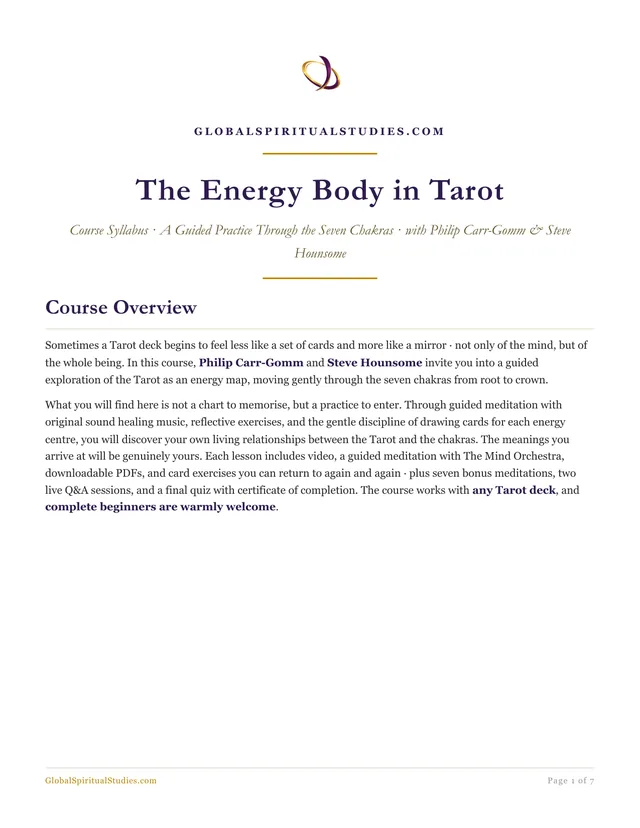
The Energy Body in Tarot
A Guided Practice Through the Seven Chakras · with Philip Carr-Gomm & Steve Hounsome
Nine lessons exploring the hidden energy map in every Tarot deck. Guided meditations with original sound healing music, practical exercises for each chakra, and a transformative journey from root to crown.
- 12 video lessons across nine sessions
- 15 guided meditations
- 12 PDF handouts
- Sound healing music
- Community forum
- Lifetime access
- Final quiz
- Certificate of completion
For a broader view of all seven energy centres, return to our complete chakra guide. To explore the kundalini energy that approaches its final centres as it nears the crown, our kundalini guide traces the serpent's path from root to summit. Continue ascending with our crown chakra guide, or return to the throat chakra to revisit the centre of authentic expression that prepares the ground for inner sight.
Printable Reference
Want every chakra in one chart? See our free 7-chakra reference chart · the complete correspondence table with colours, elements, and seed (bija) sounds, plus a printable PDF to keep beside your practice.
Frequently Asked Questions
What does the third eye chakra control?
The third eye chakra (Ajna) governs intuition, inner vision, wisdom, clarity, imagination, and discernment. It is associated with the light element, the pituitary gland, and the brain, eyes, and sinuses. The third eye perceives patterns, meanings, and truths that the physical eyes cannot see. In the yogic tradition, its two lotus petals represent the final duality · self and other, seer and seen · that dissolves as awareness deepens toward the unified consciousness of the crown.
How do I know if my third eye is blocked?
Common signs of a blocked third eye include chronic headaches (especially frontal), difficulty concentrating, disconnection from intuition, over-reliance on logic and analysis, closed-mindedness, inability to visualise or imagine, spiritual apathy, poor memory, insomnia, and a persistent sense of living on the surface of experience without depth or meaning. Physical signs traditionally associated with this centre include eye strain, sinus issues, and hormonal imbalances, though these should be evaluated medically.
How do I open my third eye safely?
The safest approach is daily focused-attention meditation with the OM mantra, starting with ten minutes. Grounding practices such as root chakra work should always accompany third eye development to prevent the disorientation that comes from opening the upper chakras without a stable foundation. Trataka (candle gazing), dream journaling, and contemplative reading all support gradual, stable third eye opening. Avoid forcing the process · the third eye opens on its own schedule when conditions are right.
What Tarot card represents the third eye chakra?
The High Priestess (II) is the primary Tarot correspondence, connected through the Moon's planetary association. She represents intuition, hidden knowledge, and the threshold between the seen and unseen worlds. The practice of reading Tarot itself is a third eye exercise · every intuitive reading requires perceiving beyond the literal image. The Moon card (XVIII) also connects deeply to this centre through its journey into illusion, shadow, and the unconscious.
What is the Kabbalah connection to the third eye?
The third eye maps to Binah (Understanding) and Chokmah (Wisdom), the uppermost lateral pair of sephirot on the Tree of Life. Chokmah is the flash of insight that arrives before thought; Binah gives that flash form and meaning. The hidden sephirah Da'at (Knowledge) is sometimes placed here as well, representing a union of intellectual and mystical knowing that mirrors the third eye's territory · the threshold where ordinary knowledge ends and transformative wisdom begins.
Part of our complete guide: Chakras · A Complete Guide to the Seven Energy Centres
The eye that sees everything cannot see itself. The third eye is the moment it learns to.