Dr. Roger Jahnke, OMD · His Life, Teachings, Books and How to Learn Qigong With Him
The physician-teacher behind Qi Medicine and Tai Chi Easy: where his teaching comes from, the frameworks and terms he uses, his books and research, and the clearest way to begin
Dr. Roger Jahnke, OMD, is a Doctor of Oriental Medicine and one of the most influential Qigong teachers in the English-speaking world. He founded the Institute of Integral Qigong and Tai Chi (IIQTC) in Santa Barbara, California, co-founded the National Qigong Association in 1996, developed Tai Chi Easy for community practice leaders, wrote The Healer Within and The Healing Promise of Qi, and was lead author of a 2010 review of 77 randomized controlled trials of Qigong and Tai Chi.
This page contains Amazon affiliate links. If you buy through one, Global Spiritual Studies may earn a commission at no cost to you.
His teaching rests on one idea, which he has repeated for more than three decades: the most profound medicine is produced within the human body, and simple daily practice of movement, breath, mind focus and self-applied massage is how it is turned on. Everything else on this page grows from that sentence: his lineage, the frameworks and terms he teaches, his books and research, and a seated routine you can keep, ending with the simplest way to begin practising with him.
Roger Jahnke · quick facts
| Item | Detail | Source |
|---|---|---|
| Credential | OMD, Doctor of Oriental Medicine; also described as a Doctor of Chinese Medicine | IIQTC, his course pages |
| Clinical practice | 35 years as a physician of acupuncture and Traditional Chinese Medicine; ten research tours to China | His course pages; ten trips also in his own words |
| First practice | First yoga class in 1963; first Qigong and Tai Chi class in 1967 | His own account, Discover the Power of Qi Medicine |
| Organisations | Founder, director and lead trainer of IIQTC · co-founder and chair emeritus of the National Qigong Association (1996) · co-founder of the Healer Within Foundation (2002) | IIQTC, Omega, NQA, GuideStar |
| Method | Developer of Tai Chi Easy, taught by trained practice leaders | Omega, taichieasy.org |
| Books | The Healer Within (1997) · The Healing Promise of Qi (2002) · contributor to the English edition of Chinese Medical Qigong (2010) | Publisher listings, Singing Dragon |
| Research | Lead author of a 2010 review of 77 randomized trials · co-author of two Tai Chi Easy trials (2015, 2025) · collaborations with the VA, Mayo Clinic and several universities | PubMed, Omega |
| Policy | Co-convened the 2005 National Expert Meeting on Qigong and Tai Chi | IIQTC |
| Teachers trained | Close to 6,000 teachers and practitioners, with his colleagues | His course pages |
| Where he teaches | IIQTC trainings; Omega Institute, Kripalu and Esalen; recorded online courses | IIQTC, Omega, his own account |
Biographies give between 30 and 40 years of clinical practice and eight to ten China tours; every source agrees on more than three decades.
 6 pages
Free course packet
Roger Jahnke · Course Information Packet
Qi Medicine, set out on six printable pages.
| What’s inside | |
|---|---|
| ✓ | The recorded session at a glance: what the hour teaches and how to watch it |
| ✓ | Qi Medicine with Roger Jahnke module by module, from the medicine within to inner alchemy |
| ✓ | What a module looks like: teaching, a Qigong demonstration and questions, with the bonuses |
| ✓ | A first taste of practice: the Four-Part Breath, in his words |
Arrives in your inbox as a PDF
His story, in his own words
Roger Jahnke's path into healing began with a loss. As he told MysticMag in 2024, his father died of leukemia when Roger was about ten, and the boy grew into a young man drawn to medicine. What he found in medical training puzzled him: by his account it centred on pharmaceuticals and technology, with little to say about staying well. He wanted to understand health, not only disease, and that question carried him to Chinese medicine, which treats the cultivation of wellbeing as a discipline in its own right.
The second turn came in the clinic. In the recorded conversation that opens his free Qi Medicine event, he describes seeing patients daily as a doctor of Chinese medicine while also teaching a community Qigong class. Most patients, he noticed, wanted a doctor to fix them; only a minority were fascinated by healing themselves. Everyone in the Qigong class was. So he went fully into Qigong and Tai Chi and, as he tells it, gave up his clinical practice to teach.
The arithmetic followed. One clinician sees one patient at a time; a teacher can lead thirty or a hundred people at once; a trainer of teachers can reach thousands. His institute carries a mantra that sums up the whole design:
"We train thousands to inspire millions to heal themselves for free."
Roger Jahnke · Discover the Power of Qi Medicine
Lineage and influences
Jahnke is an integrator rather than the holder of a single family lineage, and he says so plainly. His grounding is Traditional Chinese Medicine, the clinical discipline behind his OMD, deepened by ten research tours to China. Onto that he has gathered forms from many schools: his course pages note that he has studied hundreds of forms of Qigong, and his second book distils practices from twenty-five traditional and modern forms of Tai Chi and Qigong.
Two named sources stand out in his own teaching materials. Flowing Motion, his best-known beginner practice, comes from Bu Zheng, or Vitality Enhancement, Medical Qigong. His Gathering Breath and Marrow Washing visualisation come from the Shaolin Marrow Washing tradition. Around these he weaves Daoist inner alchemy (the Golden Elixir), the Chinese wellness tradition of Yang Sheng, and a lifelong interest in how other contemplative traditions describe the same territory. In the free event he speaks of yoga, Tibetan practice and indigenous healing traditions as relatives of Qigong, while naming Qigong as the tool that serves him best.
The result is a method rather than a style: a way of organising any form of Qigong into four kinds of practice, so that students can draw on whatever form suits them. That is why his frameworks travel so well, and why so many teachers trained elsewhere use his vocabulary.
Career timeline
| Year | Milestone | Source |
|---|---|---|
| 1963 and 1967 | First yoga class; first Qigong and Tai Chi class | His own account |
| 1996 | Co-founds the National Qigong Association | NQA, Omega |
| 1997 | The Healer Within, HarperSanFrancisco (paperback 1999) | Publisher listing |
| 2002 | The Healing Promise of Qi · co-founds the Healer Within Foundation | Publisher listing, GuideStar |
| 2005 | Co-convenes the National Expert Meeting on Qigong and Tai Chi | IIQTC |
| 2010 | The 77-trial review · Tai Chi Easy programme evaluation · Chinese Medical Qigong in English | PubMed, Singing Dragon |
| 2015 and 2025 | Co-authors two randomized trials of Tai Chi Easy with breast cancer survivors | PubMed |
IIQTC and Tai Chi Easy
The Institute of Integral Qigong and Tai Chi
IIQTC is the Santa Barbara institute he founded and still leads. In his own 2020 description it trains teachers and practice leaders, conducts research and educates the public, with programmes for children to seniors in schools, faith communities, hospitals, businesses, the military and the justice system. The Qigong Institute has described its teacher certification as 200 hours across three intensive levels plus self-study.
Tai Chi Easy and the practice-leader model
Tai Chi Easy is his simplified approach to Tai Chi and qi cultivation. Its defining design choice is that trained lay and peer "practice leaders" teach it, rather than masters. Omega calls it "beneficial, fun, and easily accessible."
The idea has a policy history. In 2005 Jahnke co-convened the National Expert Meeting on Qigong and Tai Chi with the University of Illinois at Urbana-Champaign and the National Blueprint for Active Aging, which named "exclusive dependence on masters or experts" as a barrier to wider practice. Tai Chi Easy is his answer: a practice simple enough for a nurse, a volunteer or a retired neighbour to lead.
A 2010 evaluation in Geriatric Nursing trained practice leaders at 18 US sites; 330 older adults (average age 73) completed the programme and reported less stress and better sleep and energy, and 91 percent planned to continue. As an uncontrolled evaluation, it shows the model spreads well and that people enjoy it, rather than measuring what it does for health.
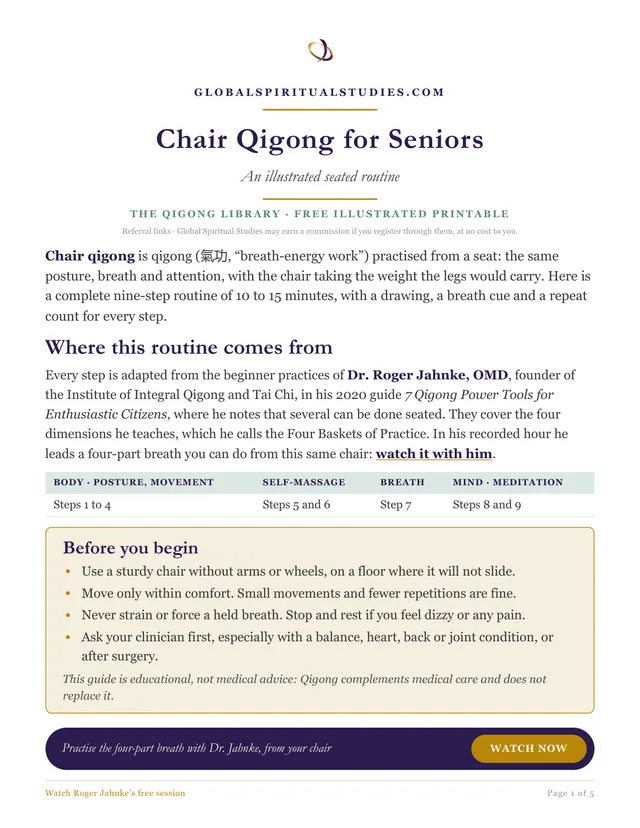
Many of his beginner practices can be done seated, which suits older adults and anyone with limited balance. The library has adapted a gentle seated routine from his Four Dimensions practices into an illustrated printable.
An illustrated seated routine for older adults · arrives in your inbox as a PDF
What he teaches
Jahnke's teaching is built from a small set of frameworks. The names shift between his books and courses; the ideas stay steady, and together they make one of the clearest maps of Qigong practice available to a beginner.
| Framework | In plain language | Where he teaches it |
|---|---|---|
| The four practices (Four Essential Self-Care Methods · Four Baskets · Four Dimensions) | Gentle movement and posture, breath, mind focus, and self-applied massage, practised together; in his words, "the essence of the operational definition of Qigong" | The Healer Within; the Qi Medicine course; his Medical Qigong courses |
| Three Treasures | Jing, Qi and Shen: essence, energy and spirit, framed for beginners as body, breath and mind | Module 1 of his courses; the free event |
| Three Intentful Corrections | Adjust the posture, deepen the breath, clear the mind; common to every form of Qigong | His 2020 guide 7 Qigong Power Tools |
| 9 (plus 1) Phases of Qi Cultivation | Discover, Gather, Circulate, Purify, Direct, Conserve, Store, Transform, Dissolve; a tenth, Transmit, shares qi with others | The Healing Promise of Qi; module 5 of Qi Medicine |
| Medical Qigong | Any Qigong practised with a health purpose: first build qi through the whole system, then direct it with massage, breath and intention | The free event; his Medical Qigong courses |
| Golden Elixir | The spiritual layer: an inner, eternal self that is already well | Module 6 of Qi Medicine; his advanced courses |
| Yang Sheng | "Nourishing life": Chinese wellness practice, living in step with the seasons | Pacific College article, 2018; his trainings |
In practice the four baskets fit together easily. Body: Flowing Motion is an easy rocking swing of the arms timed with the breath. Breath: he calls it the most powerful and the easiest tool for gathering qi, and in the free event he notes that most busy people breathe 16 to 22 times a minute, while practice can slow that to a handful. Mind: resting attention on what is happening now, which he calls "the power point" of practice. Self-massage: pressing, stroking, holding and tapping; he suggests massaging one hand with the other, even under the table in a meeting.
His formula for Medical Qigong is the same four baskets with a direction added. First do any kind of Qigong to raise function through the whole system; then use massage, breath and intention to bring qi to the place that needs it most. As he puts it, quoting the old saying, the qi flows where the mind goes.
His free hour, Discover the Power of Qi Medicine, puts the Four Baskets you just read about into practice and leads the Four-Part Breath with you in real time.
Watch nowOpens the course page · the session is one click away
Key terms in his teaching
Jahnke moves easily between Chinese terms and plain English. These are the words a new student meets first, with the sense he gives them.
| Term | Meaning | How he uses it |
|---|---|---|
| Qi | Vital energy, or breath | He often translates it as "function": the working capacity of cells, blood, digestion and nerves |
| Qigong | Qi plus gong, a skill patiently cultivated | The four baskets practised together, in any of thousands of forms |
| Jing | Essence | The most subtle aspect of the physical self; the first of the Three Treasures |
| Shen | Spirit, or mind | The third treasure; in his framing the doorway to the eternal self |
| Yi | Mind intent | The intention that directs qi; the root of "the qi flows where the mind goes" |
| Dantian | Elixir Field | Three centres on the body's midline, at the navel, the heart and the brow; the middle one he calls the heart-mind |
| Wei Qi | Protective qi | The outer field around the body, which in his teaching replenishes the channels and points |
| Yang Sheng | Nourishing life | Everyday wellbeing through rest, food, moderate practice and the seasons |
| Golden Elixir | The goal of Daoist inner alchemy | A medicine "you cannot buy" and can only make within yourself |
| Qi Medicine | His name for Qigong as daily self-care | The natural healing resources the body produces when the right conditions are created |
Glosses drawn from his recorded teaching in Discover the Power of Qi Medicine, his 2020 guide and his course descriptions. Terms such as Jing, Shen and Wei Qi come from Traditional Chinese Medicine; the readings in the third column are his.
"The most profound medicine is produced within"
If his work has one sentence at its centre, it is this.
"The most profound medicine is produced within the human body, for free."
Roger Jahnke · Omega interview, published on HuffPost, 2017
In that interview he describes the body producing its own resources, the mind contributing focus and intention, and the spirit becoming a healing resource when life is aligned with purpose. In the free event he roots the idea in older cultures, where a person with "big medicine" has insight, vitality and resilience rather than a pharmacy: medicine, he says, "is something that you own." His name for the whole is "the healer within," the title of his first book.
At its deepest the idea becomes the Golden Elixir. He describes an aspect of each person that is "irrevocably well," and the alchemist's saying that "the gold does not fear the fire": steady attention, brought to bear on the raw ingredients of a life, reveals what was golden all along. He is careful to frame all of this as self-care that complements medicine; his own practice guide asks readers to consult their physician and not to change medication without doing so.
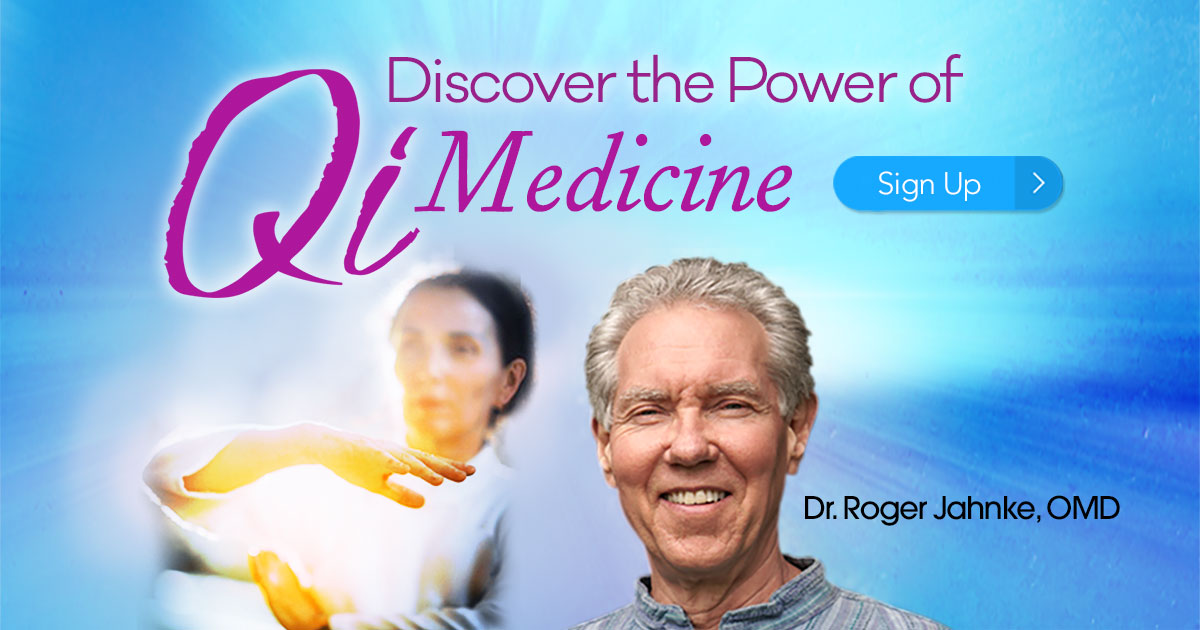
The medicine within is the idea his recorded hour is built around, taught through the Four-Part Breath, the Three Treasures and the Four Baskets; the course page presents the session as a way to meet stress, sleeplessness and low energy.
Watch nowOpens the course page · the session is one click away
His books
| Book | Published | What it covers | Best for |
|---|---|---|---|
| The Healer Within | 1997, HarperSanFrancisco | The four essential self-care methods: movement, self-massage, breathing and meditation | Beginners |
| The Healing Promise of Qi | 2002, McGraw-Hill/Contemporary | Qigong and Tai Chi as a path of cultivation, organised around his 9 Phases and drawing on 25 traditional and modern forms | Readers ready to go deeper |
| Chinese Medical Qigong | 2010, Singing Dragon | English edition of the Chinese medical Qigong textbook, edited by Tianjun Liu and Kevin Chen; Jahnke contributed to the English edition | Practitioners and clinicians |
The Amazon links are affiliate links.
Which to read first
Begin with The Healer Within. It is the gentler book, written for someone who has never practised, and its four methods are the four baskets he still teaches. Move to The Healing Promise of Qi once a daily practice has taken root and you want the larger map, including the nine phases. Chinese Medical Qigong is a clinical textbook for practitioners and those training to teach.
What the research says
Jahnke is one of the few Qigong teachers who has published research himself, which makes precision about it part of understanding his work.
The 2010 review of 77 trials
He was lead author of "A comprehensive review of health benefits of Qigong and Tai Chi" in the American Journal of Health Promotion. It gathered 77 randomized controlled trials from 1993 to 2007, with outcomes ranging from cardiopulmonary effects and physical function to falls, quality of life and psychological symptoms. The authors concluded that the trials showed consistent, significant results for a number of health benefits. Many trials were small, and the review stops at 2007.
The Tai Chi Easy trials
Two randomized trials co-authored by Jahnke tested Tai Chi Easy with breast cancer survivors living with fatigue. In 2015 (87 women, 12 weeks), fatigue fell significantly more than with a sham Qigong comparison. In the larger 2025 trial (167 women, 8 weeks), gains over an education control were limited to cognitive function, and the sham group improved there too. The fair reading: benefits are modest, and gentle mindful movement of many kinds seems to help. He also helped design the programme being tested.
The wider evidence
The National Center for Complementary and Integrative Health summarises studies suggesting Qigong may help with fibromyalgia symptoms, COPD and fatigue in cancer, while noting that many studies are small. It finds evidence that Tai Chi helps balance and fall prevention in older adults, and calls both generally safe.
Where his work sits in modern Qigong
Most Qigong teachers in the West are known for a form or a lineage. Jahnke is known for a structure. His contribution has been to make Qigong legible to public health: a four-part method any form can fit into, a practice-leader model that does not depend on masters, a national association for the field, and a body of research that put Qigong and Tai Chi into the medical literature as "meditative movement."
Set beside the other teachers in the Qigong Library, the differences are instructive.
| Teacher | Root of the teaching | Signature practice | Emphasis |
|---|---|---|---|
| Roger Jahnke, OMD | Traditional Chinese Medicine, integrating many forms | The Four Baskets; Flowing Motion; the Four-Part Breath | Daily self-care, Medical Qigong, training teachers and practice leaders |
| Daisy Lee | 59th-generation lineage holder of Hua Tuo's Five Animal Qigong | Zang Fu Gong organ Qigong; Radiant Lotus Women's Qigong | The organs and the emotions they hold in Chinese medicine |
| Robert Peng | Apprenticeship from childhood with the monk Xiao Yao | Xi breathing; the three dantians and the Central Meridian | Breath, inner stillness and the heart |
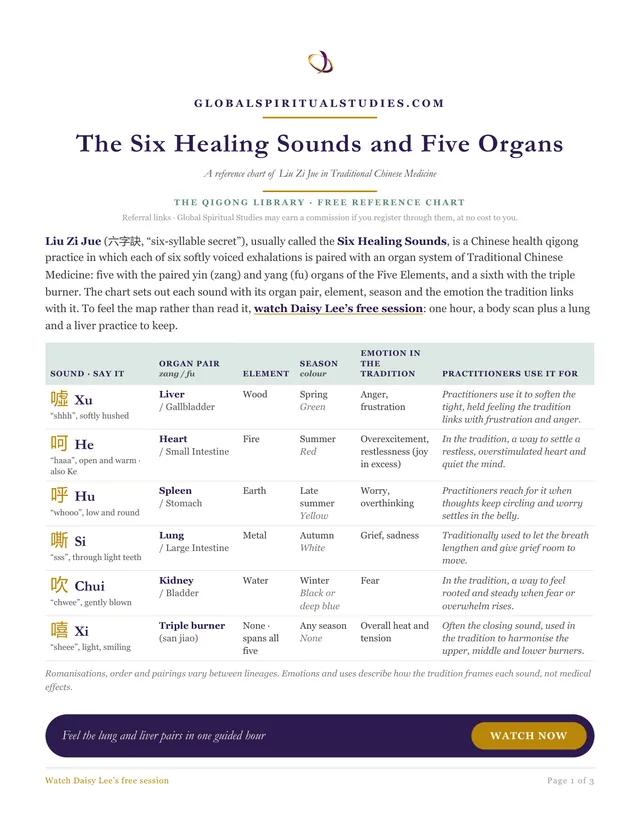
| Master Faye Li Yip | Family lineage: daughter and student of Professor Li Deyin | Health Qigong Ba Duan Jin; the Six Healing Sounds (Liu Zi Jue) | The standardized classical forms, each movement paired with an organ |
A student drawn to the organs and emotional healing often finds a home with Daisy Lee; one drawn to breath and meditative depth, with Robert Peng. Jahnke suits the reader who wants the whole map first, explained by a physician, with practices simple enough to do every day.
His teaching voice
He sounds like a man who enjoys his subject. His free 2020 guide is titled 7 Qigong Power Tools for Enthusiastic Citizens, and "Enthusiastic Citizens" is how he addresses readers: people capable of looking after themselves. The tone is warm, inclusive and a little playful; he rings a gong to open a session and calls a room of practitioners a "Qi party."
"Chinese medicine is wellness based."
Roger Jahnke · Qigong Institute profile
He argues for a health system that puts more effort into keeping people well, and he consistently presents practice as a complement to medical treatment. He translates Chinese medical language into terms such as the relaxation response and inflammation. He also insists that there is no correct feeling to chase: everyone feels something different, and trusting your own experience is, in his words, the secret of turning the medicine on. On the main obstacle to practice he is plain: "Distraction is a big issue." His answer is to start small.
How to begin learning with him
The simplest path runs in three steps: an hour with his free session, then his seven-module Qi Medicine course for the full method, then his books or his institute's trainings for depth. He has said that the people who arrive with the least knowledge and the most curiosity are often the ones who blossom.
| Option | Format | Good for | Where |
|---|---|---|---|
| Free session · Discover the Power of Qi Medicine | Hour-long free video event with the Four-Part Breath | A first taste of his teaching | Begin with the free session |
| Qi Medicine with Roger Jahnke | Seven-module on-demand video course | The Four Baskets, the 9 Phases and the Golden Elixir in depth | The Qi Medicine course page · the complete course guide |
| Qi Medicine Advanced Training · Medical Qigong with Dr. Roger Jahnke, OMD · 4 Dimensions of Medical Qigong · Deeper Dimensions of Medical Qigong · Qi Medicine for the "Heart-Mind" · Activate Your Inner Healing Elixirs With the 10 Phases of Qi Cultivation · The Powerful Healing Medicine of Bu Zheng Qigong · Qigong as a Natural Elixir to Activate Your Body's Capacity for Self-Healing | Recorded courses of 7 to 14 modules | Going deeper on one theme | His course pages |
| Institute of Integral Qigong and Tai Chi | Teacher and practice-leader trainings | Training to teach | iiqtc.org |
| Tai Chi Easy | Practice-leader training | Leading a simple practice locally | taichieasy.org |
| Retreat centres | In-person workshops | Residential study | Omega Institute, Kripalu, Esalen |
| YouTube | Free short practices, including seated ones, and interviews | Seeing his style first | Dr. Roger Jahnke · IIQTC · Tai Chi and Qigong Way |
Course formats and availability change; see his course pages or iiqtc.org for current details.
Printable · 6 pages
Keep the course details to hand
Every module and bonus of Qi Medicine, on six pages.
Get the packetHow students describe his teaching
Students on his course pages describe a fuller personal practice, easier breathing and movement, less stress, and more confidence in teaching others. His standing rests on a long record: the National Qigong Association, IIQTC, the 2010 review, and two books still in print more than twenty years after they first appeared.
This guide is educational and is not medical advice. Qigong complements medical care; it does not replace it. Talk with your clinician before starting, especially if you are pregnant, recovering from surgery, or have balance, back or heart conditions.
Begin here
Begin with one free hour
The way into Qi Medicine is an hour with Dr. Roger Jahnke. You meet the teacher, learn the four-part breath, and decide from there.
Discover the Power of Qi Medicine
A recorded session with Dr. Roger Jahnke, OMD
| What the hour gives you | |
|---|---|
| ✓ | A little over an hour of teaching, recorded, to watch whenever it suits you |
| ✓ | The four-part breath, the foundation of Qi Medicine, practised with him three times |
| ✓ | The Four Baskets of Qigong practice, named and explained in his own words |
| ✓ | His map of how qi meets the body, from the protective field to the three Elixir Fields |
| ✓ | A tour of all seven course modules, so you know exactly what the course holds |
Recorded session
Free
A little over an hour · watch whenever it suits you
Watch nowOpens the library's course page, with the session one click away.
- RegisterA short form reserves your place
- Practise alongThe four-part breath, with him
- Decide laterThe course is presented at the end
No correct sensation to chase · the breath practice is yours to keep · decide about the course in your own time.
Sources
Roger Jahnke, recorded conversation with Stephen Dinan, Discover the Power of Qi Medicine · IIQTC and taichieasy.org founder pages · Omega teacher bio and 2017 interview (HuffPost) · MysticMag interview, 2024 · Qigong Institute profile · GuideStar · The Shift Network teacher, event and course pages · Jahnke, 7 Qigong Power Tools for Enthusiastic Citizens (2020) · Pacific College blog · Singing Dragon and Amazon listings · PubMed records for the 2010, 2015 and 2025 papers · NCCIH.
Further reading: PubMed 20594090 · NCCIH, Tai Chi: What You Need To Know · iiqtc.org · Dr. Roger Jahnke · Tai Chi and Qigong Way.
Frequently asked questions
Who is Roger Jahnke?
Dr. Roger Jahnke, OMD, is a Doctor of Oriental Medicine and Qigong teacher. He founded IIQTC in Santa Barbara, co-founded the National Qigong Association, developed Tai Chi Easy, and wrote The Healer Within and The Healing Promise of Qi.
What does OMD mean after his name?
OMD stands for Doctor of Oriental Medicine, a credential in acupuncture and Chinese medicine, distinct from a conventional medical degree (MD).
What lineage does Roger Jahnke teach?
He is an integrator rather than the holder of one family lineage. His grounding is Traditional Chinese Medicine, and he draws practices from many schools, including Bu Zheng (Vitality Enhancement) Medical Qigong for Flowing Motion and Shaolin Marrow Washing for his Gathering Breath, organised into his four-part method.
What is Medical Qigong?
Qigong practised with a health purpose, within the framework of Chinese medicine. In Jahnke's teaching you first practise any Qigong to raise function through the whole system, then use massage, breath and intention to direct qi where it is needed. It complements medical treatment rather than replacing it.
What are Roger Jahnke's four dimensions of Qigong?
Gentle movement and posture, breath practice, mind focus or meditation, and self-applied massage. He also calls them the four essential self-care methods and the Four Baskets.
What is Tai Chi Easy?
Roger Jahnke's simplified approach to Tai Chi and Qigong, designed to be taught by trained lay practice leaders rather than masters.
What is IIQTC?
The Institute of Integral Qigong and Tai Chi, the Santa Barbara institute Jahnke founded. It trains teachers and practice leaders, conducts research and educates the public.
Which Roger Jahnke book should I read first?
Start with The Healer Within, which teaches four self-care methods for beginners. Read The Healing Promise of Qi next for his 9 Phases of qi cultivation.
Is Roger Jahnke's approach evidence-based?
Partly. His 2010 review of 77 randomized trials found consistent benefits for several outcomes, and trials of Tai Chi Easy itself show modest benefits. Qigong complements medical care; it does not replace it.
How do I start learning Qigong with Roger Jahnke?
Begin with his free hour-long session, Discover the Power of Qi Medicine, which teaches the Four-Part Breath and the Four Baskets. It leads into Qi Medicine with Roger Jahnke, a seven-module on-demand course. His book The Healer Within and his institute's trainings take you further.
Does the free Qi Medicine session cost anything?
No. Discover the Power of Qi Medicine is a free, hour-long video event. At the end Dr. Jahnke describes his optional paid seven-module training.
Can Qigong be done seated?
Yes. His 2020 practice guide gives seated versions of several practices, including Flowing Motion, and our free chair Qigong printable adapts them for older adults. Stop if you feel dizzy or in pain.
A physician who decided one clinic was too small a room · and set out to teach the medicine within to anyone willing to practise.