The Moon
The Desire You Cannot Name · What Moves Beneath the Surface

In love, intimacy and sexual-energy readings, the Moon is the card of wordless longing, projection and the desire you cannot yet name.
There is a kind of wanting that has no words for itself. You feel it in the middle of the night when you wake from a dream about someone you thought you had forgotten. You feel it in the presence of a person whose pull on you makes no rational sense. You feel it as a low hum beneath a relationship that looks fine on the surface but trembles with something unnamed.
The Moon is the card of that wanting.
It is Card XVIII of the Major Arcana, and it may be the least comfortable to encounter in a love reading. The Moon does not offer answers. It does not confirm feelings or resolve doubts. It places you on a narrow path between two towers in near-darkness and says: keep walking. What you think you see may not be what is there. What you think you feel may belong to someone else, or to a version of yourself you have not yet met. And still, something ahead of you is calling.
To understand the Moon in love, we have to listen to several streams at once: the ancient triple goddess Hecate, who governs crossroads and erotic magic, Carl Jung's writings on projection and the unconscious forces that shape how we desire, Aleister Crowley's vision of the dark night as a necessary passage, and the Kabbalistic teaching of Qoph, the Hebrew letter meaning "back of the head," the part of yourself that sees what the conscious mind refuses to look at. What follows is a deep exploration of what this card reveals when love is the question.
The Moon began as a calm figure holding a crescent in the Visconti-Sforza deck (c. 1450). The Marseille tradition gave it the towers, the dog and wolf and the crayfish, and the mood turned to disorientation; Waite and Smith refined that landscape in 1909, and Crowley made it the darkest hour before dawn. For love, the card has always marked the stretch of road lit only by reflected light.
Read for love, the two towers are the defences around your heart, the dog and the wolf are the tame and the wild halves of the same desire, and the crayfish is the feeling just surfacing from the water, real before it has words.
On the Tree of Life the Moon is Path 29, Qoph ('back of the head'), carrying desire from Netzach (Venus) down into Malkuth (the body), under Pisces. In intimacy it teaches that desire arrives filtered through memory and fantasy, and that the body often perceives a relationship more truly than thought. Full Moon meaning, history and symbolism.
Hecate at the Crossroads: The Triple Goddess and Lunar Desire
The Moon card descends from a lineage of goddesses who governed the night, the liminal, and the erotic dimensions of the unknown. These traditions are not the same, and they should not be collapsed into one another. But across them, we can trace recurring patterns of lunar power, feminine mystery, and the binding force of desire that operates outside the daylight world of reason and contract.
The most directly relevant figure is Hecate, the Greek goddess of crossroads, thresholds, and the dark moon. Hesiod, writing around 700 BCE, described Hecate as a powerful titaness honored by Zeus above all others, with dominion over earth, sea, and sky. By the Hellenistic period, she had become specifically associated with witchcraft, necromancy, and the trivia (three-way crossroads) where offerings were left on the night of the dark moon. Her torches illuminate the underworld but cast shadows that distort as much as they reveal.
Hecate's connection to love and sexuality runs through the ancient practice of binding spells. The defixiones (curse tablets) found throughout the Greco-Roman world often invoke Hecate in love magic, asking her to bind a desired person, to inflame passion until they submit. These are the raw, coercive face of wanting that the Moon card dares to acknowledge: the desire that does not ask permission, that operates through compulsion rather than choice.
The triple goddess tradition connects Hecate to the Moon's three phases. Artemis (the waxing crescent) represents desire in its early, fierce, autonomous form: the huntress who chooses her own prey. Selene (the full moon) represents desire fulfilled, the moment of complete illumination that is also temporary by nature. Hecate (the dark moon) represents desire in its most hidden and potent form: what moves beneath the surface when the visible light is gone. In a love reading, the Moon card activates all three simultaneously. You are the hunter, the beloved, and the one standing at the crossroads deciding which path to take next.
The connection between lunar cycles and female sexuality is not merely symbolic. The human menstrual cycle averages approximately 29.5 days, closely mirroring the lunar synodic cycle of 29.53 days. While modern science has not established a direct causal link, virtually every ancient culture observed the correspondence and wove it into their understanding of female power, fertility, and desire. When the Moon appears in intimacy readings, it often speaks to the rhythmic, cyclical nature of desire itself: wanting is not constant but ebbs and flows with its own internal tides.
Projection and the Beloved: What the Moon Reveals About How We Love
If the High Priestess is the card that governs the anima and romantic projection, the Moon is the card that shows what happens when projection goes unrecognized. The High Priestess holds the veil between the conscious and unconscious. The Moon is what it looks like when the veil drops and you can no longer tell which feelings are yours and which belong to the other person.
Carl Jung described a phenomenon he called participation mystique: a state in which the boundaries between two psyches become so blurred that each person's unconscious material flows freely into the other. In early romantic love, this can feel ecstatic. You dream about each other. You feel what the other person is feeling across distances. The merger feels like proof of destiny. But it also means you can no longer see the other person clearly. What you love may be your own projected material, reflected back through the distorting lens of your unconscious needs.
The ex who haunts you years after the relationship ended is rarely haunting you because of who they actually were. They are haunting you because they carry parts of yourself that you have not yet reclaimed: the unlived life, the unexpressed desire, the shadow qualities that only become visible in the mirror of another person. The psychoanalyst Melanie Klein called this projective identification: the unconscious process of placing disowned parts of yourself into another person, then relating to them as though those qualities belong to them. You become furious at a partner for the very trait you refuse to see in yourself. You idealize them for qualities you have not yet developed in your own psyche.
The Moon card in a love reading often indicates that projective identification is active. The feelings are real. The intensity is genuine. But the map does not match the territory. The crayfish is climbing out of the pool, and it has not yet taken its full shape.
Confusion, Gaslighting, and the Distortion of Reality
Not all of the Moon's confusion is internal. Sometimes the distortion comes from outside.
There is a particular kind of suffering in love where you know something is wrong but cannot locate it. Your partner says everything is fine, but your body tells you otherwise. The words say one thing; the tone, the timing, the small withdrawals say another. You begin to doubt your own perception. Maybe you are too sensitive. Too demanding. Too much.
This is the Moon's shadow at its most painful, and it can shade into what contemporary psychology calls gaslighting: a pattern in which one person systematically undermines another's confidence in their own reality. The term comes from the 1944 film Gaslight, in which a husband dims the gas lamps and then insists to his wife that the light has not changed. The manipulation targets perception itself. The victim is not merely deceived about facts; they are made to distrust the instrument of perception. They are made to doubt the back of their own head.
The Moon card does not automatically indicate gaslighting. Confusion in love has many sources, including one's own unresolved psychology. But when the Moon appears reversed, or in combination with cards suggesting deception (the Seven of Swords, the reversed Magician), it may be pointing to a situation where the confusion is not organic but manufactured. Where the fog is not rising from the querent's own unconscious but being produced by someone else's manipulation.
If a relationship involves coercion, fear, or harm, the invitation is not to analyze the bond alone, but to seek real-world support from trusted people and qualified professionals.
The distinction matters: the Moon's invitation to walk the path between the towers assumes that the confusion is the traveler's own material to work through. When the confusion is imposed from outside, when the towers are being moved by someone else's hand, the instruction changes. The work is not to endure the fog but to recognize that the fog is not yours.
Dreams, the Unconscious, and the Erotic Night
The Moon governs the dream world. No other card in the Tarot owns this territory with such specificity. The High Priestess governs intuition. The Hermit governs deliberate inner work. The Moon governs the involuntary material that arrives while you sleep: the dreams you did not choose, the images that surface without permission, the encounters with people who are no longer in your waking life but visit you nightly in the theater of the unconscious.
Jung treated dreams as communications from the unconscious, not as coded wish-fulfillments (Freud's model) but as genuine attempts by the psyche to balance itself. When you dream about a former partner, the dream is rarely about that person. It is about the parts of yourself that the relationship activated: the qualities you projected onto them, the emotional patterns that were constellated in their presence, the unfinished developmental tasks that the relationship was meant to serve. An erotic dream about a specific person is often the psyche's way of expressing a desire for union with the qualities that person represents. The dream lover is the anima or animus in a specific costume, and the intensity of the dream is proportional to the urgency of the integration.
The Moon card in a love reading can point to this kind of unconscious activity. Something is working itself out beneath the surface. Dreams may be carrying important information that the daylight mind is not equipped to hear. The invitation is not to control the dreams or to literalize their content, but to pay attention to them. The crayfish is climbing out of the pool, and its shape, when it fully emerges, may surprise you.
There is also a dimension of sexuality that belongs specifically to the night, to the unconscious, to the parts of desire that do not translate neatly into daylight conversation. The Moon governs the erotic imagination: the fantasies, the unnamed attractions, the desires that exist in a register beneath language. This is not shameful material. It is the psyche's way of expressing the full range of its wanting. The Moon asks only that you acknowledge it rather than suppress it, and that you bring curiosity rather than judgment to what you find moving beneath the surface.
The Dark Night and the Midnight Sun
Crowley's treatment of the Moon in The Book of Thoth (1944) provides the card's redemptive teaching, the thread that transforms the Moon from a card of pure disorientation into a card of necessary passage.
At the bottom of the Thoth Moon card sits Khephra, the scarab beetle of Egyptian mythology who pushes the sun through the underworld during the twelve hours of night. Khephra is the midnight sun: the light that exists at the darkest point of the cycle, invisible to anyone standing on the surface. Crowley wrote that the Moon represents "the waning of the light" and "the midnight of the soul," but he insisted this was not an ending. It was a threshold.
The concept echoes through multiple contemplative traditions. The Spanish mystic St. John of the Cross described the noche oscura del alma, the dark night of the soul, as a stage of spiritual development in which everything familiar is stripped away: comfort, certainty, the sense of the divine's presence, even the ability to pray. The dark night is not punishment. It is purgation. It is the soul being emptied of everything that is not essential so that something new can be born into the cleared space. For love readings, this is the Moon's deepest teaching. There are seasons in a relationship, or between relationships, where confusion is not a failure of perception but a necessary dissolution of old patterns. The clarity you had was false clarity, built on assumptions, projections, and inherited scripts about what love is supposed to look like. The Moon dissolves those scripts, plunging you into not-knowing so that genuine knowing can eventually emerge.
The crayfish at the bottom of the Moon card is Khephra in biological form. It carries its skeleton on the outside, the hard shell that protects soft flesh. In the process of growth, it must periodically shed that shell and endure a period of total vulnerability before the new one hardens. The Moon's confusion may be this kind of shedding. You are between shells. The old protection no longer fits. The new one has not yet formed. The only option is to keep moving along the path, soft and exposed, trusting that the process has its own intelligence.
Crowley's Anubis jackals reinforce this teaching. In Egyptian funerary tradition, Anubis guided the recently dead through the underworld and presided over the weighing of the heart. The jackals on the Moon card are not threats. They are escorts. In a love reading, the Moon's guides may take the form of dreams, intuitions, synchronicities, or the uncomfortable but truthful observations of trusted friends: anything that arrives from outside the loop of your own confused thinking to offer a bearing.
Upright and Reversed in Love Readings
Something important is moving beneath the surface that has not yet become clear. Trust the process without forcing resolution. The Moon upright in love suggests powerful unconscious currents shaping the relationship: deep attraction that defies rational explanation, projection that needs to be examined, desires that have not yet found words. Heightened intuition and dream activity. The cyclical nature of desire. The need to walk the path between the towers rather than retreating to false safety. Waite's keyword for this card is "bewilderment," but the bewilderment is purposeful. It is dissolving patterns that no longer serve the truth of the connection.
The fog is lifting, or the fog is being deliberately created. The Moon reversed in love can indicate either the gradual clearing of confusion (truth emerging, illusions dissolving, the crayfish finally finding its form) or the discovery that someone has been manufacturing the confusion. Deception revealed. Hidden agendas surfacing. The end of a period of self-deception about the nature of a relationship. Alternatively, repression of the unconscious: refusing to look at dreams, instincts, or gut feelings about a partner, forcing false clarity over genuine ambiguity. Waite's reversed keywords: "instability, inconstancy, silence."
- What are you feeling about this relationship that you cannot yet put into words?
- When you dream about a former partner, what part of yourself are they carrying?
- Is the confusion you are experiencing your own, or is someone else producing it?
- What would your body tell you about this relationship if your mind stopped overriding it?
- Which desires have you placed behind the Moon's veil because you are not ready to see them in daylight?
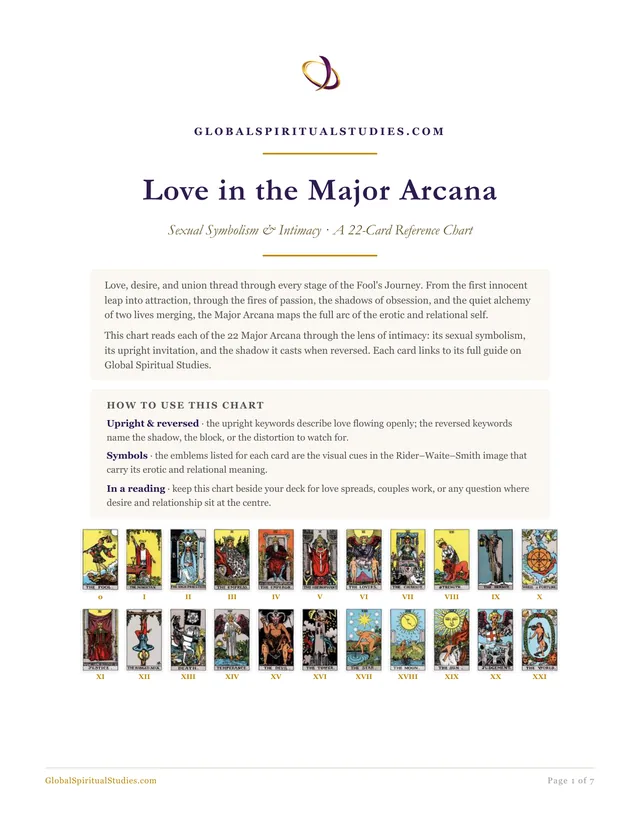
To compare the Moon with the other twenty-one Major Arcana in love readings, upright and reversed, open the free Tarot love chart.
Card Pairings in Intimacy Readings
The Moon takes on specific dimensions when paired with other cards in love and relationship spreads.
Two lunar cards together, both governing the unconscious. The High Priestess holds the veil with intentionality; the Moon represents what happens when the veil drops unbidden. This combination can indicate a period of profound intuitive knowing that resists rational explanation, or a relationship so deeply unconscious that neither person can articulate what draws them together. The difference between these outcomes often depends on whether the querent has done the High Priestess's inner work of self-knowledge before entering the Moon's fog.
Shadow and confusion together. The Devil names the attachment; the Moon obscures its origin. This pairing often appears when a powerful bond is driven by unconscious compulsion rather than conscious choice. The desire is real, but neither person can see it clearly. There may be projection, idealization, or repetition compulsion at work. Together these cards ask: what would this relationship look like if you could see it in daylight?
The Tower follows the Moon in the dark stretch of the Major Arcana. Together, they describe prolonged confusion followed by sudden revelation. The Moon's fog is shattered by the Tower's lightning. In love readings, this pairing may indicate uncertainty that ends with a shocking discovery, or a relationship that collapses when the truth finally surfaces. What the Moon concealed, the Tower forces into the open.
Two cards of darkness, but with different relationships to it. The Hermit carries a light; the Moon does not. Together, this pairing suggests navigating confusion about love with the aid of hard-won self-knowledge. The Moon represents the fog of projection, illusion, and unconscious fear. The Hermit's lantern is the one thing that can cut through it. This pairing asks: what do you actually know about yourself, versus what are you imagining?
Choice in the midst of confusion. The Lovers demands a conscious decision; the Moon warns that full clarity may not be available. This pairing often appears when the querent must choose without having all the information. It asks whether you can commit to the path between the towers even when you cannot see where it leads. The Lovers provides discernment; the Moon tests whether you can use it in dim light.
The body and the unconscious together. The Empress celebrates embodied desire; the Moon reveals the hidden currents running beneath that desire. This combination can indicate a deeply sensual connection that is also psychologically complex, or a period where the body's desires and the unconscious mind's fears are in tension. The Empress says "feel this." The Moon says "but also ask why you feel it." Together, they invite an intimacy that integrates physical pleasure with psychological honesty.
Two cards of the deep unconscious and transformation. Death dissolves what is finished; the Moon dissolves what cannot yet be seen clearly. Together, they describe a passage in which a relationship is ending and reforming simultaneously. The confusion is not random; it is the disorientation of metamorphosis. The old shape is dissolving before the new one has emerged. This pairing asks for trust in the process even when the outcome is invisible.
The Moon's confusion is, at its heart, a narrative problem: the story you are telling yourself about this relationship may not be the story the cards are actually constructing. Linda Marson's course teaches how to read the arc of meaning that the cards build together, finding the thread of coherence that runs even through the Moon's fog.
Explore the CourseFor the psychological dimension of the Moon's projections and unconscious patterns, Mary K. Greer's Active Imagination and the Tarot teaches Jung's technique of engaging directly with the figures that appear in the cards and in your dreams.
Go deeper · explore our Tarot courses, or download the free 7 chakra chart to map the body's energy centres.
Frequently Asked Questions
What does the Moon mean in a love reading?
The Moon in a love reading indicates that powerful unconscious forces are at work beneath the surface of the relationship. Something important is present but not yet clearly visible. This can include unspoken desires, unresolved projections from past relationships, deep intuitive connections that defy rational explanation, or confusion about what you actually feel versus what you want to feel. The Moon does not offer clear answers. It asks for patience with ambiguity, attention to dreams and intuitions, and honesty about the difference between what you see and what you imagine. The card suggests that genuine clarity will emerge, but only after the unconscious material has been acknowledged.
Is the Moon a yes or no card for love?
In yes-or-no style readings, the Moon often leans toward "not yet clear," which is neither a simple yes nor a simple no. It points toward the need for more information, more time, or more honest self-examination before the answer can emerge. The Moon suggests that the question itself may need to change: instead of "will this relationship work?" it may be asking "what am I not seeing about this relationship?" Allow the fog to clear naturally rather than forcing a premature answer. What emerges from the unconscious, given time and attention, is often more truthful than what the anxious mind demands to know immediately.
What does the Moon reversed mean in a love reading?
The Moon reversed in love can carry two distinct meanings depending on context. First, it can indicate that confusion is clearing: illusions about a relationship are dissolving, truths are surfacing, and the querent is beginning to see the situation as it actually is. Second, it can indicate that deception has been or is being revealed, that someone has been deliberately distorting reality within the relationship. Waite's reversed keywords, "instability, inconstancy, silence," suggest a partner whose behavior is inconsistent or whose silence is concealing something important. The reversed Moon can also point to the suppression of intuition: ignoring gut feelings, dismissing dreams, or forcing false certainty onto a situation that genuinely requires sitting with ambiguity.
What does the Moon represent as a person in a love reading?
When the Moon represents a person, it describes someone who is deeply complex, emotionally layered, and not easily read. This person may be highly intuitive, artistic, or psychically sensitive. They live much of their inner life beneath the surface and may communicate through mood, atmosphere, and unspoken feeling rather than direct statement. They can be profoundly magnetic precisely because of what they do not reveal. However, the Moon as a person can also describe someone who is confusing, inconsistent, or whose motivations are difficult to discern. The distinction often comes down to whether the mystery is organic (a genuinely deep person) or defensive (a person who uses ambiguity to avoid accountability). Trust your body's response to this person more than your mind's analysis of them.
What is the sexual meaning of the Moon card?
The Moon governs the dimensions of sexuality that live beneath conscious control: fantasy, dreams, instinctual attraction, the desires that do not have tidy names. Crowley associated the card with "the impure blood" and the Corporeal Intelligence, connecting it to the body's own rhythms and the menstrual cycle's ancient association with lunar phases. In intimacy, the Moon speaks to the erotic imagination, the nighttime landscape of desire where the rules of the daytime self do not apply. This is not shameful material. It is the psyche's way of expressing the full range of its wanting. The Moon invites curiosity rather than judgment about what moves you at the deepest level, and suggests that acknowledging the unconscious dimensions of desire is essential to sexual honesty and depth.
Why do I keep dreaming about my ex when the Moon appears?
When the Moon appears alongside recurring dreams about a former partner, it often indicates that the relationship activated parts of your psyche that are still seeking integration. In Jung's framework, the dream figure of the ex is rarely about them as a person. It is about the qualities you projected onto them: aspects of your own unconscious (anima, animus, or shadow) that became visible in the context of that relationship and were never fully reclaimed when the relationship ended. The dreams are the psyche's attempt to complete unfinished developmental work. The Moon invites you to engage with the dream material directly, perhaps through journaling, active imagination, or work with a therapist, asking not "why am I still thinking about this person?" but "what part of myself is this person carrying that I have not yet integrated?"
Does the Moon indicate deception in a relationship?
The Moon can indicate deception, but it does not automatically point to a deliberate liar. The card's primary meaning is confusion, and confusion has many sources: self-deception, mutual projection, unspoken assumptions, or the simple fact that human relationships are often more complex than either person can clearly perceive. When the Moon appears reversed, or alongside cards that suggest intentional concealment (such as the Seven of Swords), the possibility of deliberate deception becomes stronger. The important distinction is between a situation where both people are confused and a situation where one person is manufacturing confusion to control the other. If a relationship involves coercion, fear, or harm, the invitation is not to analyze the bond alone, but to seek real-world support from trusted people and qualified professionals.
What is the Kabbalistic meaning of the Moon?
In Kabbalah, the Moon corresponds to Path 29 on the Tree of Life, connecting Netzach (Victory, the sphere of Venus, desire, and emotion) to Malkuth (Kingdom, the material world). The Hebrew letter is Qoph, meaning "back of the head," which names the part of perception that operates beyond conscious awareness. The zodiacal attribution is Pisces, the two fish swimming in opposite directions, representing the dissolution of boundaries between self and other. The Yetziratic title is "The Corporeal Intelligence," teaching that the body knows things the conscious mind denies. Path 29 describes the process by which desire descends from its idealized form (Netzach) into material reality (Malkuth), and the distortions, projections, and confusions that can occur along the way.