The Chariot
Momentum, Desire, and the Two Horses You Cannot Control

In love, intimacy and sexual-energy readings, the Chariot is the card of desire in motion: momentum, pursuit and the will to steer opposing forces.
There is a kind of desire that feels like velocity. Not the stillness of longing, not the patience of waiting, but the headlong rush toward someone you have not yet reached. You feel it in the early weeks of falling for someone, when everything accelerates. When the phone buzzes and your stomach drops. When you drive across town at midnight because they asked you to. When the pull is so strong that you begin to confuse it with certainty.
The Chariot sits at the center of this momentum.
He is Card VII of the Major Arcana, the armored figure standing in a stone chariot drawn by two sphinxes, one black and one white, pulling in different directions. He holds no reins. He carries no weapon. The chariot moves not because he controls his animals through force, but because something within him holds the opposing forces together long enough to move forward. Waite described the card's meaning as "succour, providence" and also "triumph, presumption, vengeance." A card, in other words, that carries both victory and its shadow.
In love readings, the Chariot is often reduced to "pursuing what you want" or "determination in love." But the card is far more interesting and far more dangerous than that. It asks the question that sits beneath every rush of early desire: Are you directing this, or is it directing you?
To understand the Chariot in love, we have to listen to several streams at once: the Renaissance triumph processions from which the card descends, Plato's allegory of the charioteer and the two horses of desire, Crowley's startling identification of the charioteer with the bearer of the Holy Grail, the Kabbalistic teaching of Cheth as the fence that protects the heart, and Jung's account of ego-development at the midpoint of the hero's journey. What follows is a complete exploration of what this card means when love is the question.
The Chariot began as the triumphal procession of Renaissance Italy, a crowned figure in a cart drawn by horses in the Visconti-Sforza deck. The Marseille card added the canopy; Waite and Smith's 1909 charioteer drives two sphinxes without reins, and Crowley's armoured figure carries the Holy Grail. For love, the card's victory moved from outward conquest to inner mastery.
Read for love, the black and white sphinxes are opposing desires pulling in different directions, the absence of reins says they are steered by will rather than force, and the armour shows the protection we wear while rushing toward someone.
On the Tree of Life the Chariot is Path 18, Cheth ('fence' or 'enclosure'), joining Binah (understanding) to Geburah (strength), under Cancer. In intimacy it is the fence of the heart: the protective shell that lets desire move forward without losing itself. Full Chariot meaning, history and symbolism.
Plato's Charioteer: The Two Horses of Desire
Twenty-four centuries before Waite painted his sphinxes, Plato described the same struggle.
In the Phaedrus (c. 370 BCE), Socrates offers an allegory for the human soul. He describes it as a charioteer driving a chariot drawn by two winged horses. One horse is "noble and of noble breed": white, beautiful, obedient, responsive to reason and honor. The other is "the opposite in breed and character": dark, stubborn, deaf to commands, pulling constantly toward appetite and gratification. The charioteer represents the rational soul, the mind that must hold these opposing forces together long enough to ascend toward truth and beauty.
But the Phaedrus is not an abstract philosophical text. It is a dialogue about love. Socrates tells this allegory specifically to explain what happens when we encounter beauty in another person. When the charioteer sees a beautiful beloved, memory stirs. The soul recalls the divine beauty it glimpsed before birth, in its flight among the gods. The white horse trembles with reverence. The dark horse lunges forward, consumed with desire to possess the beloved physically. The charioteer must hold both responses simultaneously: the sacred recognition and the animal urgency.
Plato does not resolve this by eliminating the dark horse. This is the crucial point. The dark horse is not evil. It is appetite, instinct, the bodily dimension of desire. Without it, the chariot cannot move at all. Without the white horse, desire has no direction toward what is genuinely beautiful. Without the charioteer, the two forces tear each other apart. The teaching is not suppression. It is integration: holding the tension between reverence and hunger long enough for something real to emerge.
The lover who has mastered this tension does not become passionless. Plato describes the soul that governs its horses well as entering a state of "divine madness" that is higher than mere sanity. The lover who has integrated both horses loves more fully, not less. The chariot moves because both horses pull. The question is whether they pull together.
For love readings, Plato's charioteer offers a framework far richer than "be determined" or "stay in control." It asks: can you hold the tension between the part of you that wants to devour this person and the part of you that recognizes something sacred in them? Can you let both horses exist without letting either one drag the chariot off a cliff? The Chariot card does not promise that you will succeed. It says: this is the work.
The Momentum of Early Love
The Chariot is Card VII. It follows the Lovers (Card VI), the moment of conscious choice. And there is a specific emotional geography to this sequence that matters for anyone who has drawn the Chariot in a reading about a relationship.
The Lovers is the moment of decision: I choose you. The Chariot is what happens next. The Chariot is the morning after the choice has been made, when desire becomes momentum, when the gravitational pull of another person begins to reorganize your daily life. You change your schedule. You check your phone. You drive across town. You replay conversations. The Chariot is desire that has found an object and is now moving toward it with the full weight of emotional investment behind it.
This momentum can be exhilarating. It can also be terrifying. Because the Chariot's momentum does not guarantee arrival. The card is not the destination. It is the movement. And movement toward someone you desire is one of the most vulnerable states a human being can occupy. You have declared your direction. You have committed to the chase. You have not yet been caught, received, or refused.
This is why the charioteer wears armor. Not because he is going to war, but because he is exposed. Velocity without arrival is the definition of vulnerability. He has nowhere to hide except behind his determination. And determination, in the early stages of love, often serves the same function as armor: it protects you from the possibility that the person you are racing toward may not be racing toward you.
The Chariot's teaching for love is uncomfortable. It says: you can want someone with every cell in your body, and wanting does not guarantee receiving. The sphinxes pull. The chariot moves. But the destination is not under your control. What is under your control is whether you move toward love with integrity, whether your desire is aligned with genuine care for the other person, or whether you have confused the thrill of pursuit with love itself.
Emotional Mastery vs. Emotional Suppression
This is the distinction the Chariot demands you make honestly, and it is one of the most consequential distinctions in any relationship.
The card's traditional meaning centers on willpower, control, triumph. And in our culture, these words are almost always used approvingly. The person who "has it together." The partner who "doesn't let emotions run the show." The lover who is strong, steady, unflappable. We admire the charioteer's composure. We want to be the one holding the reins (even when, as the card shows, there are no reins to hold).
But there is a shadow version of this composure that deserves honest examination. Emotional mastery means feeling your feelings fully while choosing how to express them. Emotional suppression means not feeling them at all, or forcing them underground where they fester and eventually detonate. From the outside, these two states can look identical. Both produce the appearance of calm. Both generate an impression of strength. The difference is entirely internal, and it matters enormously for what happens in the relationship.
Research on emotional suppression in relationships consistently finds that suppressing feelings does not make them disappear. It makes them leak out in other ways: passive aggression, withdrawal, unexplained irritability, physical tension, sudden eruptions of anger that seem disproportionate to their trigger. Partners of emotional suppressors often report feeling shut out, confused, and unable to connect, even when the relationship appears "fine" on the surface. The suppressor's armor, like the charioteer's, prevents both injury and touch.
The Chariot upright represents genuine mastery: the capacity to feel desire, fear, vulnerability, and uncertainty without being overwhelmed by any of them. This is not cold detachment. It is the fierce presence of someone who has learned to hold contradictory feelings simultaneously. The charioteer who has truly mastered his sphinxes does not pretend he has no dark horse. He has integrated it. He knows his appetite, his shadow, his capacity for obsession, and he has made room for all of it within a coherent sense of self.
The Chariot reversed, or the Chariot's shadow, represents the collapse of this integration. Control becomes rigidity. Determination becomes stubbornness. The refusal to be vulnerable becomes the inability to be intimate. The armor, initially worn for protection, becomes a prison. If a relationship involves coercion, fear, or harm, the invitation is not to analyze the bond alone, but to seek real-world support from trusted people and qualified professionals.
The Grail Within: Crowley's Hidden Teaching
Crowley's interpretation of the Chariot in The Book of Thoth (1944) turns the card's conventional meaning inside out. Where most readers see a conqueror, Crowley saw a vessel.
In the Thoth deck, the central and most important feature of the card is not the charioteer but the Holy Grail: a cup of pure amethyst, purple as Jupiter, shaped like the full moon, positioned at the very center of the chariot. The charioteer wears golden armor and carries a disk, but his primary function, Crowley insisted, is not to fight or conquer. It is to carry the Grail.
This reframes the entire card. The triumph is not over an enemy or an obstacle. The triumph is bearing something sacred through a world that threatens to spill it. The Grail, in the medieval legends from which Crowley drew, was the vessel of divine grace: the cup that held something too precious to be casually handled. Only the pure of heart could carry it. Only the one who had asked the right question could find it. The knights who pursued the Grail through force and ambition invariably failed. The one who succeeded was Perceval (or Galahad, depending on the tradition), who succeeded through innocence, compassion, and the willingness to ask rather than seize.
Crowley also emphasized that the Hebrew letter Cheth, when spelled out in full (Cheth-Yod-Tav), has the numerical value of 418, which equals ABRAHADABRA, the cipher of the Great Work in Thelemic magick. This links the Chariot not to ordinary victory but to the completion of spiritual transformation itself.
For love readings, Crowley's teaching is startling in its implications. What if the Chariot's purpose in your love life is not to win the beloved, but to carry something sacred within you toward them? What if the real triumph is not the conquest of another person's heart, but the capacity to bring your own heart, intact and unspilled, through the turbulence of desire? The Grail-bearer does not fight for love. He protects the love he already carries within himself and brings it, undiminished, to the encounter.
The Shell and the Soft Interior: Cancer in Love
The Chariot's zodiacal attribution is Cancer, and understanding Cancer's particular relationship to love illuminates the card in ways that the triumph imagery alone cannot.
Cancer is a water sign ruled by the Moon. It is cardinal water: the initiating force of emotional life. Where Scorpio's water runs deep and still, and Pisces' water dissolves all boundaries, Cancer's water moves. It surges like tides, governed by lunar cycles, advancing and retreating in rhythms that even the crab itself does not fully control. These traditions are not the same, and they should not be collapsed into one another. But across them, we can trace recurring patterns of emotional protection, deep attachment, and the tension between vulnerability and defense.
The crab carries its home on its back. It can retreat into its shell at any moment. It approaches sideways rather than directly, as if testing whether it is safe before committing to a direction. This is the Chariot's less obvious teaching about love: the person represented by this card may be moving toward you, but not in a straight line. They may circle, retreat, advance from an unexpected angle. The armor is real, but so is the softness beneath it. The momentum is real, but so is the hesitation.
The Moon's rulership adds another dimension. The Moon governs the unconscious, the realm of feeling that operates beneath rational awareness. It governs the tides of emotion that swell and recede according to cycles we do not choose. The charioteer may believe he is directing his course through pure willpower. But beneath the armor, beneath the starry canopy, beneath the determination, the Moon is pulling the water. The charioteer's desire may be shaped by forces older and deeper than his conscious mind: attachment patterns formed in childhood, longings inherited from family systems, the gravitational pull of what is familiar rather than what is healthy.
This is not a condemnation of the Chariot's drive. It is an invitation to look beneath it. The crab's shell exists for a reason. The armor exists for a reason. The question is whether the shell is protecting something worth protecting, or whether it has become so thick that nothing can get through, including love.
Upright and Reversed in Love Readings
Momentum in love that is aligned with genuine desire and integrity. The determination to pursue what your heart truly wants, not what habit or fear dictates. Emotional mastery: the capacity to feel everything without being overwhelmed. Moving toward someone with confidence while respecting their autonomy. The early rush of falling in love, experienced with presence rather than compulsion. The courage to be vulnerable beneath the armor. Willpower that serves the heart rather than defending against it. Carrying something sacred (your own emotional truth) toward another person. Waite's upright meanings: "succour, providence, triumph, presumption."
Momentum without direction. Pursuing someone out of ego rather than genuine desire. Emotional suppression mistaken for emotional strength. Controlling behavior in relationships: managing the other person's feelings instead of facing your own. The collapse of willpower into stubbornness or aggression. Being dragged by desire rather than directing it. Obsessive pursuit that has lost contact with the beloved's actual humanity. The armor that cannot be removed. Stalled progress, scattered energy, the chariot stuck in the mud. The dark horse running unchecked or the white horse refusing to move at all. Waite's reversed meanings: "riot, quarrel, dispute, litigation, defeat."
- Are you pursuing this person, or pursuing the feeling of pursuit?
- What are you wearing as armor in this relationship, and what would happen if you took it off?
- Can you name both horses: the part of you that wants to rush forward and the part that wants to hold back?
- Is your determination serving your heart, or defending against your vulnerability?
- What are you carrying toward this person that matters more than victory?
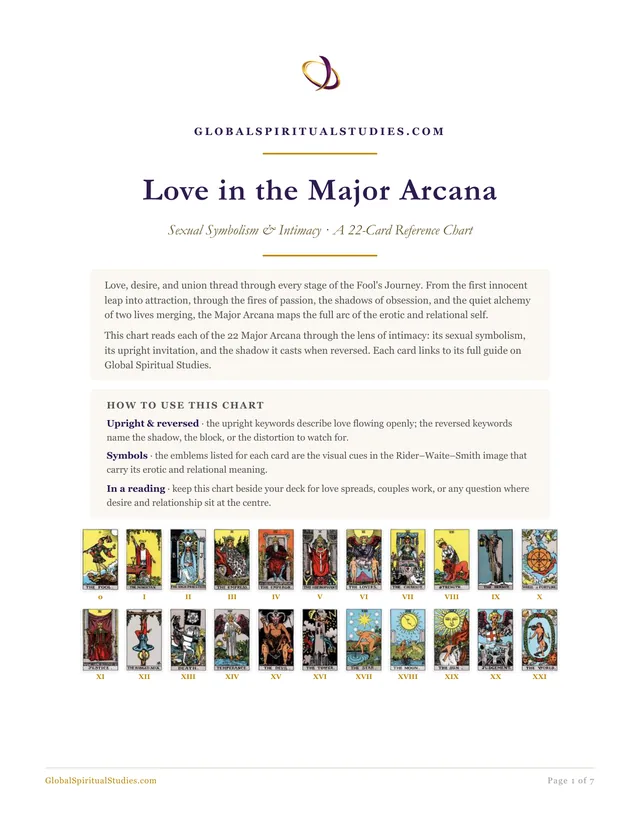
To compare the Chariot with the other twenty-one Major Arcana in love readings, upright and reversed, open the free Tarot love chart.
Card Pairings in Intimacy Readings
The Chariot takes on specific dimensions when paired with other cards in love and relationship spreads.
Cards VI and VII side by side: conscious choice followed by momentum. This pairing often appears when a decision about love has been made and is now being acted upon. The Lovers chose. The Chariot moves. Together they describe a relationship entering its active phase, where the initial spark becomes deliberate pursuit. The question is whether the momentum honors the choice or has outrun it.
Two cards of structure, authority, and will. The Emperor builds; the Chariot moves. Together in a love reading, they can describe a relationship where both partners value strength, ambition, and direction. The shadow of this pairing is rigidity: two armored figures facing each other with no vulnerability between them. The teaching is that love between strong people requires the courage to be soft.
Cards VII and VIII in the Waite sequence: willpower followed by gentleness. The Chariot drives through opposition. Strength opens the lion's mouth with a touch. Together, these cards suggest that the force required to pursue love is not the same force required to sustain it. The Chariot gets you to the relationship. Strength teaches you how to stay in it. This pairing often appears when someone needs to shift from conquest mode to presence.
Movement and stillness. Momentum and mystery. The Chariot races toward what it desires; the High Priestess sits between two pillars and waits. In love readings, this pairing often describes the dynamic between a pursuer and the person who draws through magnetic stillness. One advances. The other reveals nothing. The tension between these energies can create extraordinary attraction, or extraordinary frustration, depending on whether both are honored.
Desire driven and desire bound. The Chariot's momentum combined with the Devil's obsessive attachment can indicate a relationship where the pursuit has become compulsive. The charioteer no longer drives by choice but by addiction. Alternatively, this pairing can describe the raw power of desire that is both exhilarating and dangerous: the affair that sweeps everything aside, the attraction so intense it obliterates ordinary judgment. The question is whether you are still holding the reins.
Momentum and withdrawal. The Chariot charges forward; the Hermit retreats to the mountain. In love readings, this pairing can indicate alternating seasons: periods of intense pursuit followed by periods of solitary reflection. It can also describe the necessary rhythm of any deep relationship, where both engagement and solitude feed the other. The Chariot without the Hermit is blind momentum. The Hermit without the Chariot is stagnation.
Momentum meets sudden collapse. The chariot that was moving so confidently hits the wall it did not see coming. In love readings, this pairing often appears around revelations that stop the pursuit in its tracks: the discovery that the person you were racing toward is not who you thought they were, or the moment when the armor cracks and everything you were trying to control spills out at once. It is catastrophic and, ultimately, clarifying. The Tower destroys what the Chariot was defending. What remains is what was always real.
The Chariot teaches that not every journey needs a predetermined map. Steve Hounsome's course explores the art of reading Tarot without fixed layouts, letting the cards speak in their own sequence and finding meaning in the momentum of the reading itself.
Explore the CourseFor deeper work with Major Arcana cards like the Chariot in real-life questions about love and direction, Linda Marson's TarotNav teaches how to read the Major Arcana as a GPS for life's most pressing questions.
Go deeper · explore our Tarot courses, or download the free 7 chakra chart to map the body's energy centres.
Frequently Asked Questions
What does the Chariot mean in a love reading?
The Chariot in a love reading indicates momentum, determination, and the active pursuit of what your heart desires. It often appears when a relationship is entering an exciting but vulnerable phase: the early weeks of intense attraction, the decision to move a connection forward, or the moment when feelings become too strong to remain passive. The card does not guarantee arrival at the desired destination. It describes the movement itself and asks whether that movement is aligned with genuine desire and emotional integrity, or driven by ego, compulsion, or the thrill of the chase. The Chariot also points to the tension between wanting to control love and learning to hold opposing feelings (passion and caution, desire and fear) simultaneously.
Is the Chariot a yes or no card for love?
In yes-or-no style readings, the Chariot often leans toward yes, but not a passive or guaranteed yes. It suggests a "yes, if you are willing to do the work." The Chariot's yes requires effort, focus, and the integration of competing desires. It indicates that the outcome depends heavily on your own alignment and willingness to move forward with integrity. This is not the easy yes of the Sun or the Ace of Cups. It is a yes that comes with conditions: direct your energy honestly, do not confuse pursuit with possession, and be prepared to hold contradictory feelings without forcing a premature resolution.
What does the Chariot reversed mean in a love reading?
The Chariot reversed in love often indicates that momentum has stalled, been scattered, or turned aggressive. It can point to controlling behavior in a relationship, where one partner tries to manage the other's feelings or direction rather than addressing their own vulnerability. It may describe a pursuit that has become obsessive, disconnected from the actual person being pursued. The reversed Chariot can also indicate inner conflict between what you want and what you think you should want, leaving you paralyzed rather than purposeful. Waite gave reversed meanings of "riot, quarrel, dispute, litigation, defeat." In the context of love, this translates to the collapse of emotional mastery into either aggressive control or scattered helplessness.
What does the Chariot represent as a person in a love reading?
As a person, the Chariot describes someone who is driven, ambitious, and emotionally intense but carefully defended. This person pursues what they want with focus and determination. They may appear confident, even dominant, but beneath the armor is often a deeply sensitive interior, especially given the card's Cancer attribution. They are likely to pursue a relationship actively rather than wait passively, but they may struggle with vulnerability. Getting to know this person requires patience with their defenses and recognition that their need for control often masks a fear of being emotionally overwhelmed. When they trust you enough to lower the armor, what they reveal can be unexpectedly tender.
What is the Chariot's sexual meaning in Tarot?
The Chariot's sexual dimension centers on the tension between control and surrender, the two forces that Plato described as the charioteer's eternal struggle. Sexually, the Chariot can represent intense desire that is being channeled and directed rather than expressed chaotically. It points to the erotic charge of pursuit, the anticipation before consummation, the moment when desire is at its most concentrated because it has not yet been fulfilled. Crowley's identification of the Chariot with the bearer of the Holy Grail adds another layer: the idea that sexual energy at its highest is not about conquest but about carrying something sacred. The Cancer attribution connects it to emotionally charged intimacy, where vulnerability and protectiveness coexist.
Does the Chariot mean someone is coming back?
The Chariot can sometimes appear in readings about reconciliation, and when it does, it often suggests that someone may indeed be moving in your direction, but with determination and agenda rather than simple nostalgia. The Chariot's return is purposeful, not accidental. However, the card is equally likely to represent your own momentum toward or away from someone. It does not promise reunion. It describes direction and effort. The key question is not "are they coming back?" but "what is driving the movement, and is it serving the genuine well-being of both people?" Desire in motion is not the same as love arriving.
What does the Chariot mean for moving on from a relationship?
In the context of moving on, the Chariot is one of the most empowering cards in the deck. It suggests that the querent has the inner resources to redirect their emotional energy, to transform the momentum of loss into forward movement. The card says: you are not stuck. Your desire, your drive, your emotional intensity are still intact. They are looking for a new direction. The work of moving on, for the Chariot, is not about suppressing what you felt but about choosing where to channel it next. The sphinxes still pull. The question is whether you will let them pull you back toward what ended, or forward toward what has not yet begun.
What is the Kabbalistic meaning of the Chariot?
In Kabbalah, the Chariot corresponds to Path 18 on the Tree of Life, connecting Binah (Understanding, the Great Mother) to Geburah (Severity, martial strength). The Hebrew letter is Cheth, meaning "fence" or "enclosure," representing the protective boundary that defines sacred space. The zodiacal attribution is Cancer, the crab whose shell protects its soft interior. The Yetziratic title is "The Intelligence of the House of Influence," suggesting a consciousness that governs how emotional energy flows through protected channels. Crowley noted that Cheth spelled out in full (Cheth-Yod-Tav) equals 418, the value of ABRAHADABRA, the cipher of the Great Work, linking the Chariot to the completion of spiritual transformation.