The Emperor
Structure, Authority, and the Desire That Builds Rather Than Burns

In love, intimacy and sexual-energy readings, the Emperor is the card of steady love: protection, structure and the commitment that keeps showing up.
There is a kind of love that is not made of fire.
It is made of stone. Of mornings when you show up even though the passion has quieted. Of the decision to stay and build when everything in you wants to chase the next blaze. It is the love that remembers to lock the door, to check the foundation, to ask the question you already know the answer to because asking it is how you keep the walls from crumbling.
The Emperor sits at the center of this love. He is Card IV of the Major Arcana, the figure on the stone throne who has traded the intoxication of conquest for the discipline of governance. He is not the most exciting card to draw in a reading about desire. He is not the Lovers, who promises the thrill of choosing. He is not the Devil, who confronts the shadow places where wanting becomes compulsion. He is not the Empress, who celebrates the body's abundant yes.
The Emperor is the one who asks: now that you have found something worth loving, what are you willing to build to keep it alive?
Attraction gets all the poetry. Passion gets all the heat. But the structure that holds a relationship together over time, the boundaries that protect intimacy, the authority that knows when to be firm and when to soften, these are the Emperor's territory. And getting them wrong, mistaking control for care, rigidity for strength, domination for devotion, is one of the oldest failures in the human experience of love.
To understand the Emperor in love, we have to listen to several streams at once: the historical evolution of a card that has depicted worldly authority for nearly six centuries, Carl Jung's framework of the Father archetype and the dangerous Senex, the Kabbalistic teaching of Heh (the window through which light enters), and the astrological energy of Mars in Aries that drives this card's fierce, protective desire. What follows is a contemplative exploration of what the Emperor means when love is the question.
The Emperor began as L'Imperatore, a robed ruler with orb and sceptre in the Visconti-Sforza deck, and the Marseille card kept his imperial eagle. Waite and Smith's 1909 Emperor sits on a stone throne carved with rams' heads, armour under his robes, and Crowley's version is a crowned figure of Aries fire. For love, the card turned from political rule to the strength that holds a life together.
Read for love, the stone throne is reliability, the rams' heads are Aries drive and desire, and the armour beneath the robe is the protectiveness that can shelter a partner or shut them out.
On the Tree of Life the Emperor is Path 15, Heh ('window'), joining Chokmah (wisdom) to Tiphareth (the heart). In intimacy Heh is the window in the wall: structure that still lets light, and the other person, in. Full Emperor meaning, history and symbolism.
The Father Archetype: Protector and Tyrant
In Carl Jung's analytical psychology, the Emperor embodies the Father archetype: the masculine principle of authority, law, order, structure, and the capacity to set boundaries that enable development.
The Father archetype holds a paradox that is central to every love reading involving this card. In its positive expression, the Father is the one who protects, who provides stability, who establishes the conditions under which growth becomes possible. Jung described this aspect as wisdom, benevolence, guidance, and moral integrity. The positive Father says: I will hold the ground steady so you can risk becoming who you are. In a relationship, this manifests as the partner who creates safety, who follows through on commitments, who offers a consistency that allows the other person to explore, to fail, to be vulnerable without fear of abandonment.
But the Father archetype has a shadow, and Jung named it with precision.
The negative Senex (from the Latin for "old man") is the Father who has become rigid, devouring, and hostile to life. The Greek myth that captures this most vividly is Kronos, who swallowed his own children because he feared they would overthrow him. The negative Senex maintains structure at the expense of everything that structure was supposed to serve. He enforces rules without wisdom. He demands obedience without earning respect. He confuses control with care and rigidity with strength.
The devouring father in a relationship is the partner who protects so fiercely that the beloved cannot breathe, who provides so thoroughly that the other person never develops their own strength, who loves so possessively that love becomes a kind of beautiful captivity.
Jung described a further complexity: the Father also appears as the voice of collective authority, the internalized rules about how relationships "should" work, who should lead, who should follow, what desire is acceptable and what is not. When the Emperor appears in a love reading, he may be pointing not only to a specific person but to the entire inherited structure of assumptions about authority in relationships. Whose rules are you following? Are they yours, or were they handed to you by a father, a culture, a tradition that never asked what you actually needed?
The work of individuation, Jung argued, requires integrating both faces of the Father. The mature psyche does not reject authority. It learns to exercise it with consciousness, holding the protector and the tyrant together without collapsing into either.
Mars, Aries, and the Structure of Desire
The Emperor is ruled by Aries and governed by Mars, the planet of desire, action, and the will to fight for what you want. Understanding this astrological dimension is essential, because it reveals something the popular image of the Emperor often obscures: this card is not cold. It is not passionless. It is desire organized, desire given direction, desire that has chosen to build rather than simply burn.
Mars, in the ancient world, was not merely the god of war. He was the god of boundaries, of defended territory, of the force that protects what matters. Mars governs the impulse to act, to assert, to initiate. In love, Mars is the energy that makes the first move, that speaks desire aloud, that refuses to let a connection die from passivity.
Aries adds the quality of cardinal fire: the spark that begins things. Aries is the first sign of the zodiac, the equinox, the moment when something new breaks through. In relationships, Aries energy is the passion of early attraction, the directness of someone who knows what they want and says so, the courage to pursue a connection despite the risk of rejection.
But Mars has a shadow, and the Emperor card knows it well. When desire is organized without wisdom, the result is domination. When assertiveness operates without empathy, it becomes aggression. When protection becomes control, the fortress becomes a prison. The difference between a partner who says "I will keep you safe" and one who says "I will keep you" is the entire distance between the Emperor upright and the Emperor reversed.
The fire of Mars, the drive to protect, to provide, to build, is not inherently destructive. It is one of the most powerful forces available to love. The partner who fights for the relationship during difficult seasons, who builds stability when the world is uncertain, who stands between what they love and what threatens it, this partner is channeling the Emperor's energy at its finest. The question is always whether the fire serves the relationship or only serves the one who wields it.
The Emperor and The Empress: Structure and Flow
No discussion of the Emperor in love readings can avoid addressing the card that sits beside him in the Major Arcana: the Empress, Card III. They are the Tarot's most fundamental pair, and for readings about intimacy, they represent complementary principles that neither can fulfill alone.
The Empress is the body's yes: sensuality, receptivity, abundance, creative fertility, the love that flows like water and grows like a garden. Her domain is pleasure, nourishment, the felt experience of being alive in a body alongside another body. She does not organize. She overflows.
The Emperor is the container for all of that. He is the wall around the garden, the riverbank that gives the water its direction, the boundary that keeps the abundance from dissipating into formlessness. Without the Empress, the Emperor rules over an empty kingdom. Without the Emperor, the Empress's garden has no fence, no gate, no way to distinguish what belongs inside from what does not.
In readings about love and relationships, this pairing carries a precise teaching. Passion without structure burns itself out. Structure without passion becomes a monument to nothing. The relationship that has fire but no commitment is exciting but unsustainable. The relationship that has commitment but no fire is stable but slowly dying. Both cards together suggest the rare integration: a partnership where desire is given form, where boundaries serve pleasure rather than restricting it, where someone has built walls strong enough to protect the tender things growing inside.
When the Emperor and Empress fall out of balance, the result is a relationship that is either all structure and no warmth (the cold, dutiful marriage) or all feeling and no foundation (the passionate connection that collapses under the first real pressure). The Emperor in a love reading often appears when the question is whether someone can provide the structural complement to the emotional richness already present.
Boundaries as an Act of Love
This may be the Emperor's most important teaching for intimacy, and it is the one that the popular culture of love resists most fiercely: boundaries are not barriers to love. They are the conditions under which love becomes sustainable.
A boundary in a relationship is a structure that says: this is where I end and you begin. This is what I can give and what I cannot. This is the line beyond which I lose myself, and I am choosing not to cross it, not because I do not love you, but because I cannot love you if I have disappeared. A relationship without boundaries is not more loving. It is more chaotic.
Attachment theory, the psychological framework developed by John Bowlby and expanded by Mary Ainsworth, offers a modern framework for understanding what the Emperor provides. Bowlby described the concept of a secure base: a relationship in which one partner provides enough stability and predictability that the other feels safe to explore, to take risks, to venture into the unknown and return to find the same person still there. The secure base is an Emperor function. It does not restrict movement. It enables it. The child who knows the parent will be there when they return is the child who can explore the world. The partner who trusts the relationship's foundation is the one who can be truly vulnerable.
But the Emperor reversed teaches the opposite lesson with equal clarity. When boundaries become walls, when structure becomes control, when "I am protecting us" becomes "I am deciding for you," the Emperor's authority turns corrosive. There is a painful proximity between the partner who provides healthy structure and the one who uses structure as a tool of domination. Both may look similar from the outside. Both may speak the language of care. The difference lies in whether the boundaries serve both people's growth or only one person's need for control.
If a relationship involves coercion, fear, or harm, the invitation is not to analyze the power dynamic alone, but to seek real-world support from trusted people and qualified professionals.
The Window: Seeing Clearly in Love
We return to the Hebrew letter Heh. The window.
A window does two things at once. It reveals what is outside, bringing light and sight into an interior space. And it frames what it reveals, creating a perspective, a specific way of seeing. The Emperor's window is not open sky. It is structured vision: the capacity to see clearly because there is a frame.
In love, the window metaphor speaks to clarity about what a relationship is and what it is not. The Emperor sees the beloved without the distortions of romantic projection (that belongs to the High Priestess and the Moon) and without the consuming intensity of obsessive desire (that belongs to the Devil). The Emperor sees with the sober clarity of someone who has chosen to stay and build, who knows what the relationship costs, who has counted the price and paid it willingly.
This is not a cold seeing. It is a warm one. There is profound tenderness in the act of seeing someone clearly, stripped of fantasy, and choosing them anyway. The Emperor does not love an image. He loves the actual person, the one who snores, who has bad mornings, who sometimes cannot meet him where he needs to be met. He loves her as she is, not as the fire of first attraction made her seem.
The "Constituting Intelligence" of Path 15 adds another dimension. To constitute means to bring into being, to establish, to give form. The Emperor in a love reading does not merely witness the relationship. He constitutes it. He is the partner whose daily choices, whose reliability, whose willingness to do the unglamorous work of maintenance, actually brings the relationship into existence as something solid, something real, something that can hold weight.
Many relationships fail not from a lack of love but from a lack of constitution. There is fire but no hearth. There is devotion but no structure to express it through. The Emperor appears in love readings to ask whether you are willing to do more than feel. Whether you are willing to build.
Upright and Reversed in Love Readings
Stability, commitment, and the willingness to build lasting structure in a relationship. The Emperor upright indicates a partner or dynamic characterized by reliability, follow-through, and the capacity to provide a secure foundation. Strong protective instincts channeled through healthy boundaries rather than control. Directness in communication and desire. The relationship is moving toward something solid, something that can hold weight over time. Commitment that is chosen and maintained through discipline, not merely felt. Waite's upright meanings include "stability, power, protection, realization." For singles, this card often signals readiness for a relationship that requires showing up consistently, not just feeling intensely.
The protector becomes the tyrant. The Emperor reversed in love signals control disguised as care, rigidity mistaken for strength, domination presented as devotion. Authority without empathy. Rules without reason. The partner who decides everything, who leaves no room for the other person's voice, who confuses providing for a relationship with owning it. Alternatively, the reversed Emperor can indicate the absence of necessary structure: a relationship without direction, without clear boundaries, without someone willing to make the difficult decisions. Waite's reversed meaning, "benevolence, compassion, credit; also confusion to enemies," is gentler than most modern interpretations suggest, pointing to authority that has softened but perhaps lost its effectiveness.
- Where in your intimate life does structure serve love, and where does it suffocate it?
- Whose rules about how a relationship should work are you following, and are they actually yours?
- When you say "I am protecting us," is that true, or are you protecting only yourself?
- What would it mean to build something with someone rather than simply feeling something for them?
- Where do you confuse control with commitment?
- What boundary have you been afraid to set, and what might become possible if you set it?
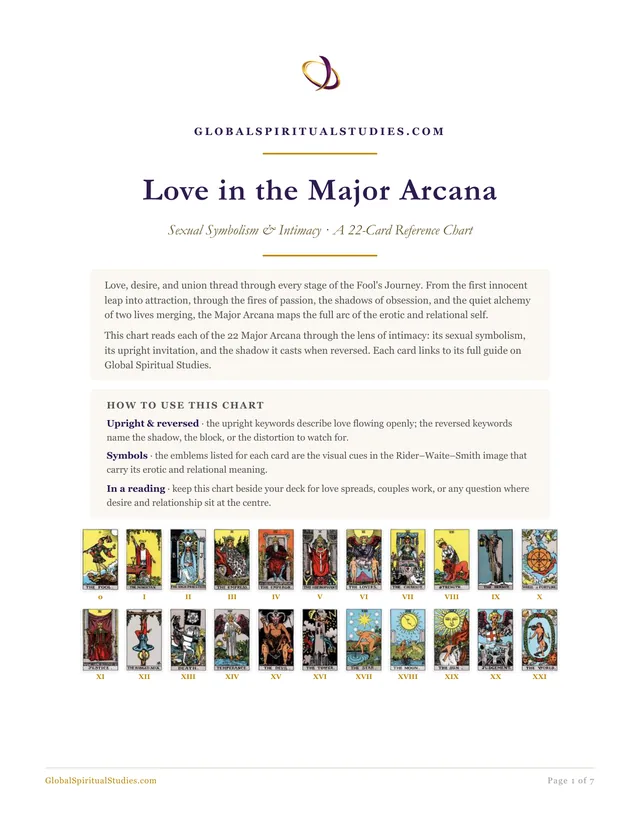
To compare the Emperor with the other twenty-one Major Arcana in love readings, upright and reversed, open the free Tarot love chart.
Card Pairings in Intimacy Readings
The Emperor takes on specific dimensions when he appears alongside other cards in love and relationship spreads.
The Tarot's foundational pair in love readings. Structure meets flow. The wall meets the garden. Together, these cards describe a relationship where both principles are present: the Emperor's stability and the Empress's abundance, the boundary and the blossoming. This pairing often appears when a relationship has found or is seeking the integration of passion and commitment, where neither partner is sacrificing their nature to accommodate the other.
Choice meets structure. The Lovers asks what you desire; the Emperor asks what you are willing to build for it. This pairing suggests a relationship that is moving from the electricity of choosing to the discipline of commitment. It can also indicate a moment when a decision about the relationship's future requires both the heart's clarity (Lovers) and the will to follow through (Emperor).
Authority's shadow. The Emperor provides structure; the Devil reveals what happens when structure becomes bondage. This pairing often appears in readings about controlling relationships, where one partner's "protectiveness" has become the other's cage. But it can also suggest the tension between healthy discipline and the desire to let go, between the Emperor's order and the Devil's invitation to explore what lies outside the walls.
The visible and the hidden. The Emperor governs the external structure of a relationship; the High Priestess governs what moves beneath the surface. Together, they suggest that a relationship needs both: the architecture that the world can see and the mystery that only the two people inside it can feel. This pairing can also indicate a tension between a partner who leads with action and one who leads with intuition.
Two solitary figures, but for different reasons. The Emperor is alone because authority requires solitude; the Hermit is alone because wisdom requires withdrawal. Together in a love reading, these cards may describe a relationship where both partners value independence and personal space, or a period where one partner's need for structure (Emperor) conflicts with the other's need for retreat (Hermit). At their best, these cards together describe a relationship mature enough to hold both togetherness and solitude.
Two forms of power that could not be more different. The Emperor commands from a throne; Strength tames the lion with an open hand. Together, they ask whether authority in this relationship comes from position or from genuine inner capacity. The Emperor builds the walls; Strength keeps the heart open inside them. This pairing often appears when a relationship needs both firmness and gentleness, when the question is how to be strong without being hard.
Momentum meets foundation. The Chariot drives forward with fierce determination; the Emperor holds the ground that the Chariot departs from and returns to. In love readings, this pairing can indicate a relationship that is moving quickly toward commitment, or it can describe the tension between a partner who wants to advance (Chariot) and one who wants to consolidate (Emperor). The Emperor asks where the Chariot is going. The Chariot asks why the Emperor is still sitting down.
If the Emperor resonates with you, it may be because this archetype lives in your personal constellation. Mary K. Greer's course on Birth and Year Cards explores how the Major Arcana maps onto your life story, revealing the archetypal patterns that shape how you love, lead, and build.
Explore the CourseFor the psychological dimensions of the Father archetype and its role in how we love, Mary K. Greer's Jungian course explores the archetypal forces that shape our relationships from within.
Go deeper · explore our Tarot courses, or download the free 7 chakra chart to map the body's energy centres.
Frequently Asked Questions
What does the Emperor mean in a love reading?
The Emperor in a love reading points to the structural dimensions of a relationship: commitment, stability, boundaries, and the willingness to build something that lasts. He represents a partner or dynamic characterized by reliability, protectiveness, and the capacity to provide a secure foundation. The Emperor does not speak to the fire of attraction (that belongs to the Empress or the Lovers) but to what happens after the fire has been lit: whether someone is willing to tend it, to build a hearth around it, to keep it burning through the seasons when passion quiets. He can also indicate the need to examine authority dynamics in the relationship, asking whether power is shared or concentrated.
Is the Emperor a yes or no card for love?
In yes-or-no style readings, the Emperor often leans toward yes, but not a passionate or impulsive yes. It is a considered yes, a structural yes, the kind of yes that comes after careful thought rather than a rush of feeling. The Emperor says "yes, but build it properly." He points toward commitment, stability, and long-term potential rather than fleeting excitement. If the question involves whether a relationship has staying power, the Emperor's presence tends to be affirming. If the question involves whether a connection has the kind of fire or spontaneity someone is seeking, the Emperor may suggest that what is available is steadier and more deliberate than what was imagined.
What does the Emperor reversed mean in a love reading?
The Emperor reversed in love often signals that authority within the relationship has become imbalanced. This can manifest as controlling behavior disguised as protectiveness, rigidity that prevents growth, or one partner dominating decisions while the other loses their voice. It is the negative Senex of Jungian psychology: the father figure who devours rather than nurtures. Alternatively, the reversal can indicate the opposite problem, a relationship lacking necessary structure, direction, or follow-through, where no one is willing to take responsibility for building something solid. Waite's reversed meaning includes "benevolence, compassion, credit," suggesting the authority has softened, though in some readings this softening means the structure has collapsed.
What does the Emperor represent as a person in a love reading?
When the Emperor represents a person in a love reading, he describes someone who leads with stability, decisiveness, and protective strength. This person values commitment and expresses love through action rather than words: they show up, they follow through, they build. They may struggle with vulnerability, preferring to demonstrate care through providing and protecting rather than through emotional expression. At their best, they are a rock, a reliable presence who creates safety through consistency. At their worst, they can be controlling, emotionally unavailable, or unable to relinquish authority even when the situation calls for softness. This person often has a strong sense of how things should be done and may need to learn that love sometimes requires letting go of being right.
What is the sexual meaning of the Emperor card?
The Emperor's sexual energy is that of Mars in Aries: direct, assertive, initiatory, and physically present. This is not the subtle magnetism of the High Priestess or the all-consuming intensity of the Devil. It is the sexuality of someone who knows what they want and communicates it clearly. The Emperor can indicate a partner who takes the lead in physical intimacy, who values directness and confidence, and whose desire expresses itself through decisive action rather than gradual seduction. The ankh scepter, combining masculine and feminine symbols, suggests that the Emperor's sexuality is most potent when it serves the life force of the relationship rather than mere appetite. In some readings, the Emperor reversed can point to sexual dynamics where dominance has become rigid or one-sided.
What is the difference between the Emperor and the Empress in love readings?
The Emperor and the Empress represent complementary principles in love. The Empress is the garden: sensuality, receptivity, nourishment, the body's pleasure, and the creative abundance that flows when love is welcomed. The Emperor is the wall around the garden: structure, boundaries, protection, and the commitment that keeps love safe through difficult seasons. The Empress says "feel this." The Emperor says "build this." Neither is complete without the other. A reading that contains both often signals a partnership that has achieved or is seeking the rare balance of passion and stability, where desire is given form and commitment is given warmth.
Does the Emperor indicate commitment or marriage?
The Emperor often appears in readings when commitment is either present or being considered, and many readers associate this card with marriage, long-term partnership, or formalized commitment. However, the Emperor's teaching is subtler than "you are getting married." He points to the underlying principle: the willingness to give love a structure, to move from feeling to building, to make the relationship a constituted reality rather than an ongoing possibility. This can manifest as marriage, but it can also manifest as any deliberate choice to organize a shared life. The Emperor's question is not "will there be a wedding?" but "are you prepared to build something that requires daily maintenance, ongoing responsibility, and the discipline to stay when passion quiets?"
What is the Kabbalistic meaning of the Emperor?
In Kabbalah, the Emperor corresponds to Path 15 on the Tree of Life, connecting Chokmah (Wisdom, the primal masculine force) to Tiphareth (Beauty, the heart center). The Hebrew letter is Heh, meaning "window," and the Yetziratic title is "The Constituting Intelligence." This framework reveals the Emperor as the structure through which divine wisdom reaches the human heart, the window that makes sight possible through framing. The astrological correspondence is Aries, the cardinal fire sign ruled by Mars. In love readings, this Kabbalistic meaning deepens the card's teaching: the Emperor is not merely authority but constituting authority, the force that takes raw attraction and builds it into something visible, sustainable, and real.