The Sun
Joy, Clarity, and Desire in Full Daylight in Card XIX

In love, intimacy and sexual-energy readings, the Sun is the card of love with nothing to hide: warm, direct and openly joyful.
There is a kind of love that has nothing to hide.
Not the love that conceals itself behind mystery, or the love that tests its own depths through shadow work, or the love that proves itself through endurance. A simpler love. The love that laughs in the morning. The love that reaches for you without strategy or self-protection. The love that feels, if you are honest about it, like sunlight on bare skin: warm, direct, unhidden, and so ordinary that you almost forget it is also holy.
The Sun is Card XIX of the Major Arcana, and it is the card that almost nobody writes about well. Not because it is difficult to understand, but because it is difficult to take seriously. We have trained ourselves, as seekers and as adults, to associate depth with darkness. The deepest insights must be hard-won. The most meaningful relationships must involve struggle. The most authentic spiritual experiences must emerge from suffering. The Sun asks a question that undoes all of this: what if joy is the deepest thing?
A naked child rides a white horse beneath an enormous, radiant sun. Sunflowers turn their faces upward behind a low garden wall. There are no shadows in this card. No hidden symbols that require a key. No esoteric puzzle that only initiates can unlock. Everything is visible. Everything is warm. And this very simplicity is what makes the Sun one of the most radical cards in the entire deck, especially when the question is about love.
To understand the Sun in love readings, we have to listen to several traditions at once: the solar mythologies of Apollo and Helios, where the sun sees everything and hides nothing. Carl Jung's writings on consciousness, the realized Self, and the divine child archetype. Aleister Crowley's Book of Thoth (1944), where the Sun card depicts the united twins of Heru-ra-ha. The Kabbalistic teaching of Path 30, the Hebrew letter Resh, and what it means that this letter means "head." And the journey from the Moon to the Sun, from confusion to clarity, from the dark night to the dawn. What follows is a deep exploration of what this card reveals when love is the question.
The Sun has stayed recognisable since the Visconti-Sforza putto carried a golden sun (c. 1450). The Marseille deck put two children beneath it, giving the joy a partner; Waite's 1909 child on a white horse made it an earned, conscious innocence; Crowley's winged twins made it a union of active and receptive. Each step moved the card closer to shared delight.
Read for love, the naked child asks what your relationship would look like if neither of you were performing, the saddle-less white horse shows desire and awareness moving together, and the low garden wall says joy needs a container: a boundary, not a fortress.
On the Tree of Life the Sun is Path 30, Resh ('head'), joining Yesod (dreams, the unconscious, sexuality) to Hod (the mind). In intimacy it is the moment the fog lifts and what the body wants and what the mind understands finally agree. Full Sun meaning, history and symbolism.
The Inner Child and the Wholeness Before Division
In Carl Jung's analytical psychology, the child archetype is not a symbol of immaturity. It is a symbol of wholeness.
Jung described the divine child (the puer aeternus or puella aeterna, the eternal boy or girl) as an image of the Self before it was divided by the demands of socialization. The child contains all possibilities. It has not yet been required to choose between thinking and feeling, between masculine and feminine, between the acceptable and the forbidden. The child is whole in a way that adults, who have been shaped by thousands of compromises, no longer are.
This is why the Sun card depicts a child rather than an adult. The naked figure on the white horse is not regressing to infancy. It is showing what wholeness looks like from the other side of experience. The child has passed through the entire journey of the Major Arcana: through the Fool's leap, through the Tower's destruction, through the Moon's confusion. It arrives at the Sun not because it has avoided suffering, but because it has completed it. The innocence of Card XIX is not the innocence of Card 0. It is innocence reclaimed.
The British psychoanalyst D.W. Winnicott argued that the capacity to play is the foundation of all creative and intimate experience. Playing happens in a "transitional space" between inner and outer reality, where the rules of ordinary life are temporarily suspended and something genuine can emerge. Adults who cannot play, who cannot enter this space without self-consciousness or control, struggle with intimacy because intimacy requires exactly this kind of surrender to the moment.
In love readings, the Sun's child asks whether you can still play. Not perform. Not strategize. Not manage the relationship like a project with deliverables. Play. Be spontaneous. Be silly. Be naked, not just physically, but emotionally, in the sense of dropping the adult armor and letting something unscripted emerge between you and the person you love.
There is a particular kind of laughter that only happens between people who trust each other completely. Not the laughter of wit or irony, but the laughter of release, of recognition, of two people who have stopped performing and started being. The Sun card is the sound of that laughter.
From Moon to Sun: Clarity After the Dark Night
The Sun follows the Moon in the Major Arcana sequence, and this placement is not accidental. The journey from Card XVIII to Card XIX is one of the most significant transitions in the entire deck: the passage from confusion to clarity, from the dark night to the dawn.
The Moon is the card of everything you cannot quite see. Illusion, projection, the desire you cannot name, the fear that distorts your perception of the person beside you. The Moon's landscape is a strange twilight populated by howling dogs, a crawfish emerging from dark water, and two towers marking a path that disappears into the unknown. In love readings, the Moon is confusion about feelings, gaslighting, the ex who haunts you, the dream that will not resolve into waking clarity.
The Sun dispels all of this. Not by fighting the darkness, not by analyzing the confusion, but simply by rising. The Sun does not argue with the Moon. It replaces it. The dogs stop howling. The crawfish retreats. The towers vanish. The path is no longer treacherous because you can see where you are going.
In the Christian mystical tradition, St. John of the Cross described the "dark night of the soul" as a necessary passage through spiritual desolation before divine illumination becomes possible. The Sun card follows this same pattern. The clarity it offers is not naive. It is post-confusion clarity: the kind that only becomes available after you have been thoroughly lost.
For love readings, this Moon-to-Sun sequence carries a very practical teaching. If you have been through a period of confusion in a relationship, of not knowing what you feel or what the other person feels, of projection and counter-projection and sleepless uncertainty, the Sun announces that the confusion is ending. Not because someone explained it to you, but because the conditions have changed. What was unclear is becoming clear. What was hidden is becoming visible. And the visibility is a relief, even when what it reveals is complicated, because at least now you can see.
Joy as Spiritual Practice
The most challenging teaching of the Sun card is also its simplest: happiness is not a consolation prize for those who have not gone deep enough. Happiness is itself a depth.
We resist this. Spiritual traditions, therapeutic traditions, literary traditions all share a quiet bias toward suffering as the more authentic experience. We trust the person who has struggled more than the person who is at peace. We assume that the Hermit's solitary vigil or the Death card's transformation must be more spiritually significant than the Sun's simple radiance. The Sun challenges this assumption directly.
In the Buddhist tradition, mudita (sympathetic joy) is one of the four Brahmaviharas, the four "divine abodes" that constitute the highest emotional states a human being can cultivate. The other three are loving-kindness (metta), compassion (karuna), and equanimity (upekkha). Mudita is the capacity to feel genuine joy at another person's happiness. It is considered one of the most difficult practices precisely because it requires the complete absence of envy, comparison, and self-referential thinking. To be purely happy for someone else's happiness, without any movement of "what about me?", is an advanced spiritual accomplishment.
The Sun in a love reading often points toward this kind of joy: uncomplicated, non-possessive, radiant. Not the intensity of new passion (the Ace of Wands) or the depth of soul-level union (the Lovers). Something simpler. The quiet happiness of a Sunday morning together. The pleasure of watching someone you love do something they are good at. The warmth of being known without performance and liked anyway.
This is not a lesser love. It is, in many ways, the most sustainable love. The Sun card does not burn with the intensity that consumes itself. It shines steadily. Day after day. Year after year. The love that wakes up next to you on a Tuesday morning and is glad.
The Love That Has Nothing to Hide
In Greek mythology, Helios was called Panoptes: the all-seeing. From his chariot crossing the sky, nothing on earth was hidden from his gaze. When Aphrodite and Ares conducted their secret affair, it was Helios who saw them and told Hephaestus. When Demeter searched for her abducted daughter Persephone, it was Helios who told her the truth that no one else would speak. The sun is the force before which all secrets collapse.
Apollo, the later Greek sun god (distinct from but gradually merged with Helios), was the god of truth and prophecy. His oracle at Delphi bore the inscription "Know thyself." Apollo's domain was not hidden knowledge but revealed knowledge: the truth spoken aloud, the pattern made visible, the self examined in broad daylight. Apollo was also a god of both desire and beauty. His love affairs, with Daphne, Hyacinthus, Coronis, were marked by their visibility. Apollo did not love in secret. His desire was celebrated, sometimes devastating in its intensity, but never hidden.
These traditions are not the same, and they should not be collapsed into one another. But across them, we can trace a recurring pattern: solar love is love without concealment. The Sun card in a love reading often indicates a relationship where the essential dynamic is transparency. Both partners know what they feel. Both partners say what they mean. There are no hidden agendas, no strategic withholdings, no games of advance and retreat. This is not the same as having no privacy or no boundaries. The garden wall in the card is still there. But within the bounded space of the relationship, the light reaches everywhere.
For many people, this is more frightening than darkness. The High Priestess hides behind her veil, and we find that mysterious and appealing. The Devil works in shadow, and we find that exciting and transgressive. But the Sun asks: can you stand in full light and still feel loved? Can you let someone see everything, not just the parts you have curated for display, and trust that the seeing will not destroy the desire? This is the Sun's particular form of courage. Not the courage to face fear, but the courage to face joy. To let yourself be happy without waiting for the other shoe to drop.
Sexual Joy and the Body in the Light
The Sun card's relationship to sexual energy is distinctive in the Major Arcana. It is neither the raw, compulsive force of the Devil nor the veiled, interior sexuality of the High Priestess. It is not the sacred union of the Lovers or the fierce surrender of Strength. The Sun represents sexual joy: desire experienced as celebration, as play, as the body's own delight in being alive.
The child on the white horse is naked, and the nakedness is joyful. There is no shame in this body, no performance, no anxiety about being seen. The sexual energy of the Sun card is what happens when two people have moved past the initial charged tension of attraction and arrived at a place where physical intimacy is comfortable, warm, and genuinely fun. Not every sexual encounter needs to be a mystical revelation. Sometimes it can be laughter in bed on a Saturday morning. Sometimes the most intimate act is not the most intense one, but the most relaxed one.
In many ancient cultures, solar energy was directly connected to fertility and creative potency. The Egyptian pharaoh was considered a living embodiment of Ra, his vitality inseparable from the land's fertility. The Roman festival of Sol Invictus ("Unconquered Sun"), celebrated at the winter solstice, marked the return of the light and the renewal of creative energy. Across cultures, the sun's warmth was the force that made seeds germinate, crops grow, and life continue.
The Sun card carries this fertile energy into love readings. It can indicate a relationship that is generative: one that creates something, whether that is a child, a home, a creative project, or simply a shared life that is bigger than either person could build alone. The sunflowers behind the wall are evidence of this generativity. The garden is growing. The love is producing something visible and alive.
Crowley's interpretation adds another dimension. His twin children, winged and embracing, represent what he called the "formula of Heru-ra-ha": the active and receptive principles united, not as a single undifferentiated force, but as two distinct energies dancing together. In sexual terms, this is polarity as play rather than power. The interplay of giving and receiving, leading and following, holding and being held, not as fixed roles but as a fluid exchange that generates warmth between the partners.
Upright and Reversed in Love Readings
Happiness, warmth, and genuine joy in partnership. A relationship characterized by honesty, transparency, and mutual delight. The end of a period of confusion or uncertainty about a relationship. Clarity about what you feel and what you want. A love that does not need to perform or prove itself. Fertility, vitality, and the generative energy of a partnership that creates something together. Physical comfort and playfulness in intimacy. The inner child alive and free within the relationship. Waite's upright keywords: "material happiness, fortunate marriage, contentment."
Joy blocked or delayed. A relationship that should be happy but feels dimmed, as though clouds have obscured something that was once clear. Inability to accept happiness, the tendency to sabotage good things because you do not trust them. An inner child that has been silenced: the loss of spontaneity, play, and genuine warmth in a relationship. Excessive focus on problems at the expense of gratitude. Burnout, exhaustion, the light turned too high. The reversed Sun can also suggest overexposure: a relationship where nothing is private, where there is no room for individual mystery or solitude. Waite's reversed keywords: "the same in a lesser sense."
- When was the last time you felt uncomplicated joy in your relationship, and what were the conditions that allowed it?
- What would it mean to let yourself be fully seen by the person you love, without curating what they see?
- Where have you confused depth with difficulty, or dismissed happiness as something shallow?
- Is your inner child welcome in your relationship, or have you required yourself to be only the adult?
- What would your love life look like if there were truly nothing to hide?
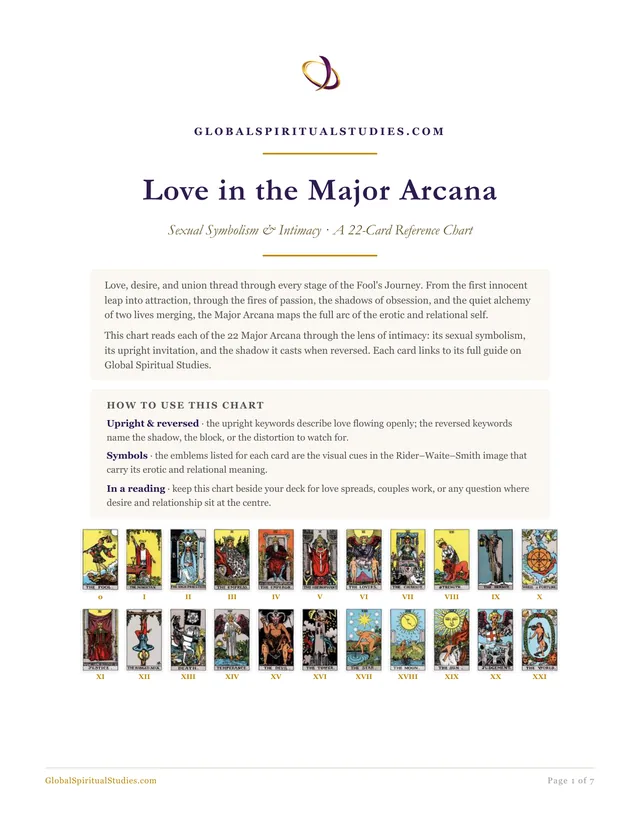
To compare the Sun with the other twenty-one Major Arcana in love readings, upright and reversed, open the free Tarot love chart.
Card Pairings in Intimacy Readings
The Sun takes on specific dimensions when paired with other cards in love and relationship spreads.
The fog lifts. This is the most significant pairing for the Sun, because the two cards represent the complete journey from confusion to clarity. When Moon and Sun appear together in a love reading, they often indicate a relationship that has passed through a period of deep uncertainty and is emerging into a new, clearer phase. What was projected is being withdrawn. What was feared is being faced. The light does not erase the Moon's teachings; it reveals what they were preparing you to see.
Two cards of innocence, but of different kinds. The Fool is innocent because the journey has not yet begun; the Sun is innocent because the journey has been completed. Together, they suggest a relationship that combines the Fool's spontaneity and openness to surprise with the Sun's earned wisdom and stability. This pairing can also indicate a new beginning that feels joyful rather than anxious, a leap taken with confidence rather than blind faith.
Embodied joy at its fullest. The Sun provides warmth, clarity, and the energy of consciousness; the Empress provides sensuality, fertility, and the body's deep pleasure. Together, they form one of the most auspicious pairings in any love reading, suggesting a relationship that is both emotionally transparent and physically abundant. The garden is in full bloom. This pairing can indicate fertility, creative partnership, or simply a period of extraordinary warmth and satisfaction.
The dawn sequence. In the Major Arcana, the Star, the Moon, and the Sun form a three-card progression: hope after devastation (Star), the confusion of the dark night (Moon), and the clarity of the new day (Sun). When the Star and Sun appear together without the Moon between them, they suggest that the healing process has accelerated, that hope is turning directly into joy without a prolonged period of confusion. A beautiful pairing for relationships recovering from heartbreak or loss.
Shadow and light, concealment and revelation. The Devil operates through what is hidden: unconscious compulsions, unacknowledged desires, chains that bind precisely because they are not seen. The Sun makes everything visible. Together, these cards suggest a relationship where something that was hidden or compulsive is coming into the light, not necessarily to be destroyed, but to be seen honestly for the first time. The Sun does not judge the Devil's material. It illuminates it.
Conscious love celebrated in full light. The Lovers card is the moment of choice, the deliberate decision to stand naked before another person. The Sun is the joy that follows when that choice proves right. Together, they suggest a love that was chosen wisely and has blossomed into sustained happiness. The couple in the Lovers stands in the garden before the Fall; the child in the Sun plays in the garden after the journey through experience. Both are transparent, but the Sun's transparency is earned.
Joy completed and still dancing. The World is the final card of the Major Arcana, the image of wholeness, integration, and the dance at the center of everything. Paired with the Sun, it suggests a love that has reached a genuine sense of completion: not an ending, but an arrival at a place where both partners feel whole, individually and together. This is one of the most positive pairings in the entire deck for questions about long-term partnership.
The Sun card teaches that love radiates. Linda Marson's course explores how to sense and work with the energy that surrounds you and your querents, the subtle field of warmth, connection, and intention that makes every reading a living exchange.
Explore the CourseFor the experiential and magical dimensions of the Sun's energy, Mary K. Greer's Experience Tarot Magic explores how to embody the archetypes and discover their living power in your own experience.
Go deeper · explore our Tarot courses, or download the free 7 chakra chart to map the body's energy centres.
Frequently Asked Questions
What does the Sun mean in a love reading?
The Sun in a love reading indicates joy, warmth, and clarity in a relationship. It suggests a partnership characterized by honesty, transparency, and genuine mutual happiness. The Sun often appears when a period of confusion or uncertainty is ending, and the truth about a relationship is becoming clear. It points toward a love that does not need to perform or prove itself, a connection where both people feel free to be themselves. The Sun can also indicate fertility, vitality, and the generative energy of a partnership that creates something meaningful together.
Is the Sun a yes or no card for love?
In yes-or-no style readings, the Sun often leans toward yes, and it is among the most affirmative cards in the deck. However, it is not a passive yes. The Sun points toward a love that is honest, visible, and genuinely joyful. It suggests that what you are asking about has the potential for real happiness, provided both people are willing to be open and authentic. The Sun does not bless hidden agendas or relationships built on concealment. Its yes is for love that can stand in full daylight.
What does the Sun reversed mean in a love reading?
The Sun reversed in a love reading can indicate joy that is blocked, delayed, or dimmed. A relationship that should feel warm and happy may instead feel clouded or uncertain. The reversed Sun can suggest an inability to accept happiness, a tendency to sabotage good things because you do not trust that they are real. It can also point to a loss of playfulness and spontaneity, the inner child silenced by adult anxieties. In some readings, the reversed Sun indicates overexposure: a relationship where too much visibility has eliminated all privacy and mystery, leaving no space for individual interiority.
What does the Sun represent as a person?
When the Sun represents a person, it describes someone who is genuinely warm, open, and radiant. This person brings light into rooms and relationships. They are honest, sometimes disarmingly so, and they value transparency over mystery in their connections. They tend to be optimistic without being naive, playful without being irresponsible, and generous with their affection. The Sun person has often passed through significant challenges and arrived at a place of genuine contentment. They are not performing happiness. They are living it, and their presence tends to make the people around them feel more alive and more seen.
What is the sexual meaning of the Sun card?
The Sun card's sexual energy is characterized by joy, playfulness, and comfort rather than intensity, transgression, or mystery. It represents physical intimacy where both partners feel free and uninhibited: desire experienced as celebration rather than compulsion, need, or conquest. The naked child symbolizes a body free of shame, and the sunlit garden suggests sexuality that is open and unhidden. The Sun can also carry meanings related to fertility and creative potency. In Crowley's interpretation, the united twins represent the active and receptive principles dancing together, suggesting sexual polarity experienced as play rather than power.
What does the Sun mean after the Moon in a love reading?
When the Sun appears after the Moon in a love reading, the sequence mirrors their placement in the Major Arcana and carries a powerful message: a period of confusion, doubt, or emotional fog is ending, and clarity is arriving. The Moon represents everything you could not quite see about a relationship, the projections, fears, and uncertainties. The Sun represents the moment those veils lift and you can see clearly. This pairing often indicates that a truth about the relationship is becoming visible, that feelings are being clarified, or that a difficult emotional passage is resolving into genuine understanding and warmth.
Does the Sun indicate pregnancy or fertility?
The Sun is one of the cards most traditionally associated with fertility, pregnancy, and the birth of children, alongside the Empress. The child on the card, the sunflowers growing in the garden, and the solar energy itself all carry associations with vitality, growth, and generative power. In readings about whether to start a family, the Sun is generally encouraging. However, like all Tarot cards, it should be understood as pointing toward energy and possibility rather than making medical predictions. The Sun's fertility can also be understood metaphorically: the "birth" of a new phase in a relationship, a creative project, or a shared vision that is finally ready to emerge into the light.
What is the Kabbalistic meaning of the Sun in love?
In Kabbalah, the Sun corresponds to Path 30 on the Tree of Life, connecting Yesod (Foundation, the Moon, the unconscious) to Hod (Splendor, Mercury, the intellect). The Hebrew letter is Resh, meaning "head," linking the card to consciousness and awareness. The Yetziratic title is "The Collecting Intelligence," suggesting a consciousness that gathers scattered fragments into coherent meaning. In love readings, this Kabbalistic framework teaches that the Sun's clarity is the result of unconscious material (Yesod) being brought into the light of conscious understanding (Hod). The path from Moon to Sun, from confusion to clarity, is the path of becoming aware of what you truly feel and truly want.