Judgement
The Call That Wakes You · Desire That Demands You Become

In love, intimacy and sexual-energy readings, Judgement is the card of awakening: the call that brings a buried feeling, or a buried way of loving, back to life.
There is a sound that reaches the part of you that has been sleeping. Not the gentle alarm that eases you awake, not the whisper you can pretend you did not hear. This is the trumpet blast. The one that finds you in the coffin of the life you have been living on autopilot and says: rise.
You have heard it. Maybe in the middle of a relationship that looked fine from the outside but felt like slow suffocation from within. Maybe in the silence after a door closed for the last time. Maybe in the sudden, unbearable clarity of realizing that the person lying next to you is not the problem. You are. Or rather, the version of you that settled, that compromised, that buried some essential part of yourself in order to keep the peace.
Judgement is Card XX of the Major Arcana. It is the card of awakening, reckoning, and resurrection. In most Tarot love guides, it gets reduced to a cheerful platitude about second chances or an ex returning. But Judgement is not gentle. It is the desire that does not seduce you. It summons you. It does not promise comfort. It promises transformation, and transformation, as anyone who has lived through it knows, often feels indistinguishable from destruction while it is happening.
To understand Judgement in love, we have to listen to several streams at once: the Christian imagery of the Last Judgment that shaped the card's visual language, the resurrection myths of Osiris, Persephone, and Inanna that predate Christianity by millennia, Carl Jung's teaching that individuation demands the Self call the ego beyond all previous identities, and Aleister Crowley's radical renaming of the card as The Aeon, the arrival of a new dispensation that renders the old world obsolete. What follows is a deep exploration of what this card reveals when love is the question.
Judgement has kept one image for six centuries, the dead rising to an angel's trumpet, from the Visconti-Sforza deck through the Marseille Le Jugement to Waite's Gabriel (1909). Crowley alone broke with it, renaming the card The Aeon. For love, the shared teaching is that what looked finished is not, and what rises may be something entirely new.
Read for love, the trumpet is the recognition you cannot unfeel, the coffins floating on water say that what you gave up on sank below awareness rather than dying, and the rising man, woman and child suggest that what returns is a way of loving: the third thing a conscious couple creates between them.
On the Tree of Life Judgement is Path 31, Shin (fire, 'tooth'), running from Hod (the intellect) to Malkuth (the life you actually live). In intimacy it marks the moment an insight about your relationship stops being an idea and changes how you love. Full Judgement meaning, history and symbolism.
The Trumpet and the Call: Awakening from Relational Sleep
There is a particular kind of sleep that happens inside long relationships. Not boredom exactly, though it can look like that. Not indifference, though it can feel like that. It is more like a slow anaesthetic: the gradual numbing of the senses that occurs when two people stop surprising each other, stop challenging each other, stop asking the questions that might disturb the peace.
John Gottman, whose research at the University of Washington tracked couples over decades, identified what he called "turning away," the small, repeated moments when one partner bids for connection and the other fails to respond. Accumulated over years, the pattern creates a kind of emotional coma. Both people are present. Neither is awake.
Judgement is the trumpet that sounds inside that coma.
It might arrive as a sudden attraction to someone who makes you feel alive in ways you had forgotten were possible. It might arrive as a health crisis or a confrontation with mortality. It might arrive as nothing more dramatic than a morning when you look across the breakfast table and realize, with a clarity that feels like a physical blow, that you have been going through the motions of love without actually feeling it.
The call is not always welcome. The coffins in the Rider-Waite-Smith image are open, but the figures inside did not ask to be woken. Resurrection is not a gentle process. It demands that you leave behind the comfortable darkness of unconsciousness and step into a light that will show you everything, including what you would rather not see. In the context of a relationship, answering the call may mean confronting truths that have been carefully avoided for years: I married the wrong person. I have been pretending. I buried the part of myself that knows what I really want.
But the call can also be the beginning of something magnificent: the moment two people who have been sleepwalking through their partnership wake up together and choose, consciously and deliberately, to be present. Not the young, naive presence of new love, but the weathered, scarred, eyes-open presence of people who know exactly what it costs to love someone over time and choose it anyway.
Resurrection in Love: Second Chances and the Return of What Was Lost
The resurrection theme in Judgement draws on mythological patterns that predate Christianity by thousands of years, and each of them carries a specific teaching about love.
Inanna, the Sumerian goddess of love and war, descended to the underworld in the early second millennium BCE in one of the oldest recorded myths. She passed through seven gates, was killed, and three days later was restored to life, but the underworld demanded a substitute. She chose her consort Dumuzi, who had not mourned her absence. The teaching is stark: you can return from the depths, but the return costs something. And the partner who did not grieve your disappearance may be the one who pays.
Persephone ate pomegranate seeds in Hades' kingdom and was changed forever. She could return to the surface but never fully. Part of her would always belong to the depths. In love, this is the partner who has survived something genuinely dark and who returns to the relationship transformed. They are present, but they are no longer innocent. They carry knowledge of the underworld, and that knowledge makes them both more compassionate and less willing to pretend.
The Christian resurrection narrative adds another dimension. In the Gospels, those who encounter the risen Christ do not immediately recognize him. The person who returns from the dead is the same and not the same. In love readings, Judgement often appears when someone or something you thought was finished returns, but in an altered form. The ex who contacts you is not the person who left. The capacity for intimacy you buried after being hurt has been growing in the dark, and it returns with new depth.
What all these traditions share is a refusal of simple restoration. Resurrection is not rewinding the clock. It is not getting back what you lost in the form you lost it. It is the return of something essential in a new form, transformed by its passage through the depths. The Judgement card does not promise that your old relationship will come back. It suggests that something you thought was dead, your capacity to love fully, your willingness to be seen, your courage to show up as who you actually are, may be rising.
Individuation's Final Call: The Self Summoning the Ego
In Carl Jung's psychology, the process of individuation, the lifelong movement toward psychological wholeness, reaches a decisive turning point when the Self calls the ego to transcend all its previous identities. Judgement is the Tarot's image of that moment.
Jung distinguished between the ego (the conscious sense of "I," the personality we present to the world) and the Self (the totality of the psyche, conscious and unconscious, the center of gravity that the ego orbits but does not control). For most of our lives, the ego runs the show. It manages relationships, constructs identities, makes deals with reality. It decides who we are, what we want, and how we present ourselves to the people we love.
But the Self, Jung wrote, has its own agenda. And at certain critical junctures, it issues a summons that the ego cannot refuse without consequences. Jung described this as the moment when the mask drops, when the roles you have been playing in your relationships, the good partner, the reliable provider, the accommodating lover, are suddenly revealed as masks, and the person underneath is exposed.
The Self does not call you to become a better version of the person you have been performing. It calls you to become someone you have never been before, someone who was always there beneath the performance, waiting for permission to exist.
In love, this often manifests as a crisis that feels destructive but is actually generative. The partner who suddenly announces, after twenty years, that they need something fundamentally different. The person who realizes mid-relationship that they have been performing a version of desire rather than feeling it. The moment when you look at the life you have built with someone and understand, with the force of the trumpet itself, that the life is beautiful and it is not yours.
Jung was careful to distinguish individuation from selfishness. The call of the Self is not "do whatever you want." It is "become who you are." Those are profoundly different invitations. The first abandons the relationship. The second transforms it, or, if the relationship cannot hold the transformation, allows both people to move toward what is true. Judgement in a love reading does not say "leave." It says "wake up." What you do after waking is your choice, but you cannot return to the coffin once you have heard the trumpet.
The Aeon: Crowley and the End of the Old World
Aleister Crowley's decision to rename Judgement as The Aeon was not merely a stylistic preference. It was a theological and philosophical statement about the nature of transformation itself.
In Crowley's system, history moves through great aeons. The Aeon of Isis was the age of matriarchy and nature worship. The Aeon of Osiris was the age of patriarchal religion, sacrifice, and guilt. The Aeon of Horus, which Crowley believed began in 1904, was an era of individual sovereignty and direct experience of the divine.
In The Book of Thoth, Crowley wrote that the old card of Judgement belonged to the dying Osirian paradigm: a wrathful God sorting the saved from the damned. The Aeon card replaces this with transformation, not punishment but the arrival of a new consciousness that renders the old paradigm obsolete.
For love readings, Crowley's reframing carries a specific and liberating insight. The old model of love, the one built on obligation, duty, sacrifice, and the suppression of individual truth for the sake of the institution, belongs to the Aeon of Osiris. It is not wrong. It served its purpose. But for many people, it has stopped working. The Aeon of Horus demands something different: partnership built on authenticity rather than performance, on mutual sovereignty rather than codependence, on the recognition that two whole people choosing each other freely creates something more sacred than two half-people clinging together out of fear.
This is not a license for narcissism. Crowley's "Do what thou wilt" is routinely misread as permission for indulgence. In context, "True Will" refers to the deepest purpose of the soul, not the whims of the appetite. Applied to love, it asks: is this relationship an expression of your deepest truth, or a comfortable escape from it?
From Performance to Presence: Desire That Demands Authenticity
The call that Judgement sounds is, at its core, a call away from performance and toward presence. And in the realm of love and intimacy, the distance between those two can be measured in years of quiet desperation.
Most of us perform love to some degree. We learn early what kind of partner earns approval. We construct a relational self, a version of who we are in intimacy, and we present that version so consistently that we sometimes forget it is a construction.
Judgement interrupts the performance. It is the moment when the character you have been playing can no longer sustain itself. Perhaps the mask cracks because you meet someone who sees through it. Perhaps it cracks because the effort has become exhausting. Perhaps it simply cracks because you have grown too large for it, because the person you are becoming can no longer fit inside the person you have been pretending to be.
In sexual intimacy, this dynamic plays out with particular intensity. Performance in bed can sustain itself for a surprisingly long time. But there comes a point where the body's truth cuts through the script. The desire that arrives after that moment is raw, unscripted, and sometimes frightening in its honesty. It does not care about looking good. It cares about being real.
This is the desire that Judgement speaks to. Not performative desire, but the desire that emerges after the masks have fallen, after the coffin has opened, after the grey-skinned self has heard the trumpet and risen. It is the desire of someone who has stopped trying to be lovable and started trying to be honest. It is rarely pretty. It is almost always more intimate than anything that came before it.
Upright and Reversed in Love Readings
A profound awakening within a relationship or about your approach to love. The call to stop sleepwalking through your intimate life and respond to what is true. A second chance that arrives not as a repetition of the past but as an invitation to something genuinely new. The return of a capacity for love that was buried, numbed, or abandoned. Honest reckoning with what a relationship has been versus what it could become. Clarity about your own patterns that, once seen, cannot be unseen. The relationship that changes your life by demanding you become who you were meant to be. Waite's keywords include "change of position, renewal, outcome."
Refusing the call. Hearing the trumpet and pulling the coffin lid shut again. Clinging to a relationship or a version of yourself that you know is no longer alive because the alternative, rising, changing, becoming, feels too frightening. Self-doubt that masquerades as humility: "Who am I to want more?" Fear of judgment, either your own harsh inner critic or the judgment of others who are invested in you staying the same. Delayed reckoning with a truth you already know. Waite's reversed keywords hint at "weakness, pusillanimity, simplicity." The reversed Judgement can also indicate that the process of awakening is underway but not yet complete, that the trumpet has sounded but you have not yet fully risen.
- What part of you has been sleeping in your current relationship, and what would it mean to let it wake?
- If the trumpet sounded right now, what truth about your love life would you have to face?
- Where have you been performing love instead of feeling it?
- What relationship, capacity, or version of yourself did you bury that may be ready to rise?
- What would it cost you to answer the call, and what is it costing you not to?
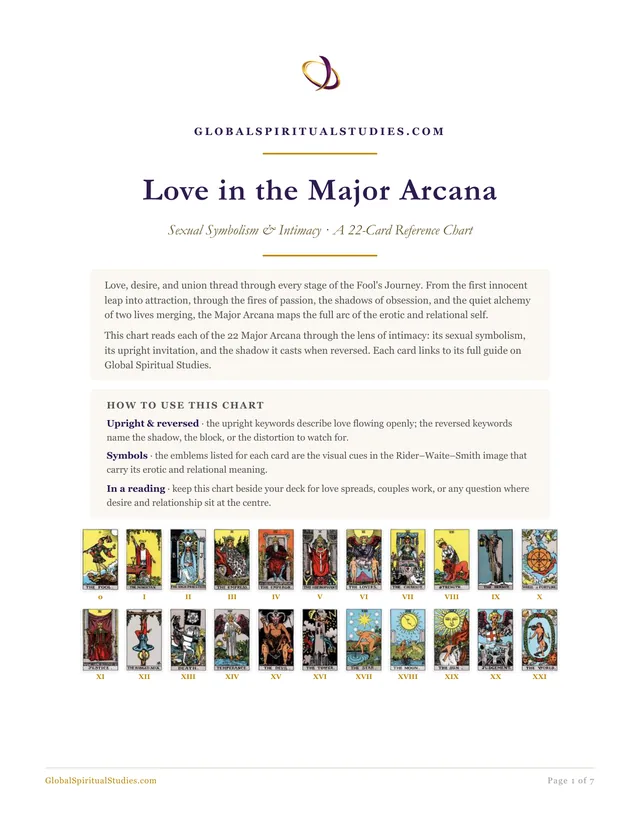
To compare the Judgement with the other twenty-one Major Arcana in love readings, upright and reversed, open the free Tarot love chart.
Card Pairings in Intimacy Readings
Judgement takes on specific dimensions when it appears alongside other cards in love and relationship spreads.
The call to choose again, this time with full awareness. The Lovers represents conscious choice; Judgement represents the awakening that makes genuine choice possible. Together they suggest a relationship being re-chosen after a period of reckoning, not from obligation or habit, but from a place of clear-eyed knowing. This is the couple who nearly ended and decided to begin again, not as a retreat to the familiar but as a deliberate step into something new.
The complete cycle of transformation. Death clears what has run its course. Judgement calls what is essential to rise from the clearing. Together they describe the full arc: the relationship that must end in its current form so that something truer can emerge. This is not a gentle pairing. It asks for the courage to let go completely before the new thing arrives, trusting the trumpet even when the coffin is the only ground you know.
Destruction followed by summoning. The Tower shatters the false structure; Judgement calls you out of the rubble. This pairing often appears when a relationship has been blown apart by revelation or crisis and the question is whether anything real survives the collapse. The Tower does not discriminate. Judgement does. It calls only what is true to rise. What was false stays in the wreckage.
The call from the deepest levels of the unconscious. The High Priestess guards the threshold between conscious and unconscious; Judgement sounds the trumpet that brings what has been hidden into the light. Together they suggest that the awakening is not coming from outside. It is rising from within, from a knowing you have always carried but refused to acknowledge. The Priestess whispers. Judgement announces. Together they cannot be ignored.
Awakening after confusion. The Moon governs the period of uncertainty, projection, and illusion that often precedes clarity. Judgement arrives when the fog lifts and you see, with sudden and sometimes painful precision, what is real and what was shadow. This pairing frequently appears when someone emerges from a period of confusion about a relationship and finally knows what is true, even if the truth is uncomfortable.
The solitary reckoning that precedes the public rising. The Hermit withdraws to find truth in solitude. Judgement answers the call to bring that truth back into the world, into the relationship, into lived life. Together they describe the person who needed to be alone to understand what they wanted, and who now returns, transformed by the knowing, ready to love from a place of genuine self-knowledge rather than performance.
Healing that prepares you to answer the call. The Star's nakedness under starlight is the vulnerability that comes after the Tower's destruction; Judgement's rising figures are the response to what the healing made possible. Together they describe the arc from wounding to openness to transformation: the person who was broken, who allowed themselves to be gently rebuilt, and who now hears the trumpet and rises, scarred but whole, ready for a love they could not have imagined before the breaking.
Judgement readings surface some of the deepest material a client will ever bring to the table: life-changing decisions, buried truths, the call to become. Jenne Perlstein's course teaches the professional skills that let you hold space for these moments without flinching.
Explore the CourseWhen Judgement-level transformation surfaces in a reading, the emotional intensity can challenge even experienced readers. Jenne Perlstein's Difficult Clients course explores how to navigate the conversations that matter most.
Go deeper · explore our Tarot courses, or download the free 7 chakra chart to map the body's energy centres.
Frequently Asked Questions
What does Judgement mean in a love reading?
Judgement in a love reading signals a profound awakening about your relationship or your approach to love. It suggests that something you thought was finished, a relationship, a capacity for intimacy, a buried truth about what you want, is rising to the surface and demanding your attention. The card does not predict a specific outcome. It announces that a reckoning is here: the moment when you can no longer sleepwalk through your intimate life and must choose, with full awareness, how to respond. This often involves an honest assessment of where you have been performing love rather than feeling it, and the courage to let what is false fall away so what is real can emerge.
Is Judgement a yes or no card for love?
In yes-or-no style readings, Judgement often leans toward yes, but not a passive or comfortable yes. It points toward a yes that requires transformation. If the question is "Is this relationship worth pursuing?", Judgement says "yes, if you are willing to show up as your whole self, not the edited version." If the question is "Should I give this another chance?", the card suggests that a genuine second chance may be available, but only if both people are willing to do the work of honest reckoning with what went wrong. Judgement's yes is always conditional on authenticity.
What does Judgement reversed mean in a love reading?
Judgement reversed in love often indicates a refusal of the call. The trumpet has sounded, but you are choosing not to answer it, clinging to a relationship, a role, or a version of yourself that you know has run its course because the alternative feels too frightening. It can suggest self-doubt that masquerades as humility, a fear of change dressed up as contentment, or a delayed reckoning with a truth you already know but are not yet ready to act on. Reversed Judgement does not mean the call disappears. It means you are not yet rising to meet it. Waite's reversed keywords include "weakness" and "simplicity," suggesting a retreat from the complexity that genuine transformation requires.
What does Judgement represent as a person in a love reading?
When Judgement represents a person, it describes someone who has been through a significant transformation and emerged with a clarity that can be both compelling and uncomfortable. This person has done their reckoning. They know what they want and they know what they will no longer tolerate. They tend to cut through pretense quickly, not from cruelty but from an unwillingness to spend time in relationships that lack authenticity. Being with a Judgement person can feel like being seen with an intensity you did not expect, the kind of seeing that makes it impossible to maintain comfortable illusions about yourself or the relationship. They often catalyze change in the people around them, whether or not they intend to.
What is the sexual meaning of the Judgement card?
The sexual dimension of Judgement relates to the moment when performance drops away and raw presence takes its place. In the context of physical intimacy, Judgement can indicate a sexual awakening: the discovery (or rediscovery) of authentic desire after a period of going through the motions. It often points to the kind of sexual experience that feels genuinely transformative, not because of technique or novelty, but because both people are fully present, fully honest, and fully willing to be seen. The card's element is Fire (through the Hebrew letter Shin), and its sexual energy is that of fire that purifies: the intimacy that burns away pretense and leaves something more honest in its place.
Does Judgement mean my ex is coming back?
Judgement's resurrection theme does sometimes appear in readings when an old connection resurfaces, but it is important to understand what the card is actually saying. Judgement does not promise a return to the past. What it suggests is that something you thought was finished may be rising in a new form. This could mean an ex reaching out, but it is equally likely to mean the return of a capacity within yourself, a willingness to be vulnerable, a readiness to love honestly, that was buried during or after that relationship. If an old partner does reappear, Judgement insists that the reconnection must be genuinely new, built on transformed understanding rather than nostalgia. The person who returns is not the person who left, and you are not the person they left behind.
What is the connection between Judgement and the Last Judgment in Christianity?
The Tarot's Judgement card draws directly from Christian iconography of the Last Judgment described in Revelation 20, where the dead are raised for final reckoning. The angel, the trumpet, and the rising dead are all taken from this tradition. However, the Tarot's treatment differs from orthodox theology in important ways. In the Christian Last Judgment, souls are sorted into saved and damned. In Tarot tradition, the rising figures are not being judged by an external authority. They are being called to account by something within themselves, a higher awareness, a deeper truth, what Jung would call the Self. The distinction matters for love readings: the card asks you to become your own judge, to reckon honestly with what is true in your intimate life, not to await someone else's verdict.
How does Judgement relate to Crowley's Aeon card?
Aleister Crowley renamed Judgement as "The Aeon" in his Thoth deck, replacing the angel and rising dead with the cosmic imagery of Nuit (the sky goddess), Hadit (the winged sun-disc), and Horus (the child-god of the new age). For Crowley, the old concept of divine judgment belonged to a dying religious era. The Aeon represents not reckoning but transformation, not punishment but the arrival of a new consciousness. In love readings, Crowley's reframing suggests that the old model of relationship, built on duty, sacrifice, and the suppression of individual truth, may be giving way to something built on authenticity, mutual sovereignty, and the recognition that two whole people choosing each other freely creates something more sacred than obligation ever could.