There is a Sephirah on the Kabbalah Tree of Life that most students would rather skip. It sits on the left-hand Pillar of Severity, coloured red, governed by Mars, and its name is Geburah (גבורה), meaning Severity, Strength, or Judgment. It is also called Din, the principle of strict Justice. Everything about it sounds harsh. And that is precisely why it is so widely misunderstood. Geburah is not cruelty. It is the surgeon's scalpel, not the torturer's blade. It is the force that prunes the vine so the vine can bear fruit. Without it, the boundless love of Chesed across the Tree would expand until it smothered everything it touched. Geburah is the necessary "no" that gives shape to every "yes."
Geburah is the fifth emanation, sitting on the left side of the Ethical Triad, directly opposite Chesed (Mercy) on the Pillar of Mercy. Between them, at the centre, sits Tiferet (Beauty), the heart that holds severity and mercy in balance. This triad governs the moral and ethical dimension of consciousness, the realm where values are forged, where character is tested, and where the hardest decisions are made.
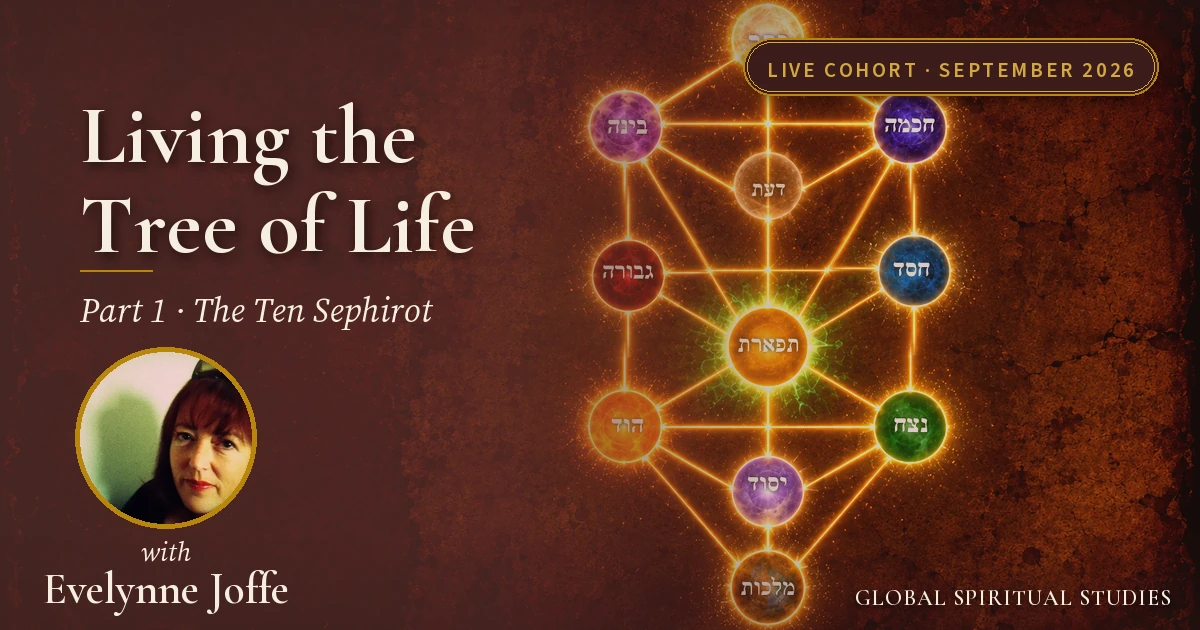
If you would like to study Gevurah with a teacher rather than on your own, Evelynne Joffe now teaches the whole Tree as a live September 2026 cohort of Living the Tree of Life · The Ten Sephirot · eight weekly classes climbing from Malkuth to Kether, with two live Q&A sessions where you bring your own questions.
Featured Course · Live Cohort
Living the Tree of Life · Part 1: The Ten Sephirot
A live September 2026 cohort · with Evelynne Joffe, Director of the Institute of Esoteric Studies
Evelynne Joffe has spent decades teaching the Tree of Life not as religion but as a living map of a whole human life. In this live cohort she walks you up the Tree one Sephirah at a time · from Malkuth at the ground to Kether at the crown · with two live Q&A sessions where you bring your own questions. No background is needed · only curiosity.
- Eight weekly classes
- Two live Q&As
- Malkuth to Kether
- Five+ hours of video
- Downloadable handouts
- Transcripts & subtitles
- Private cohort forum
- Quiz & certificate of completion
- Lifetime access
What Is Geburah?
Gevurah (also spelled Geburah) is the fifth Sephirah on the Kabbalah Tree of Life. It represents severity, strength, and divine judgment · the necessary force of boundaries and discipline that gives form to the boundless mercy of Chesed.
Geburah is the fifth sphere in the descent of divine energy from Kether to Malkuth. It is the first Sephirah on the Pillar of Severity, the left-hand column that gives form, limitation, and structure to the expansive, formless energy of the right. If Chesed is the force that says "more," Geburah is the force that says "enough." Both are divine. Both are necessary. Neither is complete without the other.
The divine name is Elohim Gibor, meaning "Almighty God" or "God the Mighty Warrior." The word Gibor carries the connotation of a hero, a champion, someone who possesses not only physical strength but moral courage. The archangel is Kamael, whose name means "Severity of God" or "He Who Sees God." Kamael is sometimes depicted with a sword, and the image is instructive: the sword of Geburah is not wielded in anger. It is wielded in service of justice.
The planet is Mars, and the colour in the Queen Scale is red, the colour of blood, fire, and the life force itself. Mars governs willpower, assertiveness, conflict, and the capacity to act decisively. In the astrological tradition, Mars is often feared, much as Geburah is feared on the Tree. But fear of Mars, like fear of Geburah, arises from a misunderstanding of what strength actually requires.
The body correspondence is the right arm, the arm of action. This is the arm that swings the sword, that draws the boundary, that pushes back against what threatens. It is also the arm that holds the scalpel, that removes the tumour, that cuts the cord. Geburah's action is always purposeful. It serves life by removing what threatens life.
The Spiritual Experience of Geburah is the Vision of Power. This is not power as domination. It is power as capacity: the capacity to act, to decide, to enforce a boundary, to say no when no is what love requires. A parent who refuses to let a child cross a busy road is exercising Geburah. A therapist who names a painful truth that the client has been avoiding is exercising Geburah. A leader who makes an unpopular decision because it is the right one is standing in this Sephirah.
The traditional virtue is energy and courage. These belong together. It takes energy to maintain boundaries, to resist the gravitational pull of permissiveness, to do what is difficult rather than what is comfortable. And it takes courage because the person who exercises Geburah is rarely thanked for it. The surgeon who saves a life receives gratitude. The one who says "this limb must come off" is the object of fear. Geburah accepts this. It acts not for approval but for necessity.
Symbolism and Correspondences
| Attribute | Correspondence |
|---|---|
| Number | 5 |
| Hebrew | גבורה (Geburah / Gevurah) |
| Meaning | Severity, Strength, Judgment (also Din: Justice) |
| Pillar | Pillar of Severity (Left) |
| Divine Name | Elohim Gibor |
| Archangel | Kamael |
| Angelic Order | Seraphim ("Fiery / Burning Ones") |
| Planet | Mars |
| Colour | Red (Queen Scale) |
| Body | Right arm |
| Spiritual Experience | The Vision of Power |
| Virtue | Energy, Courage |
| Vice | Cruelty, Destruction |
| Tarot | The four Fives |
| Qliphah | Golachab (the Burners) |
Free printable chart: all 10 Sephirot with Hebrew names, pillars, Tarot and planetary correspondences at a glance · see the complete Tree of Life chart.
See the divine name, archangel and angelic order of every Sephirah in the free Kabbalah Archangels chart, and how Gevurah stands on the Pillar of Severity, one of the Three Pillars of the Tree.
The Tarot attribution is telling. The four Fives are among the most difficult cards in the deck: the Five of Wands (strife), the Five of Cups (loss and grief), the Five of Swords (defeat and conflict), and the Five of Pentacles (material hardship). In every suit, the Five disrupts the harmony of the Four. It breaks things. It introduces conflict. And yet this disruption is not pointless. The Fives clear the way for the Sixes, which represent the restored harmony of Tiferet. Without the breaking of the Five, the rebalancing of the Six could not occur.
Note on spelling: "Geburah" and "Gevurah" are both common transliterations of the same Hebrew word. This guide uses both forms interchangeably.
Geburah on the Tree
Geburah sits on the left side of the Ethical Triad, opposite Chesed and below Binah. It is connected to four other Sephirot by paths, and each connection reveals a different aspect of how severity operates within the larger system.
Path 19 (Strength) connects Geburah to Chesed. This is the horizontal path between severity and mercy, and the Strength card (in the Thoth deck, Lust) depicts the primal encounter between the two forces. The woman taming the lion, or riding it, is the image of mercy and severity in dynamic relationship: not one conquering the other, but both finding their place.
Path 18 (The Chariot) ascends from Geburah to Binah, the Great Mother. The Chariot represents the directed will, the capacity to harness opposing forces and drive them forward with purposeful control. Through this path, Geburah receives its form-giving power from Binah, the mother of all limitation. Where Binah gives form to the cosmos, Geburah gives form to ethical life.
Path 22 (Justice) descends from Geburah to Tiferet. Justice is Geburah's own card in many respects: the scales, the sword, the blindfold of impartiality. Through this path, the severity of Geburah is tempered by the compassion of Tiferet, and the harmony of Tiferet is given backbone by the discipline of Geburah. This is one of the most important paths on the Tree because it connects the principle of strict judgment with the principle of mercy-in-balance.
Path 23 (The Hanged Man) reaches from Geburah down to Hod. The Hanged Man is the card of willing surrender, of seeing the world from a reversed perspective. This path suggests that the severity of Geburah, when it descends into the intellectual sphere of Hod, requires a radical shift in viewpoint. The mind must be willing to be turned upside down, to sacrifice its comfortable assumptions, in order to receive the discipline that genuine thought demands.
The Psychological Dimension
In Jungian terms, Geburah corresponds to the Shadow as a necessary force, to the capacity for ego boundaries, and to the psychological function of saying no. Jung observed that one of the most common failures in psychological development is the inability to set limits, to refuse, to disappoint, to let something go. This failure is not kindness. It is a deficit of Geburah.
The Shadow, in Jung's framework, is not evil. It is the part of the personality that has been rejected, repressed, or denied. Geburah's relationship to the Shadow is complex. On one hand, Geburah is the force that creates boundaries, including the boundary between what we accept in ourselves and what we push into the Shadow. On the other hand, engaging with Geburah requires confronting the Shadow, because severity scares us. We fear our own capacity for anger, for judgment, for cutting things off. And so we push these capacities into darkness, where they fester.
A well-integrated Geburah manifests as healthy assertiveness, clear boundaries, the ability to make difficult decisions without excessive guilt, and the courage to confront what needs confronting. It is the faculty that allows you to end a relationship that has become destructive, to leave a job that violates your values, to tell someone a truth they do not want to hear because silence would be a greater cruelty than honesty.
An undeveloped Geburah manifests in two ways, and they may appear opposite but share the same root. The first is passivity: the inability to act, to decide, to draw a line. The person with undeveloped Geburah says yes to everything and then resents the burden. They confuse permissiveness with love and endurance with virtue. The second manifestation is the eruption of repressed severity: sudden explosions of anger, cruelty that shocks even the person expressing it, judgments delivered with a ferocity that has been building for years beneath a surface of apparent gentleness.
In daily life, Geburah is at work every time you make a conscious choice to limit something. Choosing not to check your phone during a conversation. Ending a meeting on time rather than letting it drift. Saying "I cannot do that" without apology. Refusing to tolerate behaviour that crosses a line, even when the refusal costs you comfort. These are small acts, but they accumulate. A life without these small severities becomes shapeless, overextended, and eventually exhausted.
The Shadow Side: The Qliphoth of Geburah
The Qliphah of Geburah is Golachab, the Burners. The image is fire without purpose: a conflagration that destroys indiscriminately, burning what is precious along with what is worthless. This is severity divorced from love, judgment without compassion, the sword swung not in service of justice but in the grip of rage.
Golachab manifests as cruelty and destruction for their own sake. It is the teacher who humiliates rather than corrects. The leader who punishes to demonstrate power rather than to restore order. The inner critic that does not motivate improvement but paralyses with shame. In each case, the form of severity is present, but the soul of it, the connection to mercy and to the larger purpose of the Tree, has been severed.
The antidote is not the abandonment of severity but its reintegration with Chesed. Severity that remembers mercy is discipline. Severity that forgets mercy is cruelty. The path between Geburah and Chesed (Strength, Path 19) is the constant reminder that these two forces are not enemies but partners. Every act of genuine severity must be held in the awareness that its purpose is ultimately compassionate, not to destroy but to protect, shape, and serve.
The Zohar teaches that Geburah exists because unlimited mercy would dissolve the world. A creation with no boundaries, no consequences, no friction would have no form. It would collapse under the weight of its own abundance. Geburah is what gives the universe its edges, and edges are where things become real.
Working with Geburah
A Geburah Meditation: The Red Fortress
Find a quiet place and sit in a posture that is upright and alert. Geburah is not a Sephirah for drowsy contemplation. Close your eyes and take several deliberate breaths, each one firm and complete.
Imagine yourself standing before a fortress built from red stone, strong and angular, set against a landscape of bare rock and clear sky. The air is dry and sharp. There is nothing soft here. The gate is open, and you walk through it without hesitation.
Inside the fortress is a single great hall. At its centre stands a figure in armour, holding a sword. This is the Guardian of Geburah. The sword is not raised in threat. It is held at rest, ready but calm. The Guardian looks at you and asks a single question: What in your life needs to be cut away?
Do not rush your answer. Sit with the question. What commitment, habit, relationship, belief, or pattern has outlived its purpose? What are you carrying out of obligation or fear that no longer serves your growth? What would you release if you had the courage?
Name it. Say it clearly, even if only to yourself. The Guardian nods. The sword does not strike. Geburah does not act impulsively. It acts when the time is right and the intent is clear.
Ask yourself: What is one concrete step I can take this week to begin this severance? Make it small and specific. Geburah respects precision.
When you are ready, thank the Guardian and walk back through the gate. Open your eyes. Write down the step you committed to.
Beyond meditation, Geburah is strengthened by any practice that requires discipline, boundary-setting, and the willingness to be uncomfortable. Physical training that pushes you to your edge. Honest conversations you have been avoiding. Simplifying your environment by removing what is unnecessary. Saying no to a request and letting the discomfort of refusal teach you something about where your limits actually are.
The four Fives of the Tarot offer a contemplative practice. Lay them out and sit with each one. The Five of Wands shows you conflict as creative friction. The Five of Cups shows you loss as a necessary clearing. The Five of Swords shows you the cost of victory pursued without mercy. The Five of Pentacles shows you the stripping away that reveals what truly matters. Together, they tell the story of Geburah across all four elements.
Common Misconceptions
Severity Means Punishment
The most common misunderstanding of Geburah equates it with punishment. Geburah is not punitive. It is corrective. The difference matters. Punishment looks backward, seeking retribution for what has been done. Correction looks forward, seeking to restore balance and prevent further harm. A parent who disciplines a child is exercising Geburah. A parent who punishes a child out of anger has fallen into Golachab.
The Left Pillar Is "Bad"
The association of Geburah with the Pillar of Severity, along with Binah and Hod, sometimes creates the impression that the left side of the Tree is negative. It is not. The left pillar is the pillar of form, limitation, and structure. Without it, the Tree would have no shape. Binah gives cosmic form. Geburah gives ethical form. Hod gives intellectual form. These are gifts, not punishments.
Geburah Is Only for Warriors
The martial imagery surrounding Geburah, Mars, the sword, armour, the colour red, can make it seem like a Sephirah only relevant to soldiers or fighters. In reality, Geburah is relevant to anyone who must make hard choices, which is everyone. The quietest, gentlest person on earth still needs Geburah: the strength to maintain their boundaries, the courage to be honest, and the discipline to follow through on their commitments.
Recommended Courses
Eight recorded classes covering all ten Sephirot. Geburah receives a full session exploring its mythology, its partnership with Chesed, and its role in psychological maturation.
Twenty classes on all twenty-two paths. The paths connected to Geburah, including Strength, the Chariot, Justice, and the Hanged Man, each receive individual treatment.
For a printable reference to all ten Sephirot and twenty-two paths, download our free Kabbalah Tree of Life PDF guide.
Ready to take this inward? Learn to work with Geburah in meditation as part of a complete Tree of Life practice.
To go further from Gevurah:
- the 22 paths and their Tarot correspondences · every path that touches Geburah, with its Hebrew letter and Major Arcana card
- the planetary and zodiacal correspondences · Geburah’s Mars, and the planets of the other Sephirot
- the Liber 777 correspondences · Geburah’s four colour scales, stone, perfume and Egyptian god
To understand how Geburah's Tarot correspondences fit the broader Kabbalistic framework, see our guide to Kabbalah and Tarot.
Geburah does not ask you to be harsh. It asks you to be honest. It asks you to find the courage that cuts cleanly, that removes what no longer serves, and that trusts the healing that follows every necessary severance.
To go deeper, our Kabbalah courses offer the full progression from foundations through advanced practice.
Sources & Tradition
The material presented here for Gevurah draws on the foundational texts and teachers of the Tree of Life · the Sefer Yetzirah (Book of Formation), the Zohar, the Sephirotic attributions codified by the Hermetic Order of the Golden Dawn, and Dion Fortune’s The Mystical Qabalah (1935). The identification of Geburah with Din, strict Justice, and its balance against Chesed, belongs to the Zohar’s account of the divine attributes. The divine name, archangel and angelic order given in the table above follow our own Kabbalah Archangels chart, which sets out the Golden Dawn and Liber 777 attributions and notes where the tradition is divided. The living, practice-based reading of Gevurah reflects Evelynne Joffe’s Living the Tree of Life courses taught at Global Spiritual Studies.
Frequently Asked Questions
What does Geburah represent on the Kabbalah Tree of Life?
Geburah is the fifth Sephirah, associated with severity, strength, judgment, and discipline. Its Hebrew name means Severity or Strength, and it is also called Din (Justice). It sits on the left-hand Pillar of Severity, governed by Mars and coloured red. Geburah represents the necessary force of limitation that gives form to the unlimited mercy of Chesed. In psychological terms, it corresponds to the capacity for boundaries, assertiveness, and the courage to make difficult decisions.
Why is Geburah considered the most misunderstood Sephirah?
Geburah's associations with Mars, the colour red, and the concept of severity lead many students to view it as negative or even dangerous. In reality, Geburah is the force that gives form, maintains boundaries, and prevents the collapse that occurs when mercy operates without limit. It is the surgeon's scalpel, not a weapon. The misunderstanding arises from confusing severity with cruelty. Properly understood, Geburah is an expression of love, the willingness to do what is difficult because it serves life.
How do Geburah and Chesed work together?
Geburah (Severity) and Chesed (Mercy) form the fundamental polarity of the Ethical Triad, connected by Path 19 (Strength). Chesed expands, gives, and embraces without limit. Geburah contracts, limits, and shapes. Without Chesed, Geburah becomes cruel. Without Geburah, Chesed becomes smothering. Together they produce the balanced, compassionate action embodied by Tiferet, which sits between them at the heart of the Tree.
Featured Course · Live Cohort
Living the Tree of Life · Part 1: The Ten Sephirot
A live September 2026 cohort · with Evelynne Joffe, Director of the Institute of Esoteric Studies
Evelynne Joffe has spent decades teaching the Tree of Life not as religion but as a living map of a whole human life. In this live cohort she walks you up the Tree one Sephirah at a time · from Malkuth at the ground to Kether at the crown · with two live Q&A sessions where you bring your own questions. No background is needed · only curiosity.
- Eight weekly classes
- Two live Q&As
- Malkuth to Kether
- Five+ hours of video
- Downloadable handouts
- Transcripts & subtitles
- Private cohort forum
- Quiz & certificate of completion
- Lifetime access