Binah is the third Sephirah on the Kabbalah Tree of Life, and its Hebrew name (בינה) means Understanding or Discernment. It is the receptive, form-giving intelligence that takes the formless creative flash and gives it shape, boundary and definition · the Great Mother, seated at the top of the left-hand pillar above the Abyss. It is dark. It is still. It is the womb of all things, and the grief that comes with knowing that everything born must also die.
Binah (בינה) is the third Sephirah on the Tree of Life, seated at the summit of the Pillar of Severity in the Supernal Triad. If Chokmah is the lightning bolt, Binah is the dark sky that receives it and gives it form. If Chokmah is the seed, Binah is the womb. Without Binah, nothing would ever come into being, because being requires limitation, and limitation is Binah's domain.
This is one of the most profound and paradoxical teachings on the Tree: that the act of giving form is simultaneously an act of constriction and an act of love. The Great Mother brings things into existence by defining their boundaries. And in defining their boundaries, she also defines their mortality. Everything that has a shape will eventually lose it. This is why Binah's spiritual experience is called the Vision of Sorrow. It is not despair. It is the clear-eyed recognition that all formed things are passing.
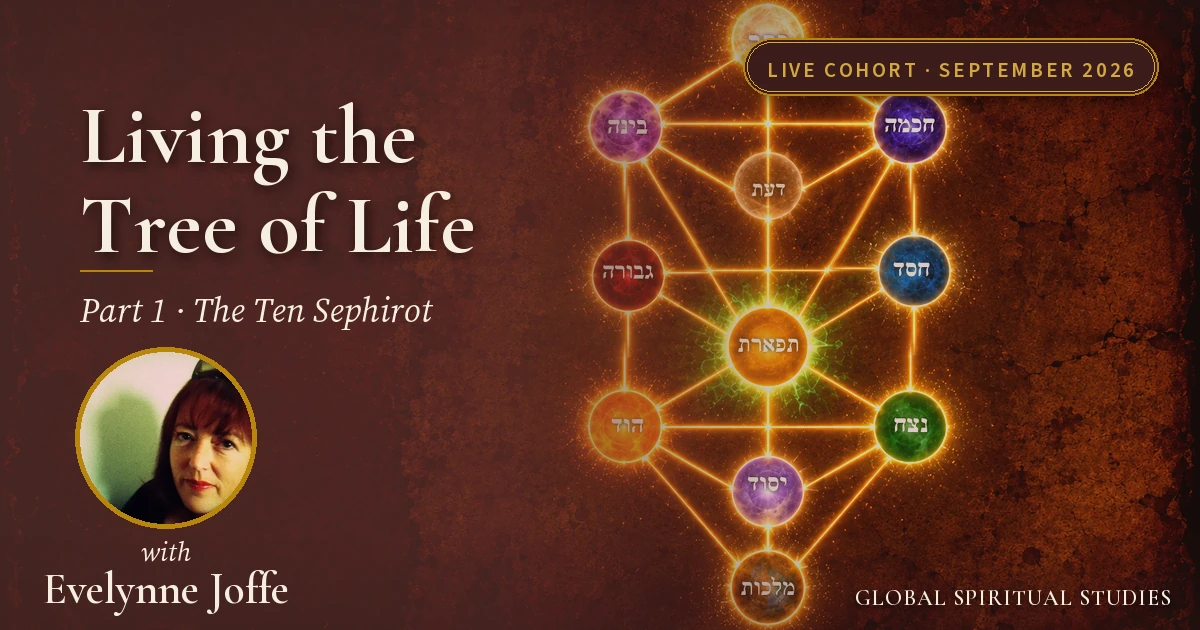
If you would like to study Binah with a teacher rather than on your own, Evelynne Joffe now teaches the whole Tree as a live September 2026 cohort of Living the Tree of Life · The Ten Sephirot · eight weekly classes climbing from Malkuth to Kether, with two live Q&A sessions where you bring your own questions.
Featured Course · Live Cohort
Living the Tree of Life · Part 1: The Ten Sephirot
A live September 2026 cohort · with Evelynne Joffe, Director of the Institute of Esoteric Studies
Evelynne Joffe has spent decades teaching the Tree of Life not as religion but as a living map of a whole human life. In this live cohort she walks you up the Tree one Sephirah at a time · from Malkuth at the ground to Kether at the crown · with two live Q&A sessions where you bring your own questions. No background is needed · only curiosity.
- Eight weekly classes
- Two live Q&As
- Malkuth to Kether
- Five+ hours of video
- Downloadable handouts
- Transcripts & subtitles
- Private cohort forum
- Quiz & certificate of completion
- Lifetime access
What Is Binah?
Binah (Understanding) is the third Sephirah on the Kabbalah Tree of Life, located at the top of the left-hand Pillar of Severity, above the Abyss. It represents form, receptivity, limitation, and the womb of creation · the principle that gives structure to raw force. It corresponds to the planet Saturn.
The Hebrew root of Binah (B-Y-N) means "to distinguish between," "to discern," or "to understand through analysis." Where Chokmah's wisdom is instantaneous, a flash that arrives whole and undifferentiated, Binah's understanding is the process of separating that flash into parts, examining it, giving it structure. Chokmah knows. Binah comprehends.
In the Kabbalistic creation narrative, the Infinite (Ein Sof) first concentrated itself into a single point (Kether), then projected outward as a dynamic force (Chokmah), and then that force needed to be received, contained, and shaped. Binah is the receiving. Without her, the creative impulse would dissipate into nothingness, a spark with no hearth to hold it.
Binah is called Ama (the dark, sterile Mother) in one aspect and Aima (the bright, fertile Mother) in another. As Ama, she is potential before it is activated. As Aima, she is the principle of fertility and generation. Both aspects are present simultaneously. The Great Mother contains both the power to give birth and the stillness that precedes birth.
The divine name is YHVH Elohim, the four-letter name of God combined with the plural noun that denotes divine creative powers. This compound name points to Binah's role as the vessel through which the unnameable becomes the named, the formless becomes the formed.
Binah's planet is Saturn, and this correspondence reveals much about her nature. Saturn is the planet of time, limitation, structure, discipline, and endings. In traditional astrology, Saturn was the outermost known planet, the boundary of the visible universe, the wall at the edge of creation. Binah is precisely that: the boundary that makes creation possible. Without Saturn's rings, there would be no defined space within which anything could exist.
The archangel Tzaphkiel ("the contemplation of God") stands in Binah. The name suggests the deep, patient, receptive gaze of consciousness turned toward the divine, not the ecstatic flash of Chokmah's Raziel, but the sustained attention that allows understanding to develop over time.
Symbolism and Correspondences
| Attribute | Correspondence |
|---|---|
| Number | 3 |
| Hebrew | בינה (Binah) |
| Meaning | Understanding, Discernment |
| Pillar | Pillar of Severity (Left) |
| Divine Name | YHVH Elohim |
| Archangel | Tzaphkiel |
| Angelic Order | Aralim ("Thrones") |
| Planet | Saturn |
| Colour | Black (Queen Scale) |
| Body | Right side of the face |
| Spiritual Experience | The Vision of Sorrow |
| Virtue | Silence |
| Vice | Avarice |
| Tarot | The four Threes · The Queens |
| Qliphah | Satariel (the Concealers) |
Free printable chart: all 10 Sephirot with Hebrew names, pillars, Tarot and planetary correspondences at a glance · see the complete Tree of Life chart.
See the divine name, archangel and angelic order of every Sephirah in the free Kabbalah Archangels chart, and how Binah stands at the head of the Pillar of Severity, one of the Three Pillars of the Tree.
The colour black is not the black of evil or negation. It is the black of the fertile earth, of deep water, of the night sky that contains all stars. Black absorbs all light, just as Binah absorbs Chokmah's radiance and transforms it into structured manifestation. In meditation, Binah's blackness is experienced as depth rather than darkness.
The virtue of Silence is essential to Binah's nature. Understanding requires receptivity, and receptivity requires the willingness to be still and listen. Chokmah speaks. Binah listens. The creative flash arrives in noise and brilliance. Its comprehension arrives in stillness.
The Queens in Tarot belong to Binah as the Heh (Water) of each suit. The Queens are the receiving, nurturing, form-giving principle within their element. They do not initiate (that is the Kings, who belong to Chokmah). They receive, shape, and sustain. The Queen of Cups holds the emotional depth. The Queen of Pentacles cultivates material abundance. The Queen of Swords cuts through confusion with discernment. The Queen of Wands channels creative fire into purposeful action.
Binah on the Tree
Binah occupies the summit of the Pillar of Severity (also called the Pillar of Form). Together with Kether and Chokmah, she forms the Supernal Triad, the three Sephirot that exist above the Abyss. This is a crucial distinction. The Supernals operate at a level of reality that ordinary ego-consciousness cannot directly access. They must be approached indirectly, through meditation, contemplation, and the gradual dissolution of the ego's insistence on being separate.
Four paths connect Binah to other Sephirot:
Path 12 (The Magician) connects Binah to Kether. This is the path of focused will, the capacity to channel undifferentiated unity into specific understanding. Mercury's path between the crown and the mother.
Path 14 (The Empress) connects Binah horizontally to Chokmah. The Empress is the Great Mother herself, and this path represents the primal relationship between force and form, father and mother, seed and womb. It is the most fundamental polarity on the Tree.
Path 17 (The Lovers) connects Binah downward across the Abyss to Tiferet. This path represents the relationship between the Supernal Mother and the heart of the Tree. The Lovers card here describes not romantic love but the reconciliation of opposites, the moment when the soul in Tiferet looks upward and glimpses the understanding that lies beyond the Abyss.
Path 18 (The Chariot) connects Binah downward to Geburah, linking the top and bottom of the Pillar of Severity. The Chariot carries Binah's form-giving discipline into the world of ethical action. Where Binah defines cosmic form, Geburah applies that same principle to moral judgement.
The Psychological Dimension
In Evelynne Joffe's Jungian reading of the Tree, Binah represents the Great Mother archetype at its deepest level, the fundamental feminine principle of the psyche that receives, contains, transforms, and ultimately releases.
Jung identified the Great Mother as one of the most powerful archetypes in the collective unconscious. She appears in mythology as Isis, Demeter, Kali, the Black Madonna, and countless other figures who embody the paradox of creation and destruction held in a single image. She gives life. She also takes it back. She nourishes. She also devours. Both aspects are genuine, and the mature psyche must come to terms with both.
Binah as the deepest expression of the Anima (the feminine archetype within the male psyche) or the feminine Self carries the quality of wisdom that comes through suffering, through enduring, through allowing time to do its work. This is not the quick insight of Chokmah but the slow comprehension that develops through lived experience, the understanding that a mother has of her child's nature, not because she reasoned it out, but because she has watched, waited, and held space for years.
The Vision of Sorrow is psychologically precise. To truly understand anything is to understand that it will end. The person who has integrated Binah's energy lives with this knowledge openly. They do not deny impermanence, and they do not collapse under its weight. They grieve, because grief is the natural response to the beauty of transient things. This is not pessimism. It is the clarity that allows genuine appreciation of what exists now, precisely because it will not exist forever.
When Binah's energy is absent or blocked, the psyche loses its capacity for depth. Everything becomes surface, reaction, impulse, the uncontained flash of Chokmah without the vessel to hold it. Ideas proliferate but nothing takes root. Enthusiasm flares and dies. There is no patience, no staying power, no willingness to endure the slow work of understanding.
The Shadow Side: The Qliphoth of Binah
Binah's Qliphah is Satariel, the Concealers. Where Binah gives form so that the divine can be known, Satariel gives form so rigid that the divine is hidden behind it. The structure that was meant to reveal becomes the structure that obscures.
You encounter Satariel whenever form becomes more important than the life it was meant to contain. The religious institution that has forgotten its spiritual purpose but maintains its rituals with fanatical precision. The intellectual system so elaborate that it prevents direct experience of the reality it claims to describe. The parent so devoted to providing structure that the child has no room for spontaneity or growth.
Satariel is also the energy of stagnation, the refusal to let go of forms that have served their purpose. If Binah is the womb, Satariel is the womb that will not release the child. The result is not protection but suffocation. The vice of Avarice connects directly: the grasping, hoarding impulse that refuses to let anything pass, that clings to form as if form itself were the point.
The remedy is to remember Binah's connection to Chokmah through the Empress path. Form must remain in living relationship with the creative force that animates it. When it loses that connection, it becomes a tomb rather than a womb.
Working with Binah
A Contemplation for Binah
This is not a meditation you rush through. It asks for time and stillness. Choose a moment when you will not be interrupted.
Sit quietly and bring your attention to something in your life that you love deeply: a relationship, a creative work, a place, a practice. Hold it clearly in your mind. Feel the warmth of your connection to it.
Now allow yourself to acknowledge, gently and honestly, that this thing you love will not last forever. Not as a morbid exercise, but as an act of truthful seeing. The relationship will change. The body will age. The creative work will one day be finished or forgotten. This is not wrong. It is the nature of formed things.
Notice what arises. There may be sadness. There may be a deepening of appreciation. There may be a quiet sense of tenderness for the fragility of what you hold dear. This is the Vision of Sorrow. It is not depression. It is the understanding that comes from loving something fully while knowing it is temporary.
Sit with this as long as feels right. When you are ready, return your attention to the present moment and to the gift of what is here now.
Working with Saturn correspondences attunes you to Binah's frequency: spending time with elders, studying history, practising patience, honouring endings and transitions, and engaging with any discipline that requires sustained effort over time. Binah is not found in quick fixes or weekend workshops. She is found in the practice you return to year after year.
Silence is Binah's virtue. Practising deliberate silence, not as self-punishment but as receptivity, opens the channel. Listen more than you speak. Wait longer than feels comfortable before responding. Let understanding arrive in its own time rather than forcing it.
Common Misconceptions
Binah Is "Negative" Because She Is on the Pillar of Severity
The Pillar of Severity is not the pillar of negativity. It is the pillar of form, structure, and necessary limitation. Without Binah, nothing would exist in a way that could be perceived, experienced, or loved. Calling her negative is like calling the banks of a river negative because they confine the water. Without banks, there is no river, only a flood.
The Vision of Sorrow Means Binah Is Depressing
The Vision of Sorrow is not clinical depression or nihilistic despair. It is the poignant, bittersweet recognition that all formed things are impermanent. This awareness does not diminish beauty. It deepens it. The Japanese aesthetic of wabi-sabi, the beauty of impermanence, captures something of Binah's quality. So does the Buddhist teaching on impermanence. What passes is precious precisely because it passes.
The Supernals Are "Better" Than the Lower Sephirot
Students sometimes treat the Supernal Triad as the "advanced level" and the lower Sephirot as preliminary. The Tree does not work as a hierarchy of value. Malkuth is as sacred as Kether. The point of the Tree is the relationship between all ten Sephirot, not the elevation of some over others. The Supernals are above the Abyss, which means they are less accessible to ordinary consciousness, but "less accessible" is not "more important."
Continue Your Study
Eight recorded classes covering all ten Sephirot. Binah is explored through the lens of the Great Mother archetype, Saturn, and the Vision of Sorrow. The foundation for serious Tree of Life study.
A master class tracing the soul's ascent up the Tree from the World to the Fool. See how the Major Arcana paths that connect through Binah shape the journey above the Abyss.
For a printable reference to all ten Sephirot and twenty-two paths, download our free Kabbalah Tree of Life path notes PDF.
Ready to take this inward? Learn to work with Binah in meditation as part of a complete Tree of Life practice.
To go further from Binah:
- the 22 paths and their Tarot correspondences · every path that touches Binah, with its Hebrew letter and Major Arcana card
- Hod · the foot of the Pillar of Severity, the pillar Binah heads
- Da’ath, the hidden Sephirah · the Abyss that separates Binah from the Sephirot below
- the planetary and zodiacal correspondences · Binah’s Saturn, and the planets of the other Sephirot
- Living the Tree of Life · Part 2: The Paths · the companion course on the twenty-two paths
Binah does not ask you to be cheerful about impermanence. She asks you to be honest about it. And in that honesty, something unexpected arises: not despair, but a tenderness for all things that exist within time. That tenderness is Understanding.
For the full range of teachings, see our Kabbalah course library.
Sources & Tradition
The material presented here for Binah draws on the foundational texts and teachers of the Tree of Life · the Sefer Yetzirah (Book of Formation), the Zohar, the Sephirotic attributions codified by the Hermetic Order of the Golden Dawn, and Dion Fortune’s The Mystical Qabalah (1935). The Great Mother imagery and the Vision of Sorrow follow the Golden Dawn attributions as transmitted by Fortune. The divine name, archangel and angelic order given in the table above follow our own Kabbalah Archangels chart, which sets out the Golden Dawn and Liber 777 attributions and notes where the tradition is divided. The living, practice-based reading of Binah reflects Evelynne Joffe’s Living the Tree of Life courses taught at Global Spiritual Studies.
Frequently Asked Questions
What is Binah in Kabbalah?
Binah is the third Sephirah on the Kabbalah Tree of Life. Its name means "understanding" or "discernment" in Hebrew. It represents the form-giving, receptive intelligence that shapes the raw creative force of Chokmah into defined structures. Known as the Great Mother, Binah sits at the top of the Pillar of Severity in the Supernal Triad, above the Abyss. Its planet is Saturn, its colour is black, and its divine name is YHVH Elohim.
What is the Vision of Sorrow?
The Vision of Sorrow is the spiritual experience attributed to Binah on the Tree of Life. It is the clear-eyed recognition that all formed things are impermanent, that everything brought into existence through Binah's form-giving power will eventually pass away. This is not depression or nihilism but a profound awareness that deepens appreciation for the beauty of transient existence. It parallels the Buddhist teaching on impermanence and the Japanese aesthetic of wabi-sabi.
What is the difference between Binah and Chokmah?
Chokmah (Wisdom) and Binah (Understanding) form the primal polarity of the Supernal Triad. Chokmah is the initial creative flash, the dynamic outpouring of energy, the seed. Binah is the receiving, containing, and structuring intelligence that gives that flash form, the womb. Chokmah is active and expansive. Binah is receptive and defining. Together they produce all subsequent emanation on the Tree. In Tarot, the Kings belong to Chokmah and the Queens to Binah, reflecting this fundamental creative polarity.
What does Binah mean?
Binah (בִּינָה) is a Hebrew word meaning "understanding" or "discernment." On the Kabbalah Tree of Life it names the third Sephirah · the receptive, form-giving intelligence that takes the raw creative spark of Chokmah and shapes it into defined structure. Where Chokmah is the flash of wisdom, Binah is the understanding that contemplates that flash and gives it form.
Where is Binah on the Tree of Life?
Binah is the third Sephirah, sitting at the top of the Pillar of Severity on the left side of the Kabbalah Tree of Life. Together with Kether (Crown) and Chokmah (Wisdom) it forms the Supernal Triad above the Abyss. It is the feminine, receptive pole that balances the active, masculine Chokmah across the Tree.
What is the meaning of Understanding (Binah)?
Understanding, as Binah, is not intellectual analysis but the deep, contemplative intelligence that receives the seed of Wisdom (Chokmah) and gives it form. It is the Great Mother · the womb that shapes raw creative force into structure. To "understand" in Binah's sense is to hold, contain, and give boundaries to what Wisdom flashes forth, making manifestation possible.
Featured Course · Live Cohort
Living the Tree of Life · Part 1: The Ten Sephirot
A live September 2026 cohort · with Evelynne Joffe, Director of the Institute of Esoteric Studies
Evelynne Joffe has spent decades teaching the Tree of Life not as religion but as a living map of a whole human life. In this live cohort she walks you up the Tree one Sephirah at a time · from Malkuth at the ground to Kether at the crown · with two live Q&A sessions where you bring your own questions. No background is needed · only curiosity.
- Eight weekly classes
- Two live Q&As
- Malkuth to Kether
- Five+ hours of video
- Downloadable handouts
- Transcripts & subtitles
- Private cohort forum
- Quiz & certificate of completion
- Lifetime access