Chesed · Mercy
The Fourth Sephirah · Lovingkindness, Expansion, and the Benevolent Ruler
Below the Abyss, on the right side of the Kabbalah Tree of Life, there is a Sephirah that gives without asking anything in return. It is the first emanation that the human mind can grasp directly. It has the expansiveness of open sky, the warmth of a fire lit for strangers, the generosity of a ruler who does not count the cost. Its Hebrew name is Chesed, and it means mercy.
Watch Evelynne Joffe on Chesed
Chesed (חסד) is the fourth Sephirah on the Tree. It is the highest Sephirah on the Pillar of Mercy below the Abyss, the first station on that column the human mind can reach, and it carries the quality of boundless, unconditional love. In the Kabbalistic tradition, this is the energy that sustains the world. Without Chesed, there would be no creation at all, because creation itself is an act of overflowing generosity.
But Chesed is also the Sephirah that teaches one of the Tree's most important lessons: that love without limit is not always love. Expansion without form collapses into chaos. The benevolent ruler who cannot say no becomes a tyrant of kindness. This is why Chesed never stands alone. It exists in permanent creative tension with its opposite, Geburah, the Sephirah of severity and discipline.
If you would like to study Chesed with a teacher rather than on your own, Evelynne Joffe teaches the whole Tree in Living the Tree of Life · The Ten Sephirot · eight self-paced classes climbing from Malkuth to Kether, with both of her live Q&A sessions included as recordings.

Featured Program · The Whole Tree
The Complete Tree of Life
Sephirot · Paths · Tarot on the Tree · with Evelynne Joffe
Three courses in one program: Part 1’s eight classes on the Ten Sephirot with their two recorded Q&As, Part 2’s twenty classes on the twenty-two Paths with the 2026 Cohort’s two live Q&As, and Tarot on the Tree of Life. You climb in order, the Sephirot first and then the Paths that join them.
- Three courses
- 29 classes
- Four Q&As (two recorded, two live)
- Three certificates
- Handouts & transcripts
- Lifetime access
What Is Chesed?
Chesed (Mercy) is the fourth Sephirah on the Kabbalah Tree of Life, the highest Sephirah on the right-hand Pillar of Mercy below the Abyss. It represents loving-kindness, abundance, expansive generosity, and the impulse to give without limit. It corresponds to the planet Jupiter.
The Hebrew word chesed appears throughout the Torah and is one of the most important terms in Jewish ethical thought. It is usually translated as "lovingkindness," "mercy," or "steadfast love," but none of these single words captures the full meaning. Chesed is the quality of giving that flows from abundance rather than obligation. It is the love that arrives before you have earned it and continues after you have failed to deserve it.
On the Tree of Life, Chesed occupies a pivotal position. It is the first Sephirah below the Abyss on the descending path of emanation, which means it is the point where the abstract energies of the Supernal Triad (Kether, Chokmah, Binah) first become something that ordinary consciousness can engage with. The Supernals are beyond direct comprehension. Chesed is where the divine energy arrives in a form we can receive.
This is sometimes described as the moment the lightning flash of creation, having crossed the Abyss, first touches the world of human experience. And the quality of that first touch is pure mercy. The universe begins its manifest life not with law or structure, but with open-handed love.
Chesed is also called Gedulah, meaning "greatness" or "magnificence." This alternate name points to the royal quality of this Sephirah. The traditional image is the benevolent king seated on a throne, sceptre in hand, dispensing justice tempered by compassion. The ruler does not govern through fear but through the sheer abundance of what they have to give. Their authority comes from generosity, not force.
The divine name associated with Chesed is El, one of the oldest names for God in the Semitic languages, carrying the sense of might and power directed toward benevolence. When you encounter El in a divine name compound (El Shaddai, El Elyon), you are encountering the Chesed principle: power expressed as protection and provision.
Chesed's planet is Jupiter, the largest body in the solar system, and this correspondence is precise. Jupiter in astrological tradition governs expansion, abundance, philosophy, and the impulse to grow beyond current boundaries. Jupiter gives. Jupiter enlarges. Jupiter blesses. And Jupiter, unchecked, inflates.
Symbolism and Correspondences
| Attribute | Correspondence |
|---|---|
| Number | 4 |
| Hebrew | חסד (Chesed) · also Gedulah (Greatness) |
| Meaning | Mercy, Lovingkindness |
| Pillar | Pillar of Mercy (Right) |
| Divine Name | El |
| Archangel | Tzadkiel |
| Angelic Order | Chashmalim ("Brilliant / Shining Ones") |
| Planet | Jupiter |
| Colour | Blue (Queen Scale) |
| Body | Left arm |
| Spiritual Experience | The Vision of Love |
| Virtue | Obedience |
| Vice | Bigotry, Hypocrisy, Gluttony, Tyranny |
| Tarot | The four Fours |
| Qliphah | Gamchicoth (the Devourers) |
Free printable chart: all 10 Sephirot with Hebrew names, pillars, Tarot and planetary correspondences at a glance · see the complete Tree of Life chart.
See the divine name, archangel and angelic order of every Sephirah in the free Kabbalah Archangels chart, and how Chesed stands on the Pillar of Mercy, one of the Three Pillars of the Tree.
The colour blue is significant. It is the colour of open sky, of deep water, of distance and possibility. In liturgical traditions, blue represents heaven. Chesed's blue is the colour of a generosity so vast it resembles sky.
The left arm correspondence places Chesed in the body as the arm that embraces. In the Kabbalistic image of Adam Kadmon (the primordial human), the right arm is Geburah (the arm that disciplines), while the left arm is Chesed (the arm that holds close). Together, the two arms of God hold creation in the balance between mercy and judgement.
The Vision of Love is the spiritual experience attributed to Chesed. This is not romantic love or sentimental attachment. It is the direct perception of the love that sustains all existence, the recognition that the universe is fundamentally generous, that being itself is a gift.
Chesed on the Tree
Chesed is the highest Sephirah on the Pillar of Mercy below the Abyss, on the right side of the Tree, with Chokmah heading the pillar above it. It is the first Sephirah of the Ethical Triad (Chesed, Geburah, Tiferet), the triad that governs moral and ethical experience. Where the Supernal Triad deals with forces beyond ordinary comprehension, the Ethical Triad is the realm of conscience, values, and character.
Four paths connect Chesed to other Sephirot:
Path 16 (The Hierophant) connects Chesed upward to Chokmah. This is the path of transmitted wisdom, the teaching lineage through which the creative flash of Chokmah enters the world of human institutions. The Hierophant bridges raw inspiration and organised tradition.
Path 19 (Strength) connects Chesed horizontally to Geburah. This is one of the most important paths on the Tree: the direct relationship between mercy and severity. Strength here is not brute force but the courage to hold both tenderness and discipline simultaneously.
Path 20 (The Hermit) connects Chesed downward to Tiferet. The Hermit carries Chesed's expansive love into the balanced centre of the Tree. This path teaches that true mercy must pass through solitude and self-examination before it can become the grounded compassion of Tiferet.
Path 21 (The Wheel of Fortune) connects Chesed downward to Netzach. Jupiter's own card links two Sephirot on the Pillar of Mercy. The Wheel reminds us that Chesed's abundance is not static; it cycles, waxes and wanes, expands and contracts. Fortune turns.
The Psychological Dimension
In Evelynne Joffe's Jungian approach to the Tree, Chesed corresponds to the benevolent Father archetype, the positive face of authority and provision. This is the inner figure who protects, provides, blesses, and affirms. It is the voice that says "you are enough" and means it without condition.
When Chesed is well-integrated in the psyche, a person possesses genuine generosity. They give freely because they experience themselves as having enough. Their sense of abundance is not performative. It arises from an authentic relationship with their own inner resources. They can be magnanimous in disagreement, generous in success, and compassionate in the face of failure.
When Chesed is overactive without Geburah's balancing discipline, the result is not kindness but its distortion: enabling, people-pleasing, codependency, or the subtle tyranny of someone who gives so much that they cannot tolerate receiving. The parent who never sets boundaries. The leader who agrees with everyone. The philanthropist who uses generosity as a mechanism of control.
Jung's concept of inflation maps precisely onto Chesed's shadow. Inflation occurs when the ego identifies with an archetype, mistaking the archetypal energy for a personal quality. A person inflated by Chesed believes they are infinitely generous, infinitely capable of giving, infinitely good. They lose the capacity to recognise their own limitations. The remedy is always Geburah: the willingness to be bounded, to say no, to accept that mercy without judgement is not mercy at all but indulgence.
The four Fours in Tarot carry Chesed's energy into the four elements. The Four of Wands (completion, celebration), the Four of Cups (contemplative withdrawal), the Four of Swords (rest and recovery), and the Four of Pentacles (security, holding). Notice that even in the Fours, the theme of structure appears. Four is the number of stability, of the square, of the foundation. Chesed's mercy is not formless. It builds.
The Shadow Side: The Qliphoth of Chesed
Every Sephirah has its shadow, its distorted or unbalanced expression, called the Qliphah (plural: Qliphoth). For Chesed, this is Gamchicoth, the Devourers.
The name tells you everything you need to know. When love becomes devouring, when generosity becomes smothering, when mercy becomes an appetite that consumes the freedom of those it claims to serve, you have entered the territory of Gamchicoth. This is the parent who loves their child so intensely that the child cannot breathe. The partner whose affection is indistinguishable from possession. The institution that provides everything and demands your autonomy in return.
Gamchicoth also manifests as spiritual bypass, using the language of love and acceptance to avoid the difficult, painful, necessary work of confrontation. If Chesed is the arm that embraces, Gamchicoth is the arm that will not let go.
The remedy is straightforward in theory and difficult in practice: cultivate Geburah. Learn to set limits. Accept that genuine love includes the willingness to withhold, to say no, to allow others the dignity of their own struggle.
Working with Chesed
A Practice for Chesed
Find a quiet place and sit comfortably. Close your eyes and bring your attention to the area of your heart. Imagine a deep, warm blue light filling your chest, the blue of a clear sky just after sunrise.
Now bring to mind someone you find it easy to love. Notice the quality of the feeling: its warmth, its openness, the sense of wanting good things for this person without needing anything in return. Let the feeling expand. Let it fill your whole body.
Now bring to mind someone neutral, a stranger you passed on the street, a cashier you barely noticed. Extend the same quality of warmth toward them. Not as an effort of will, but as an expansion of what is already present.
Finally, bring to mind someone difficult. Not your worst enemy, but someone who irritates or frustrates you. Can you find, somewhere in the blue light, a thread of genuine goodwill toward this person? Not approval. Not agreement. Just the acknowledgement that they, too, are a vessel for the same life that flows through you.
This is Chesed: love that does not depend on worthiness. Sit with whatever arises. There is no requirement to force anything.
Beyond meditation, Chesed can be cultivated through concrete acts of generosity. In Jewish ethical teaching, chesed is one of the three pillars on which the world stands. The tradition distinguishes between charity (tzedakah, giving what is owed) and chesed (giving beyond what is owed, from the overflow of the heart). Both matter, but chesed is the higher practice because it arises from abundance rather than obligation.
Working with Jupiter correspondences can also attune you to Chesed's frequency: wearing blue, spending time in expansive natural landscapes, studying philosophy, and practising hospitality.
Common Misconceptions
Chesed Is Just "Being Nice"
Chesed is not niceness. Niceness is a social performance. Chesed is a cosmic principle, the force that sustains creation through unconditional giving. It requires genuine inner abundance, not the suppression of difficulty behind a pleasant exterior. A person operating from true Chesed can be fierce, direct, and even confrontational when the situation requires it, because their love is not contingent on being liked.
Mercy Means Never Setting Boundaries
This is precisely the confusion that the Chesed-Geburah polarity exists to resolve. Mercy without severity is not compassion. It is collapse. The Kabbalistic teaching is insistent on this point: Chesed and Geburah are a pair, and neither can function properly without the other. A boundary set in love is still love. A firm "no" spoken from a place of genuine care is an expression of mercy, not its negation.
Chesed Is "Higher" Than Geburah
Students sometimes assume that because Chesed is on the Pillar of Mercy, it is morally superior to Geburah on the Pillar of Severity. The Tree does not work this way. The two pillars are complementary forces, not a hierarchy. Neither mercy nor severity alone produces a just or compassionate world. Only the balance between them, held in the heart of Tiferet, achieves that.
Continue Your Study
Eight recorded classes covering all ten Sephirot. Chesed is explored in depth alongside its relationship to Geburah and the rest of the Ethical Triad. The foundation for serious Tree of Life study.
Twenty classes covering all twenty-two paths, including the four paths that connect through Chesed. Hebrew letters, Tarot correspondences, and practical guidance for each transition.
For a printable reference to all ten Sephirot and twenty-two paths, download our free Kabbalah Tree of Life path notes PDF.
Ready to take this inward? Learn to work with Chesed in meditation as part of a complete Tree of Life practice.
To go further from Chesed:
- the 22 paths and their Tarot correspondences · every path that touches Chesed, with its Hebrew letter and Major Arcana card
- Netzach · the third station of the Pillar of Mercy, below Chesed
- the planetary and zodiacal correspondences · Chesed’s Jupiter, and the planets of the other Sephirot
- the Liber 777 correspondences · Chesed’s four colour scales, stone, perfume and Egyptian god
Chesed is the arm that holds the world. But an arm that cannot release is not embracing. It is trapping. Learn to give without grasping, to love without possessing, and to offer mercy without abandoning the harder work of truth. That is the teaching of the fourth Sephirah.
Looking for more? Browse the complete Kabbalah course catalogue at Global Spiritual Studies.
Sources & Tradition
The material presented here for Chesed draws on the foundational texts and teachers of the Tree of Life · the Sefer Yetzirah (Book of Formation), the Zohar, the Sephirotic attributions codified by the Hermetic Order of the Golden Dawn, and Dion Fortune’s The Mystical Qabalah (1935). The balancing of Chesed against Geburah · mercy held in tension with severity · belongs to the Zohar’s account of the divine attributes. The divine name, archangel and angelic order given in the table above follow our own Kabbalah Archangels chart, which sets out the Golden Dawn and Liber 777 attributions and notes where the tradition is divided. The living, practice-based reading of Chesed reflects Evelynne Joffe’s Living the Tree of Life courses taught at Global Spiritual Studies.
Frequently Asked Questions
What is Chesed in Kabbalah?
Chesed is the fourth Sephirah on the Kabbalah Tree of Life. Its name means "mercy" or "lovingkindness" in Hebrew. It represents the principle of unconditional, expansive love and generosity. Positioned on the Pillar of Mercy, Chesed is the first Sephirah below the Abyss, making it the highest emanation directly accessible to ordinary human consciousness. Its planet is Jupiter, its colour is blue, and its divine name is El.
What is the relationship between Chesed and Geburah?
Chesed (Mercy) and Geburah (Severity) form one of the Tree of Life's essential polarities. They sit opposite each other in the Ethical Triad, connected by Path 19 (the Strength card). Chesed represents expansive, unconditional giving, while Geburah represents necessary limitation and discipline. Neither functions properly alone. Chesed without Geburah becomes smothering or indulgent. Geburah without Chesed becomes harsh and destructive. Their balance resolves in Tiferet (Beauty) at the centre of the Tree.
How do I work with Chesed in daily life?
Working with Chesed involves cultivating genuine generosity, not as a social performance but as an inner quality. Practical approaches include lovingkindness meditation, acts of hospitality and charity, studying Jupiter correspondences, and examining where in your life you give from obligation versus abundance. The Jewish ethical tradition emphasises chesed (giving beyond what is required) as a daily spiritual practice. Equally important is noticing where your generosity becomes controlling or boundary-less, which signals the need for Geburah's balancing discipline.
Featured Course · 2026 Cohort
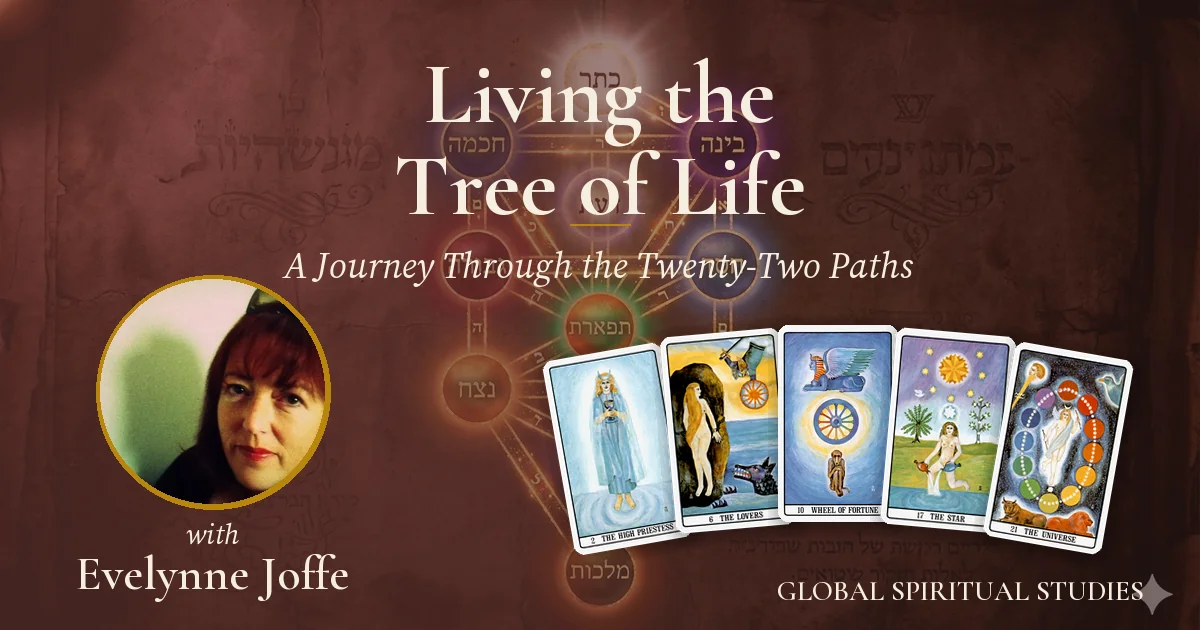
Living the Tree of Life · Part 2: The Paths
The 2026 Cohort · with Evelynne Joffe, Director of the Institute of Esoteric Studies
Across twenty classes Evelynne climbs all twenty-two Paths of the Tree, from Path 32 to Path 11, opening each one through its Hebrew letter and its Tarot card. The 2026 Cohort adds two live Q&A sessions with her on Zoom in Q1 2027, exact dates to follow, and both are recorded and added to the course. Part 1 or an equivalent grounding in the Sephirot is recommended before you begin.
- Twenty classes
- Two live Q&As
- Path 32 to Path 11
- 11.5+ hours of video
- Handouts & transcripts
- Subtitles
- Private course forum
- Quiz & certificate
- Lifetime access

About this article
Based on the teachings of Evelynne Joffe
Kabbalist, Tarot Counsellor & Dream Therapist · Director, Institute of Esoteric Studies
This article was written by the Global Spiritual Studies editorial team, drawing on Evelynne Joffe's Kabbalah teaching for Global Spiritual Studies. Evelynne directs the Institute of Esoteric Studies in Melbourne, Australia, and has spent more than thirty years teaching students to read the Tree of Life as a practical map for self-realization. In 1992 she co-founded the Tarot Guild of Australia.
Study this with her
Living the Tree of Life · Part 1: The Ten Sephirot
Living the Tree of Life · Part 2: The Twenty-Two Paths
The Complete Tree of Life
More from Evelynne Joffe →