Path of Vav · The Hierophant
Path 16 · Chokmah to Chesed · The Nail That Fastens
Path 16, the Path of Vav, is the path of tradition descending. It connects Chokmah (Wisdom) to Chesed (Mercy) on the Pillar of Mercy and corresponds to The Hierophant, card V of the Major Arcana. Its zodiac sign is Taurus, the steady ground in which a teaching takes root and continues to feed those who come after the first teacher has gone.
Watch Evelynne Joffe teach this path
Vav is the path of the nail. The Hebrew letter Vav literally means "hook" or "nail," and the work of a nail is to fasten one thing to another so that what was given can be kept. The Hierophant is the figure who keeps. Whatever the religion or wisdom tradition, the Hierophant is the one who refuses to let the original gift dissolve back into private inspiration. The Path of Vav teaches that lineage is not a constraint on revelation. It is what allows revelation to last.
If some of the terms in this guide are new to you, let them be new. We will walk slowly through each one, not as a test of knowledge but as a way of listening to the symbol more deeply.
A note on tradition: Kabbalah has deep Jewish mystical roots reaching back more than two thousand years. This guide focuses on the Western Qabalah and Tarot correspondences that developed later through the Hermetic tradition and the Golden Dawn. The two streams overlap and inform each other, but they are not identical. Wherever a teaching is specific to one tradition, we will name which one.
Featured Course · 2026 Cohort
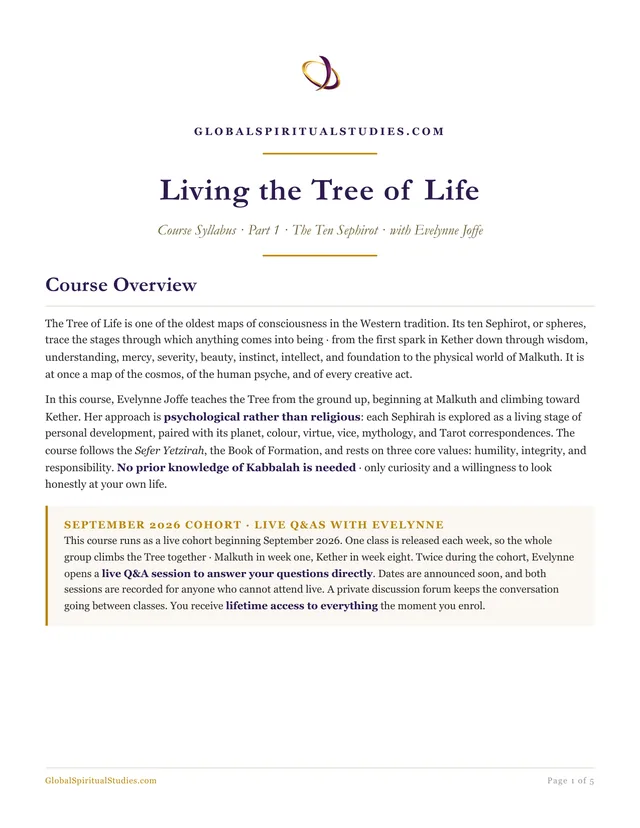
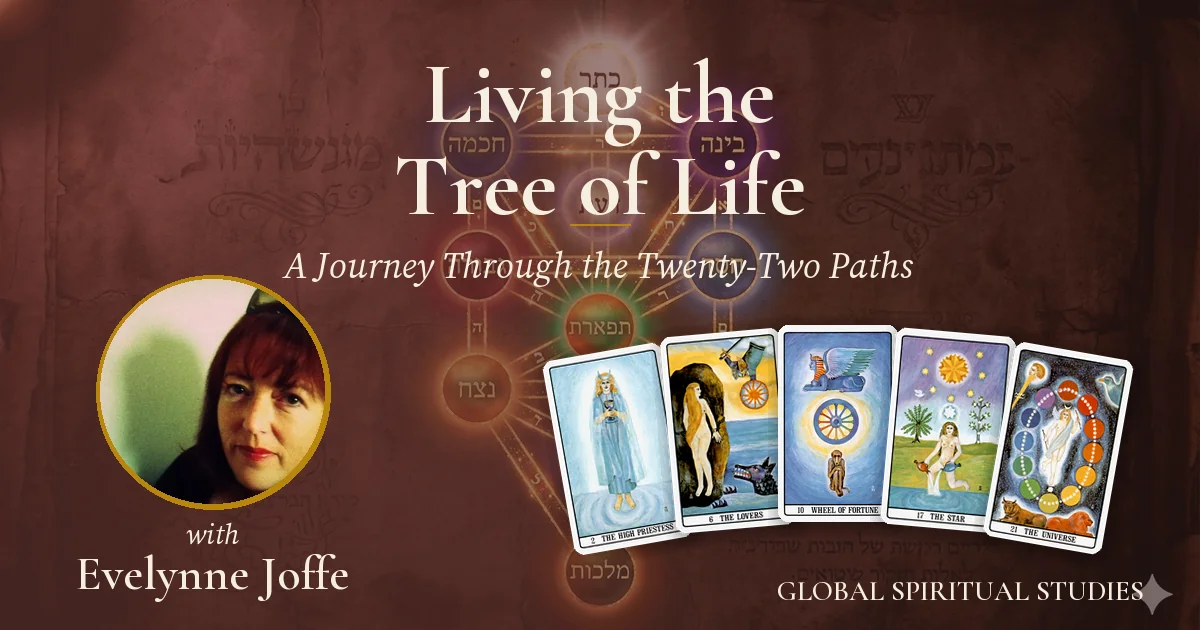
Living the Tree of Life · Part 2: The Paths
The 2026 Cohort · with Evelynne Joffe, Director of the Institute of Esoteric Studies
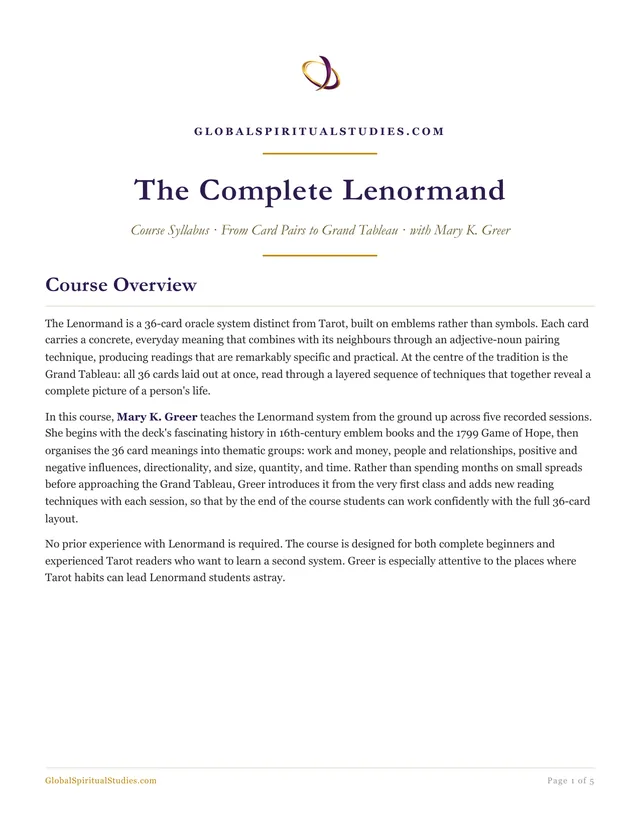
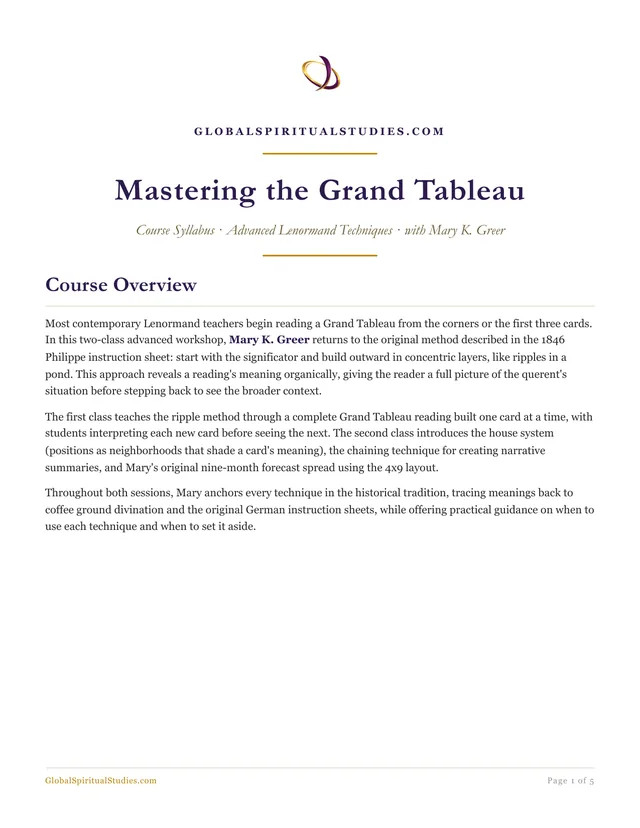
Across twenty classes Evelynne climbs all twenty-two Paths of the Tree, from Path 32 to Path 11, opening each one through its Hebrew letter and its Tarot card. The 2026 Cohort adds two live Q&A sessions with her on Zoom in Q1 2027, exact dates to follow, and both are recorded and added to the course. Part 1 or an equivalent grounding in the Sephirot is recommended before you begin.
- Twenty classes
- Two live Q&As
- Path 32 to Path 11
- 11.5+ hours of video
- Handouts & transcripts
- Subtitles
- Private course forum
- Quiz & certificate
- Lifetime access
What Is the Path of Vav?
The Path of Vav connects the second and fourth Sephiroth on the Tree of Life. Chokmah (Wisdom) is the first flash of creative insight, the divine masculine principle at the top of the Pillar of Mercy. Chesed (Mercy, also called Gedulah, "Greatness") is the divine principle of expansion and unconditional giving, sitting one Sephirah below on the same pillar. The Path of Vav is the descent of original wisdom into the form that can be received and lived by ordinary people.
The Sefer Yetzirah calls this path the Eternal Intelligence. The translation is precise. What Vav carries does not lose freshness over time, because it is not built from any particular moment's understanding. It is built from the structural relationship between insight and the form that holds it. A scripture, a ritual, a teaching lineage, a properly cared-for tradition: each is a vessel that the Path of Vav has consecrated.
In the descending direction, Path 16 is how the wordless wisdom of Chokmah becomes the established teaching of Chesed: the wisdom that can be passed down, embodied in custom and law, made available to a community across generations. In the ascending direction, it is the path the practitioner walks when they trace a tradition back to its source: the teaching back to the teacher, the teacher back to the original encounter, the original encounter back to the silence of Chokmah.
Vav is the only Hebrew letter whose name (vav) names its own function. The shape of the letter is a vertical line, like a nail driven through the page, and the meaning of the word is the function of that shape: to fasten, to hold, to keep two things in relationship. On a path between Chokmah and Chesed, this is exactly the work being done.
Correspondences at a Glance
| Attribute | Correspondence |
|---|---|
| Path Number | 16 |
| Hebrew Letter | Vav (ו) |
| Letter Type | Simple Letter (one of twelve) |
| Letter Meaning | Nail; hook; the fastener |
| Numerical Value | 6 |
| Tarot Card | V · The Hierophant |
| Astrological Sign | Taurus (♉) |
| Element of the Sign | Earth (fixed) |
| Sephiroth Connected | Chokmah (2) ↔ Chesed (4) |
| Sefer Yetzirah Title | Eternal Intelligence |
| Pillar | Pillar of Mercy (vertical descent on the right) |
| Body Correspondence | Neck and throat (Taurus); shoulders |
| Colour (Queen Scale) | Deep indigo or red-orange |
The Hebrew Letter Vav
Vav (ו) is the sixth letter of the Hebrew alphabet and one of the twelve Simple Letters. The Simple Letters in Kabbalistic tradition correspond to the twelve signs of the zodiac and form the backbone of the lower path system on the Tree of Life. Vav is among the most structurally important: numerically equal to 6, it is the conjunctive letter in Hebrew, the letter that, when prefixed to a word, means "and."
The pictographic origin of Vav is a nail or tent peg. Both are objects whose entire purpose is to hold two things together. A nail joins two boards. A tent peg fastens cloth to ground so that what is fluttering in the wind becomes a shelter that keeps the rain out. The Path of Vav teaches that fastening is itself a sacred act: the moment when something becomes durable enough to be inherited.
Vav appears in the Hebrew word vavim (the hooks of the Tabernacle, mentioned repeatedly in the book of Exodus where the curtains of the dwelling place of God are joined together by them) and is the second letter of the Tetragrammaton (YHVH), where it represents the world of Yetzirah, the realm of formation in which divine archetypes first take specific structure.
To meditate on Vav is to feel the moment when something loose in your life finds its anchor: the relationship that becomes a marriage, the practice that becomes a discipline, the insight that becomes a way of life.
The Hierophant: Tarot Correspondence
The Hierophant is one of the most culturally loaded cards in the Major Arcana. In the Rider-Waite-Smith deck, a robed figure sits between two pillars, wearing a triple crown and holding a triple cross. Two tonsured monks kneel before him. Behind him hang the keys of the kingdom, crossed. He raises his right hand in a gesture of blessing that is also a teaching gesture: two fingers extended, two fingers curled, joining heaven and earth.
The Golden Dawn assigned The Hierophant to the Path of Vav. The match is dense with structural meaning:
- The two pillars behind the Hierophant are the same two pillars (Mercy and Severity) that frame the Tree of Life. The Hierophant sits on the Middle Pillar, between them, in a posture of integration.
- The two kneeling figures are not merely worshippers; they are students, the next generation of the tradition. The Hierophant teaches them so that what was received from above can continue downward without distortion.
- The crossed keys are the keys to a tradition: one for the outer teaching that anyone can learn, and one for the inner teaching that requires preparation. Vav is the path that joins the two.
- The triple crown represents the three worlds (or three pillars, depending on the tradition) brought into a single point of authority. The Hierophant claims no personal sovereignty; he wears the crown of the position, not of his own person.
A.E. Waite, in The Pictorial Key to the Tarot, was characteristically reserved about The Hierophant, calling him "the ruling power of external religion." Dion Fortune, in The Mystical Qabalah, was more generous: "The Hierophant is the principle of teaching itself, the impulse by which one generation gives to the next what cannot be invented anew each time." Crowley, less reverent toward institutional religion, renamed the card the same in his Thoth deck but reframed the figure as the bull-headed initiator of a new aeon.
Whichever framing you prefer, the Path of Vav teaches that revelation alone is not enough. Without the Hierophant's careful work of preserving and transmitting, every generation would have to start over from scratch, and most would never reach the original gift.
Taurus: The Astrological Correspondence
The astrological correspondence of Vav is Taurus, the second sign of the zodiac. Taurus is a fixed earth sign, ruled by Venus, and it carries qualities that the Path of Vav inherits directly: stability, patience, sensual presence in the body, the capacity to hold form against the pressure of change. The bull, Taurus's symbol, is famously slow to move and almost impossible to redirect once moving.
This is the temperament of the Hierophant as well. A teaching tradition cannot afford to follow every fashion. It has to be heavier than the moment, slow enough to outlast the enthusiasms that pass through any given decade. The Path of Vav is the slow, patient, body-centred fixity that allows wisdom to last.
In the body, Taurus governs the neck and throat. The throat is the seat of the voice, and so the Hierophant's domain: the speaking of teaching aloud, the chanted Torah portion, the spoken vow. To work with the Path of Vav in the body is to bring attention to the throat, to feel the moment when sound becomes word and word becomes a gift that someone else can receive.
Chokmah to Chesed: What This Path Connects
Path 16 joins the second and fourth Sephiroth: Chokmah and Chesed. Both are on the Pillar of Mercy (the right-hand side of the Tree), and both are concerned with expansive, giving energies, but at different levels of refinement.
Chokmah is the first creative flash, the original masculine impulse, the divine word before it has any specific content. Its divine name is Yah, its archangel Raziel, its colour grey. Chokmah is wisdom that has not yet been articulated; it is the seed-state of all teaching.
Chesed is the divine principle of expansion: unconditional generosity, mercy without limit, the love that gives without first calculating whether the receiver can repay. Its divine name is El, its archangel Tzadkiel, its planet Jupiter, its colour blue. Chesed is also called Gedulah, "Greatness," because what flows through it is so abundant that it requires the discipline of Geburah on the opposite pillar to keep it from dissolving form altogether.
The Path of Vav carries the energy from one to the other. In the descending direction, the original wordless wisdom of Chokmah is fastened into a teachable, transmissible form by passage through Vav, arriving in Chesed as a tradition: a body of practice and instruction that can be inherited and shared. In the ascending direction, the practitioner who has been formed by a tradition follows the path back to its source, finding behind every received teaching the original silence from which it came.
Geometrically, Vav is the upper vertical path on the Pillar of Mercy. It descends straight down from Chokmah to Chesed, with no horizontal component. In doing so it crosses the Abyss, the gulf between the three Supernal Sephiroth and the seven lower ones · Vav is one of five paths that make that crossing, alongside Gimel, Heh, Zayin and Cheth. This makes it a path of pure transmission, not relationship: what passes through Vav is given, not negotiated.
Pathworking and Meditation
Pathworking is the meditative practice of imaginatively travelling a path on the Tree of Life. The Path of Vav is unusual among pathworking subjects because much of its work happens in the texture of daily life rather than in formal sit-down meditation. To walk Vav is to take seriously the lineages and traditions that have shaped you, and to ask which of them are worth fastening yourself to more deeply.
An Exercise · Sitting with Vav
Sit comfortably with your spine upright. Place a Tarot card of The Hierophant in front of you, or simply visualise the Hebrew letter Vav (ו) as a single vertical line of light running from the crown of your head down through your throat.
Bring your attention to your throat. Notice the fine sensation of breath passing through it. Feel the place where word becomes sound becomes gift.
Now bring to mind a teacher, living or dead, whose teaching has shaped you. It does not have to be a religious teacher. A grandmother who taught you to cook, a coach, a writer whose books you keep. Hold them in attention.
Ask: What from this person is asking to be passed on through me? What did they fasten that I am now responsible for keeping? Wait. Do not work for an answer. The Path of Vav reveals slowly, in the body, over days. Notice what arises. After ten or fifteen minutes, return to ordinary attention.
Practitioners working in the Golden Dawn tradition often pair this meditation with the colour red-orange, the King Scale colour of Vav associated with Taurus, and with the divine name El (associated with Chesed) vibrated at the throat. Evelynne Joffe's Living the Tree of Life: The Paths course at Global Spiritual Studies includes guided audio for a longer Vav pathworking that engages the practitioner's actual lineage history rather than working only with abstract symbols.
The Hierophant in a Tarot Reading
When The Hierophant appears in a Tarot reading, the path of Vav is being invoked in the querent's life. The card asks: What tradition, lineage, or established structure is asking you to step into it more fully? Or: which one have you outgrown?
The Hierophant carries both possibilities. It can indicate the moment when a person finds their teacher, joins their community, makes their formal commitment. It can also indicate the moment when an inherited structure has become a cage, and the work is to leave it (often in favour of a different lineage that fits more truly). In context, the card tends to indicate:
- Initiation, formal study, or apprenticeship. The querent is being called into a structured practice with a teacher, a curriculum, or a community.
- The role of mentor or teacher for the querent themselves. They are being asked to pass on what they have received.
- An established institution playing an important role in the question: a marriage, a profession, a religion, a school. The card asks the querent to consider their relationship to the institution rather than its content.
- Reversed, The Hierophant can indicate the question of breaking with tradition: the moment when the querent must leave a structure that has stopped giving, or refuse to fasten themselves to a lineage that does not fit their actual life.
Read alongside its Kabbalistic correspondence, The Hierophant reminds the querent that no individual reaches Chokmah alone. Wisdom comes through the patience of the Path of Vav, through being held in a relationship long enough for what was given at the source to settle in the body of the receiver.
Common Misconceptions
"The Hierophant means religious authority and is therefore a card of conformity." The Hierophant is the principle of transmission, not the principle of obedience. Some traditions do require obedience, and reading the card in context will reveal which kind of structure is at issue, but the path of Vav itself is older and broader than religious institution. Any practice that gets passed down across generations is being held by Vav.
"Vav is the same as the conjunction 'and' in Hebrew, so it is just a grammatical letter." The grammatical function and the spiritual function are the same function. Vav is the letter that joins. Whether it joins two clauses in a sentence or two Sephiroth on the Tree of Life or two generations in a tradition, it is doing the same work.
"Taurus is a stubborn sign, so the Path of Vav resists change." The Path of Vav is fixed, but fixedness is not stubbornness. A fixed sign holds what has been given long enough for it to deepen; a stubborn person refuses to consider new information. The Hierophant card includes the keys precisely because the tradition has more to reveal than was visible at first contact.
"Working with the Path of Vav means accepting orthodoxy." Working with Vav means taking transmission seriously as a category, which sometimes leads a practitioner deeper into their inherited tradition and sometimes leads them to leave it for a tradition that fits better. The path itself does not prescribe outcome. It prescribes attention to what has actually shaped you.
Recommended Courses
For students who feel drawn not only to understand these symbols but to enter them through guided practice, Evelynne Joffe's teachings offer a steady and deeply experienced path. Her work has shaped how the Tree of Life is taught at Global Spiritual Studies, and her courses are the natural next step after this guide.
Twenty recorded classes covering all twenty-two paths in depth. The Path of Vav receives extended treatment as the upper transmission path on the Pillar of Mercy.
The companion course covering all ten Sephiroth, including extended treatment of Chokmah and Chesed, the two Sephiroth that the Path of Vav connects.
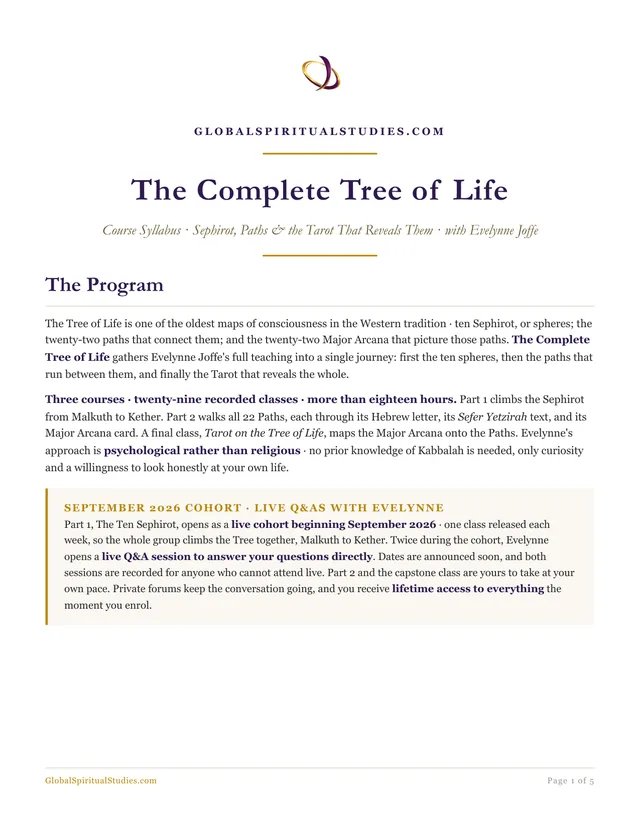
Everything in this guide · and twenty-one paths more. Evelynne Joffe walks every path and every Sephirah on the Tree of Life across twenty-nine recorded classes, with sixty-seven downloadable PDFs (transcripts, study guides, workbooks, reference cards, glossaries, and self-assessment quizzes), three private course-group forums, three certificates of completion, and lifetime access. This is the complete curriculum that these guides are drawn from.
Explore The Complete Tree of Life →For a printable reference to all ten Sephiroth and twenty-two paths, download our free Kabbalah Tree of Life PDF guide.
To see how all twenty-two paths relate to the Major Arcana at once, see the complete 22 Paths and Tarot Correspondences guide.
For more from this tradition, our Kabbalah course collection covers foundations through advanced pathwork programs.
Frequently Asked Questions
Why does The Hierophant correspond to Vav and not to a different letter?
The pairing was formalised by the Hermetic Order of the Golden Dawn in the late nineteenth century. The match works because Vav literally means "nail" or "hook," the function of which is to fasten one thing to another so it endures. The Hierophant is the figure who fastens revelation to tradition, ensuring that what was given at the source can be passed down through generations. Both the letter and the card share the same function: holding what would otherwise dissolve. The Hierophant's position between two pillars also mirrors the structural placement of Vav between Chokmah and Chesed on the Pillar of Mercy.
Is the Hierophant always about religion?
No. The Hierophant is the principle of transmission itself, which appears wherever knowledge or wisdom passes from one generation to the next. It can refer to an apprenticeship, a school, a marriage, a craft tradition, a profession, a family lineage. Religious institutions are one common application of the principle, but they are not the only one. In a reading, the surrounding cards usually clarify which kind of transmission is at stake.
Why is Taurus assigned to the Path of Vav?
Taurus is a fixed earth sign, ruled by Venus, and its characteristic quality is patient durability. The Path of Vav requires exactly this: a teaching tradition cannot afford to be reactive to fashion, because the wisdom it carries needs to outlast the moment in which it was first received. Taurus also governs the throat in astrological body-mapping, which links the sign to the spoken voice, the chanted teaching, the formal vow. The Hierophant raises his hand in blessing because Taurus's domain is the throat, the place where benediction is given.
Can the Hierophant indicate a need to break with tradition?
Yes, especially when reversed or in difficult positions in a spread. The Path of Vav is the principle of fastening, but the same principle implies that some fastenings need to be undone when they no longer serve. The Hierophant reversed often indicates the moment when a structure has become a cage, and the querent must leave it (often in order to find a different lineage that fits more truly). The card never advises mere rebellion; it advises careful relationship to lineage, including the deliberate work of leaving when leaving is what wisdom requires.
The Hierophant is not what the Hierophant says. The Hierophant is the patient nail that holds the door of the temple to its frame, so that the people coming after the first revelation will find the door still standing, and find that it still opens.
About this article
Based on the teachings of Evelynne Joffe
Kabbalist, Tarot Counsellor & Dream Therapist · Director, Institute of Esoteric Studies
This article was written by the Global Spiritual Studies editorial team, drawing on Evelynne Joffe's Kabbalah teaching for Global Spiritual Studies. Evelynne directs the Institute of Esoteric Studies in Melbourne, Australia, and has spent more than thirty years teaching students to read the Tree of Life as a practical map for self-realization. In 1992 she co-founded the Tarot Guild of Australia.
Study this with her
Living the Tree of Life · Part 1: The Ten Sephirot
Living the Tree of Life · Part 2: The Twenty-Two Paths
The Complete Tree of Life
More from Evelynne Joffe →