
Path of Tav · The World
Path 32 · Yesod to Malkuth · The Mark That Completes the Tree
Path 32, the Path of Tav, is the last of the twenty-two paths on the Kabbalah Tree of Life and the first one most ascending pathworkers walk. It connects Yesod (Foundation) to Malkuth (Kingdom) along the bottom of the Middle Pillar. It corresponds to The World, card XXI of the Major Arcana. As a Double Letter, Tav carries the planet Saturn and the Hebrew meaning of cross or mark: the original signature, the sign placed on what is true.
The World on the Tarot card is the figure of completion. A dancer turns inside an oval wreath of laurels, and the four kerubic creatures (angel, eagle, lion, and bull) appear at the corners. Everything is gathered. Nothing is missing. Tav teaches that the work of the Tree is not finished elsewhere; it is finished here, in the manifest world, in the body that is reading this sentence. The Tree descends to Malkuth on this path, and the practitioner ascends from Malkuth on the same path. Tav is the gateway in both directions.
If some of the terms in this guide are new to you, let them be new. We will walk slowly through each one, not as a test of knowledge but as a way of listening to the symbol more deeply.
A note on tradition: Kabbalah has deep Jewish mystical roots reaching back more than two thousand years. This guide focuses on the Western Qabalah and Tarot correspondences that developed later through the Hermetic tradition and the Golden Dawn. The two streams overlap and inform each other, but they are not identical. Wherever a teaching is specific to one tradition, we will name which one.
Featured Course · 2026 Cohort
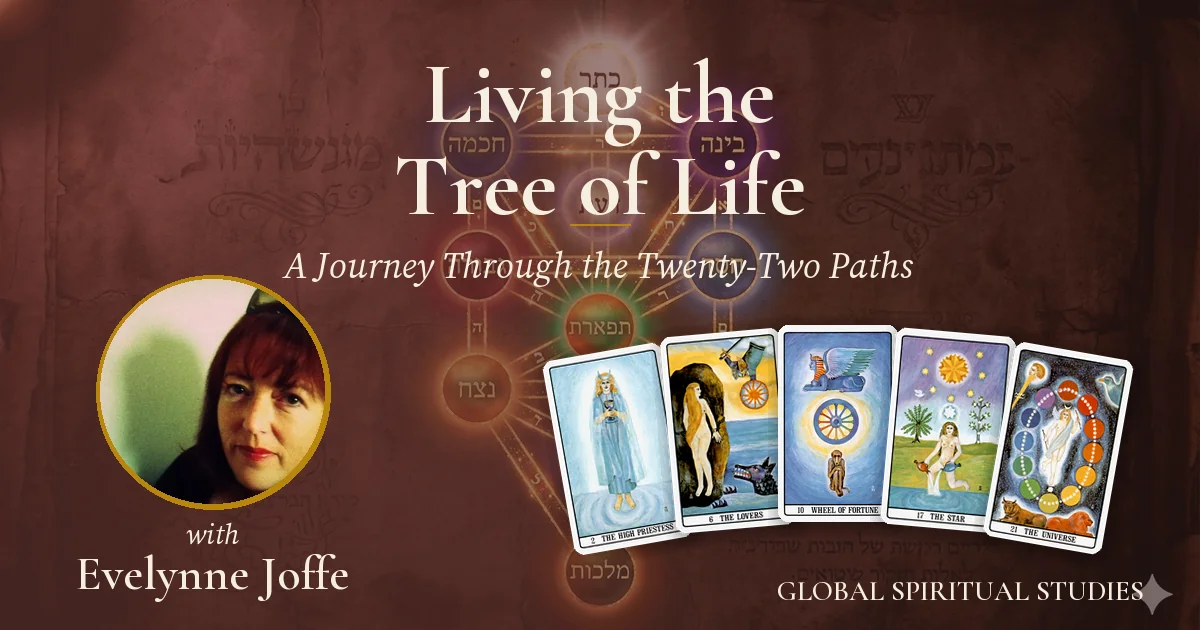
Living the Tree of Life · Part 2: The Paths
The 2026 Cohort · with Evelynne Joffe, Director of the Institute of Esoteric Studies
Across twenty classes Evelynne climbs all twenty-two Paths of the Tree, from Path 32 to Path 11, opening each one through its Hebrew letter and its Tarot card. The 2026 Cohort adds two live Q&A sessions with her on Zoom, dates announced soon, and both are recorded and added to the course. Part 1 or an equivalent grounding in the Sephirot is recommended before you begin.
- Twenty classes
- Two live Q&As
- Path 32 to Path 11
- 11.5+ hours of video
- Handouts & transcripts
- Subtitles
- Private course forum
- Quiz & certificate
- Lifetime access
What Is the Path of Tav?
The Path of Tav is the line drawn between the ninth and tenth Sephiroth on the Tree of Life: Yesod at the bottom of the Middle Pillar and Malkuth at the very base of the Tree. Path 32 is the shortest and lowest of the twenty-two paths, and it is the first path that an ascending pathworker meets on the journey upward from ordinary embodied consciousness.
The Sefer Yetzirah, the oldest Kabbalistic text, calls this path the Administrative Intelligence (also rendered Helping Intelligence or Serving Intelligence). The translation captures Saturn's specific work. Saturn governs structure, time, limit, and the careful administration of finite resources. The Path of Tav is the work of organising the practitioner's actual life so that the higher Sephiroth have somewhere to land.
In the descending direction, Tav is how the imaginative foundation of Yesod becomes specific manifestation in Malkuth. The dream world descends into the body, the room, the calendar, the actual material substance of a life. In the ascending direction, Tav is the doorway through which the practitioner standing in their own kitchen begins the upward journey: the recognition that the Tree of Life is not somewhere else but is being lived from this particular point of embodied existence.
Because Tav is the lowest path, it is also the most accessible. Most beginning pathworkers in the Western Qabalah tradition begin here, with the Path of Saturn and The World card. Tav teaches the foundational lesson without which no higher pathwork is possible: that the contemplative life starts with the body, with the day, with the actual conditions of the practitioner's existence, and only afterward ascends into more rarefied territory.
Geometrically, Tav runs vertically along the very bottom of the Middle Pillar. It is the third and last of the three paths that touch Malkuth directly. The other two are Shin (Path 31, from Hod to Malkuth) and Qoph (Path 29, from Netzach to Malkuth). Together these three paths form the three primary entry points into the Tree from the practitioner's ordinary embodied life. Tav is generally considered the most foundational of the three.
Correspondences at a Glance
| Attribute | Correspondence |
|---|---|
| Path Number | 32 (the final path) |
| Hebrew Letter | Tav (ת) |
| Letter Type | Double Letter (one of seven) |
| Letter Meaning | Cross; mark; signature; the sign placed on what is true |
| Numerical Value | 400 |
| Tarot Card | XXI · The World (Crowley: The Universe) |
| Planet | Saturn |
| Sephiroth Connected | Yesod (9) ↔ Malkuth (10) |
| Sefer Yetzirah Title | Administrative Intelligence (Helping Intelligence) |
| Position | Bottom of the Middle Pillar; the gateway path |
| Pillar | Middle (Equilibrium), final descent |
| Body Correspondence | The feet; the lower spine; the bones |
| Colour (Queen Scale) | Indigo (sometimes black or dark blue) |
The Hebrew Letter Tav
Tav (ת) is the twenty-second and last letter of the Hebrew alphabet and the seventh of the seven Double Letters. Its planet is Saturn, and its paired qualities are dominion and slavery: the alternation between the conscious mastery of the conditions of one's life and the unconscious entanglement with them.
The pictographic origin of Tav is a cross or mark, in the most original sense: the sign that one is allowed to make. In the ancient Near East, a person who could not write often signed their name with a small cross or X. The sign was the signature; the mark made the agreement real. In Hebrew scripture, the prophet Ezekiel describes a divine command that a tav be placed on the foreheads of the righteous in Jerusalem, marking them as those who would be spared (Ezekiel 9:4). The letter that ends the alphabet is also the letter that, in its oldest sense, simply says: this one is mine.
The Path of Tav carries this marking work. Saturn's domain is the careful drawing of distinctions: this is mine, this is not; this is now, this is later; this is real, this is imagined. To walk the Path of Tav is to take these distinctions seriously without becoming rigid in them. Saturn is the planet of structure precisely because, without structure, the higher emanations of the Tree have nowhere to be.
Numerically, Tav equals 400. Four hundred is the largest single value in the Hebrew alphabet (without using compound numerals) and represents completion. The number forty appears repeatedly in Hebrew scripture as the duration of significant transitions; four hundred is forty doubled by ten, the completion of the long journey through forms. Tav at the bottom of the Tree is the place where the long descent comes to rest in a particular life.
In the Sefer Yetzirah, the Double Letters are sealed into the seven major openings of the head and body. Tav is associated with the anus, the body's opening of release. The teaching is unsentimental and physical: every spiritual practice must include the actual body, including the parts of the body that ascetic traditions have sometimes refused to name. Tav refuses to skip the body. The work of the Tree is incarnate or it is not real.
The World: Tarot Correspondence
The World is the final card of the Major Arcana and one of the most positive images in the deck. In the Rider-Waite-Smith deck, a dancing figure turns inside an oval wreath of laurels. The dancer is sometimes drawn as androgynous, holding two short wands. In the four corners of the card appear the same four kerubic creatures that hold the Wheel of Fortune: an angel, an eagle, a lion, and a bull. The wreath is bound at top and bottom with red ribbons in figure-eight (lemniscate) shapes.
The Golden Dawn assigned The World to the Path of Tav, drawing on the long association of Tav with Saturn and on the card's role as the figure of completion. The match holds together at every level the tradition tests:
- The dancing figure is the soul that has integrated the journey through the previous twenty cards. The dance is not abstract; it is the actual movement of a body in space and time, which is Saturn's domain. The figure dances because the work of the Tree, when it is complete, is embodied joy.
- The oval wreath (sometimes called the mandorla) is the threshold between worlds. The same shape appears in Christian iconography around figures of ascending or transfigured saints, and in alchemical illustration as the meeting place of opposites. The Path of Tav passes through this threshold: the manifest world is also the threshold from which all higher work begins.
- The four kerubic creatures at the corners are the same four that hold the Wheel of Fortune (Path of Kaph). They appear here because The World is the card of the four worlds reconciled, the four elements integrated, the four directions held in a single dance. What was being held in motion on the Wheel is here held in completion.
- The two wands in the dancer's hands are short ones, sometimes called batons. They are the conscious will at the scale of an individual life. The dancer does not need a great staff or sceptre; the small wands are enough. The Path of Tav teaches that completion is local, not grand.
A.E. Waite, in The Pictorial Key to the Tarot, called the World "the perfection and end of the Cosmos, the secret which is within it, the rapture of the universe when it understands itself in God." Dion Fortune, in The Mystical Qabalah, framed the path more directly: "Tav is the path of incarnate completion, and the World is the figure of the soul that has come down all the way and recognised that the descent was the point."
Crowley's Thoth deck renames the card The Universe and emphasises the cosmological scale. Both readings hold. Tav is the point at which the personal life and the cosmic work prove to be the same work, viewed from two angles.
Saturn: A Double Letter
Tav governs the planet Saturn. Of the seven classical planets, Saturn is the slowest, the most distant from the Sun in the visible system, and the one whose orbit defines the boundary of what was, before the discovery of the outer planets, the known cosmos. Classical traditions called Saturn the Greater Malefic, the planet whose influence was associated with limitation, austerity, and the slow grinding work of time.
The Kabbalistic reading of Saturn is more nuanced than the classical one. Saturn is not malefic; Saturn is structural. He governs time, gravity, mortality, and the necessity of finite form. Without Saturn, the higher emanations of the Tree would have no resting place. The Path of Tav teaches that the limits Saturn enforces are also the conditions of incarnation. To be in a body is to be in Saturn's territory, and the work is not to escape this but to work skillfully within it.
Saturn also governs discipline, patience, and the cultivation of long-term mastery. The Path of Tav is, in this sense, the path of the slow work. Spiritual development rarely moves quickly. The Path of Saturn rewards practitioners who can sit with their practice over years and decades, allowing the slow work to mature into something the quick work could never produce.
In the body, Saturn governs the bones, the teeth, the skin, and the structural tissues that hold the body in shape. To meditate on Tav is to bring attention to the skeleton, the framework on which the rest of the body hangs. The Path of Tav teaches that the practitioner's actual material being, including its mortality, is part of the spiritual work rather than something to transcend on the way to it.
Saturn is also the only planet with rings, and in some Kabbalistic readings the rings are taken as a visual analogue of the encircling wreath on The World card. Saturn carries his own boundary. The Path of Tav teaches that boundary and substance are not opposed; the one defines the other.
Yesod to Malkuth: What This Path Connects
Path 32 joins the ninth and tenth Sephiroth: Yesod and Malkuth.
Yesod is Foundation, the ninth Sephirah, on the Middle Pillar. Its planet is the Moon, its archangel Gabriel, its colour violet. Yesod is the seat of the imaginal world: dreams, the subconscious, the imagination, the realm of symbols. Yesod is sometimes called the treasure house of images, the place where the dream-fabric of the manifest world is woven.
Malkuth is Kingdom, the tenth and final Sephirah, the place of physical manifestation. Its archangel is Sandalphon, its element is the four elements together (Earth as the synthesis of all). Malkuth is the body, the room, the bread on the table, the actual stuff of existence. It is also the Shekhinah, the divine presence dwelling in the world.
The Path of Tav carries the energy from one to the other. In the descending direction, the imaginal foundation of Yesod becomes specific physical form in Malkuth. The dream descends into the body. The image becomes a thing. The pattern becomes a particular bowl, a particular morning, a particular weight in the hands. In the ascending direction, the practitioner standing in Malkuth begins the long journey upward by recognising that their actual physical existence is the entry point to the entire Tree.
This is the most foundational teaching in the Western Qabalah tradition. The contemplative life does not start somewhere else and then descend to incarnation; it starts here. The body is not the obstacle to spiritual work; it is the territory of it. The Path of Tav carries this teaching as its primary work.
Geometrically, Tav is the shortest path on the Tree, running from Yesod (just above) to Malkuth (just below). It is also the path most commonly walked first in any pathworking sequence. A traditional Western Qabalah ascent begins at Tav and moves upward through Shin (Path 31) and Qoph (Path 29) before climbing the higher paths.
Pathworking and Meditation
Pathworking is the meditative practice of imaginatively travelling a path on the Tree of Life. The Path of Tav is the most accessible of the twenty-two paths and is generally the first one a beginner pathworker meets. It is also a path that experienced pathworkers return to repeatedly, because every increase in practice is also an increase in the practitioner's capacity to be present to ordinary embodied life.
An Exercise · Sitting with Tav
Sit comfortably with your feet flat on the floor and your spine upright. Place a Tarot card of The World in front of you, or simply visualise the Hebrew letter Tav (ת) as a small cross or signature drawn at the base of your awareness.
Bring your attention to your feet. Notice the contact between your soles and the ground. Notice the weight of your body resting on the chair, on the floor, on the planet. Saturn's gravity is the most reliable presence in your life. It has held you every minute since you were born.
Now bring to mind the actual conditions of your day: the specific room you are in, the specific clothes on your skin, the specific calendar of obligations and small joys waiting for you when this meditation ends. Hold all of this gently. The Path of Tav does not ask you to transcend these conditions; it asks you to recognise that they are the territory of the Tree.
After ten or fifteen minutes, return to ordinary attention. Notice that the meditation has not removed you from your life; it has, if anything, returned you to it more fully. This is the Path of Tav at work.
Practitioners working in the Golden Dawn tradition often pair this meditation with the colour indigo, the Queen Scale colour of Tav, and with the divine name Adonai ha-Aretz (Lord of the Earth), the divine name of Malkuth. Evelynne Joffe's Living the Tree of Life: The Paths course begins its ascent of the Tree with extended treatment of the Path of Tav, and most students return to this material throughout the course as they work the higher paths. Tav is foundational; everything else rests on it.
The World in a Tarot Reading
When The World appears in a Tarot reading, the path of Tav is being invoked in the querent's life. The card asks: What in your life is being completed? What journey is asking to be recognised as having arrived rather than continuing toward an arrival that never comes?
The World is the card of completion, but the completion it indicates is structural rather than ultimate. In context, the World tends to indicate:
- The successful integration of a long-running project, relationship, or life chapter. The World rarely indicates a single isolated event; it indicates the gathering up of much earlier work into a recognisable whole.
- Embodied wholeness as a felt experience rather than as an abstract goal. The card reminds the querent that the body is not the obstacle to spiritual integration but the place where it is felt.
- A threshold between one phase of life and the next. The dancer in the wreath is moving; the World is not a static endpoint but a passage through completion into the next beginning. After The World comes The Fool again, and the cycle resumes at a different scale.
- Reversed, the World can indicate a completion being delayed, a sense of being almost there without being able to cross the final threshold. Sometimes it indicates the failure to recognise a completion that has already happened.
Read alongside its Kabbalistic correspondence, the World reminds the querent that completion happens in this body, in this room, in this life, not somewhere else. The Path of Tav is the assurance that the Tree of Life is being walked from where the querent is actually standing, even when they have not been able to see the structure of the path.
Common Misconceptions
"The World is about literal travel or international success." The card has been read in some popular contexts as predicting travel or worldly achievement, but its deeper teaching is structural completion in any domain. The World can appear in readings about contemplative practice, parenting, recovery, or domestic life, and its meaning in each case is the same: a long journey is gathering into a recognisable whole.
"Tav is a beginner's path because it is at the bottom of the Tree." Tav is the most accessible path, but its work is foundational rather than introductory. Experienced pathworkers return to Tav throughout their practice because every advance in the higher paths is also an advance in the practitioner's capacity to be present to ordinary embodied life. Tav is foundational at every level, not just at the beginning.
"Saturn is bad luck." Saturn's classical reputation as the Greater Malefic comes from a literalist reading of the planet's slowness and severity. The Kabbalistic reading recognises Saturn as the planet of structural integrity, without which incarnation would not be possible. The discipline Saturn enforces is the same discipline that allows the higher emanations to land in actual life.
"The contemplative life is about leaving the world." The Path of Tav teaches the opposite. The contemplative life is about descending into the world more fully, not less. The figure on The World card is dancing inside the manifest universe, not above it. To walk Tav is to recognise that there is no other place to walk it from.
Recommended Courses
For students who feel drawn not only to understand these symbols but to enter them through guided practice, Evelynne Joffe's teachings offer a steady and deeply experienced path. Her work has shaped how the Tree of Life is taught at Global Spiritual Studies, and her courses are the natural next step after this guide.
Twenty recorded classes covering all twenty-two paths in depth. The Path of Tav receives extended treatment as the foundational gateway path, with attention to its role in beginning ascending pathwork and in returning to embodied presence throughout the rest of the journey.
The companion course covering all ten Sephiroth, including extended treatment of Yesod and Malkuth, the two Sephiroth that the Path of Tav connects. Recommended preparation for working any of the lower paths.
Everything in this guide · and twenty-one paths more. Evelynne Joffe walks every path and every Sephirah on the Tree of Life across twenty-nine recorded classes, with sixty-seven downloadable PDFs (transcripts, study guides, workbooks, reference cards, glossaries, and self-assessment quizzes), three private course-group forums, three certificates of completion, and lifetime access. This is the complete curriculum that these guides are drawn from.
Explore The Complete Tree of Life →For a printable reference to all ten Sephiroth and twenty-two paths, download our free Kabbalah Tree of Life PDF guide.
To see how all twenty-two paths relate to the Major Arcana at once, see the complete 22 Paths and Tarot Correspondences guide.
For more in this tradition, browse our Kabbalah course collection.
Frequently Asked Questions
Why does The World correspond to Tav?
The pairing was formalised by the Hermetic Order of the Golden Dawn in the late nineteenth century, drawing on the long association of Tav with the planet Saturn and on the card's role as the figure of completion. The match holds at every level: Saturn's domain of structure, time, and finite form is exactly the territory of incarnate completion; Tav's pictographic origin in the cross or signature names the marking of what is true; and the dancing figure inside the wreath dramatises the embodied wholeness that the Path of Tav makes possible. Tav is the last letter of the Hebrew alphabet, and The World is the last card of the Major Arcana, an alignment that reinforces the correspondence.
Should I start pathworking with Tav?
Yes. Tav is the most foundational path on the Tree and is generally the first one a beginning pathworker meets. The traditional sequence in Western Qabalah ascends from Path 32 (Tav, the World) to Path 31 (Shin, Judgement) to Path 29 (Qoph, the Moon), completing the so-called "first ascent" before climbing into the higher paths. Even after extensive practice, returning to Tav remains valuable; experienced pathworkers often describe their relationship to Tav as the foundation that everything else rests on, and they return to it as the deepening proceeds.
What is the meaning of the four creatures in the corners of The World card?
The four creatures (an angel, an eagle, a lion, and a bull) are the kerubim of Ezekiel and the four living creatures of Revelation, also corresponding to the four fixed signs of the zodiac (Aquarius, Scorpio, Leo, Taurus) and the four elemental principles. The same four creatures appear in the corners of the Wheel of Fortune (Path of Kaph). On The World card, they signify that the dancer at the centre is integrating all four elements, all four worlds, and all four directions in a single wholeness. The card is the figure of complete cosmological integration in human form.
Why does Crowley call this card The Universe instead of The World?
Crowley's renaming reflects his interpretation of the card at cosmological scale: where the traditional World card emphasises the personal completion of the soul's journey, Crowley's Universe emphasises the same completion at the scale of all manifest existence. Both readings hold simultaneously. The Path of Tav is the place at which the personal life and the cosmic work prove to be the same work, and the choice of card name is a matter of which scale the deck designer wishes to emphasise. In the Rider-Waite-Smith deck, "The World" preserves the personal scale; in Crowley's Thoth deck, "The Universe" preserves the cosmic scale.
The dancer in the wreath has come down all the way and is dancing in the body. The Path of Tav teaches that the long journey of the Tree begins and ends in the same place: this room, this breath, this particular life. The mark you make is your signature on what you have been given. Saturn does not ask for more.
About this article
Based on the teachings of Evelynne Joffe
Kabbalist, Tarot Counsellor & Dream Therapist · Director, Institute of Esoteric Studies
This article was written by the Global Spiritual Studies editorial team, drawing on Evelynne Joffe's Kabbalah teaching for Global Spiritual Studies. Evelynne directs the Institute of Esoteric Studies in Melbourne, Australia, and has spent more than thirty years teaching students to read the Tree of Life as a practical map for self-realization. In 1992 she co-founded the Tarot Guild of Australia.
Study this with her
Living the Tree of Life · Part 1: The Ten Sephirot
Living the Tree of Life · Part 2: The Twenty-Two Paths
The Complete Tree of Life
More from Evelynne Joffe →

