Heart and Moon
Heart and Moon is glossed as deep romantic love on almost every list that carries it, and the gloss is not wrong so much as narrowed. Heart first makes affection the subject and the Moon colours it, which gives feeling at its most resonant and, in the register the combination entries quietly drop, feeling that other people can see. Moon first makes the recognition or the mood the subject and the Heart warms it, which is closer to being well thought of and glad about it than to being in love. Every one of the six references reviewed here that credits card 32 with reputation elsewhere on its own site then declines to bring that meaning into this pair. Closing that gap is what this page is for.
- Heart + Moon (24 + 32)
- Affection is the subject and the Moon says how it registers: deeply felt, and frequently visible to other people. The relationship that becomes known belongs in this order.
- Moon + Heart (32 + 24)
- The feeling or the standing is the subject and the Heart makes it warm: esteem you are glad of, or a mood with real tenderness in it rather than only intensity.
- The cards
- Heart · card 24 · Jack of Hearts · positive. Moon · card 32 · 8 of Hearts · neutral. Both inserts are Hearts, which no published list found for this page makes anything of.
- Yes or no
- Yes in both orders, and gently so. Two positive cards with nothing obstructive between them, though neither undertakes that any particular hope is met.
- Timing
- The pace belongs to whichever card falls second. Heart + Moon ends on the Moon, which most references count by the lunar month and not by the number printed on it: reckon on four weeks, and on evening rather than daylight. Moon + Heart ends on the Heart, where the field cannot agree, offering spring, February, August, October and the 24th of the month in different places. In that order, name the sequence and leave the date alone.
The two cards
The Heart, card 24, is the deck's plainest statement of affection, and it is also the card whose timing nobody can agree on. Its insert is the Jack of Hearts, which older cartomancy reads as a young admirer and a bearer of goodwill, and that is worth holding on to: the card describes warmth extended toward someone, not merely warmth felt.
The Moon, card 32, carries two registers. One is emotion, intuition and the inner life. The other is honour, recognition and public standing, and ten of the seventeen references reviewed for this page list it among the card's own keywords. It is the second register that does the interesting work here, because it is not missing from the field. It is missing from this combination.
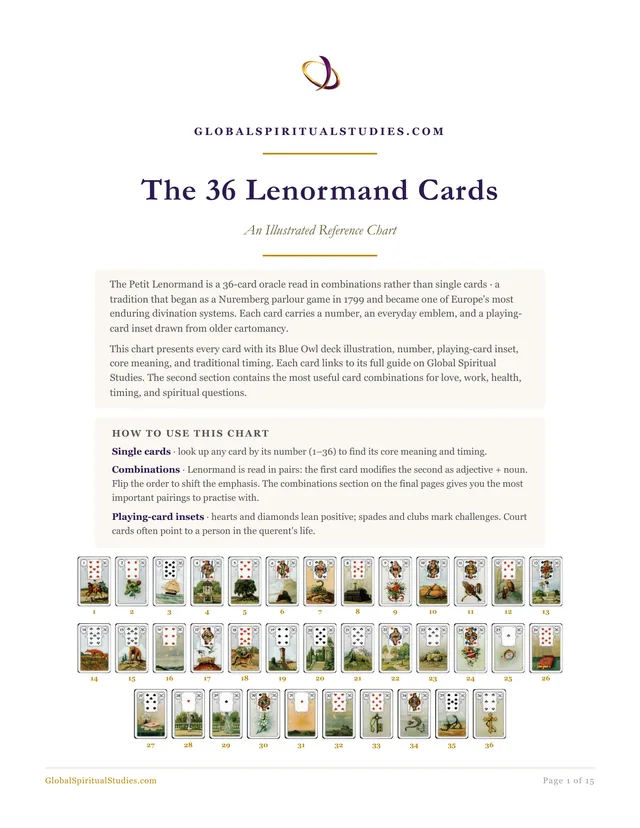
In the directional method used on this site, we read the first card as the subject and the second as its modifier. Applied to two cards that both lean positive, the question stops being whether the news is good and becomes what the news is about. Readers new to pairs will want the full 36-card Lenormand guide first.
A card with two registers is only ambiguous while you are guessing which one the spread has woken. Our free 36-card Lenormand chart puts every card's keywords and timing on one printable sheet, so the neighbours can answer that for you instead of a keyword you half remember.
Heart + Moon
Affection is the subject and the Moon says how it registers
Heart first makes the feeling the thing being talked about, and the Moon reports what happens to it. Under the emotional register that gives the reading everyone prints: love felt at depth, romance with an imaginative quality to it, an attachment that has got into somebody's inner life. That is true, and it is not the whole card.
Under the other register the same order says something the lists do not. A feeling described by recognition is a feeling other people can see. That covers a relationship that stops being private, an affection that is spoken about, a fondness that has become part of how somebody is regarded. Lisa Boswell comes nearest to it of anyone found for this page, slipping the phrase loving the limelight into her Heart-first entry and into no other, though she means enjoying attention rather than being seen while loving.
This order shows up when somebody asks whether a relationship they have kept quiet is about to stop being quiet, or wants to know how an attachment of theirs looks from outside.
Moon + Heart
Recognition or mood is the subject and the Heart makes it warm
Reversed, the Moon takes the leading position and the Heart becomes the description attached to it. Under the emotional register the sentence reads this mood is a tender one, which distinguishes it usefully from a mood that is merely strong. Intensity and kindness are not the same weather, and this order specifies which.
Under the reputational register the sentence reads this recognition is affectionate, and that is a genuinely different piece of news from recognition that is formal, grudging or purely professional. Being valued and being liked arrive separately in most working lives. A reader who hears only romance in this order will tell somebody about their partner when the cards were describing the room they walked into.
It suits a question about how a person is held by a group, a family or a workplace, and it is the order that most often turns up on questions that had nothing to do with a relationship.
The pair across five areas of life
| Area | Heart + Moon | Moon + Heart |
|---|---|---|
| Love | Affection with depth to it, and often affection with witnesses. The order in which a relationship becomes known, gets talked about, or begins to shape how somebody is seen. | The feeling itself described as tender rather than merely intense. Useful when a querent knows something is strong and cannot tell whether it is kind. |
| Work | Attachment to the work, and the visibility that comes with caring about it in public. A vocation somebody is known for rather than a job they hold. | Warm regard from the people around you. Being liked as well as rated, which the English combination entries almost never separate from being loved. |
| Money | Neither card counts, so no sum lives here. What this order can describe is money attached to something cared about, which is a motive rather than an amount, and any decision resting on it wants an independent professional view. | Standing that has some goodwill behind it. Silent about figures, and worth reading alongside a Fish or a Bear before anything financial is claimed from it. |
| Health | A description of mood and circumstance, not of a body. Both cards are positive, which is not a clinical statement, and anything medical belongs with a qualified professional. | Feeling looked after, or being someone others are warm toward. Circumstances again, since diagnosis is not something two cards can offer. |
| Timing | Timing belongs to the Moon as the trailing card, and card 32 is counted by the moon's own month instead of by its number: four weeks or so, after dark. | Timing belongs to the Heart as the trailing card, and card 24 supplies one of the deck's least settled intervals. Spring, February, August, October and the 24th of the month all appear in print. Describe an order of events instead. |
Heart and Moon in the Grand Tableau
Neither of these placements has a published reading, so both are our own, built from the questions the houses ask. The Moon in house 24, which is the tableau's love position, puts feeling or reputation inside the romantic field: what is happening in the love life is either an intensity of feeling or a matter of how the relationship is regarded. The Heart in house 32 reverses it, and is the more useful of the two, because house 32 is the position for feeling and for being recognised at the same time. A Heart landing there says the warmth and the regard are one thing.
Two cautions. The house numbering used here is not universal: at least one published system, drawn from French and Romanian sources, reads house 24 as advancement and house 32 as fortune, which is a different set of questions entirely and therefore a different tableau. And distance is a separate instrument from the houses. One published treatment of distance holds the Moon near the person to mean recognition and honours and the Moon far away to mean being passed over, which if it is right makes adjacency to the Heart the strongest form of the register this page is arguing for.

Where the traditions differ
The disagreement here is not between schools. It is between what the sources say about the Moon and what they say about the Moon once the Heart turns up.
The recognition register is dropped, and dropped completely. Ten of the seventeen references reviewed for this page list honour, fame, reputation or recognition among card 32's own keywords. Six of those ten also publish a gloss for this combination. All six give it as romance and nothing else. Phuture.me opens its Moon page with reputation and fame and then writes the pair as fated love; Lisa Boswell opens hers with recognition and reputation and then writes it as loving the psychic world; Lenormand Reader opens with honour and then gives deep emotions and kindness. The meaning is printed inches from the entry that discards it.
One page proves the drop is deliberate rather than absent-minded. Learn Lenormand keeps the fame register alive for the Moon beside the Tower, where it gives public honour, for the Moon beside the Bear, where it gives recognition from management, and for the Moon beside the Star, where it gives honour again. Then it reaches the Heart and gives romance and deep passion. The register is not missing from the site. It is switched off at this one card.
The orders are mostly not separated at all. Of seventeen sites in two languages, four treat the two directions as different readings. Three print one gloss twice: Labyrinthos carries a single sentence about deep emotions on both its Heart page and its Moon page, Anna K carries an identical block on hers, and Andreas Roth repeats the same German paragraph word for word across his two card pages. A reader who dutifully checks both orders on those sites receives one opinion twice and may reasonably mistake it for agreement.
German practice is split on the Moon itself. The assumption that the honour reading is a German speciality does not survive contact with the pages. Madame-Lenormand lists success, standing and high honours among the Moon's meanings; Andreas Roth's list for the same card is entirely interior, running to thought, psyche, reflection and melancholy, with no public dimension anywhere. Two German references, two different cards.
Only the German-language material admits a shadow. Esoterikpalast reads this combination outright as fear of love, and Anna K's block holds needing love, fearing love and a lover's grief together in one entry. Nothing in the English sources reviewed here allows the pair to describe anything but good news, which is a suspiciously tidy result for two cards that between them cover longing.
A note on the historical layer. In the dice game these thirty-six images come from, card 24 is the one square that hands you to a person: land there and you are handed over to one of the two figure squares, and you stop. Card 32 has no rule at all. The route onward from the figure squares leads to the Moon, and arriving by way of the Heart is the single thing that blocks it. Those are movement rules and not meanings, since the leaflet contains no meanings, but a game in which the Heart is what stops you reaching the Moon is a pleasing thing to know about a pair the modern lists treat as seamless.
A reading in three cards
A man asks about a woman he has been seeing quietly for the better part of a year. The line comes out Heart · Moon · Letter.
Affection leads, the Moon says it is becoming visible, and the Letter says the visibility arrives in a written form: something gets said in a message, an announcement, or a post other people will read. Nothing in the line says the relationship changes. It says the privacy does.
Swap the first two. Moon · Heart · Letter puts the recognition in front, so what is being written about is not the relationship but the standing, and the Heart reports that the acknowledgement is a warm one. The first line is a private thing going public. The second is a public thing turning affectionate. Same three cards, and only one of them answers the question he asked.
What readers get wrong about this pair
Hearing only the romance. The recognition meaning is on the same websites, one scroll above the entry that leaves it out, and one of them keeps it for three other combinations and abandons it here. That is not simplification. It is a habit, and it costs a reader the whole vocational and reputational half of the pair.
Reading the number as the month. The Moon times to the lunar cycle in most references, and the tell is easy to spot: at least one current teaching page gives this card thirty-two hours or thirty-two days, taken straight off the number printed on it, on a page that times its neighbours the same way.
Assuming there is no shadow. Two positive cards do not make a promise. The German-language entries hold needing love and fearing love in the same breath and one of them names the pair as fear of love outright, while the English entries reviewed here offer nothing but reassurance. A pair that can describe longing can describe longing that hurts.
Missing the audience. Both cards carry Hearts as their playing-card insert, and one published gloss of the 8 of Hearts is a gathering of well-inclined people. The social dimension of this combination is sitting in the inserts, and nothing found for this page picks it up.
Questions about Heart and Moon
Does the Heart and Moon combination mean deep romantic love?
It is the standard reading and it is a fair one, but it is only half the card. Every source reviewed for this page gives the pair as romance, including the six that credit the Moon with recognition and reputation elsewhere on their own sites. Read with that second register in play, the combination also describes affection that has become visible, or regard that is warmly meant, neither of which needs a relationship in it at all.
What is the difference between Heart + Moon and Moon + Heart?
Which of the two is being described. Heart first makes affection the topic and the Moon reports how it registers, so the reading runs to feeling at depth and, in the register the lists mislay, feeling other people can see. Moon first makes the recognition or the mood the topic and the Heart describes it as warm, which gives esteem with goodwill in it rather than a romance. Four of the seventeen references reviewed here separate the orders at all, and none of them separates them in these terms.
Can the Heart and Moon combination be about reputation rather than love?
Yes, and it is the reading the combination entries lose most reliably. Ten of the seventeen references reviewed for this page list honour, fame or recognition among the Moon's own meanings, and the six of those that also publish this pair give it as romance without exception. One of them keeps the fame reading for the Moon beside the Tower, the Bear and the Star, and drops it only when the Heart arrives. Read that way the pair describes being thought well of by people who also like you.
Is the Heart and Moon combination a yes or a no?
Yes in both orders, though it is a soft yes rather than an emphatic one. Both cards are positive and neither obstructs the other, so nothing in the pair argues against the thing being asked about. What it does not do is guarantee an outcome, because two agreeable cards describe a situation rather than settle it, and the cards on either side can still take the answer somewhere else.
How long does the Heart and Moon combination take?
The governing card is the one dealt second, and here the two orders are very unequal. Heart + Moon ends on the Moon, timed by the lunar month in most references rather than by the number on the card, which puts it at four weeks and in the evening. Moon + Heart ends on the Heart, and the field offers spring, February, August, October and the 24th of the month with no acknowledgement that these conflict. In that order the order of events is the more honest answer.
Related combinations
Browse the full Lenormand combination finder to look up any pair in the deck.
Learn Lenormand · explore our Lenormand courses with Mary K. Greer and Caitlín Matthews.
Half the difficulty with this combination is that one of its cards means two things and the lists only remember one. The Complete Lenormand teaches how the neighbouring cards, the houses and the Grand Tableau decide which register is running, so a pair like this one tells you what the reading is about rather than only that it is warm.