Garden and Heart
Garden and Heart puts warmth and company in the same sentence, and the order decides which of the two you already have. Garden leading describes a gathering with affection in it: the room comes first, and the love is something met there. Heart leading describes affection that becomes visible: the feeling already exists, and the crowd is what it is being shown to. The published lists collapse both into an engagement party, which is one occasion out of many and the least interesting of them.
- Garden + Heart (20 + 24)
- A social setting with warmth in it. Meeting someone at a gathering, a community that is genuinely kind, a network that behaves generously. The affection belongs to the room.
- Heart + Garden (24 + 20)
- An existing affection going public. The announcement, the introduction to friends, the relationship that stops being private. The feeling came first and the audience is new.
- The cards
- Garden · card 20 · 8 of Spades · positive. Heart · card 24 · Jack of Hearts · positive. One of the few pairs in the deck with no negative card in it at all.
- Yes or no
- Leans yes in both orders, with one caveat worth stating: the pair says a matter is social and warm, not that it succeeds. Warmth and outcome are separate questions.
- Timing
- The card that lands second determines the pace. With the Heart in that place the answer is emotional rather than calendrical: it happens when the people involved are ready, and 24 stands as the fallback count. With the Garden in that place you get something rare in this deck, an actual date, because card 20 points at an occasion that is already arranged.
The two cards
The Garden · card 20 · is public life: the gathering, the network, the reputation, the room you are seen in. It is a positive card with one well-attested shadow, which is being alone in company. That shadow does more work on this combination than on most.
The Heart · card 24 · is warmth in action, and romance is only its most advertised sense. Compassion, kindness and generosity are in the same card, and beside the Garden they are at least as likely to be what is meant. Lisa Boswell's Garden entry hints at the breadth by including an open relationship, which nobody else prints and which follows from the grammar rather than from tradition.
In the directional method used on this site, we read the first card as the subject and the second as its modifier. Two positive cards means the interesting question is not whether this is good news but which of the two things you have already: the room, or the feeling. Our complete guide to the Lenormand cards opens with exactly that convention.
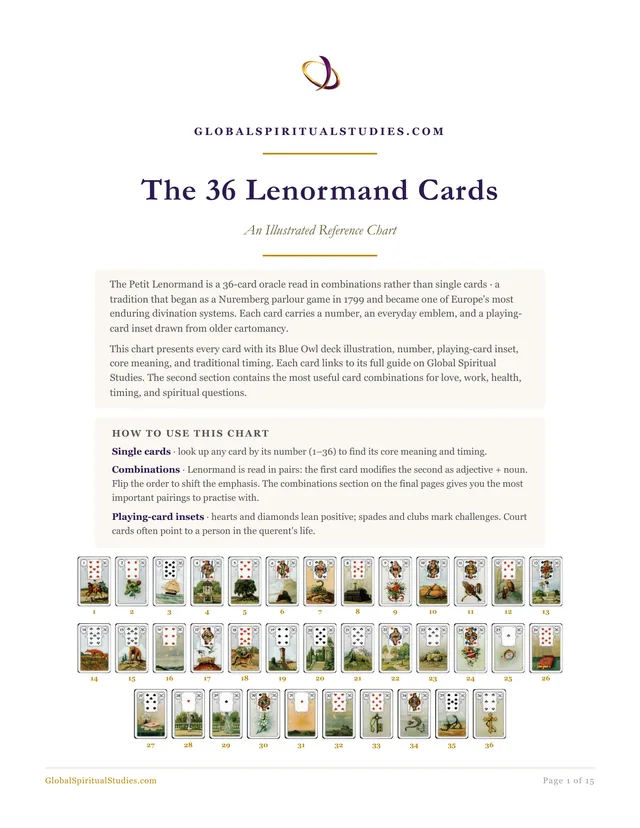
Pairs made of two bright cards are the ones readers skim, and skimming is where the useful detail goes. Our free 36-card Lenormand chart holds all thirty-six on one printable page, which makes it quick to see whether the cards around a warm pair agree with it.
Garden + Heart
The room, and the warmth in it
Garden leading makes the public setting the noun and the Heart the adjective. The sentence is this gathering is affectionate. Something social is happening and warmth is a property of it, which is not the same as saying two people are in love.
The romantic version is real and well attested: Boswell gives meeting a lover at a party, and this is the order behind it. What is worth noticing is that in this order the love does not exist before the room does. The gathering is what produces it, which is why this is the order to hope for on a question about whether someone will meet anybody at all.
The wider readings are the ones the lists lose. Anna.K's entry for these two cards runs to a culture of love, compassionate communities, organising a fundraiser, and the attempt to be kind to everybody. That is the Heart's compassion rather than its romance, and beside the deck's card of community it is an obvious fit. A congregation, a support group, a workplace that genuinely looks after people: all of them are this pair, and none of them is an engagement.
Heart + Garden
The feeling, and who can see it
Turn the pair around and the Heart becomes the noun, with the Garden describing it. The sentence is this affection is public. The love is established. What changes is who knows about it.
German material reads this order almost exclusively that way: making a relationship known, feelings shown openly, a partnership becoming publicly acknowledged, love encountered in company. Anna.K reaches the same territory from the other side with a proposal made in public and publicly acceptable ways of showing affection. Two independent sources, reading the two orders separately without either of them saying so, land on precisely the split the grammar predicts. The Garden-first entries are about finding love; the Heart-first entries are about announcing it.
That is a rare thing in this material and worth stating plainly, because it means the distinction is not a house invention. It is already there in the published lists, unremarked, waiting for somebody to line the two entries up side by side.
The pair across five areas of life
| Area | Garden + Heart | Heart + Garden |
|---|---|---|
| Love | Meeting someone through company rather than by design: an introduction, an event, a shared circle. The attachment does not exist yet, and the room is what makes it possible. | An attachment that already exists and is about to be seen. The introduction to friends and family, the announcement, the point at which a private thing acquires an audience and other people's opinions. |
| Work | A workplace or professional network with real goodwill in it. Also the collaboration that begins socially, and the job that arrives through people rather than through an application. | Loyalty or care that becomes visible: public credit given, an alliance made explicit, someone putting their name to a colleague in front of everyone. Also the working relationship that is now common knowledge. |
| Money | Generosity organised in public: a collection, a fundraiser, a community effort, money moving because people care rather than because of a contract. Any actual financial step is a matter for independent professional advice. | A shared commitment made visible, or spending that goes with an occasion. Neither card names a sum, and figures in the reading arrive from other cards in the line. |
| Health | Support from other people, which is the most useful thing this pair says about health: company, care networks, not being alone with something. The cards describe a social situation and never a body. | A private matter becoming known to a wider circle, with the mixture of relief and exposure that carries. Health questions themselves belong with a qualified professional. |
| Timing | Governance passes to the Heart as the closing card, and the Heart answers to readiness rather than to dates. This arrives when it arrives, with a count of 24 behind it if a number is wanted. | Now the Garden is the closing card and governs, which produces one of the few datable readings in the deck: an occasion already scheduled, or a stretch of heavy social activity, with 20 as the fallback. |
Garden and Heart in the Grand Tableau
In a tableau the two work as above, the subject belonging to whichever of them the significator is closer to. Far apart they report separately, and this is a pair where separation is easy to read badly: a Heart anywhere near a Garden invites a reader to announce a romance that the tableau has not mentioned.
The Heart in house 20 is one of the placements our own house notes already carry, and it says love has become a public matter, celebrated or complicated by what other people make of it. The Garden in house 24, the position that carries the love question, is the mirror and the more searching of the two: the social world has moved into the relationship. That can be warm, and it can also mean a private attachment is being conducted in front of an audience it did not invite.

Where the traditions differ
The English monoculture here is the engagement party, and it is unusually total. Our own card pages give an engagement party and a public celebration of romance. The reference corpora say much the same. The result is a combination that has one occasion attached to it, when the two cards between them cover every social situation in which anybody feels anything.
The genuinely useful divergence is that the two fullest lists split by order without noticing. Boswell's Garden entry gives meeting a lover at a party, gathering with people you love, and an open relationship: all of them situations in which the company is prior. The German material for the Heart-first order gives making the relationship known, showing feelings openly, a partnership becoming publicly acknowledged: all of them situations in which the feeling is prior. Neither source presents this as a rule about direction. They simply wrote up the card they were writing up, and the grammar did the rest.
The compassion register is the other thing the English lists drop. Anna.K's entry gives loving communities, a culture of kindness, and charity organised for people in need. Card 24 has carried compassion alongside romance in most traditional references, and beside the Garden that reading is not an extension of the pair. It is half of it.
Boswell's open relationship deserves its own note, since it appears nowhere else. Read as grammar rather than as tradition it is entirely defensible: a Heart described by the Garden is an affection with more than two people inside it, and that is what the two cards literally say. It is a minority reading, one source carries it, and it should not be the first thing said to a querent. It is also the only entry in the surveyed field that took the grammar seriously enough to follow it somewhere uncomfortable.
The founding rules add a texture that no modern list carries. In the Nuremberg parlour game of 1800 or thereabouts that these cards come from, the Garden at square 20 has no rule of its own, and yet the board keeps sending players back to it: the path at 22 curls around the mountains and returns them there, and the spell book at 26 throws its reader back to it as a penalty. It is also one of the six squares nominated in the leaflet for singing songs of friendship. The Heart at 24 is not kept by whoever lands on it: the winner "will immediately offer it" onward as a gift to one of the two young figures higher up the board, and the giver loses the jump those squares would otherwise have granted. At the origin, then, the Garden is the place you are returned to and the Heart is the thing you hand to somebody else. Reading that as a claim about the modern cards is our own extension rather than inherited teaching, but the shape of it is hard to miss: both of these cards point away from the person holding them.
A reading in three cards
A man asks about a new attachment he has not told anyone about. The line falls Heart · Garden · Clouds.
The affection is the subject, the public describes it, and the Clouds sit over the pair. Something real is on its way to being known, and the unclarity attaches to the becoming-known rather than to the feeling. Read plainly, the reading points toward the attachment being sound and the disclosure being the part with no shape to it yet: nobody has decided how, or to whom, or in what order. It says nothing about the response he will get. It says the announcement is the unresolved thing, not the relationship.
Move the first two cards. Garden · Heart · Clouds becomes a different question entirely: the social world is the subject, warmth describes it, and the fog now sits over the room. This is a circle in which affection is present and the querent cannot read it, which is what happens when somebody is not sure whether a group of people are friends or acquaintances. Three identical cards, and one line is about a secret while the other is about belonging.
What readers get wrong about this pair
Turning every appearance into a wedding. The engagement party is one occasion this combination covers, and the lists have made it the only one. A choir, a fundraiser, a workplace with genuine warmth and a family gathering are the identical two cards, and most querents get one of those rather than a proposal.
Assuming the affection is romantic. Card 24 carries compassion and kindness as steadily as it carries passion, and beside the deck's card of community the collective reading is frequently the stronger one. A pair read as a love affair when it meant a support network has told somebody the wrong thing warmly.
Hearing "public" as "approved". The Garden makes a thing visible. It does not make it welcome, and visibility and acceptance are separate matters that this pair does not distinguish between. The neighbouring cards are what say how the room responded.
Missing the loneliness case. The Garden's own documented shadow is being alone among people, and set beside the Heart that gives a room full of company and nobody to talk to. It is the reading nobody prints, it is not rare, and it is the one a querent occasionally recognises before you have finished the sentence.
Questions about Garden and Heart
Does the Garden and Heart combination mean an engagement?
It can, and the English-language lists have made that reading crowd out everything else. The two cards between them cover any social situation with warmth in it, which includes a fundraiser, a congregation, a reunion and a workplace that treats people well. Before reaching for a proposal it is worth asking whether the question was about romance at all, because this pair answers questions about belonging just as readily.
What is the difference between Garden + Heart and Heart + Garden?
Garden first puts the gathering in the subject position and lets the warmth qualify it, so the affection is found in the room rather than carried into it. Heart first reverses that: the affection takes the subject position and the public qualifies it, so the feeling already exists and what changes is who knows. The two fullest published lists split along exactly that line without remarking on it, which is about as close to independent confirmation as this material offers.
Can the Garden and Heart combination mean friendship rather than romance?
Yes, and quite often. Compassion and kindness are core meanings of card 24 in most traditional references, and beside the card of community they produce a reading about a warm circle rather than a couple. One careful German-language list gives loving communities and charitable effort for this pair directly. If the question was about a group, the answer is about a group.
Is the Garden and Heart combination a yes or a no?
It leans yes in both orders, which is unusual: this is one of a small number of pairs in the deck with no negative card in it. The caveat is worth keeping. The pair reports that a matter is social and warm, and warmth is not the same as an outcome. A reading that turns two positive cards into a guarantee has gone further than they went.
When does the Garden and Heart combination happen?
Which card lands second decides the pace, here and on every other page of this site, and the two orders answer very differently. Put the Heart there and the reading turns emotional rather than calendrical, arriving when the people involved are ready, with 24 as a fallback count. Put the Garden there and you have one of the deck's few cards that will genuinely give you a date, because it points at an occasion that is already arranged.
Related combinations
Browse the full Lenormand combination finder to look up any pair in the deck.
Learn Lenormand · explore our Lenormand courses with Mary K. Greer and Caitlín Matthews.
Bright pairs are harder to read well than dark ones, because it is tempting to stop at the good news. The Complete Lenormand runs from two-card lines through house placement to a full tableau, so a warm combination like this one still gives you something precise to say about who, where and when.