Heart and Ring
Heart and Ring is the deck's engagement pair, and it is also the pair most often used to announce that card order matters by sources that then print one sentence for both orders. Heart first is a feeling looking for a shape: love arriving at a form it can be held in. Ring first is a shape with feeling in it: a bond that already exists, described as affectionate rather than merely binding. Both are good news. They are good news about different things, and there is an older rule underneath them that decides the verdict on grounds neither order controls.
- Heart + Ring (24 + 25)
- Love becoming formal. An engagement, a commitment, a feeling that acquires a structure. In the Ring's cyclical sense it can also be a love that keeps coming round again.
- Ring + Heart (25 + 24)
- An existing bond with genuine warmth in it. A marriage that is loving rather than habitual, a contract entered into out of affection, a partnership that is more than an arrangement.
- The cards
- Heart · card 24 · Jack of Hearts · positive. Ring · card 25 · Ace of Clubs · positive. Two of the deck's warmest cards, and adjacent by number.
- Yes or no
- Yes in both orders, which is uncommon. The oldest instruction sheet attaches one condition, and it is about the Ring's position rather than the pair's order.
- Timing
- The second card decides the pace. Heart + Ring closes on the Ring, whose answer is a cycle rather than a date, so it tells you again rather than then. Ring + Heart ends on the Heart, which runs at whatever speed the feeling does, with 24 available as a count.
The two cards
The Heart · card 24 · is love and emotional warmth, and it is broader than romance. Forgiveness, reconciliation and plain kindness belong to it too, which matters here because it is what lets this pair mean something other than a wedding. Its shadow is softness: affection that keeps a person from seeing clearly.
The Ring · card 25 · is where the interest lies, because it carries two meanings that pull apart. The first is the binding one: marriage, contract, agreement, any promise that holds. The second is the circle: repetition, cycles, things coming round again, a loop that closes. English lists usually name the cycle among the keywords and then forget it in the combination entries. German sources keep it front and centre, and run it as far as recurrence and duration. The Ring's shadow follows from the same shape, and it is obligation: a bond kept up because it is there rather than because it is wanted.
In the directional method used on this site, we read the first card as the subject and the second as its modifier. Caitlín Matthews, who teaches with us, sets out the same rule on her own blog, describing the second card as doing the work of an adjective on the first. It is worth noting that she demonstrates it with the Heart and the Coffin rather than with this pair. Our complete guide to the Lenormand cards takes the grammar from the beginning.
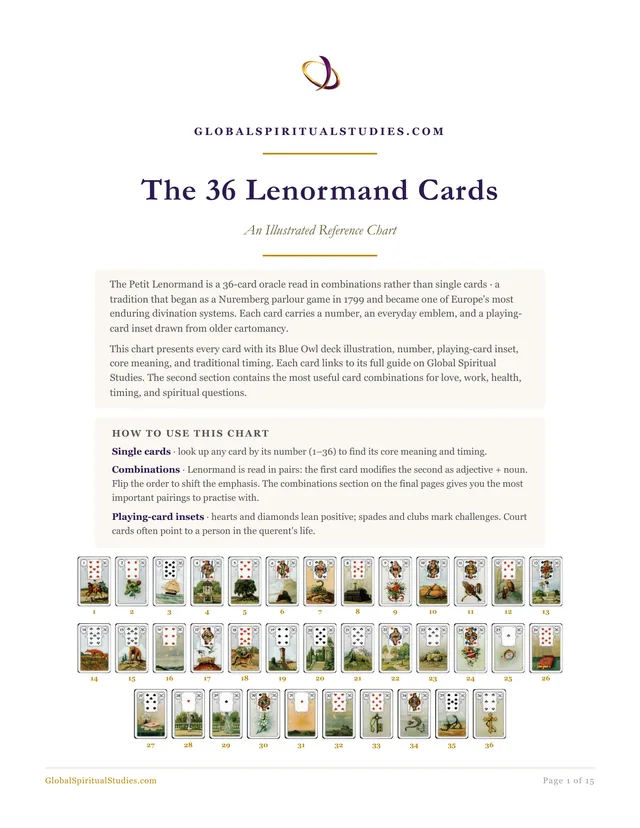
Half of what this combination can say depends on which sense of the Ring you are holding, and most keyword lists bury the second one. Our free 36-card Lenormand chart gathers the whole deck onto one printable page, so a card carrying two registers shows you both of them at once.
Heart + Ring
The feeling finds a form
Heart leading makes the affection the noun and the Ring the adjective. The sentence is this love becomes binding. Something felt acquires a shape it can be held in: an engagement, a decision to commit, a relationship crossing from private to declared. Every source surveyed for this page agrees on that much, and for this order they are right.
Two things it also means, both underused. The first comes from the Heart's wider range: what becomes formal need not be romantic. A reconciliation that finally sticks, a forgiveness acted on rather than felt, a friendship given a legal shape, a kindness written into an arrangement. The second comes from the Ring's circle: love that returns. The relationship that keeps starting again, the person who comes back. That reading is unwelcome next to the engagement one, and it uses exactly the same two cards.
Which applies is a question for the neighbours: the Sun or the Bouquet favour the formal reading, the Clouds, the Mice or the Crossroads the returning one.
Ring + Heart
The form is found to have feeling in it
Reversed, the Ring is the noun and the Heart describes it. The commitment is the given, and what is being reported is that there is warmth inside it. The sentence is this bond is a loving one. The distinction from the order above is not dramatic and it is real: one describes a feeling arriving at a structure, the other a structure that turns out to hold feeling.
This is the order in which a marriage, a partnership or a contract is characterised rather than predicted: a long relationship confirmed as still affectionate, or a business arrangement with real goodwill in it and not only terms. Taking the Ring's shadow, it is also an obligation the person is fond of, which is gentler and far commoner than either an ideal marriage or a trap.
Neither direction of this pair is a warning. Both cards are positive, and a page that turned one of them dark to make the contrast sharper would be inventing a difference. The genuine difference is which card is already true, and it changes what a reader should say: one order is news about a decision, the other is news about a condition.
The pair across five areas of life
| Area | Heart + Ring | Ring + Heart |
|---|---|---|
| Love | The headline reading: engagement, a formal step, a relationship being declared. With the Ring's cycle sense in play, also a love that returns rather than one that begins. | An existing relationship described as warm. Reassurance about a marriage or long partnership rather than an announcement about a new one. |
| Work | An agreement entered into because of the people rather than the terms. A partnership formed with someone you like, or a role taken for the colleagues. | A working arrangement that has goodwill in it. The contract renewed because the relationship is good, not because the paperwork demanded it. |
| Money | Finances becoming shared and formal: a joint account, a mortgage, money folded into a commitment. Neither card names a sum, so any figure comes from a Fish or a Bear nearby. | An existing financial tie with affection attached, which is also where generosity inside an obligation lives. Where a decision is involved, an independent professional perspective is the place for it. |
| Health | Care becoming a settled arrangement rather than an emergency. The German reading of the Ring as recurrence gives a second sense here, the long-running or returning matter, which English lists rarely carry. | The same recurrence seen from the other side, with the emphasis on the people rather than the condition. Cards describe circumstances, not bodies, and anything medical is a matter for a qualified professional. |
| Timing | The Ring closes the pair and governs the pace, and its answer is a shape rather than a date: cycles, anniversaries, the thing coming round. The count of 25 is a fallback. | The Heart closes the pair and governs, moving at the speed feeling moves, which is quick and sometimes abrupt. A count of 24 is usable. |
Heart and Ring in the Grand Tableau
Dealt together the pair reads as described above, the subject role falling to whichever card lies nearer the significator. These two are neighbours by number, which is not the same as neighbours on the board: in a six-by-six tableau house 24 closes one row and house 25 opens the next, so they sit at opposite ends of adjacent rows rather than side by side. Check the layout in front of you before reading them as close.
The Heart in house 25, the house of commitments, is love housed inside a formal bond: the feeling located in the marriage rather than outside it. The Ring in house 24, the house of love, is the mirror: commitment housed inside feeling, an agreement whose real basis is affection. Houses are fixed and cards are not, which makes the Grand Tableau the place where the order question genuinely has teeth.
There is a further placement rule for this pair, older than any of the above, and it is set out in the tradition notes below because it overrides order rather than refining it.

Where the traditions differ
On what the pair means, the sources barely differ at all: commitment with love in it, in every list surveyed for this page, English and German alike. The disagreements are about something more interesting, which is what actually decides the reading.
The oldest rule is about side, not order. The oldest instruction sheet these cards travelled with gives card 25 a placement rule and gives it in both directions: "on the right of the person it announces a happy and brilliant marriage", while far away and to the left it announces the separation of two loves. Same card, same pair, opposite verdicts, decided by where the Ring falls relative to the querent. The sheet's own preamble is explicit that every card takes its meaning from its distance to the two significators. That is a different method from the one this site teaches, not a competing gloss within it, and for this pair it is more consequential than the order question that dominates the modern web.
The cycle reading survives in German and thins out in English. German references keep the Ring as a literal circle, giving repetition, recurrence, permanence and endlessness, one extending it as far as long-running conditions. English lists name cycles among the keywords and then write the combination entries as though the card meant only marriage. The consequence is real: the reading in which a relationship keeps coming back rather than settling follows from the card's own meanings and is almost never offered.
Almost nobody separates the two orders. Most sources reviewed publish one entry and stop, and at least two print the same sentence under both cards. One dedicated combinations site does write the orders differently and in substance, putting feelings seeking a form on the Heart-first side and an existing bond recovering its emotional meaning on the Ring-first side, which is the distinction drawn above.
Our own card pages have been part of the problem, and it is worth saying so plainly. The Heart page states that the two orders carry different emphasis and then gives an identical sentence for each, and the Ring page repeats it. That is precisely the failure these combination pages exist to correct, and both are being brought into line.
On attribution the honest report is short. No published gloss on this exact combination could be verified under Greer's name or Rana George's, and the Matthews lexicon was not available in a legitimate copy, so none of the three is credited here beyond the method rule Matthews states publicly. Lisa Boswell is the best-sourced named reader on the pair. The rest of the reading above follows from the grammar and from the cards' own registers, which is Global Spiritual Studies house interpretation rather than inherited teaching.
One last piece of perspective. In the Game of Hope, the Nuremberg race game of about 1800, neither card meant what it means now. Landing on the Ring paid you three marks. Landing on the Heart sent you to offer it to the figure of the opposite sex, at square 28 or 29. Two adjacent squares, both good to reach, mechanically unrelated to each other. The engagement is a later reading laid over a board game.
A reading in three cards
A woman asks about a relationship that ended two years ago and has recently started again. The line comes out Stork · Heart · Ring.
Change is the subject, love describes it, and the Ring modifies everything built so far: a transition, an affectionate one, now taking a settled form. Read plainly the line supports the formal reading. But the Ring's second register is exactly the question she asked, so the honest reading holds both open. This may be a return that ends in a commitment, or a commitment to a pattern of returning, and the line as drawn does not choose between them.
Move one card. Stork · Ring · Heart reads differently: the change is to the commitment itself, and the warmth is the result. That is a bond being altered, renewed or renegotiated, with affection as the outcome rather than the starting point. Same three cards, and the first line is about two people getting somewhere while the second is about an arrangement changing shape.
What readers get wrong about this pair
Reading it as an announcement. Two positive cards describe a bond that is warm and binding. They do not undertake that a proposal is coming, and a reader who converts this pair into a date has added something the cards did not supply.
Dropping the circle. The Ring's cyclical sense goes missing precisely where it would be most useful, which is on a question about a relationship that keeps restarting. A card that means both this holds and this comes round again is saying something more specific than either alone.
Assuming romance. The Ring covers any binding agreement and the Heart covers kindness, forgiveness and reconciliation as well as love. Business partnerships, family reconciliations and formalised friendships all read on this pair, and defaulting to a wedding narrows a combination that is genuinely broad.
Arguing about order and ignoring position. In the oldest surviving instructions the thing that flips this pair from a happy marriage to a parting is which side of the person the Ring falls on. In a Grand Tableau that rule is still available, and it outranks the question most readers spend their time on.
Questions about Heart and Ring
Does the Heart and Ring combination mean engagement or marriage?
It is the most common reading and a fair one, particularly in the order Heart + Ring, where a feeling is shown taking a formal shape. It is a description rather than a promise, and the pair does not name a date. It also covers commitments that are not weddings, since the Ring means any binding agreement and the Heart covers reconciliation and kindness as well as romance. A partnership, a reconciliation made permanent, or a friendship given a formal shape all read on these two cards.
What is the difference between Heart + Ring and Ring + Heart?
Which of the two is already true. Heart + Ring makes the feeling the subject and the commitment the news, so it describes love arriving at a form. Ring + Heart makes the commitment the subject and the warmth the news, so it describes a bond that already exists and is found to have real affection in it. One is news about a decision, the other is news about a condition, and both are favourable.
Can the Heart and Ring combination be a bad sign?
Rarely on its own, since both cards are positive. Two cautions are worth knowing. The Ring also means the circle, so it can describe a relationship that keeps returning rather than one that settles, which is a different answer to the question most people are asking. And the Ring's shadow is obligation, a bond maintained because it is there rather than because it is wanted. Neither reading is available from the pair alone: the surrounding cards have to support it.
What does the Heart and Ring combination mean for timing?
That turns on which of the two falls second, because pace always follows the modifier. Heart + Ring finishes on the Ring, whose contribution to timing is a shape rather than a moment: cycles, anniversaries, the point at which something comes round again, with 25 as a fallback count. Ring + Heart finishes on the Heart, which moves at the speed of feeling and can be quick, with a count of 24. Neither card is a reliable calendar card, and the pair answers duration better than it answers date.
Does it matter where the Ring falls in a Grand Tableau?
More than the order does, according to the oldest surviving instructions for these cards. That sheet reads the Ring by its position relative to the querent's own card: to the right it announces a happy marriage, while far away and to their left it announces the separation of two loves. The same two cards therefore produce opposite verdicts depending on placement alone. If you are reading a full tableau rather than a two-card line, position is the first thing to check.
Related combinations
Browse the full Lenormand combination finder to look up any pair in the deck.
Learn Lenormand · explore our Lenormand courses with Mary K. Greer and Caitlín Matthews.
The best-known pairs are the ones most often read on autopilot, and this is the best known of all. The Complete Lenormand teaches what sits underneath the keyword, including the placement rules that decide a reading before order ever gets a say, so a familiar combination still tells you something you had not already assumed.