Coffin and Scythe
Coffin and Scythe carries a reputation as the worst two cards in the deck, and that reputation fits one order far better than the other. Dealt Coffin first, an ending is the subject and the Scythe says how it behaves: abruptly, with no notice and nothing to negotiate. Dealt Scythe first, the cut is the subject and the Coffin says what fell under it, which is where both of the published lists that separate the two orders put their lighter reading: an illness ending, a danger closed off, something long finished finally cleared. Neither direction forecasts anything about a person's life or health. Both describe circumstances, and the cards standing beside them decide how far the description reaches.
- Coffin + Scythe (8 + 10)
- An ending, described as sudden. Something closes without warning or preparation. One German reference also gives this order a plainly occupational reading: funeral work, or a job cut short.
- Scythe + Coffin (10 + 8)
- A cut, described by what it takes. The two lists that split the orders both put the relief reading here: an illness over, a danger ended, a thing removed that had already stopped living.
- The cards
- Coffin · card 8 · 9 of Diamonds · negative. Scythe · card 10 · Jack of Diamonds · negative.
- Yes or no
- No in both orders, for different reasons. Coffin first closes the thing being asked about. Scythe first may be answering about the obstacle instead, so check what the question actually named.
- Timing
- The second card sets the pace. Coffin + Scythe runs on the Scythe and arrives with no run-up. Scythe + Coffin runs on the Coffin, which counts in aftermath rather than in days.
The two cards
The Coffin is the card of things finishing, and its working range is wider than its picture: closure, loss, illness, grief, and the change that becomes possible once something is genuinely over. The literal reading is rare and our own reference material has always said so. The Lenormand Reader puts the same caution in public, describing the card as figurative far more often than not and leaving how final it is to the context of the question.
The Scythe is not the Coffin's twin, though the lists tend to file it that way. It is a tool rather than a state. It cuts, and it also reaps: sudden change, decision, danger, surgery, and harvest all belong to it. What the Scythe takes is taken at once and cleanly, which is a different claim from the Coffin's, where a thing ends and then takes its own time to finish being over.
So this is not two synonyms stacked on top of each other. It is an ending and an instrument, and which of them holds the subject position changes what the sentence is about. In the directional method used on this site, we read the first card as the subject and the second as its modifier. This pairing puts two unfavourable Lenormand cards together, which is most of why it gets written up as a doubling, but polarity describes mood rather than grammar and it does not decide which card is being described.
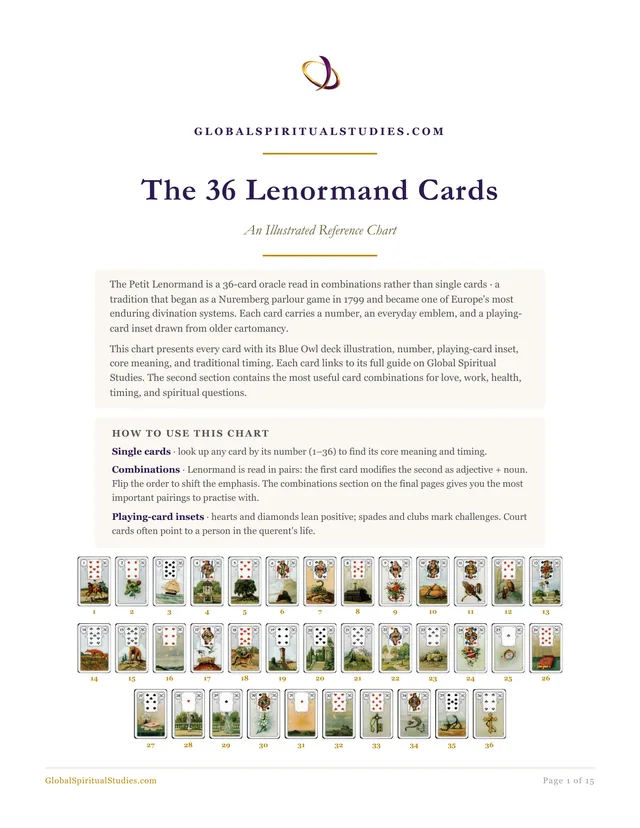
A heavy pair is exactly the one you want to read with the neighbours in view rather than from memory. Our free 36-card Lenormand chart puts every card's keywords, polarity, playing-card insert and Grand Tableau house on a single printable sheet, so the cards on either side of these two can do the work they are supposed to do.
Coffin + Scythe
The Coffin leads, so the ending is the noun. Something is closing, and the Scythe supplies the adverbs: suddenly, sharply, without consultation. The sentence is an ending that arrives at speed. Not a slow fading, not a decision anyone talked through, but a conclusion that lands before the people involved have finished preparing for it.
The register that comes with that is shock rather than sorrow. This order describes the phone call, the notice, the door closing while you were still mid-sentence. It says nothing about whether the ending was deserved, and it says nothing about who did it.
There is a second branch, and it is far more ordinary than the first. One German reference gives this order as the funeral trade, unemployment, or a person of morbid temperament: an occupation, a redundancy, and a mood. That is the Coffin read as a subject matter rather than an event, with the Scythe cutting a job away. Readers who only know the dread version tend to miss it entirely, and it turns up more often than the dramatic reading does.
Expect this order when the question concerns something that has been quietly ailing for a while and then stops without ceremony: a contract not renewed, a group that dissolves after one meeting, a routine that ends the week somebody leaves.
Scythe + Coffin
Reverse them and the noun becomes the cut. The Scythe is the event, and the Coffin describes what the event removed. The sentence is no longer an ending that happened suddenly; it is a severance whose object was already finished.
That is a real difference and it is not a softening. Lisa Boswell, one of the few writers to give the two orders separate entries, puts "the end of an illness" here, alongside breaking free from something that died long ago. A German reference in the same position gives an accident and a death, and, in the same breath, a danger being ended. So this order carries both the heaviest and the lightest readings in the pair, which sounds contradictory until you notice that they are the same grammar: a cut, named by what it took. Whether that is a relief depends entirely on what was on the block.
The practical test is the question. If the querent asked about something they have been carrying, Scythe first tends to describe its removal. If they asked about something they wanted to keep, the same two cards describe a loss. The cards are reporting an amputation without an opinion about the limb, and the reader supplies neither the opinion nor the prognosis.
This is also the order in which the Scythe's harvest sense stays available. A field is cut down at exactly the moment it is worth the most. Almost no combination entry in either language keeps that half of the card, and it belongs here more than anywhere.
The pair across five areas of life
| Area | Coffin + Scythe | Scythe + Coffin |
|---|---|---|
| Love | A relationship ending without a conversation. Also the quieter version: a phase of the relationship closing while the relationship itself continues. | A separation as an act rather than a drift. Someone has decided. Where the bond was already over in practice, this reads as the formality catching up. |
| Work | The strongest of the two here. A role ending abruptly, a project stopped, or, in the German lists, work in the funeral trade and time out of work. | A cut made to something already unproductive. Restructuring that removes the part nobody had used for a year. Harvest belongs here too: reaping a piece of work at its ripest. |
| Money | An income stream stopping without notice. The pair names the interruption and not its cause; any actual figure has to be read off the Fish, Bear or Mice standing nearby. | A deliberate closure: an account shut, a subscription cancelled, a liability finally discharged. The reading describes the act, and the decision about what comes next stays with whoever's money it is. |
| Health | Two negative cards in a health question describe circumstances, not a diagnosis and not a prognosis. Read as a situation that changed quickly and is now closed. Anything clinical is outside what cards can tell you. | The German lists read the blade and the box as a procedure and its aftermath, and Boswell reads the same order as an illness ending. Neither is offering medical information, only a picture of circumstances. |
| Timing | The second card governs the pace, so the Scythe sets it: no interval at all, an event rather than a period, arriving before it is expected. | The Coffin sets it instead, and the Coffin does not count in days so much as in stages. The pace is whatever an aftermath takes, and it is slower than the cut that started it. |
Coffin and Scythe in the Grand Tableau
Adjacent, the two cards keep the reading given above, and it is the third card that tips the outcome one way or another. Coffin, Scythe and Stars is an abrupt ending with something legible on the far side of it. Coffin, Scythe and Mice is the same ending followed by attrition, which is the version worth reading slowly.
Distance matters more here than on most pairs, because two dramatic cards attract each other in a reader's eye. If the Coffin and the Scythe sit several positions apart with unrelated cards between them, they are describing two different areas of the tableau: one thing ending in one part of the person's life, one sudden event somewhere else. Joining them across the table is a reading the cards did not offer.
The houses sharpen both placements. House 8 asks what is ending, so the Scythe landing there says the ending is itself the sudden event, with no lingering phase. House 10 asks what changes suddenly, so the Coffin landing there says the sudden change is a closure rather than a shock, which is a quieter answer than the house usually gets.
A footnote from the deck's origin, which is a board game rather than an oracle. In the rules of the Game of Hope, the Nuremberg parlour game the deck traces back to · advertised in 1799, though the surviving copy dates to sometime after 1800 · a player who lands on square 8 is treated as out of play until another player reaches that square or he throws a double, and he keeps rolling in the meantime. Square 10 has no rule attached at all: it is one of the sheets where the token simply stands quietly. The board's most feared square is a pause with two ways out, and the Scythe, two squares along, was harmless. None of that is a card meaning, but it is a useful corrective to a pair whose reputation has outrun its evidence.

Where the traditions differ
The disagreement is not about what these cards mean. It is about whether the pair has one meaning or two.
Most English-language references write the pair up once and apply that single entry regardless of which card led. Labyrinthos carries the same short string on its Coffin page and its Scythe page, glossing the pair as a sudden and painful ending. Our own repository is worse, and it is worth saying so plainly: it calls this the most devastating combination in the deck, in almost identical words in both directions, which is a ranking rather than a reading. The combination entries on both card pages have since been corrected to read the pair in order.
Two published sources do separate the orders, and they disagree with each other about which one is heavier. Lisa Boswell gives Coffin first as one death following another, refusing to see warning signs, and declining a surgery, and Scythe first as the end of an illness and the breaking of ties with something that died long ago. Madame-Lenormand.de runs the opposite way: Coffin first is the funeral trade, unemployment and a morbid man, while Scythe first is an accidental death and, in the same list, a danger ended. Neither states a rule about direction. They are two careful readers arriving at different splits, and the fact that both of them find a release reading somewhere in this pair is more useful than either split on its own.
Anna.K files a single entry and puts something in it that no other list carries: taking stock of a life in order to decide what to leave behind. That is a decision rather than a fate, and it is the least deterministic sentence written about these two cards anywhere.
The oldest written meanings are on the other side of the argument again, because they never used order at all. The earliest divinatory readings for these images belong to the instruction sheet of 1846 that travelled with the decks, and a New York paper, The Evening World, gave that sheet a full page when it reprinted it on 19 October 1903. There card 8 is graded by how close it lies to the person the reading is for, less dangerous the further away it sits. Card 10 it treats as a danger that lucky cards standing around it can avert. So the earliest text makes the Scythe conditional on its neighbours by design, which is a stronger version of the caveat modern pages add as an afterthought, and it makes proximity rather than sequence the thing to measure.
German practice adds a technique English lists do not use. Kartenorakel distinguishes the Coffin lying on the sharp side of the Scythe from the Coffin lying on its blunt side, giving a painful illness for one and a sudden one for the other. That is a geometric rule answering the same question card order answers, and it depends entirely on how a particular artist drew the blade. It travels no further than the deck it was written for, which is worth knowing before applying it from memory.
Neither Mary K. Greer nor Caitlín Matthews, both of whom teach here and have each authored a standard deck reference, has committed a directional ruling on this pair to print, which means nothing below carries their name. Linking the release reading to the Scythe-first order, and flagging that the two directions run at different speeds, is reasoning this site worked out from the grammar on its own.
A reading in three cards
A man asks what is happening with a business partnership that has been going nowhere for two years. The line comes up Scythe · Coffin · Anchor.
The cut is the subject. The Coffin says what it removes, and what it removes is the part that had already stopped working, not the whole arrangement. Then the Anchor, which does not undo any of that: it says what remains afterwards is stable. Read as a sentence, a decisive end to a dead portion of something, followed by a settled position. Nothing in the line says who moves first or whether he should be the one to move.
Deal the same three as Coffin · Scythe · Anchor and the sentence changes. Now the ending leads, the Scythe says it happens without warning, and the Anchor says the resulting state holds. That is a partnership that stops abruptly and stays stopped. Same three cards, same question, and the difference between a pruning and a full stop.
What readers get wrong about this pair
Reading it as a bereavement forecast. The pair names a closure and supplies no person, no cause and no date. Where a bereavement is genuinely in the reading it is usually one the querent has already suffered rather than one being announced, and questions about anyone's health belong with a clinician rather than with a card.
Treating a superlative as information. "The most devastating pairing in the deck" ranks the pair against thirty-four others without telling the reader a single thing about the situation in front of them. It is the sentence most often copied about these two cards and the least useful.
Losing the harvest. Half the Scythe's traditional range is reaping, and reaping is not destruction: it is taking something at the point where it is worth the most. That sense survives in almost no combination entry in either language, and it is the difference between a loss and a decision.
Assuming both orders are equally heavy. Every source that separates them finds one direction lighter than the other, even though they do not agree on which. A page that gives one gloss for both has silently made that choice for the reader.
Questions about Coffin and Scythe
Does the Coffin and Scythe combination mean a death?
No. These cards describe circumstances and make no prediction about anyone's life or health, and the older material is more cautious about literal readings than modern lists suggest. What the pair reliably names is a closure with a sharp edge on it: something finishing without a run-up, or something being cut away that had already finished. Where a death is present in a reading it is far more often one the querent has already lived through than one being forecast, and a health question is for a qualified clinician rather than for two cards.
What changes when you reverse the Coffin and Scythe combination?
Which of the two events is being described. Coffin first is an ending, and the Scythe tells you it arrives suddenly. Scythe first is a cut, and the Coffin tells you what fell under it, which is why that order can be a relief: the thing removed may be the thing that had already stopped working. Same two cards, one describing the manner of an ending and the other describing the object of a severance.
Is the Coffin and Scythe combination ever a good sign?
It can be, and the direction is where to look. Both published sources that give the two orders separate entries put a favourable reading somewhere in this pair: an illness ending, a danger closed off, ties broken with something that died long ago. Those readings sit with the Scythe leading. It is still an ending rather than an arrival, so the good news, when there is any, is the kind that comes from something finally being over.
Is the Coffin and Scythe combination a yes or a no?
A no in both orders, though not the same no. With the Coffin leading, the thing asked about closes. With the Scythe leading, the refusal may attach to an obstacle rather than to the querent's hope, so it is worth checking what the question actually named before reporting the answer. Neither direction is a maybe.
How quickly does the Coffin and Scythe combination play out?
Quickly in one order and slowly in the other, since whichever card lands second governs the pace here. Coffin + Scythe takes the Scythe's timing, which is not an interval at all: the traditional gloss is suddenly and without warning, arriving earlier than anyone planned for. Scythe + Coffin takes the Coffin's, and the Coffin counts in stages rather than days, so the cut may be instant while what follows it runs on for as long as an aftermath takes.
Related combinations
Every pair in the deck is indexed in our Lenormand card combinations guide, where you can look up any two cards together.
Learn Lenormand · explore our Lenormand courses with Mary K. Greer and Caitlín Matthews.
The heavy cards are where an unpractised method shows, because dread fills the gap that grammar should be holding. The Complete Lenormand teaches the system underneath the meanings · subject and modifier, neighbours, distance, houses and the full Grand Tableau · so that a pair like this one reads as a description of a situation rather than a sentence passed on it.