Ten of Swords
The Ten of Swords is a Minor Arcana Tarot card in the Suit of Swords, representing painful endings, rock bottom, and betrayal. It marks the absolute conclusion of a difficult cycle, where there is nowhere left to fall but toward recovery.
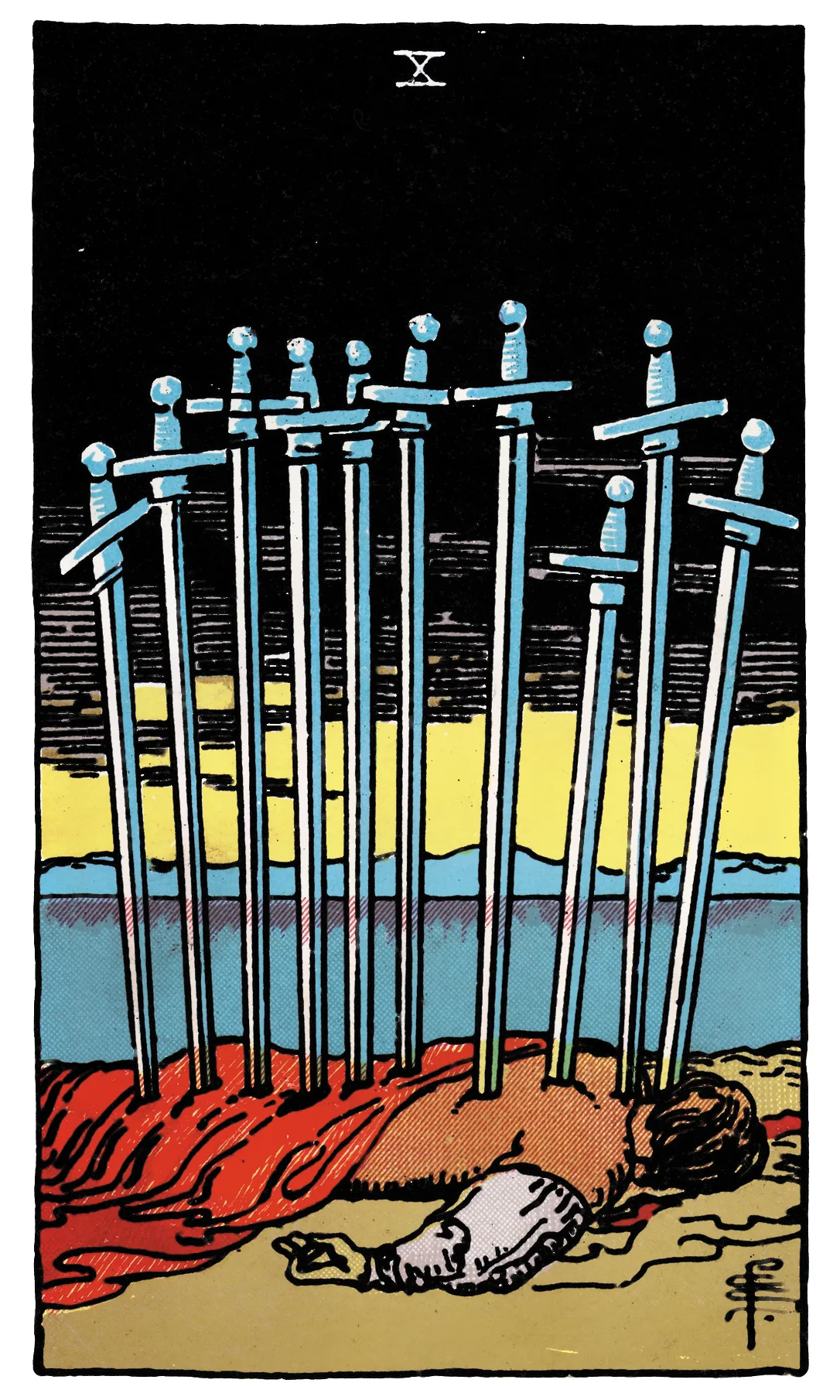
The Ten of Swords is the card of absolute ending, the moment when a painful situation reaches its definitive conclusion. In the Rider-Waite-Smith image, a figure lies face down on the ground with ten swords embedded in their back. The sky is completely black, but along the horizon, a band of golden light appears, and calm water stretches into the distance. This is the darkest card in the Swords suit, and perhaps the most dramatic image in the entire minor arcana. Yet the golden dawn on the horizon is not accidental. Waite and Smith deliberately included this detail to convey the Ten's essential message: this is the end, but it is not the end of everything. The worst has happened. You have hit the absolute bottom. And because you have, the only remaining direction is up. Sun in Gemini gives this card its quality of conscious suffering: you are aware of exactly what you have lost, exactly how bad things are, and exactly how you arrived here. The awareness itself is a form of cruelty, but it is also the beginning of wisdom.
At a Glance
| Attribute | Detail |
|---|---|
| Suit | Swords |
| Traditional Names | RWS: Ten of Swords · TdM: Ten of Swords · Thoth: Ruin |
| Element | Air |
| Zodiac / Planet | Sun in Gemini |
| Upright Keywords | painful ending, rock bottom, betrayal, loss, crisis, hitting the wall |
| Reversed Keywords | recovery, regeneration, surviving the worst, rising again, lessons learned |
Free printable chart: see the complete Minor Arcana chart · all 56 cards with upright and reversed meanings, suit, and element at a glance.
Visual Traditions: Three Decks
The Minor Arcana's imagery varies significantly across the three major traditions. Understanding these differences deepens your reading of any deck.
Rider-Waite-Smith (1909) · The image shown above.
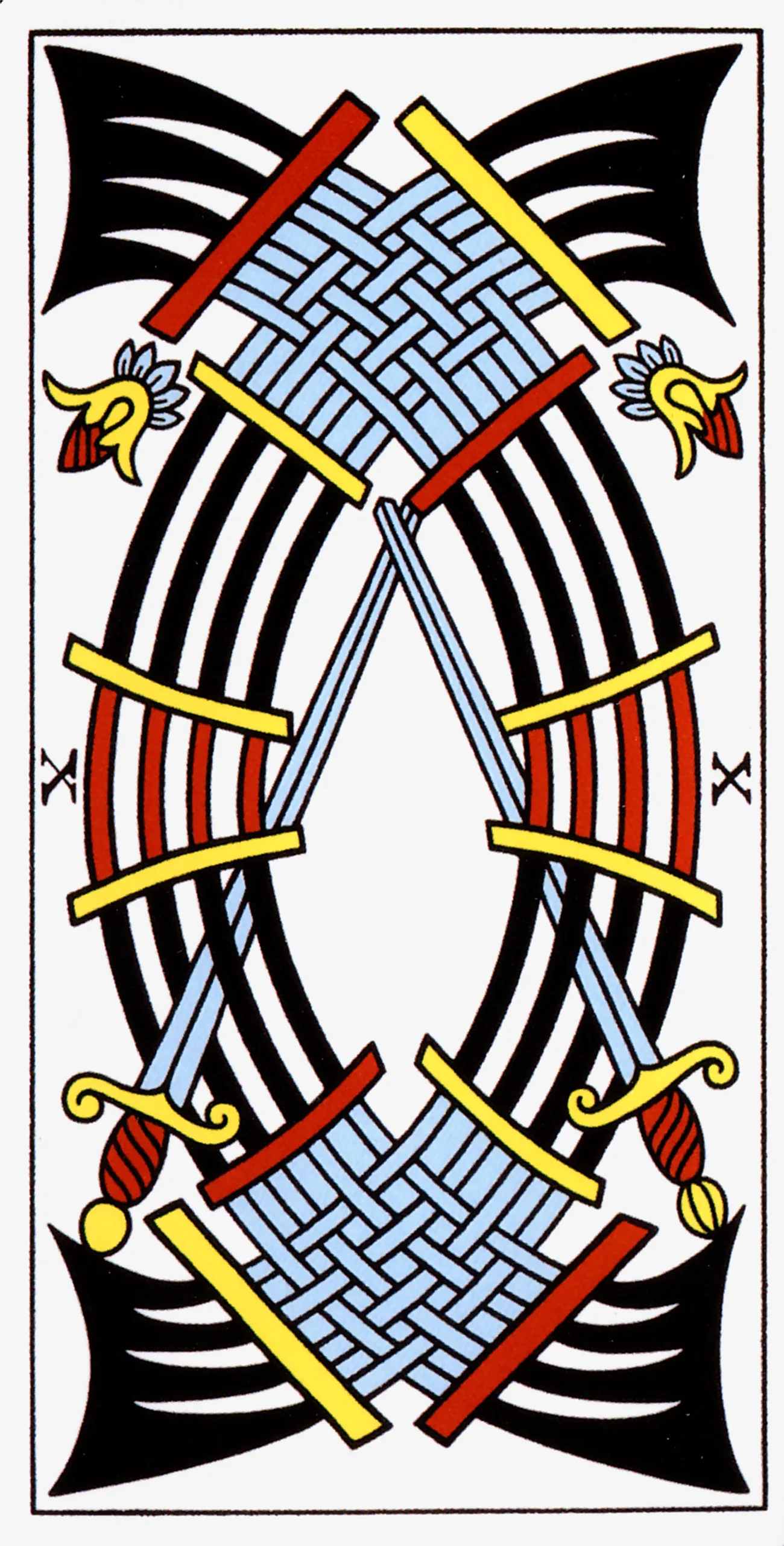
Tarot de Marseille (17th-18th century) · The Marseille Ten of Swords fills the card completely with ten densely packed blades, leaving virtually no space for ornamentation. The sheer number of swords creates a visual field of nothing but sharp edges, a suffocating density of mental force that has reached its maximum concentration. The TdM version presents the Ten's theme as absolute saturation: the suit has accumulated all the mental energy it can contain, and the result is overwhelming rather than powerful. The geometric overload mirrors the psychological state of a mind that has taken in more than it can process, reaching the point where the only possibility is release.
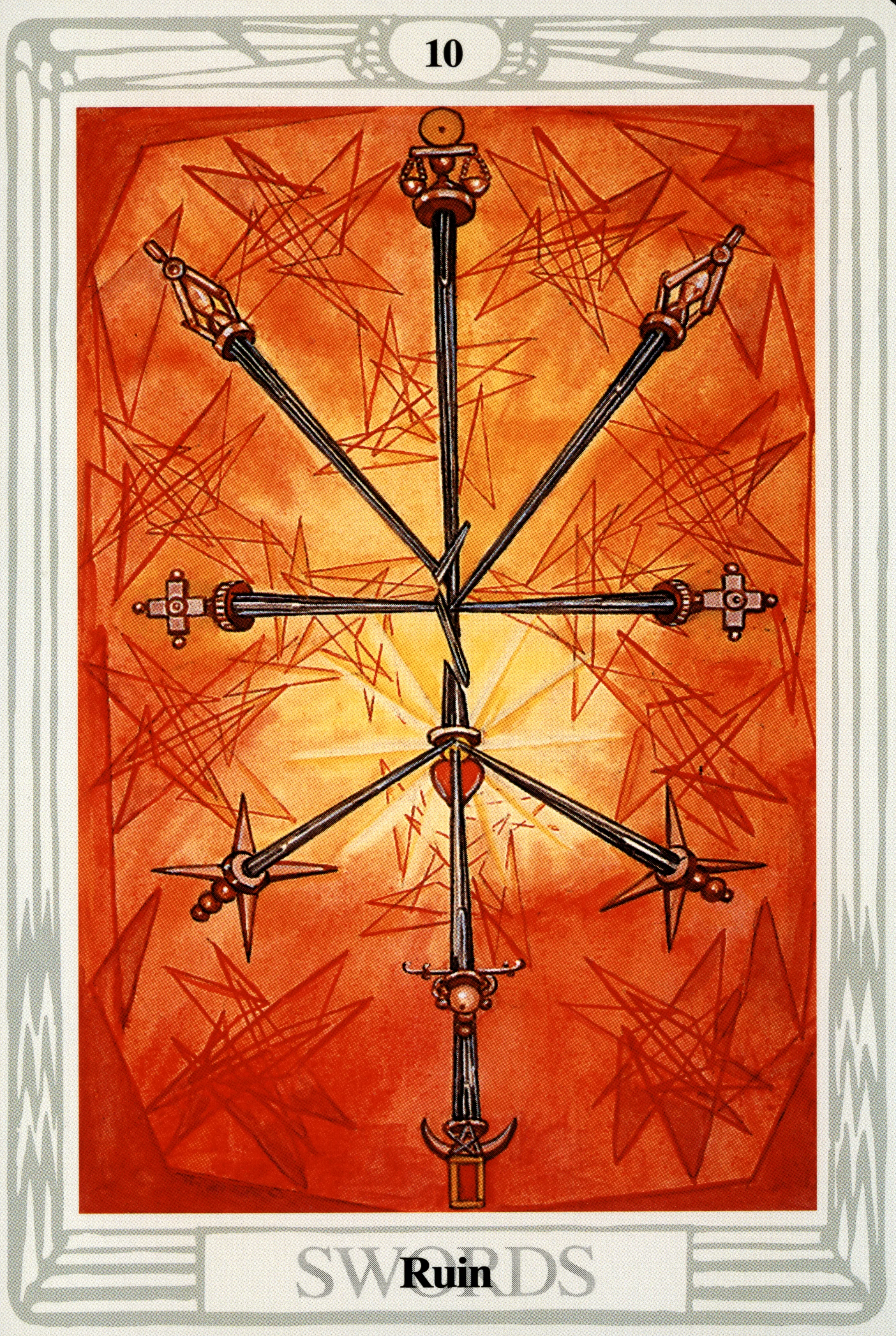
Thoth Tarot (1943) · Crowley titled this card Ruin, associating it with Sun in Gemini. Ten swords of various sizes lie broken and scattered in complete disarray. The central blade, once the largest, has been shattered at the hilt. The background is dark with the faintest suggestion of dawn at the edges, acknowledging that even total mental ruin contains the seed of renewal. Harris painted the card with a quality of exhausted finality: the battle is over, the swords are destroyed, and nothing remains to fight with or fight about. The Sun-in-Gemini attribution is paradoxical: the planet of life and consciousness in the sign of mental duality produces a state where awareness itself becomes the source of suffering. Knowing too much, seeing too clearly, understanding the full extent of the damage. These are the cruelties of the Sun in its fall.
Key Imagery and Symbolism
The figure lying face down with ten swords in the back is the most striking image in the minor arcana. The number ten is significant: this is not a single wound but a comprehensive one. The suit has exhausted its capacity for inflicting mental pain. There is nothing worse left to experience. The black sky dominates the upper portion of the card, representing the totality of the darkness. But the golden light on the horizon is equally important, and easily overlooked. It is thin, fragile, barely visible against the overwhelming darkness, but it is there. This is the card's hidden promise: dawn follows the darkest hour. The calm water in the distance suggests that peace exists, somewhere beyond this moment of complete defeat. The figure's hand forms a gesture of blessing or acceptance, two fingers extended, as though even in this moment of total prostration, something sacred is being acknowledged. The red cape covering the figure evokes sacrifice and the shedding of blood. The flat, featureless ground conveys the experience of rock bottom: there is nowhere lower to fall, and therefore nothing left to fear. If this card unsettles you, our guide to the 'scary' Tarot cards explores how to work with the Ten's energy as a gateway to renewal.
What Ten of Swords Means
Upright
The Ten of Swords upright marks a definitive, painful ending. Something is over: a relationship, a project, a belief, a phase of life, an illusion. The ending feels catastrophic, and in many ways it is. This card does not minimize the severity of the loss. Ten swords, not one or three but ten, have penetrated the figure's back. The pain is comprehensive and the defeat is total. Yet the Ten contains a paradox that is essential to its meaning: because the worst has already happened, the fear of it happening can finally stop. The Nine's agonizing anticipation gives way to the Ten's grim certainty. There is a strange relief in hitting bottom. You no longer need to worry about falling because you have landed. The Sun-in-Gemini energy ensures that you understand fully what has happened. This is conscious suffering, not numb shock. You see the damage, you feel the loss, and you know precisely how things reached this point. While this awareness is painful, it is also the foundation for genuine rebuilding. The golden light on the horizon is real. It is small, but it is there. The Ten of Swords does not end in permanent darkness. It ends in the first moment of a new dawn.
Reversed
Reversed, the Ten of Swords signals that the worst is over and recovery has begun. You have survived what you feared most, and you are beginning the slow process of pulling yourself off the ground. The swords are loosening, the sky is brightening, and the numbness of rock bottom is giving way to the first stirrings of renewed vitality. This reversal often marks a turning point: the moment when you stop identifying as a victim of circumstance and begin reclaiming agency over your narrative. In some readings, the reversed Ten suggests that a situation you feared would be catastrophic turns out to be less devastating than anticipated. The ten swords were visible, but several missed the mark, or the fall was shorter than expected. The reversal can also indicate resistance to accepting an ending. You may be clinging to something that has clearly concluded, hoping to revive a relationship, a project, or a belief that has already died. The Ten counsels acceptance. Resurrection requires death. New growth requires that the old be released completely.
How Position and Surrounding Cards Shift the Meaning
The Ten of Swords changes meaning dramatically with its neighbors. Paired with The Sun or Ace of Swords, the emphasis shifts from ending to rebirth, the dawn after the darkest night. Near The Tower, the collapse is sudden, violent, and externally imposed rather than gradually accumulated. With The Wheel of Fortune, the ending is part of a natural cycle: what goes down will eventually rise again. Beside Death, the message doubles: transformation through radical ending, the old self dying so something fundamentally new can emerge.
Suit Element: Swords
Air in the Ten of Swords has reached its ultimate extremity: the mind overwhelmed by the full weight of truth, understanding, and the consequences of the suit's accumulated journey. Sun in Gemini illuminates every aspect of the defeat with merciless clarity, leaving nothing hidden, nothing softened, nothing unexposed. In Kabbalistic terms, the Ten corresponds to Malkuth (Kingdom) in Yetzirah: the final manifestation of mental energy in the material world. All of the Swords suit's themes, clarity, conflict, pain, and truth, have fully materialized. There is nowhere further to go. The cycle is complete, and the next movement must begin from the Aces of a different register.
Numerology
Ten represents completion, culmination, and the point where a cycle's energy is fully expended. In the Swords suit, this means that the intellectual and communicative energy has run its complete course: from the Ace's breakthrough through the middle cards' conflicts and anxieties to this final, exhausted collapse. The number ten is simultaneously an ending and a potential beginning, as one plus zero returns to unity. The Ten of Swords is the compost from which new mental life will eventually grow.
Ten of Swords in Love, Work, and Health
Love and Relationships
In love readings, the Ten of Swords typically signals a definitive relationship ending. This is the breakup that is truly final, the betrayal that cannot be reconciled, or the moment when both partners recognize that attempts to save the relationship have been exhausted. The card validates the depth of pain involved while also pointing to the golden horizon: this ending, however devastating, creates the conditions for eventual new love. Clinging to what has ended will only prolong the suffering. Reversed, the card suggests the first fragile steps toward emotional recovery after a significant loss.
Career and Finances
For career questions, the Ten of Swords can represent a job loss, business failure, professional humiliation, or the collapse of a career path that has been pursued to exhaustion. The card does not soften the blow: this is a genuine professional setback. But it also confirms that continuing on the previous path was no longer viable. The ending, while painful, clears space for a fundamentally different professional direction. The card favors radical career reinvention rather than trying to rebuild what has fallen.
For students exploring the Swords cards in depth, Mary K. Greer's course Hidden Stories of the RWS Minor Arcana reveals the hidden symbolic narratives within each RWS Minor Arcana card, connecting visual details to deeper layers of meaning.
Health and Wellbeing
In health readings, the Ten of Swords can indicate a health crisis that brings an unsustainable pattern to its conclusion, a burnout that forces genuine rest, an injury that demands complete lifestyle change, or the rock-bottom moment that finally motivates serious health intervention. The card's association with the back connects to spinal health, posture, and the physical manifestation of carrying too much stress for too long. The golden dawn on the horizon promises that recovery, while slow, is genuinely possible.
Card Pairings and Relationships
Every Minor Arcana card takes on different dimensions depending on its neighbours. These pairings are not fixed rules but starting points for interpretation.
Ten of Swords + The Sun: Rebirth after total defeat. The Sun's brilliant light appears on the Ten's horizon, confirming that the ending leads to genuine renewal, joy, and a new beginning in full daylight.
Ten of Swords + Ace of Swords: A completely fresh mental start. The Ace's new clarity rises from the Ten's ashes, offering a breakthrough understanding that could not have arrived without the preceding collapse.
Ten of Swords + Death: Double transformation. Death and the Ten together create the most powerful ending-and-rebirth combination in Tarot. The old must die completely for the new to emerge.
Ten of Swords + The Wheel of Fortune: The cycle turns. The Wheel reminds the Ten that what has fallen will eventually rise, and that this nadir is a natural part of a larger pattern of change.
Ten of Swords + The Tower: Catastrophic conclusion. The Tower's sudden destruction combines with the Ten's exhausted finality, indicating a dramatic, externally imposed ending rather than a gradual decline.
Ten of Swords + The Star: Healing after devastation. The Star's gentle light is the first thing visible from the Ten's prostrate position, offering hope precisely when it is most desperately needed.
Ten of Swords + Nine of Swords: The anxiety materializes. The Nine's worst fears appear to have come true in the Ten's collapse. But paradoxically, the reality may be more bearable than the anticipation.
Ten of Swords + Judgement: Resurrection from defeat. Judgement's clarion call raises the figure from the Ten's ground, summoning renewal and a new sense of purpose from the depths of apparent ruin.
Ten of Swords + Four of Swords: Recovery from total defeat. The Four's healing rest is the immediate remedy the Ten demands. Before anything can be rebuilt, the body and mind must be restored.
Ten of Swords + Ace of Wands: Creative fire rises from mental ruin. A completely new inspiration appears in the aftermath of the Ten's devastation, suggesting that creative energy can emerge from the most barren ground.
Related Cards
- Nine of Swords · The Nine's agonizing anxiety directly precedes the Ten's definitive collapse. The anticipation of disaster gives way to the disaster itself.
- The Tower · Both cards represent dramatic, painful endings. The Tower falls suddenly; the Ten collapses under accumulated weight. Both contain seeds of renewal.
Death · Both cards deal with necessary endings that precede transformation. Death is a universal principle; the Ten is its manifestation in the mental realm.
The Sun · The Sun is literally visible on the Ten's horizon, representing the renewal and joy that follow the darkest moment of the Swords journey.
- Ace of Swords · The Ace represents the fresh mental beginning that becomes possible once the Ten's cycle has been fully completed.
The Star · The Star's healing hope is the first resource available after the Ten's total collapse, the gentle light that makes recovery conceivable.
Judgement · Judgement raises what the Ten of Swords has laid low, calling forth renewal and purpose from the ground of total defeat.
- Three of Swords · The Three's heartbreak is the miniature of the Ten's devastation. Both deal with mental/emotional pain, but the Ten takes it to its absolute extreme.
- The Wheel of Fortune · The Wheel reminds us that the Ten's nadir is part of a cycle: what has reached bottom will eventually turn upward again.
Explore the Minor Arcana Further
Ten of Swords is one of 56 cards in the Minor Arcana, and its meaning deepens when read alongside the cards that surround it. If you are drawn to the practical and psychological dimensions of the Tarot, these courses offer a guided path from first reading to professional skill.
Recommended courses:
- Reading Tarot Reversals · Twelve methods for reading reversed Tarot cards · Taught by Mary K. Greer
- Hidden Stories of the RWS Minor Arcana · The symbolic narratives hidden within each Rider-Waite-Smith Minor Arcana card · Taught by Mary K. Greer
For the complete guide to all 56 Minor Arcana cards, visit The Minor Arcana: Complete Guide.
For a comprehensive introduction to reading all 78 Tarot cards, see How to Read Tarot Cards: A Complete Guide.
Go deeper · explore our Tarot courses with Mary K. Greer, Rachel Pollack and more.