Path of Aleph · The Fool
Path 11 · Kether to Chokmah · The Breath of Spirit
Path 11, the Path of Aleph, is the first of the twenty-two paths on the Kabbalah Tree of Life. It connects Kether (the Crown) to Chokmah (Wisdom) and corresponds to The Fool, card 0 of the Major Arcana. As one of the three Mother Letters, Aleph is the element of Air, the breath of pure spirit descending from unity into the first creative impulse of being.
Watch Evelynne Joffe teach this path
Of all twenty-two paths, Aleph is the closest to the source. It carries no number you can stand on, no fixed identity to defend. The Fool walks the edge of the cliff because the cliff has not yet been drawn. To meditate on this path is to inhale before the first word of creation, to feel the moment before separation, when everything that will ever exist still rests inside the silence of Kether.
If some of the terms in this guide are new to you, let them be new. We will walk slowly through each one, not as a test of knowledge but as a way of listening to the symbol more deeply. You do not need to arrive already initiated to read what follows.
A note on tradition: Kabbalah has deep Jewish mystical roots reaching back more than two thousand years. This guide focuses on the Western Qabalah and Tarot correspondences that developed later through the Hermetic tradition and the Golden Dawn. The two streams overlap and inform each other, but they are not identical. Wherever a teaching is specific to one tradition, we will name which one.

Featured Program · The Whole Tree
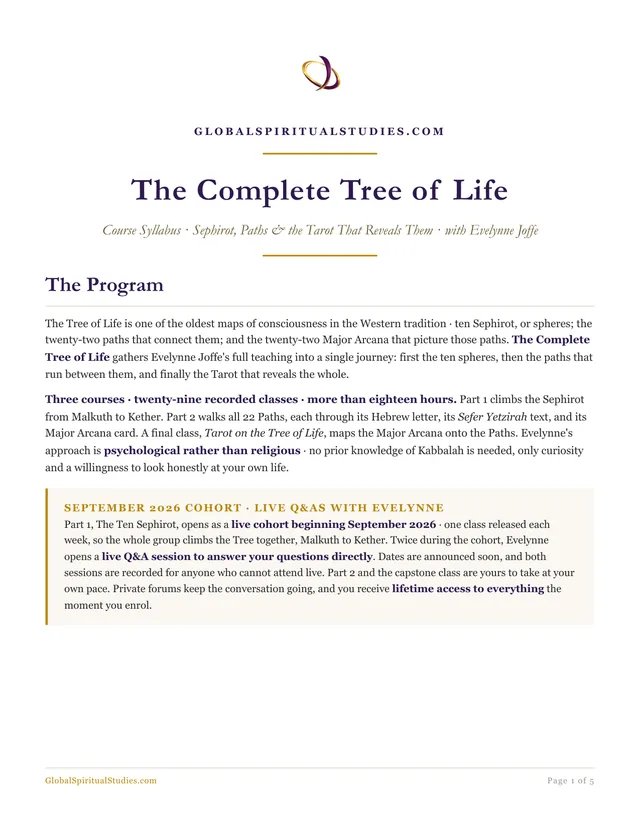
The Complete Tree of Life
Sephirot · Paths · Tarot on the Tree · with Evelynne Joffe
Three courses in one program: Part 1’s eight classes on the Ten Sephirot with their two recorded Q&As, Part 2’s twenty classes on the twenty-two Paths with the 2026 Cohort’s two live Q&As, and Tarot on the Tree of Life. You climb in order, the Sephirot first and then the Paths that join them.
- Three courses
- 29 classes
- Four Q&As (two recorded, two live)
- Three certificates
- Handouts & transcripts
- Lifetime access
What Is the Path of Aleph?
The Path of Aleph is the line drawn between the first and second Sephiroth on the Tree of Life. In Kabbalistic cosmology, every path represents not a static thing but a movement: the experience of travelling between two states of consciousness. Path 11 is the experience of moving between the absolute unity of Kether and the first flash of differentiation that becomes Chokmah.
It is sometimes called the Scintillating Intelligence in the Sefer Yetzirah, the oldest Kabbalistic text. Other traditions name it the Fiery or Fluttering Intelligence. The translations differ, but the image is consistent: a flicker, a sudden brightness, the smallest possible motion within stillness. This is what a single breath looks like when seen from eternity.
In the Western Qabalah tradition formalised by the Hermetic Order of the Golden Dawn in the late nineteenth century, this path was assigned to the Hebrew letter Aleph and to The Fool of the Tarot. The assignment is not arbitrary. The Fool steps off the cliff of Kether trusting the air to hold him, which is exactly what Aleph does: it carries the breath of the divine into form without knowing what form will arise.
Because it is the highest path that begins from Kether, the Path of Aleph lies entirely above the Abyss, the great gulf between the Supernal Triad (Kether, Chokmah, Binah) and the seven lower Sephiroth. This makes it both the first path numerically and the most rarefied experientially. It is rarely the first path a student works with practically, even though it sits at the top of the Tree.
Correspondences at a Glance
| Attribute | Correspondence |
|---|---|
| Path Number | 11 (the first path) |
| Hebrew Letter | Aleph (א) |
| Letter Type | Mother Letter (one of three) |
| Letter Meaning | Ox; the silent breath that carries speech |
| Numerical Value | 1 |
| Tarot Card | 0 · The Fool |
| Element | Air |
| Sephiroth Connected | Kether (1) ↔ Chokmah (2) |
| Sefer Yetzirah Title | Scintillating Intelligence (or Fluttering Intelligence) |
| Direction Crossed | Entirely above the Abyss · within the Supernal Triad, on the right side |
| Pillar | Joins Middle (Equilibrium) to Right (Mercy) |
| Body Correspondence | The breath; the lungs and chest |
| Colour (Queen Scale) | Sky blue |
The Hebrew Letter Aleph
Aleph (א) is the first letter of the Hebrew alphabet and one of the three Mother Letters. The Mother Letters in Kabbalistic tradition are the three letters from which all other letters proceed: Aleph (Air), Mem (Water), and Shin (Fire). Together they represent the three primary states of being from which the seven Double letters (the planets) and the twelve Simple letters (the zodiac) emerge.
The pictographic origin of Aleph is an ox, a creature whose strength quietly carries everything. But the deeper teaching of Aleph is that it is the silent letter. Aleph carries no sound of its own. It is the breath that comes before any word, the inhalation that makes speech possible. In Genesis, when God speaks the world into being, the very first thing required is the breath that will shape the words. That breath is Aleph.
Numerically, Aleph equals 1, which links it to Kether and to absolute unity. Some Kabbalists note that Aleph is structurally composed of two Yods (the smallest letter, often called the divine spark) joined by a Vav, the letter whose name means "nail" or "hook" and whose function is to fasten one thing to another. So the form of Aleph itself contains the entire Tree of Life: a higher Yod, a lower Yod, and the line that fastens them together. In this reading, every Aleph is a tiny diagram of the cosmos.
In the Sefer Yetzirah, the Mother Letter Aleph is said to be sealed into the chest as the seat of breath. To meditate on Aleph, the tradition says, is to rest one's awareness in the place where breath becomes word and word becomes world.
The Fool: Tarot Correspondence
The assignment of The Fool to the Path of Aleph was made by the Golden Dawn in the late nineteenth century, drawing on earlier hints in continental occult Tarot. Before the Golden Dawn, Éliphas Lévi and others had matched the Hebrew alphabet to the Major Arcana in various orders. The Golden Dawn's version, where The Fool corresponds to Aleph and stands as the first path, has become the standard in modern Western Qabalah.
The match is symbolically dense. In the Rider-Waite-Smith Tarot, the Fool stands at a cliff edge, a small dog at his heels, a white rose in one hand, a satchel containing the four elements over his shoulder. He is numbered 0, which in tarot signifies not nothing but unbounded potential, the state before any choice has been made. The morning sun rises behind him: the light of Kether breaking into form.
Several details on the card map directly to the Kabbalistic teaching:
- The cliff edge. The Fool stands at the boundary of the Abyss. The path of Aleph runs along the far rim of that gulf rather than across it, joining Kether to Chokmah while the drop still lies below. The Fool does not see the cliff because, from the perspective of Kether, there is no cliff yet.
- The number 0. Zero is mathematically not the same as Aleph's value of 1, but conceptually they meet: Aleph is the silent unity, and 0 is the unbroken circle, both signifying wholeness before division.
- The white rose. The five-petalled white rose carries multiple symbolic loads, but in Kabbalah it can suggest the Quintessence: the spirit that holds the four elements together. The Fool carries the seed of all four worlds in a single bloom.
- The dog. The dog is animal nature, instinct, the part of the soul (Nefesh) that has not yet ascended. It accompanies the Fool but does not lead him. On the Path of Aleph, instinct trusts spirit.
- The mountains in the distance. The peaks suggest the heights yet to be travelled, the further reaches of the Tree. The Fool has only just begun.
A.E. Waite, who designed the deck with Pamela Colman Smith, wrote of the Fool that "his act of folly will lead him to the place of his initiation." This is precisely the function of Path 11 on the Tree: the trust that lets one cross from absolute being into the first stirring of becoming.
Air: A Mother Letter
Aleph governs the element of Air. In the elemental scheme of the Mother Letters, Air sits between Fire (Shin) and Water (Mem). It is the mediating, balancing element, the one that allows the other two to coexist without cancelling each other out. Without air, fire suffocates and water has no atmosphere to evaporate into.
In tarot, Air is the suit of Swords: the realm of intellect, communication, the cutting edge of thought. But on the Path of Aleph, Air is something subtler than analytical mind. It is ruach, the Hebrew word that means both "wind" and "spirit" and which also names the second level of the human soul, the seat of moral consciousness and emotional life. The Path of Aleph is the descent of ruach from its source into the first form it can inhabit.
In the Four Worlds system of Kabbalistic cosmology, Air corresponds to the world of Yetzirah, the world of formation, where archetypal pattern becomes specific structure. To walk the Path of Aleph in meditation is to follow the breath as it moves from formless source into formed expression, to feel the moment when something that was nothing begins to be something.
Kether to Chokmah: What This Path Connects
Path 11 joins the first and second Sephiroth: Kether and Chokmah. Both belong to the Supernal Triad above the Abyss, but they could not be more different in character.
Kether is unity, stillness, the closest emanation to Ein Sof (the Infinite). It has no division within it, no movement, no quality that can be named. To experience Kether directly is to experience the dissolution of the experiencer. Its divine name is Eheieh, "I Am," the same name God speaks to Moses from the burning bush.
Chokmah is the first flash of something. It is masculine, dynamic, the active force. If Kether is the silent ground, Chokmah is the first idea that shoots up from it: the original creative impulse, the divine word before it has any specific content.
The Path of Aleph carries the energy from one to the other. In the descending direction (which is how creation moves), it is the moment when undifferentiated being becomes the first principle of motion. In the ascending direction (which is how the human consciousness returns), it is the dissolution of even the first idea back into pure presence.
Geometrically on the Tree, Aleph runs from the top of the Middle Pillar (Kether) to the top of the Right-hand Pillar of Mercy (Chokmah). It is a diagonal path, not a descending one, which marks it as a path of relationship rather than transmission. Kether and Chokmah are not parent and child here. They are two aspects of one originating reality, in dialogue.
Pathworking and Meditation
Pathworking is the meditative practice of imaginatively travelling a path on the Tree of Life. It typically combines breath, visualisation, and reflection on the path's symbols. The Path of Aleph is not a beginner's pathworking, because it deals with states of consciousness so close to the source that they tend to dissolve the boundaries the practitioner relies on for orientation. Most teachers recommend working upward from Malkuth through the lower paths first.
That said, anyone can sit with the symbols of Aleph as a contemplative exercise.
An Exercise · Sitting with Aleph
Sit comfortably with your spine upright. Place a Tarot card of The Fool in front of you, or simply visualise the Hebrew letter Aleph (א).
Bring your attention to your breath. Do not control it. Just notice it: the inhalation, the small pause at the top, the exhalation, the small pause at the bottom.
After a few minutes, narrow your attention to the pause at the top of the inhalation, the moment when the breath has fully entered and has not yet begun to leave. Rest there. This is the place where the Path of Aleph touches the body. Kether is the silence. Chokmah is the breath about to move. Aleph is the line between them.
If thoughts arise, do not push them away. Watch them rise like the Fool stepping off the cliff: with trust, with attention, without fear of where they will land. After ten or fifteen minutes, let your attention return to ordinary breath. Note anything that arose. The path has begun to work even if nothing dramatic seems to have happened.
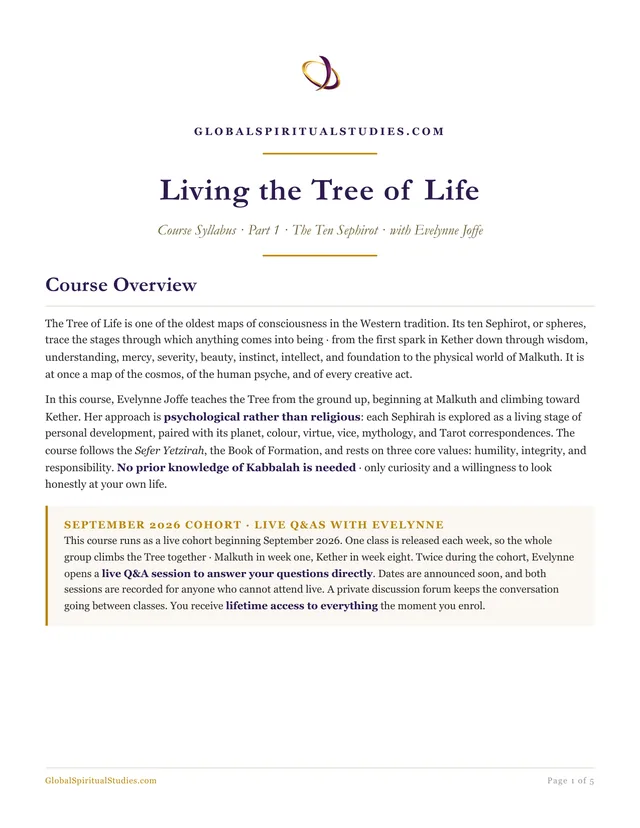
Practitioners working in the Golden Dawn tradition often pair the meditation with the colour sky blue, the Queen Scale colour of Aleph, and with the divine name Eheieh vibrated at the top of the breath. Evelynne Joffe, in her Living the Tree of Life: The Paths course at Global Spiritual Studies, teaches a more contemporary form of pathworking that uses guided imagery rather than ceremonial methods, but the contemplative core is the same: rest in the place where breath meets stillness. Her course includes recorded audio guidance for several of the upper paths if you would prefer a teacher's voice to lead you rather than working from a written exercise alone.
The Fool in a Tarot Reading
When The Fool appears in a Tarot reading, the path of Aleph is being invoked in the querent's life. The card asks: Where are you being called to begin again, with no map?
The Fool is not foolishness in the colloquial sense. It is the willingness to step off the known and into the not-yet-known with one's full attention. The Fool is the beginning of every journey on the Tree, including the journey of a single Tarot reading. Some readers will treat The Fool as a card outside the sequence, the wanderer who walks through all the other cards.
In context, The Fool tends to indicate:
- The opening of a new chapter that cannot be planned in advance. A new relationship, project, or path that requires faith more than information.
- The willingness to look foolish in pursuit of something true. Often this means stepping out of an identity the querent has outgrown.
- A reminder of original innocence, the part of the self that still trusts the unknown. In trauma-aware readings, the Fool can signal a return to that capacity after a long absence.
- Reversed, The Fool can indicate naïveté disconnected from grounding, or refusal to begin out of fear of being wrong. The path is not flowing.
Read alongside its Kabbalistic correspondence, The Fool reminds the querent that the highest source is closer than they think, and that the next step does not require the next ten steps to already be visible. The Path of Aleph teaches that the cliff is drawn after you step.
Common Misconceptions
"The Fool is the beginning of the Major Arcana, so the Path of Aleph must be the beginning of the spiritual journey." The Path of Aleph is the first path numerically, but it is not the entry point of the Tree from the human side. Practitioners traditionally begin at Malkuth and ascend. The Path of Aleph is among the highest, not the most accessible.
"Aleph means 'one,' so the path is about unity." Aleph numerically equals 1, but its meaning as a path is closer to the breath that bridges. Unity belongs to Kether. Aleph is the relationship of unity to its first articulation.
"All occult traditions agree on the Aleph · Fool correspondence." They do not. The Continental occult tradition (Lévi, Papus) sometimes assigned The Fool to Shin or placed it between Judgement and the World rather than at the beginning. The Aleph · Fool pairing is specifically a Golden Dawn formulation. Crowley's Thoth deck preserves this assignment but reinterprets the Fool quite differently. Knowing which system you are working within matters when reading older Tarot books.
"The Path of Aleph is dangerous to meditate on." Sitting with the symbols of Aleph as a contemplative exercise is safe and rewarding. What experienced teachers caution against is doing intensive ritual pathworking on the Supernal paths without first establishing a stable practice on the lower paths. The caution is not about danger so much as about disorientation: the upper paths can produce experiences the practitioner has no framework to integrate.
Recommended Courses
For students who feel drawn not only to understand these symbols but to enter them through guided practice, Evelynne Joffe's teachings offer a steady and deeply experienced path. Her work has shaped how the Tree of Life is taught at Global Spiritual Studies, and her courses are the natural next step after this guide.
Twenty recorded classes covering all twenty-two paths in depth, including the Path of Aleph. Joffe walks through the Hebrew letter, the Tarot card, and the experiential meaning of each path with guided pathworking exercises.
The companion course covering all ten Sephiroth, including the two that the Path of Aleph connects: Kether and Chokmah. Recommended as preparation before working with the upper paths.
Everything in this guide · and twenty-one paths more. Evelynne Joffe walks every path and every Sephirah on the Tree of Life across twenty-nine recorded classes, with sixty-seven downloadable PDFs (transcripts, study guides, workbooks, reference cards, glossaries, and self-assessment quizzes), three private course-group forums, three certificates of completion, and lifetime access. This is the complete curriculum that these guides are drawn from.
Explore The Complete Tree of Life →For a printable reference to all ten Sephiroth and twenty-two paths, download our free Kabbalah Tree of Life PDF guide.
To see how all twenty-two paths relate to the Major Arcana at once, see the complete 22 Paths and Tarot Correspondences guide.
For our complete catalogue, browse all our Kabbalah courses, including foundational classes and focused workshops on individual cards and Sephiroth.
Frequently Asked Questions
Why does The Fool correspond to Aleph and not to a different Hebrew letter?
The pairing of The Fool with Aleph was formalised by the Hermetic Order of the Golden Dawn in the late nineteenth century. Before the Golden Dawn, French occultists like Éliphas Lévi sometimes paired The Fool with Shin or placed it between other cards. The Golden Dawn made the Aleph · Fool match the standard because both signify pure unbounded potential, the moment before manifestation. Aleph is the silent breath that begins all words; The Fool is the unnumbered traveller who begins all journeys. The match has become canonical in modern Western Qabalah, though older Continental sources may use a different order.
What does it mean that Aleph is a "Mother Letter"?
In the Sefer Yetzirah, the oldest Kabbalistic text, the twenty-two Hebrew letters are divided into three classes: three Mother Letters (Aleph, Mem, Shin), seven Double Letters (Beth, Gimel, Daleth, Kaph, Peh, Resh, Tav), and twelve Simple Letters (the rest). The Mother Letters correspond to the three primary elements: Aleph to Air, Mem to Water, Shin to Fire. They are called "Mothers" because they are the source from which the seven planetary letters and the twelve zodiacal letters emerge. On the Tree of Life the three Mother Letters are Aleph, Mem and Shin, and they govern Paths 11, 23 and 31; the three horizontal reciprocal paths belong instead to Daleth, Teth and Peh. Aleph itself runs as a diagonal from Kether to Chokmah, and the Mother Letters together supply the elemental foundation of the whole Tree.
Should I meditate on the Path of Aleph as a beginner?
You can sit with the symbols of Aleph (the Hebrew letter, The Fool card, the breath) as a contemplative exercise at any stage. Most teachers in the Western Qabalah tradition do recommend, however, that intensive ritual pathworking begin at the bottom of the Tree (Path 32, Tav, the World) and ascend gradually. The reason is not that the upper paths are dangerous in any literal sense, but that the experiences they produce can be disorienting if you have not first developed a stable contemplative practice on the lower paths. Begin where you are, and let the path of Aleph wait until you have travelled the lower paths first.
Is the Path of Aleph the same as crossing the Abyss?
No. The Path of Aleph does not cross the Abyss. It joins Kether to Chokmah, and both are Supernal Sephiroth, so Aleph stays entirely above the gulf. The Abyss is the divide between the three Supernal Sephiroth and the seven lower ones, and the paths that actually cross it are Gimel (Path 13, Kether to Tiferet), Heh (Path 15, Chokmah to Tiferet), Vav (Path 16, Chokmah to Chesed), Zayin (Path 17, Binah to Tiferet) and Cheth (Path 18, Binah to Geburah). Of those, Gimel is traditionally considered the most direct and the most demanding, because it descends the Middle Pillar from human consciousness all the way to Kether. Aleph belongs to the rarefied dialogue above the gulf rather than to the crossing itself.
The Fool steps off the cliff because the cliff is not yet drawn. The Path of Aleph teaches that every real beginning is made before its conditions exist. To walk it is to remember that the world rests on a single inhalation that has not yet decided what to become.
About this article
Based on the teachings of Evelynne Joffe
Kabbalist, Tarot Counsellor & Dream Therapist · Director, Institute of Esoteric Studies
This article was written by the Global Spiritual Studies editorial team, drawing on Evelynne Joffe's Kabbalah teaching for Global Spiritual Studies. Evelynne directs the Institute of Esoteric Studies in Melbourne, Australia, and has spent more than thirty years teaching students to read the Tree of Life as a practical map for self-realization. In 1992 she co-founded the Tarot Guild of Australia.
Study this with her
Living the Tree of Life · Part 1: The Ten Sephirot
Living the Tree of Life · Part 2: The Twenty-Two Paths
The Complete Tree of Life
More from Evelynne Joffe →