Child and Stork
Child and Stork describes something new in the middle of a change, and it is the pair most often asked about pregnancy. With the Child first, the new arrival or the new undertaking is the subject and the Stork says it is in transition: a newborn, a young person moving on, a project changing shape as it grows. With the Stork first, the change carries the sentence and the Child marks it as barely begun: a transition only just announced, and in the reading most sources give, a child on the way rather than already here. Two independent sources split the pregnancy reading largely along that line.
- Child + Stork (13 + 17)
- A new arrival in transition. A newborn, a young person moving or changing schools, a new venture developing quickly.
- Stork + Child (17 + 13)
- A change at its earliest stage. Something new announced; in several sources, expecting a child.
- The cards
- Child, card 13, Jack of Spades, positive. Stork, card 17, Queen of Hearts, positive.
- Yes or no
- Yes in both orders for change and new beginnings. On health or fertility questions the cards describe and do not answer.
- Timing
- The second card governs. Child + Stork ends on the Stork: the turn of a season, days to weeks in one source, 17 as the count. Stork + Child ends on the Child, which is quicker: a day or a week, 13 as the count.
The two cards
The Child, card 13, is newness: a beginning, an early stage, a young person, something small that has just started. As a modifier it makes things new and small. Its oldest written entry, as it happens, is about something else entirely. The 1846 instruction sheet that shipped with Petit Lenormand decks uses card 13 to say that the querent keeps good company and is kind to everyone.
The Stork, card 17, is change, transition and improvement, and in modern practice it carries the pregnancy register that folklore gives the bird. The 1846 entry is narrower and more concrete: a change of abode, coming about "the sooner the nearer the card lies to the Person." It is one of the very few entries on the sheet in which distance sets the speed of an event rather than its fortune, and it contains no birth.
In the directional method used on this site, we read the first card as the subject and the second as its modifier. Why we read that way is set out in our Lenormand reference guide.
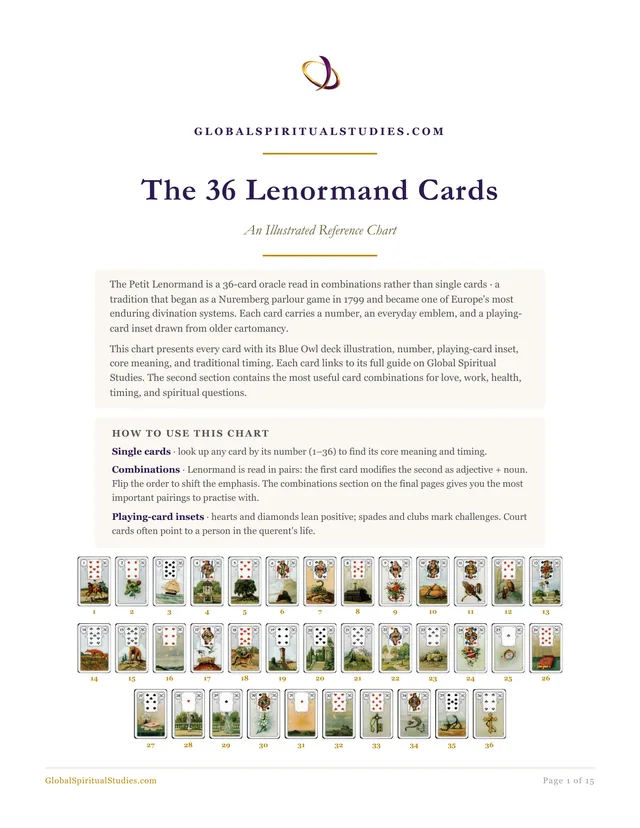
This pair can describe a birth, a house move or a project growing up, and the cards around it are usually what tell them apart. Our free 36-card Lenormand chart keeps every card's meaning, polarity and timing on one printable page, so the line can be read as a whole rather than from its most famous two cards.
Child + Stork
Put card 13 first and the newcomer, or the new undertaking, is the noun; the Stork reports that it is changing. The sentence reads something new is in transition. Taken literally, that is a child in the middle of the largest change there is: a newborn, a baby arriving into a household, an infant whose world is still being arranged around it. Taken more broadly, it is a young person on the move, changing schools or leaving home, or a new venture that is already growing out of its first form.
Two sources that give each order its own entry agree on the literal version. Herzfunken.de writes that a child changes everything and speaks of the birth, a new life coming into the world. Lisa Boswell lists newborns, small and premature babies, and then, in a wider register, the beginning of change and something starting to take shape. In both, the child is already here.
The practical point is that this order puts the change on the new thing rather than on the querent. Expect it on questions about how a young person is adapting, how a newly launched project is developing, or how a household is shifting around a new arrival.
Stork + Child
Reverse them and the change takes the noun position, while card 13 makes that change young: newly begun, still small. The sentence is a change is starting: the first announcement, the earliest stage of a transition, something new that has been signalled but not yet arrived. In a question about family, that shape is the one most sources read as expecting a child.
Herzfunken.de gives this order as something new announcing itself and bringing change, and adds that a woman is expecting. Boswell's Stork-first entry runs to pregnancy and conceiving, though it also includes the birth of a child, so her split is clean on one side and partial on the other. Anna K, whose list covers both orders at once, gives pregnancy and birthing alongside the first stage of a long process. The common thread is anticipation: the change is real and underway, and its content is still new.
Within this method, the contrast with the first order is genuine. Child + Stork describes a new thing already in the world and changing. Stork + Child describes a change whose newness is the point because it has only just begun. On a pregnancy question that is the difference between a baby and an expectation, and on any other question it is the difference between growing pains and a first step.
The pair across five areas of life
| Area | Child + Stork | Stork + Child |
|---|---|---|
| Love | A new relationship that is already changing shape, moving quickly from its first weeks into something else. | A relationship entering a new stage, with the change only just beginning. In a family question, news of a child expected. |
| Work | A new project or a new hire adapting and growing. The startup that pivots early, the trainee moving to a different team. | The first step of a reorganisation or a career change. Something new has been announced and the transition is starting. |
| Money | A new income stream in flux. Neither card counts, so the reading describes movement; any real sum deserves an independent adviser's eye rather than a card's. | An early-stage financial change: a first adjustment, a small new arrangement, described as beginning rather than settled. |
| Health | The two sources that split the orders take this one toward a newborn or a birth. The cards describe circumstances and say nothing about a body; any question here belongs with a clinician. | The order those same sources link to pregnancy. A reading cannot confirm or predict one, and a doctor or midwife is far better placed than a spread to answer it. |
| Timing | The Stork lands second and governs, and it counts in seasons: the turn from one to the next in one English source, days or weeks in one German one. Seventeen is the count. | Here the Child, sitting second, governs, and its clock runs fast: herzfunken.de says mostly a day or a week, Labyrinthos says soon. Boswell instead ties the Child to May or a birthday. Thirteen is the count. |
Child and Stork in the Grand Tableau
The 1846 Stork carries its own instruction for a full spread: the nearer it lies to the querent's card, the sooner the change. That is a distance rule about speed, not luck, and it sits comfortably beside the convention that the second card sets the pace. A Child and Stork close to the querent describes a change arriving soon in the querent's own life; the same pair far off may belong to someone else's household entirely.
The Stork in house 13, the house of fresh starts, says the fresh start is a change: the fresh start is itself a move or a transition. The Child in house 17, the square of change and improvement, says the change is small or early, the first stage of something rather than its completion. The published material reviewed here gives no reading for either placement, and both are reasoned from the house questions.
Set well apart, the two cards no longer form a phrase. A beginning in one place and a change in another need not be connected, and reading a pregnancy into two scattered cards asks far more of them than they can give.

Where the traditions differ
The order-split on pregnancy is the useful finding. Herzfunken.de and Boswell were written independently, in different languages, and both put the child already born on the Child-first side and the child expected on the Stork-first side, with one partial exception in Boswell. Neither explains the split. Our first-card-as-subject grammar would predict exactly this division, and two sources reaching it separately lends that division some outside support.
Not every source reads a pregnancy at all. Labyrinthos prints the start of a transformation, a child or naive person transforming, on both card pages, with no pregnancy in it. The 1846 sheet has none either: its Stork is a house move, its Child a sociable and kind querent.
The strongest claim in circulation is ours. Our own Stork page once called this pair the deck's strongest pregnancy indicator, and a search for the pair still hands that line back as general knowledge. No independent source reviewed here ranks it that way, and this page does not repeat it.
Nine months is a reading, not a rule. Boswell attaches a nine-month period to both the Child and the Stork. That is the pregnancy register carried into timing, and it fits a pregnancy question. It is not how either card times a change of job or a house move.
The board game gives neither square a rule. In the board game the deck descends from, published in Nuremberg about 1800, the Lad at 13 is where a player lands after paying at the Rod, and the Stork at 17 is one of the optional squares where the company sings songs of friendship and good health. Neither carries a birth. Both Mary K. Greer and Caitlín Matthews teach for us, and since no entry from either on the Child with the Stork could be found, this page credits neither with a reading.
A reading in three cards
A woman asks about her son's plans now that he has finished school. The line comes out Child · Stork · House.
The young person leads, the Stork says he is in transition, and the House supplies a home. As one sentence: he is on the move, and the movement ends at a household, a place of his own or a return to the family home on new terms. The change is his, not hers, which is exactly what this order says, and nothing in the line concerns a pregnancy.
Lay out Stork · Child · House and the change itself becomes the subject, still at its earliest stage, about home. That reads as the first conversations about moving: plans announced, nothing yet packed. Nothing has changed but the first two positions, and a son already on his way has become a move that has only just been mentioned.
What readers get wrong about this pair
Reading a pregnancy into a question about something else. The pair's fame makes the literal reading the first to come to mind, and it is an intimate thing to say to somebody who asked about a business or a son. When the question is not about family, the new thing is usually a project or a person, not a pregnancy.
Treating the two orders as one event. One order describes a new arrival changing, the other a change at its start. On a family question that is the difference between a child already here and one expected, and two independent sources make that distinction even where most lists do not.
Putting the change on the wrong person. With the Child first, the transition belongs to the new thing: the child, the trainee, the project. A querent who hears that they are about to move has been given somebody else's news.
Using nine months as a default. It suits one kind of question. For anything else, the Stork's own pace, or the 1846 rule that nearness speeds it up, is the better guide.
Questions about Child and Stork
Does the Child and Stork combination mean pregnancy?
Many sources read it that way, and two that separate the orders put pregnancy on the Stork-first side, a change just beginning with a child as its content, and birth or a newborn on the Child-first side. Two cards can sketch a situation; they cannot confirm or forecast anything about a body. Questions about fertility or a pregnancy belong with a medical professional.
What is the difference between Child + Stork and Stork + Child?
Which of the two is the subject. Child first makes the new arrival or new undertaking the subject and says it is changing, so the reading concerns something already here and in transition. Stork first makes the change the subject and says it is at its very start. Herzfunken.de and Lisa Boswell both separate the orders in a similar way, with the newborn on one side and the expectation on the other.
Is the Child and Stork combination a yes or a no?
Yes either way round, if what is being asked is whether something new or some change is on its way. On a question about health or conception the pair can describe the shape of a situation, and it cannot answer the question itself, which belongs with a clinician.
Can the Child and Stork combination mean moving house?
Yes, and the oldest source supports it more directly than it supports any pregnancy. The 1846 instruction sheet gives the Stork as a change of abode, coming sooner the nearer it lies to the querent. Paired with the Child, that can describe a young person moving, a family moving because it has grown, or simply a new home at its earliest stage.
What timing does the Child and Stork combination give?
The card in second place governs. Child + Stork closes on the Stork, which one English source times by the turn of a season and one German source at a few days or weeks, with 17 as the count. Stork + Child closes on the Child, the faster card: mostly a day or a week, or simply soon. One English writer gives nine months for both cards, which suits a pregnancy question and few others.
Related combinations
Look up any two cards in the deck through our Lenormand card combinations guide.
The most famous combinations are the ones most worth reading slowly, because their reputation arrives before the question does. The Complete Lenormand teaches order, distance and the houses together, so a pair is read for what it says in this spread and not for what it is known for.