Child and Bear
Child and Bear puts the smallest card in the deck next to one of its largest, and every useful reading of the pair turns out to be an argument about scale. With the Child leading, something new or small is the subject and power describes it: a beginner working under somebody else's authority, a first venture with real money behind it, a young person and the adult responsible for them. With the Bear leading, the strength becomes the subject and smallness describes that instead: authority in inexperienced hands, or a large matter being handled as though it were a minor one. The German lists get nearest to what readers actually do with this pair, which is telling somebody a thing is not the size they think it is.
- Child + Bear (13 + 15)
- Something small or newly begun, under a much larger influence. A novice and their boss, a child and a parent, a modest sum inside somebody else's budget. Protection or pressure, and the neighbouring cards decide which.
- Bear + Child (15 + 13)
- Power in an immature form, or a big thing being treated as a small one. A young authority, resources in the hands of a beginner, a serious matter somebody is playing down.
- The cards
- Child · card 13 · Jack of Spades · positive. Bear · card 15 · 10 of Clubs · neutral. The deck's lightest card beside its heaviest.
- Yes or no
- Yes in both orders, with the size corrected. Child first agrees to something smaller than the question assumed. Bear first agrees with weight behind it, and usually with somebody else's hand in the arrangement.
- Timing
- Pace is set by the second card. Child + Bear ends on the Bear, whose count is 15 and whose habit is steady progress through effort rather than a quick result. Bear + Child ends on the Child, which reads early and short: 13 days or weeks, and the matter is still forming.
The two cards
The Child · card 13 · is earliness and smallness before it is anything else. A literal child sometimes, a beginner often, and a stage more often still: the project two weeks old, the acquaintance that is not yet a friendship, the amount that would not register on anybody's accounts. Innocence belongs to the card, but as a description of inexperience rather than as a compliment.
The Bear · card 15 · is mass in whatever form the question is asking about. The boss, the mother figure, the bank balance, the body, the appetite. Lisa Boswell's list files it under lifestyle, which sounds modern and is closer to the older sense than most keyword lists get: this is the card of what sustains you and how much of it there is.
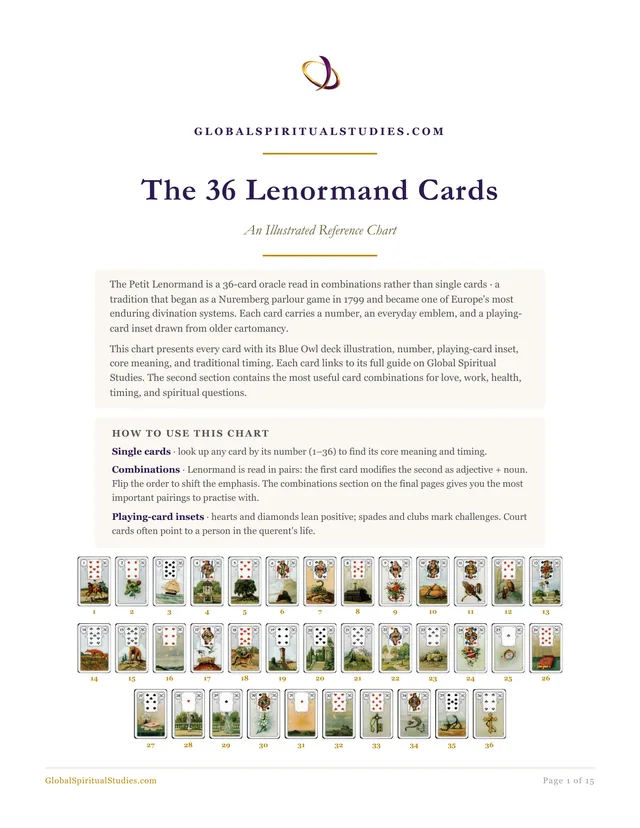
In the directional method used on this site, we read the first card as the subject and the second as its modifier. That matters unusually much here, because these two cards do not sit at the same end of any scale, and a page that gives both orders one sentence has thrown away the only distinction the pair has. The method is unpacked step by step in our guide to the thirty-six Lenormand cards.
Card 13 and card 15 are both easy to over-read: one gets flattened into babies, the other into bosses. Our free 36-card Lenormand chart keeps the full range of every card on one printable page, which is the quickest cure for a keyword that has taken over.
Child + Bear
The small thing and the large hand
Child leading makes the new or minor thing the subject, and the Bear tells you what is standing over it. The sentence is this small thing has something big attached. Read warmly, that is backing: the beginner with a mentor, the fledgling business with a serious investor, the child with a parent doing the worrying. Read coolly, it is exposure: the same beginner with no leverage, the same small sum sitting inside somebody else's decision.
The reading you choose is not a matter of mood. It comes from the cards on either side and from what the person asked. Anna.K's entry for the combination is unusually careful about this, giving both looking for guidance and providing it, and then adding the case that spoils the sentimental version: treating somebody as though they needed protection when they do not.
Boswell reads the Child leading toward beginnings in the register she calls lifestyle: a new routine, a simple regimen, the first weeks of doing something differently. It sounds like a departure from the traditional entries and it is the same grammar. A new thing, and physical resources are what it concerns.
Bear + Child
Power that has not grown up yet
Turn the pair round and the mass becomes the subject with smallness describing it. The sentence is this large thing is young. Sometimes that is a person: the manager promoted early, the parent who is barely more settled than the child, what one German list calls a large child and, in the same breath, a small man. Sometimes it is a resource: capital in the hands of somebody who has not run capital before, which is a specific and very common situation the English lists do not name.
The other use of this order is deflation. The same German entry offers making a great matter smaller than it is, alongside its opposite, making a small matter into a great one. That is the everyday work this pair does. Somebody is misjudging a size, and the order tells you in which direction: with the Bear in front, something substantial is being waved off.
Boswell's entry for this direction is blunter and worth keeping in view, since it covers domination of people who cannot answer back, and, in the same list, the protection of children. The card pair does not distinguish between those. What distinguishes them is whether the power was invited.
The pair across five areas of life
| Area | Child + Bear | Bear + Child |
|---|---|---|
| Love | A young relationship with an established figure somewhere in it: an age gap, a partner with far more history, or a family member whose opinion carries. Support or supervision, depending on who asked for it. | A settled partner behaving like a beginner, or a serious relationship still in its first weeks. A German entry offers starting again with a former partner, which fits the shape exactly. |
| Work | The junior in a powerful department. A small contract with a large client, an internship, a first role where the interesting part is who is standing behind you rather than what you are doing. | A young manager, or a big department in its early days. Also the senior person handling something well below their level, which is usually a sign about priorities rather than about ability. |
| Money | A small sum inside a big picture, or a beginner's finances. Lozzy's Lenormand names the financial novice outright, which is the most practical gloss anybody gives this pair. Substantial decisions want an independent professional view. | Significant money at an early stage: new funding, a young account, an inheritance not yet settled into anything. Neither card names an amount, so any figure has come from elsewhere in the spread. |
| Health | Boswell's lifestyle reading sits here: a new routine, kept simple on purpose. The cards describe a beginning rather than an outcome, and anything clinical belongs with a practitioner. | Something physical in an early phase, or strength that is not yet reliable. Read it as a description of where a thing has got to, never as a prognosis, and take health questions to a qualified professional. |
| Timing | The Bear falls second and governs the pace: 15 as the count, and a tempo that rewards persistence rather than speed. Weeks and months rather than days. | The Child falls second and sets the pace instead, and card 13 is the deck's early marker: 13 days or weeks, with the matter still young enough to change shape while you watch it. |
Child and Bear in the Grand Tableau
Sitting together in a tableau, this combination reads as described above, and the card closer to the significator becomes the subject. At a distance they are simply two facts: a beginning in one part of the spread and a source of power in another, and any thread joining them has been supplied by the reader, not by the spread. Worth noticing that in every standard tableau the Fox's house falls between these two, which is a quiet reminder of the third party who often turns up wherever inexperience and authority meet.
The Child in house 15, which asks where power sits, puts authority in inexperienced hands. Not necessarily badly: this is the placement for the new team lead, the first-time trustee, the person who has the say and has never had it before. The Bear in house 13, which asks what is starting, is a beginning with weight behind it, or one that somebody else is already managing. On a question about a new venture that second placement is the one to read carefully, because it tells you whose venture it actually is.

Where the traditions differ
The first thing to report is that this pair is thinly written. Card 13 is among the least covered in the English material, and our own reference corpus gives the two directions almost the same sentence: a young authority figure and a small financial matter, with parental protection swapped in on one side. When a page tells you both orders mean the same thing, it is worth asking whether that was a finding or a shortcut.
Anna.K solves the direction problem in a way nobody else does. Her list prints one entry per pair as a matter of policy, so she cannot use card order, and instead she names the two perspectives explicitly: seeking guidance from the Child's side, providing it from the Bear's. That is the same distinction this page draws with word order, arrived at from a different premise, and it is the strongest independent support for treating the two directions separately.
Boswell splits the pair cleanly and lands somewhere unexpected. With the Child first she gives a new lifestyle and uncomplicated choices about food and exercise, along with the literal teddy bear. With the Bear first she gives an older relative's child, the protection of children, and the domination of innocent people. Those are not variations on one theme. The first list is about starting something; the second is about power being used on somebody, well or badly.
The German entries are the ones that name the mechanism. Under the Child they give a strong child, immature use of power, and a fresh start with a former partner. Under the Bear they give a large child, a small man, and the two mirrored distortions: inflating a trifle, and shrinking something that is not trifling. That last pair of glosses is the practical core of the combination and it appears nowhere in the English sources reviewed here.
On attribution, no gloss on these two cards could be traced to any of the named authorities whose published work is checkable, and none is claimed. Searching for the pair also returns our own site quoted back as an authority, which is worth flagging rather than treating as corroboration. The scale argument above is ours, built from the two cards and from the German entries that already point at it.
A reading in three cards
A woman asks about a business she started nine months ago. The line comes out Clover · Child · Bear.
Read it straight: a piece of luck (Clover), still small (Child), with something substantial attached to it (Bear). The pair at the end says the venture is young and that it is not standing on its own. A backer, a major client, a family member with money in it. Whether that is a comfort or a constraint is the useful question, and the cards on either side of this line are where the answer lives rather than in the pair itself.
Move the last two cards. Clover · Bear · Child reads differently: the luck now attaches to the substantial thing, and the Child says that thing is in its infancy. Same three cards, and the account has shifted from a small business with a large friend to a large arrangement that has barely started. The first line invites a question about dependence, the second one about patience.
What readers get wrong about this pair
Turning the Child into a literal child. Most questions that draw card 13 have no children in them anywhere. The card reports that something is early and small, and the family reading is one specialisation of that, not its default meaning.
Turning the Bear into the boss. Authority is one face of card 15. Money is another, the body is a third, and appetite is a fourth. A reader who has already decided the Bear is a manager will miss the reading where the pair is describing somebody's finances or somebody's health.
Skipping the size question. The German lists name both distortions this pair produces, inflation and deflation, and between them they cover a large share of what people actually bring to a reading. Neither shows up in the English glosses, so a reader working only from those will describe the participants and never mention the proportions.
Assuming protection is welcome. The same combination that gives a parent looking after a child gives somebody being managed who never asked to be. Anna.K's entry names both, a page apart from each other in feeling and a hair apart in the cards. The question that separates them is who invited it.
Questions about Child and Bear
Does the Child and Bear combination mean an actual child?
Sometimes, and it is not the first reading to reach for. Card 13 marks earliness and small scale, so on a question about a family it may well point at a real child, and on a question about work it is far more likely to be describing a beginner, a new arrangement or a small sum. The surrounding cards settle it quickly. If the spread is full of household and family cards the literal reading gains weight; if the question was about a contract, it does not.
What is the difference between Child + Bear and Bear + Child?
Which one is the size of the thing and which is the comment on it. Child first describes something small or new with a larger force attached to it, which is the reading for beginners, junior positions and modest sums inside big arrangements. Bear first describes something powerful that is immature, undersized in some respect, or being treated as unimportant. One order is about a small thing with backing, the other about a big thing that has not grown up.
Is the Child and Bear combination a yes or a no?
It leans yes in both orders, with a correction attached rather than a caveat. Neither card refuses anything: the Child is positive and the Bear is neutral, so nothing here is pushing back. What the pair does is adjust the scale of the answer. Child first says yes to something smaller than the question imagined. Bear first says yes to something with more weight in it, and usually with another party involved in the decision.
What does the Child and Bear combination mean for timing?
Whichever card lands second is the one that owns the pace, so the two orders point in opposite directions. Child + Bear closes on the Bear, which counts 15 and works by endurance rather than speed, so read this as weeks and months and expect progress to come from persistence. Bear + Child closes on the Child, and card 13 is the deck's early marker: 13 days or weeks, with the matter young enough that it may still change shape while you are watching it.
Can the Child and Bear combination be about money?
Often, and the most useful gloss comes from Lozzy's Lenormand, which names the financial beginner. Card 15 carries money as plainly as it carries authority, so with the Child alongside it the pair frequently describes somebody new to handling a sum rather than the sum itself being small. That distinction changes the reading: inexperience is a different situation from scarcity. As always the cards describe the position rather than recommending anything, and financial decisions of any size want an independent professional view.
Related combinations
Browse the full Lenormand combination finder to look up any pair in the deck.
Learn Lenormand · explore our Lenormand courses with Mary K. Greer and Caitlín Matthews.
Most of what a reader gets wrong is proportion: how big, how soon, how serious. The Complete Lenormand works from two-card pairs up to the full tableau, teaching the part of the craft that decides whether a spread sounds like a life or like a list of keywords.