Bear and Tower
Bear and Tower is the pair everyone glosses as the big organisation, and it is the pair where the two orders come closest to saying the same thing. Bear first puts a powerful person against a structure. Tower first puts a structure and calls it powerful. That is a difference of emphasis rather than of prediction, and this page will say why instead of manufacturing a contrast. What the standard gloss leaves out is louder than what it includes: both cards carry isolation, and in the oldest instruction sheet neither of them is an institution at all.
- Bear + Tower (15 + 19)
- A powerful person seen against a structure. The boss inside the organisation, the parent who has withdrawn, the figure with authority and distance around them. A human being stays at the centre.
- Tower + Bear (19 + 15)
- A structure described as powerful or well resourced. The institution itself, its money, its reach, its ability to outlast you. Often nobody is at the centre at all.
- The cards
- Bear · card 15 · 10 of Clubs · neutral. Tower · card 19 · 6 of Spades · neutral. Two of the deck's least emotional cards.
- Yes or no
- Undetermined in both orders. Neither card has a polarity to lend, so this pair describes a situation and leaves the verdict to whatever surrounds it.
- Timing
- Pace is set by the second card, and both of these are slow. Bear + Tower closes on the Tower, the deck's longest card, so read years rather than weeks. Tower + Bear closes on the Bear, which is endurance rather than speed. This is arguably the slowest pair in the deck.
The two cards
The Bear · card 15 · is power and resources: strength, protection, the person who has authority over you. English lists usually lead with money, German ones more often with a parent, most commonly the mother. Both are live and neither is original, which matters more than it sounds and is taken up below.
The Tower · card 19 · runs along four registers that pull apart: the institution, isolation and loneliness, ambition and the long view, and sheer duration. English sources lead with the institution. German ones lead with separation and standing apart. It is also, by some margin, the card readers report finding hardest to read at all, which is part of why this pair gets written so thinly.
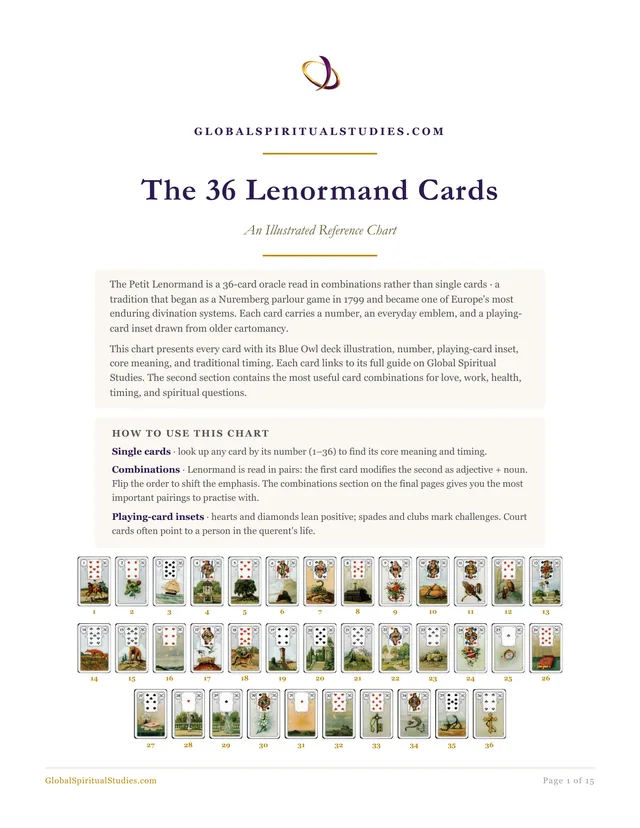
In the directional method used on this site, we read the first card as the subject and the second as its modifier. Both of these are large, static nouns of about equal weight, and that fact is the root of everything below. Our complete guide to the Lenormand cards lays the method out from first principles.
Two contested cards in one combination means the neighbours are doing most of the work. Our free 36-card Lenormand chart is a single printable page covering the whole deck, which is what you want at your elbow when a pair has four plausible registers instead of one.
Bear + Tower
A person, and the structure around them
Bear leading makes the powerful figure the noun and the Tower the adjective. The sentence is this person is institutional, or standing apart, or in it for the long haul. The chief executive rather than the company. The parent who holds the family's authority and has become remote with it. The manager who is respected and unreachable.
Both of the Tower's main registers apply and they do not fight each other. The institutional one gives office and rank, so somebody's power is formalised; the isolation one gives the cost of it, since authority puts distance around whoever holds it. Together they produce the most useful version of this order: a person whose position has separated them from the people it covers.
Tower + Bear
A structure, and the power in it
Reversed, the Tower is the noun and the Bear describes it. The sentence is this structure is powerful: a well-funded institution, a body with reserves, an organisation strong enough to wait you out. Where the previous order keeps a human being in view, this one usually removes them.
Now the honest part, because it is more useful than a manufactured contrast. These two orders read closer together than almost any pair on this site, and there is a structural reason. Lenormand's order rule does its best work when one card is an actor and the other is a condition, so that reversing them changes who is doing what. Bear and Tower are both nouns and both static. A Bear does nothing to a Tower and a Tower does nothing to a Bear; they simply occupy the same ground. So the reversal shifts the camera rather than the scene, and the surveyed sources that flatten the pair are not merely being careless. They are responding to something real.
The distinction that does survive is worth keeping, because it changes what you say out loud. Ask whether the reading has a person in it. Bear first, there is someone to name, and the advice concerns a relationship with them. Tower first, there is usually no one, and the reading concerns a system that will not be argued with.
The pair across five areas of life
| Area | Bear + Tower | Tower + Bear |
|---|---|---|
| Love | A partner or parent with authority who has grown distant, or a relationship in which one person holds the power and keeps their own counsel. The German reading of the powerful mother who withdraws lives here. | The relationship as an institution: formal, structural, durable, and short on warmth. A marriage that functions as an arrangement, or family standing that outranks the individuals inside it. |
| Work | The strongest of the five. A senior figure in a hierarchy: the boss behind the closed door, the executive with real power and little visibility. Read who else is nearby to learn whether they protect or obstruct. | The organisation itself rather than anyone in it. A large employer, a regulator, a bank, a corporate parent. Also, quite literally, head office. |
| Money | Someone else's hand on the resources: a person with financial authority over the querent, or wealth held under a formal structure rather than in reach. | Institutional money, which is the underused reading here: pensions, corporate accounts, grants, settlements, anything whose timetable is not yours. Any actual decision belongs with an independent professional perspective. |
| Health | A person of authority in a health setting, or the strength-and-endurance side of the Bear seen over a long horizon. Cards describe circumstances, not bodies. | The health system rather than the condition: institutions, waiting, formal processes. Neither card names an illness, and a clinical question is one for a qualified professional. |
| Timing | The Tower closes the pair and governs the pace. It is the deck's card of duration, so read years, or a matter with structural roots that will not be hurried. The count of 19 is a fallback. | The Bear closes the pair and governs, giving endurance rather than speed: a stretch requiring persistence, with 15 as the fallback count. Slow either way, and no order here supports a firm date. |
Bear and Tower in the Grand Tableau
Laid together the pair works as described above, the subject role going to whichever card sits nearer the significator. Separated, they generally report two unrelated facts, and with this combination that is easy to miss: both cards are imposing enough that a reader wants them to belong to one story.
The houses mirror each other neatly. The Bear in house 19, the house of institutions and boundaries, is personal power exercised through a structure or constrained by one: your authority answering to something larger. The Tower in house 15, the house of authority figures and resources, is the reverse: an institution behaving like a parent, or your own resources locked inside a formal arrangement you cannot reach into.

Where the traditions differ
Start with the finding that reframes the rest. In the 1846 instruction sheet that taught two generations of readers what these cards meant, card 19 is a tower whose entry offers no more than "the hope of a happy old age" · a hope held out, not a span of years promised · and when the Clouds surround it the same entry forebodes sickness and, as circumstances allow, even death. There is no government in it, no corporation, no bureaucracy. Card 15 in the same sheet is either a messenger of good fortune or a caution to keep clear of company, the envious above all. Not money. Not a mother. Not a boss.
The Game of Hope of about 1800, the Nuremberg board game the deck descends from, is even plainer. The Tower has a rule and the rule is a view: "To enjoy the pleasant vista from the Tower, one pays 2 marks". The Bear has no rule whatsoever. It sits among the squares where nothing happens and the player simply waits for the next turn. Whatever else the Bear became, it did not begin as the money card.
So the reading that dominates the modern web, this pair as corporate authority, is a genuinely recent construction. That is not an argument against it. Lenormand meanings have always accreted, and a card that means an institution today means one. It is an argument for holding it more loosely than the confident one-liners suggest, and for keeping the older senses in play: the long view, longevity, and the elder. Bear and Tower as a grandfather, a patriarch, a person of long-standing authority is a reading with better historical support than the corporation, and it is on no top-ranking page.
On the combination itself the field is thin, and the honest report is that hardly anyone publishes it. Nothing checkable on these two cards together turned up under the names most often cited in English: not Greer, not Matthews, not Rana George, not Treppner. Greer's Lenormand writing is historical, and it is her work on where the playing-card inserts came from that bears on this page, not any card meaning. Of the widely cited names, Lisa Boswell is the only one who publishes this pair, and she does it in both orders. Her Bear-first entry is the most quoted thing on the combination and it contradicts itself in a single line, running from a head of state to "Forced to be alone". That is not sloppiness. It is the pair's actual range showing through.
The German sources are where the missing half lives. They give this combination as a powerful mother and, in the same breath, as the mother withdrawing, alongside the rich firm and the influential person inside an institution. That single image reconciles the two things English lists treat as unrelated: the power and the loneliness. One German reference goes further in the other direction again, leading not with authority at all but with its loss, giving powerlessness, power surrendered or taken, and a lonely man. English pages read this pair as unambiguously strong. German pages frequently read it as the opposite, and no source found bridges them.
The bridge this page offers is the isolation axis, and it is house reading rather than inherited teaching. The Tower's loneliness is not a separate meaning from its institutional one. It is what institutions do to the people at the top of them.
A reading in three cards
A man asks whether to accept a promotion that would move him to head office. The line comes out Bear · Tower · Mountain.
The powerful person is the subject, the structure describes him, and the Mountain modifies the whole: authority inside an institution, obstructed or slow. Read plainly, the position is real and the progress through it is not quick. Nothing here says refuse. It says the thing he is being offered has more structure and less movement in it than the offer suggests.
Now reverse the first two. Tower · Bear · Mountain reads as the institution first, its resources second, the obstruction third: a large, well-funded organisation that is hard to move. The first line is about what happens to him. The second is about what the place is like. Same three cards, and one is a career reading while the other is a description of an employer.
What readers get wrong about this pair
Letting the corporation eat the loneliness. Isolation is a headline meaning of card 19 in most traditional references, and it almost never survives into the combination entry, so a reader who looks this pair up gets the office and not the closed door. The closed door is usually the part the querent came about.
Treating the Bear as money by default. The financial reading is strong in English sources and absent from both the board game of about 1800 and the 1846 sheet. When a question is genuinely about a sum, most readers would want a Fish or the Mice nearby before reading an amount into the Bear.
Expecting the pair to move. Two of the slowest cards in the deck do not produce a fast answer, and a reader who promises movement inside a month has read something the cards did not offer.
Assuming the power is against you. Both cards are neutral. Authority and structure protect as readily as they obstruct, and which one applies is decided by the neighbours, not by the pair. A tower is a wall to the person outside it and a shelter to the person within.
Questions about Bear and Tower
Does the Bear and Tower combination mean a big company?
Often, and it is worth knowing that the reading is younger than it looks. Neither the board game of about 1800 nor the 1846 instruction sheet gives either card an institutional meaning: the Tower there hopes for a peaceable old age and nothing more, while the Bear brings good fortune or a caution about the envious. The corporate gloss is a modern accretion. It is a legitimate reading of the cards as they are used today, but a grandfather, a long-standing authority, or a person who has become remote all fit the same pair and have deeper roots.
What is the difference between Bear + Tower and Tower + Bear?
Less than for most pairs, and that is an honest answer rather than an evasion. Both cards are large static nouns of similar weight, so neither acts on the other and reversing them moves the emphasis instead of the meaning. The test that survives is whether there is a person in the reading. Bear first keeps a human being at the centre and the structure describes them. Tower first describes a structure and often has nobody in it at all.
Is the Bear and Tower combination positive or negative?
Neither, and unusually so. Both cards are neutral, so the pair contributes no polarity of its own and takes its temperature entirely from what surrounds it. Beside supportive cards it reads as protection, standing and endurance. Beside the Mice, the Mountain or the Cross it reads as power that excludes, or a structure that will not yield. The pair reports a situation and leaves the judgement to the rest of the spread.
Can the Bear and Tower combination mean loneliness?
Yes, and this is the reading most often missing from English-language lists. Isolation and separation are core meanings of card 19 in the sources reviewed here, particularly the German ones, and they combine naturally with the Bear's authority. German references give this pair as both a powerful mother and a mother who withdraws, which is the same observation in one image. Power and distance are frequently the same fact seen from two sides.
How long does the Bear and Tower combination take to play out?
Longer than almost anything else in the deck. The modifier is the governing card for pace here as it is elsewhere on this site. Bear + Tower closes on the Tower, traditionally associated with duration itself and often read as a year or more, so think in years rather than weeks. Tower + Bear closes on the Bear, which contributes endurance rather than speed and a fallback count of 15. Neither order supports a date anyone should be held to.
Related combinations
Browse the full Lenormand combination finder to look up any pair in the deck.
Learn Lenormand · explore our Lenormand courses with Mary K. Greer and Caitlín Matthews.
Some pairs reverse sharply and some barely move, and telling the two apart is learned rather than looked up. The Complete Lenormand teaches what makes that difference legible, from two-card lines through house placement to a full tableau, so a flat-reading combination like this one still leaves you with something to say.