Gematria Explained · The Kabbalistic Art of Hebrew Number-Letters
How each of the 22 Hebrew letters doubles as a number · with the full value table, the classic worked examples, and the main systems, explained plainly
Gematria is the practice of reading meaning from the numerical values of Hebrew letters. Because each of the 22 letters of the Hebrew alphabet doubles as a number, every word carries a hidden sum · and words or phrases that share a value are held to share an inner connection. Kabbalists use gematria as a tool of Torah interpretation, uncovering links the plain text conceals. This guide gives the complete letter-value table · the same canonical values used on our Hebrew letters reference page · followed by the classic worked examples and the main systems in use.
How Gematria Works · Each Letter Is a Number
Hebrew has no separate numerals · the letters are the numbers. The first nine letters, Aleph through Teth, carry the units 1-9. The next nine, Yod through Tzaddi, carry the tens: 10, 20, 30, on to 90. The final four, Qoph, Resh, Shin, and Tav, carry the hundreds: 100, 200, 300, 400. To find a word's gematria, you simply add the values of its letters. The word חי (chai, "life"), for instance, is Cheth (8) plus Yod (10), which totals 18.
This is the foundation of the whole practice. Every Hebrew word is therefore also a number, and Kabbalists treat a shared total as a sign of a shared essence · a hidden thread running between words that look unrelated on the surface. The complete set of values is set out in the table below, drawn verbatim from our canonical Hebrew letters reference so the two pages never disagree.
The 22 Hebrew Letters and Their Values
All 22 letters in alphabet order, Aleph to Tav. Each row gives the letter's glyph (with its final form where one exists), its name and literal meaning, its standard gematria value (mispar hechrachi), its final-form value (mispar gadol) where applicable, and its Major Arcana card in the Golden Dawn tradition. For the fuller reference · the Sefer Yetzirah class and the Tree of Life path of every letter · see the complete Hebrew letters guide, and for the colours, stones, and perfumes attributed to each path, the Liber 777 correspondences.
| Letter | Name | Meaning | Standard Value | Final-Form Value | Golden Dawn Tarot |
|---|---|---|---|---|---|
| א | Aleph | Ox | 1 | None | 0 · The Fool |
| ב | Beth | House | 2 | None | I · The Magician |
| ג | Gimel | Camel | 3 | None | II · The High Priestess |
| ד | Daleth | Door | 4 | None | III · The Empress |
| ה | Heh | Window | 5 | None | IV · The Emperor |
| ו | Vav | Nail · hook | 6 | None | V · The Hierophant |
| ז | Zayin | Sword · weapon | 7 | None | VI · The Lovers |
| ח | Cheth | Fence · enclosure | 8 | None | VII · The Chariot |
| ט | Teth | Serpent | 9 | None | VIII · Strength |
| י | Yod | Hand | 10 | None | IX · The Hermit |
| כך | Kaph | Palm of hand | 20 | 500 | X · Wheel of Fortune |
| ל | Lamed | Ox-goad | 30 | None | XI · Justice |
| מם | Mem | Water | 40 | 600 | XII · The Hanged Man |
| נן | Nun | Fish | 50 | 700 | XIII · Death |
| ס | Samekh | Prop · support | 60 | None | XIV · Temperance |
| ע | Ayin | Eye | 70 | None | XV · The Devil |
| פף | Peh | Mouth | 80 | 800 | XVI · The Tower |
| צץ | Tzaddi | Fish-hook | 90 | 900 | XVII · The Star |
| ק | Qoph | Back of the head | 100 | None | XVIII · The Moon |
| ר | Resh | Head | 200 | None | XIX · The Sun |
| ש | Shin | Tooth | 300 | None | XX · Judgement |
| ת | Tav | Mark · cross · sign | 400 | None | XXI · The World |
Standard values are the mispar hechrachi ("absolute value") system, 1-400. The five final (sofit) forms · Kaph, Mem, Nun, Peh, Tzaddi · carry the extended values 500-900 only in the "great number" (mispar gadol) system. Most path and Tarot work uses the standard values. The Tarot attributions follow the traditional Golden Dawn published order (Teth = Strength, Lamed = Justice, Tzaddi = The Star).
The Five Final Letters and Mispar Gadol
Five letters change shape when they fall at the end of a word · the sofit forms: final Kaph ך, final Mem ם, final Nun ן, final Peh ף, and final Tzaddi ץ, remembered by the mnemonic MaNTZePaKh. In the standard system they keep their base value (20, 40, 50, 80, 90). In mispar gadol ("great number") they extend the count instead: Kaph 500 · Mem 600 · Nun 700 · Peh 800 · Tzaddi 900, giving the alphabet a full run to 900. Which system a commentator uses depends on the reading being drawn out · but most path and Tarot work, and most everyday gematria, uses the standard mispar hechrachi values (1-400).
Gematria in Kabbalistic Interpretation
Gematria is, above all, a tool of exegesis · a way of reading Scripture for its hidden layers. When two words or phrases share a numerical value, Kabbalists take that equivalence as an invitation to consider what the two might have in common at a level the plain sense does not show. The technique is ancient · a form of it appears in rabbinic literature and even, as substitution ciphers, in the Hebrew Bible itself · and it becomes a central instrument in the Zohar and the wider Kabbalistic tradition, where the letters of the Torah are understood as the very stuff of creation.
The Sefer Yetzirah, the oldest Kabbalistic text, already treats the 22 letters and the ten primordial numbers as the "32 paths of wisdom" through which the world is formed · language and number as the tools of creation. Gematria grows from that soil: if the letters build the cosmos, then their sums are not idle arithmetic but a map of resemblances written into the fabric of the text. The classic examples below show the method at work. The same text sorts the twenty-two letters into three mothers, seven doubles and twelve simples · that division, and the letter values that travel with it, are set out in the three mothers, seven doubles and twelve simples and in our complete guide to Sefer Yetzirah, the Book of Formation.
Classic Worked Examples
A handful of gematria equivalences are cited again and again in the tradition, because the arithmetic is clean and the meaning it opens is rich. Here are four of the most famous, with the sums shown.
Chai (חי) = 18 · "life"
Chet (8) + Yod (10)
= 18
The word chai, "life," sums to 18. This is why gifts and charitable donations in Jewish practice are so often given in multiples of 18 · "giving chai" · a wish of life for the recipient. It is the everyday face of gematria, familiar far beyond mystical circles.
Echad (אחד) = 13 and Ahavah (אהבה) = 13 · "one" and "love"
Echad ("one"): Aleph (1) + Chet (8) + Daleth (4) = 13
Ahavah ("love"): Aleph (1) + Heh (5) + Beth (2) + Heh (5) = 13
Two of the central words of Jewish faith · echad, "one" (as in "the Lord is One"), and ahavah, "love" · share the value 13. Their equality is read to teach that divine unity and divine love are two faces of one essence. There is a further layer: 13 + 13 = 26, and 26 is the value of the four-letter name of God, the Tetragrammaton YHVH (יהוה) · Yod (10) + Heh (5) + Vav (6) + Heh (5) = 26. Unity and love, joined, spell the Name · a favourite Kabbalistic layering.
Nachash (נחש) = 358 and Mashiach (משיח) = 358 · "serpent" and "Messiah"
Nachash ("serpent"): Nun (50) + Chet (8) + Shin (300) = 358
Mashiach ("Messiah"): Mem (40) + Shin (300) + Yod (10) + Chet (8) = 358
Perhaps the most striking of the classic equivalences: nachash, the "serpent" of Eden, and mashiach, "Messiah," both total 358. Commentators read this to mean that the redemptive force · the Messiah · must engage and transform the very source of the fall, the serpent. Redemption does not bypass the wound; it works through it.
The Main Systems of Gematria
Gematria is not a single method but a family of them. A word can be counted several ways, and different readings draw out different connections. The main systems are:
- Mispar Hechrachi (standard, or "absolute value") · the familiar 1-400 scheme in the table above. This is the default, and unless a source says otherwise it is the system in play.
- Mispar Gadol (great number) · identical to the standard system, except that the five final letters take the values 500-900. It extends the alphabet's range to a full 1-900.
- Mispar Siduri (ordinal) · each letter is valued by its position in the alphabet, 1 through 22 (Aleph 1, Beth 2, on to Tav 22), regardless of its standard value.
- Mispar Katan (reduced, or "small number") · the values are reduced to a single digit by dropping trailing zeros, revealing a word's underlying "root" number (so Tav's 400 becomes 4, Lamed's 30 becomes 3, and so on).
- Atbash · not a numerical system but a substitution cipher · the first letter swaps with the last, the second with the second-to-last, and so on (Aleph א with Tav ת, Beth ב with Shin ש, Gimel ג with Resh ר). Atbash appears already within the Hebrew Bible, for example in the book of Jeremiah.
A Note on Responsible Use
Gematria is a tool of contemplation and interpretation within a tradition, not a method of proof. Because many different words can share a value, a matching sum is not a demonstration but an invitation · a prompt to reflect on a possible connection, held within a received framework of meaning. Kabbalists build interpretations this way with care and restraint, not by treating the numbers as a calculator that spits out fortunes.
Read in that spirit, gematria illuminates · it reveals resonances the surface text conceals and deepens the study of a word or verse. Read as a machine for "proving" hidden messages, it misleads, because with enough freedom almost any two words can be made to meet. The tradition's own discipline · working within the text, within the framework, and with humility · is what keeps the practice meaningful.
Study the Living Tree of Life
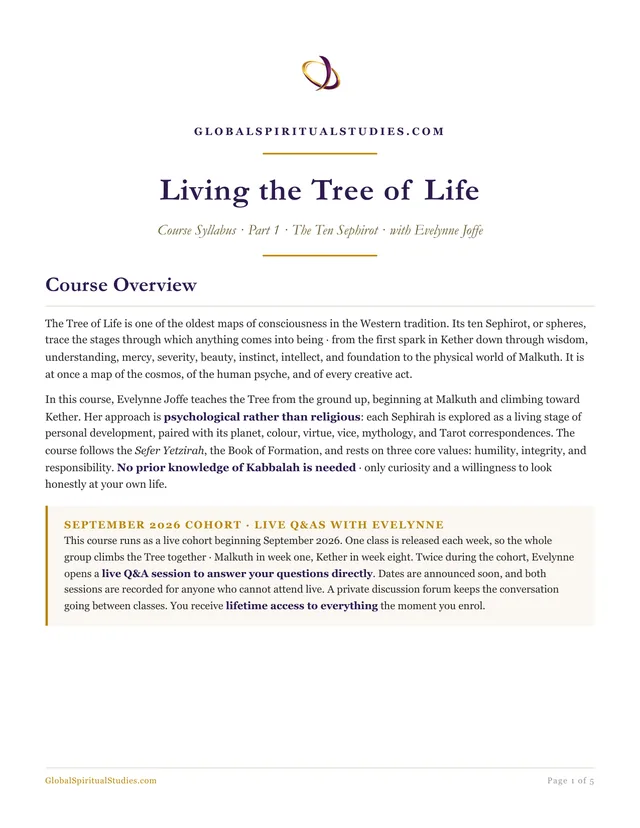
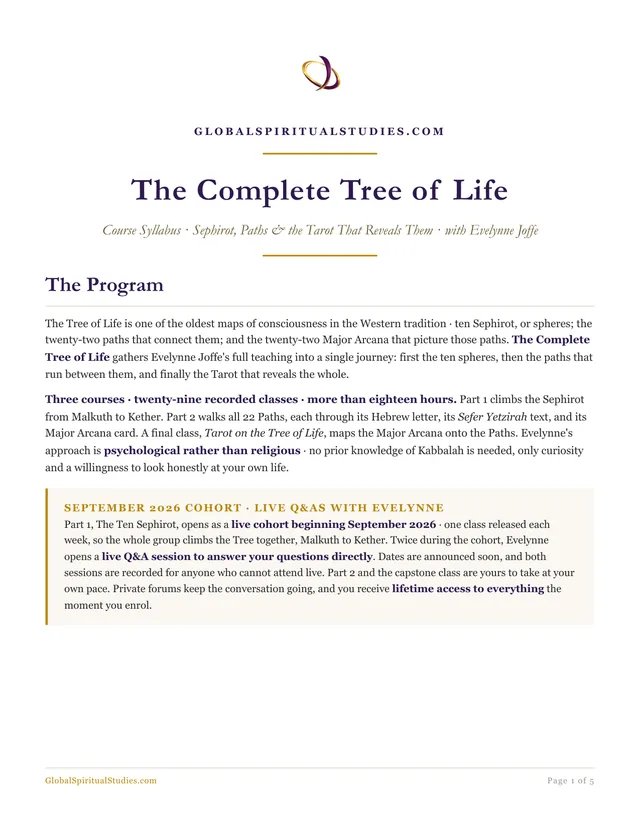
The letters and their numbers are the alphabet of the Tree · gematria is one of the keys that opens it. In Living the Tree of Life, Evelynne Joffe teaches the Hermetic Qabalah from the ground up · the Sephirot, the paths, the letters, and the Tarot cards they carry · in a measured, contemplative way. You are warmly invited to explore it.
Explore the coursesSources & Tradition
The letter values reproduced here are the standard mispar hechrachi and mispar gadol (great, final-form) tables, taken verbatim from our own Hebrew letters reference page so the two never disagree. The understanding of the letters and numbers as the creative "paths of wisdom" follows the Sefer Yetzirah (the Book of Formation) in Aryeh Kaplan's translation and commentary. The treatment of gematria as an exegetical method draws on Gershom Scholem's Kabbalah, and the standard system names follow the common gematria references. The Golden Dawn Tarot attributions follow the tradition taught across our Kabbalah path guides. These teachings are studied at Global Spiritual Studies within our courses on the Tree of Life.
Frequently Asked Questions
What is gematria?
Gematria is a traditional Jewish and Kabbalistic practice of interpreting words by the numerical values of their Hebrew letters. Each of the 22 letters is also a number, so every word has a sum · and words sharing a sum are seen as inwardly connected. Kabbalists use it as a tool of Torah interpretation, uncovering links the plain text conceals.
What is the gematria value of chai?
Chai (חי, "life") equals 18 · Chet (8) plus Yod (10). This is why gifts and donations in Jewish tradition are often given in multiples of 18, a gesture of wishing "life" to the recipient.
Why do "one" and "love" have the same value?
In gematria, echad ("one," 13) and ahavah ("love," 13) share the value 13. Kabbalists read this to mean that divine unity and divine love are two expressions of the same reality. Together they sum to 26, the value of God's four-letter name, YHVH (Yod 10 + Heh 5 + Vav 6 + Heh 5 = 26).
What does the serpent have to do with the Messiah?
Both nachash ("serpent," 358) and mashiach ("Messiah," 358) share the value 358. Traditional commentators interpret this to mean that redemption must confront and transform the very force represented by the serpent of Eden · that the Messiah works through the source of the fall rather than around it.
What are the different types of gematria?
The main methods are standard (mispar hechrachi, 1-400), great number (mispar gadol, using 500-900 for the five final letters), ordinal (mispar siduri, valuing each letter 1-22 by its position), reduced (mispar katan, reducing values to a single digit), and Atbash, a letter-reversal cipher that swaps the first letter with the last, the second with the second-to-last, and so on.
Is gematria the same as numerology?
They overlap but differ. Gematria works specifically from the Hebrew alphabet and is used within Kabbalistic and Torah interpretation as a way to explore meaning, not to predict the future. It is a contemplative tool bound to a tradition, not free-form number prediction.
Continue Your Study
- The 22 Hebrew Letters · the canonical reference · meanings, values, classes, paths, and Tarot cards
- The 22 Paths and their Tarot cards · how the letters become the paths of the Tree
- The Tree of Life · Complete Guide · the full map the letters and numbers build
- Learn Kabbalah online · guided courses in the Tree of Life and its symbols
Every Hebrew word is also a number · gematria is the art of listening for what the numbers quietly share.

About this article
Based on the teachings of Evelynne Joffe
Kabbalist, Tarot Counsellor & Dream Therapist · Director, Institute of Esoteric Studies
This article was written by the Global Spiritual Studies editorial team, drawing on Evelynne Joffe's Kabbalah teaching for Global Spiritual Studies. Evelynne directs the Institute of Esoteric Studies in Melbourne, Australia, and has spent more than thirty years teaching students to read the Tree of Life as a practical map for self-realization. In 1992 she co-founded the Tarot Guild of Australia.
Study this with her
Living the Tree of Life · Part 1: The Ten Sephirot
Living the Tree of Life · Part 2: The Twenty-Two Paths
The Complete Tree of Life
More from Evelynne Joffe →