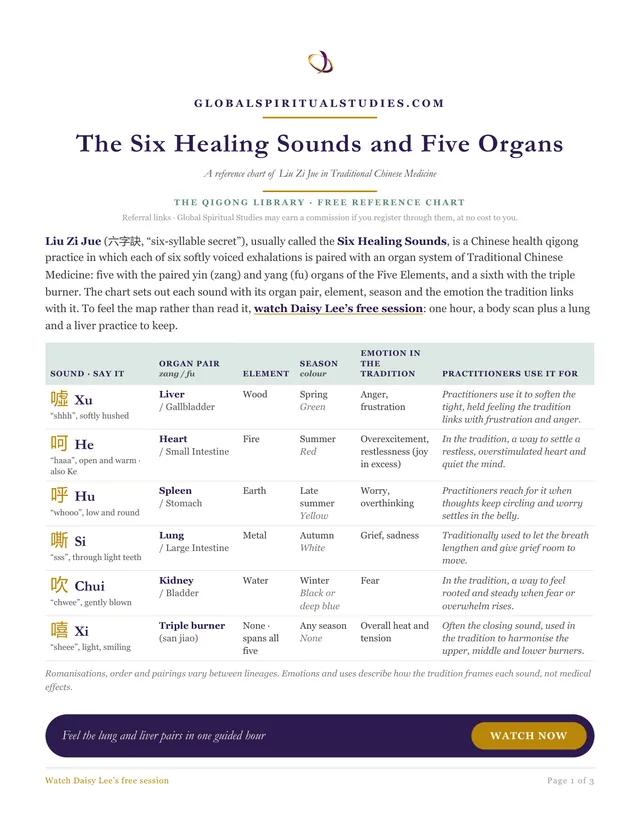
Qigong for Lymphatic Flow · The Complete Guide to Movement, Breath, Self-Massage and the Evidence
How lymph moves, the gentle Qigong practices that work with it, a ten-minute routine standing or seated, and a precise reading of the research
The lymphatic system is a body-wide network of vessels and nodes that returns excess tissue fluid to the blood, carries absorbed fats from the gut, and filters lymph through nodes where immune cells work (National Cancer Institute). It has no central pump of its own: lymph is moved along by the rhythmic contraction of the vessel walls and by squeezing from the muscles, breathing and pulsing arteries around them (PMC5922450), which is why gentle, rhythmic Qigong interests people who want to support lymphatic flow.
Most of us know the feeling of standing up after a long flight or a day at a desk: ankles a little puffy, legs heavy, the whole body asking to move. It is a small, everyday reminder that the fluid in our tissues depends partly on how we move and breathe. And it is often the moment people start looking for a gentle way to help things along.
This entry in the Global Spiritual Studies Qigong Library starts there. It sets out how lymph moves, why a movement tradition built on the idea of flow suits it, the practices Qigong teachers use, a gentle ten-minute routine you can do standing or seated, and exactly what the research does and does not show. It closes with the two teachers whose work comes closest to these practices: Daisy Lee, whose Zang Fu Gong includes lymph massage and shaking, and Dr. Roger Jahnke, whose self-care system includes self-applied massage.
How lymph moves
Every day, fluid seeps out of the smallest blood vessels into the spaces around your cells. Most of it is reabsorbed, but a share stays behind as tissue fluid, and the lymphatic system's first job is to collect it and return it to the bloodstream (NCI). A 2018 review of lymphatic physiology estimates that around eight litres a day end up in the tissues this way, and that about four litres a day travel back to the circulation as lymph after passing through the nodes (PMC5922450).
Blood has the heart. Lymph does not. Instead, the collecting vessels are divided into short segments by one-way valves, and each segment can contract on its own, roughly ten times a minute, nudging the fluid forward. Around that intrinsic pumping, the same review describes an extrinsic one: the squeeze of working skeletal muscle, the pressure changes of breathing, the pulse of neighbouring arteries, the movement of the gut and outside compression (PMC5922450).
So the accurate summary is not that lymph "needs" you to move it, as some marketing suggests. It moves all the time. But ordinary movement and breathing are part of what keeps it moving, and the National Cancer Institute describes exercise as "a natural pump for the lymph system" in its guidance for people with lymphedema (NCI).
 5 pages
Free illustrated printable
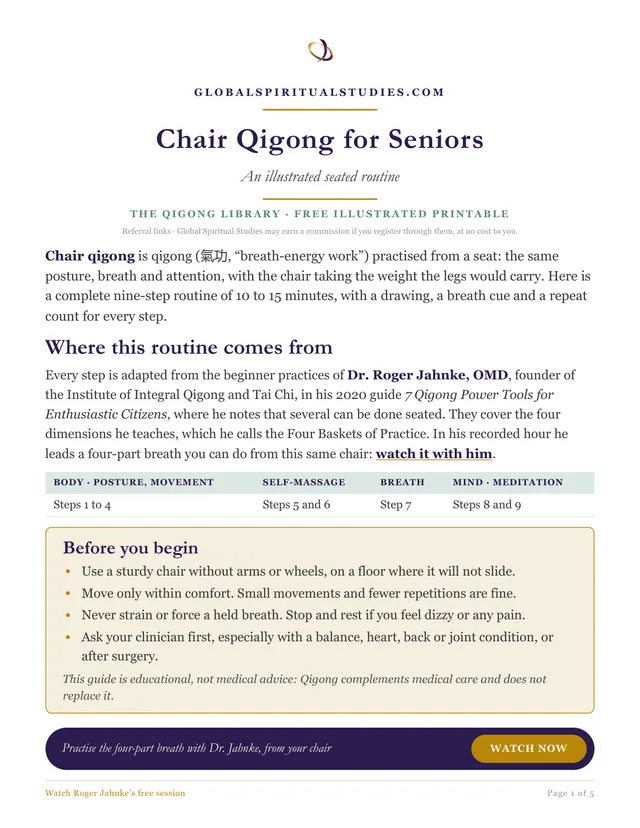
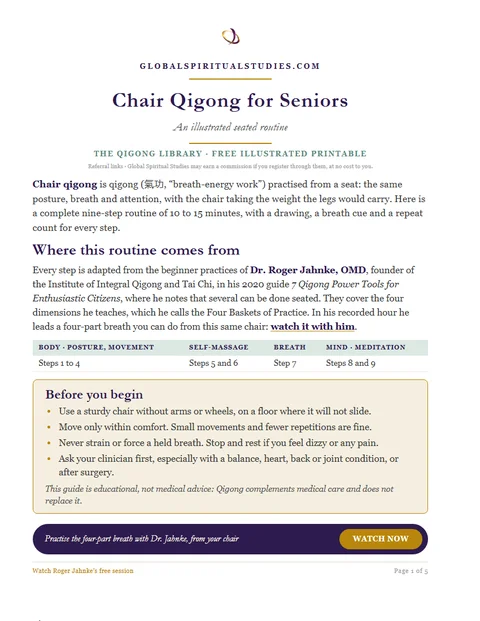
Chair Qigong for Seniors
A complete seated routine, illustrated step by step, ready to print.
| What’s inside | |
|---|---|
| ✓ | Nine illustrated seated steps, from settling into the seat to the closing |
| ✓ | The breath for every movement, printed beside it |
| ✓ | Practices adapted from Dr. Roger Jahnke: the Three Intentful Corrections, Flowing Motion, Earth and Sky |
| ✓ | A Before you begin checklist, and where the routine comes from |
Arrives in your inbox as a PDF · print it for the kitchen table
Why people look to Qigong for lymph
Qigong grew out of a Chinese tradition that prizes flow. An old line from the Lüshi Chunqiu, compiled around 239 BCE, says that running water never goes stale and a door hinge is never worm-eaten, because they move. In Traditional Chinese Medicine that image became a way of thinking about the body: health is qi and blood moving freely through the channels, and discomfort is often described as stagnation, qi that has pooled or stuck.
Western physiology has no place for qi, and it is worth keeping the two languages apart. When a Qigong teacher says a practice "moves stagnant qi" or "clears" an organ, that is an energetic description from inside the tradition. It is not a claim about lymph vessels, and it is not a physical cleanse. What the two languages do share is an observation anyone can make: slow rhythmic movement, loosened joints and full, easy breathing are pleasant, and they are among the ordinary forces that keep fluid circulating.
There is also a newer wave of interest. "Lymphatic tai chi walking" is a recent trend label, sold as a programme through self-published books, charts and videos that pair slow, tai chi style walking with lymph-focused promises. It appears here because many readers arrive searching for it. No published study has tested it, and its lymph claims are unsupported.
What about fascia?
Fascia is the connective tissue that wraps muscles and organs, and "fascia release" has become a popular phrase alongside lymph. Some Qigong teachers use it too: Daisy Lee's course page describes her Zang Fu Gong as gently stretching connective tissue, and Roger Jahnke teaches a practice he calls Connective Tissue Transformation. These describe how a practice feels and what it aims at. No published research shows that Qigong "releases" fascia or changes lymph flow through it.
Practices practitioners use · reference table
These are the movements that turn up again and again in lymph-minded Qigong classes. None of them is secret or proprietary; most are ordinary warm-ups found across many schools. Each has a seated version, and the caution column matters more than any other.
| Practice | What you do | Breath | What the tradition says | Caution |
|---|---|---|---|---|
| Shaking | Stand with soft knees and let a small bounce travel up through the legs, hips, shoulders and loose hands for one to three minutes. Seated: shake the hands and forearms, then let the shoulders jiggle. | Natural, through the nose; let the exhale soften | A common opening practice for loosening the joints and letting stagnant qi move; Daisy Lee's Zang Fu Gong course opens with a shaking warm-up | Keep it small if you have knee, hip or pelvic-floor concerns; stop if dizzy |
| Bouncing on the heels | Rise gently onto the balls of the feet and let the heels drop softly to the floor, several times. Seated: lift and lower the heels while the toes stay down. | Inhale as you rise, exhale as you settle | The last of the Eight Brocades, often called Bouncing on the Toes, is said to "smooth out" the qi after practice | Hold a chair back or wall; skip the drop with osteoporosis, foot pain or poor balance and use the seated version |
| Arm swings | Turn the waist gently side to side and let the arms swing loosely, hands tapping lightly against the body. Seated: turn a little from the waist with the arms relaxed. | Easy and unforced; do not match breath to every swing | Loosening the waist and shoulders so that qi can flow through the trunk and limbs | Small turns only after back or abdominal surgery; no forceful twisting |
| Deep diaphragmatic breathing | Hands on the lower belly. Breathe in slowly through the nose so the belly softens outward, and let the exhale be long and unhurried. Seated or lying is ideal. | Slow and comfortable, never strained or held | Breathing into the lower dantian, the body's "sea of qi"; Jahnke calls the breath the easiest tool for gathering qi | No breath holds, no forced counts; return to normal breathing if light-headed |
| Joint circles | Slow circles of the ankles, knees (hands resting on them), hips, wrists, shoulders and neck, each a few times each way. Seated: ankles, wrists, shoulders and gentle neck turns. | Natural | Loosening the joints so that movement, and in the tradition's language qi, can pass through freely | Neck: half circles or slow side turns only; move within a pain-free range |
| Self-massage strokes toward the heart | Warm the palms, then stroke lightly along the arms, legs and trunk, finishing toward the chest. Seated works well; stroke the legs only as far as you can reach easily. | Slow; a sigh on the exhale is welcome | Tracing the qi channels, part of the self-massage "basket" in Roger Jahnke's four practices of self-care; his version finishes at the heart | Light pressure only. With lymphedema, or after lymph node surgery or radiation, do not self-massage without your lymphedema therapist's instruction |
| Inversions (head below the heart) | Some classes add legs-up-the-wall or forward folds with the head below the heart; this routine, written for a general audience, leaves them out. | Not applicable | Not a core Qigong practice; gentle Qigong keeps the head upright and the spine long | Ask your clinician first if you have blood pressure, eye pressure, heart or reflux conditions, or are pregnant |
The traditional descriptions are energetic, not physiological. Movement names and forms vary between schools; the Eight Brocades wording follows the commonly published English names.
A 10-minute gentle routine
This is an invitation, not a prescription. Take it slowly, skip anything that does not feel right, and do the whole sequence in a sturdy chair if standing is not comfortable today. There is no wrong way to begin.
- Arrive (1 minute). Stand or sit tall, feet flat, shoulders soft. Let the crown of the head lift a little and the breath settle. Notice where the body feels heavy or tight, without trying to fix it.
- Shake (2 minutes). A small, loose bounce through the whole body, or the seated version: hands, then forearms, then shoulders. Let it be easy, almost lazy.
- Joint circles (2 minutes). Ankles, knees, hips, wrists, shoulders, then slow side-to-side neck turns. A few circles each way is plenty.
- Arm swings (1 minute). Turn gently from the waist and let the arms follow like empty sleeves. Seated, keep the turn small.
- Heel bounces (1 minute). Holding a chair back, rise and settle softly, or lift and lower the heels while seated.
- Belly breathing (2 minutes). Hands on the lower belly, slow breath in through the nose, long easy breath out. No counting, no holding.
- Strokes toward the heart (1 minute). Warm the palms and stroke lightly down the outside of each arm and up the inside, then from the legs up toward the trunk, finishing with both hands resting on the chest. If you have lymphedema or have had nodes removed, leave this step out until your therapist has shown you what suits you.
Finish by resting the hands on the lower belly for a few breaths. Many people like to do this in the morning, or after a long stretch of sitting at a desk or in a car.
A slower walk, if you prefer
If the lymphatic tai chi walking trend is what brought you here, you do not need a programme to borrow its best idea. Walk slowly for five minutes on a flat, familiar path, letting each heel land softly and the weight roll through the foot before the next step begins. Let the arms swing loosely, keep the knees soft, and breathe through the nose without counting. When the mind drifts, bring it back to the feel of the feet. This is simply mindful walking in the spirit of tai chi; it carries no lymph claim, only the plain fact that it is a gentle way to move more often. Use a stick or walk beside a rail if balance is uncertain, and skip it on days when your legs feel unsteady.
The self-massage step is adapted from Roger Jahnke's Tracing the Qi Channels, and the library's free printable shows it, with eight other seated steps, as simple line drawings you can keep beside your chair.
A seated routine adapted from Dr. Roger Jahnke's practices · arrives in your inbox as a PDF
What the evidence says
The research falls into three findings, each reported as narrowly as the studies allow.
Movement and breathing do influence lymph flow
Lymphatic physiologists list skeletal muscle movement and breathing among the external forces that help propel lymph (PMC5922450). Breathing has been studied most at the thoracic duct, the large vessel that empties lymph into the veins near the neck. A 2026 systematic review found that breathing influenced thoracic duct flow or pressure in five of six human studies and twelve of seventeen animal studies, but the reported effects "ranged from absent to highly synchronous", fewer than 1% of the screened studies met the inclusion criteria, and the authors framed their work as a map of a knowledge gap rather than a settled answer (PMC12828174). In plain terms: breathing matters to lymph, but how much, and how much slow deep breathing adds, is not well measured.
Exercise is safe and useful in lymphedema care, when it is guided
The best-studied group is women with, or at risk of, breast-cancer-related lymphedema. A 2020 systematic review and meta-analysis concluded that resistance exercise "does not have a systematic negative effect" on the condition and may reduce it, while recommending that programmes be at least partly supervised by an exercise specialist, with medical clearance and monitoring (PMC7316683). A 2024 meta-analysis of 15 trials with 863 patients found that when people kept closely to American College of Sports Medicine exercise guidance, quality of life improved and arm volume did not worsen, although it did not shrink either (PMC11300927).
Qigong itself has barely been studied for lymph
The only Qigong-specific lymphedema study in the literature is a small pilot in 23 breast cancer survivors after mastectomy (Fong and colleagues, 2014), and its own authors called for larger randomised trials before anyone draws conclusions. There is no review or meta-analysis of Qigong and lymphatic flow, and no study at all of lymphatic tai chi walking.
| Question | What the evidence shows | Source |
|---|---|---|
| Do movement and breathing help move lymph? | Yes, both are among the forces that propel lymph; how much slow breathing adds is not well measured | PMC5922450; PMC12828174 |
| Is exercise safe in breast-cancer-related lymphedema? | Supervised exercise does not worsen it, and quality of life improves | PMC7316683; PMC11300927 |
| Has Qigong been tested for lymph? | One small pilot study (23 women); no review or meta-analysis | Fong and colleagues, 2014 |
| Does Qigong detox the lymphatic system? | No study shows this; the body's own organs do that work | NCCIH |
What no study shows
No study shows that Qigong "drains" the lymphatic system, flushes toxins, or clears the lymph nodes. The broader "detox" idea is not supported either: the U.S. National Center for Complementary and Integrative Health reports "no compelling research" supporting detox diets for eliminating toxins from the body, and warns that some such programmes are unsafe or falsely advertised (NCCIH).
What remains is modest and still worth having. Gentle Qigong is movement plus slow breathing, both of which are part of how lymph moves, and NCCIH describes Qigong as generally safe (NCCIH). If it helps you move more often and breathe more fully, that is reason enough.
If you have lymphedema or have had lymph nodes removed
Lymphedema is swelling from lymph fluid that builds up when cancer or its treatment, such as lymph node removal or radiation, disrupts the flow (NCI). It is a medical condition with its own specialists. The National Cancer Institute's recommended care includes manual lymphatic drainage by a certified lymphedema therapist, compression, and exercise, with a doctor's advice before starting a programme.
Please read before practising. If you have lymphedema, are at risk of it after lymph node surgery or radiation, or are in or after cancer treatment, follow your oncology team's and lymphedema therapist's guidance. Do not use the self-massage strokes on this page without their instruction: lymphatic drainage massage uses specific sequences and pressures that a therapist teaches for your body. Gentle movement and breathing are usually welcome, but ask first, and tell your therapist if you notice new swelling, heaviness, redness or warmth.
This guide is educational and is not medical advice. Qigong complements medical care; it does not replace it. Talk with your clinician before starting, especially if you are pregnant, recovering from surgery, or have balance, back or heart conditions.
Where to learn
A page can describe a practice; a teacher can show you how it feels. Two of the most respected Qigong teachers working in English teach these exact practices, and each offers a free session.
Daisy Lee · Zang Fu Gong
Daisy Lee is the 59th-generation lineage holder of Hua Tuo's Five Animal Qigong, the 2020 Qigong Master of the Year (World Qigong Congress), and the teacher of Zang Fu Gong, an organ-focused form. The first module of her seven-module Zang Fu Gong course teaches lymph massage and a shaking warm-up, alongside guided meditation and synchronised breathing. Her free session, Qigong to Cleanse Your Organs for Better Health & Energy Flow, teaches a guided body scan and two short practices, one for the liver and one for the lungs. "Cleanse" there is the tradition's energetic language for moving stagnant qi; it is not a claim of physical cleansing. Read more in the complete guide to her Zang Fu Gong course and the library's entry on Qigong for the organs.
To be guided by the teacher whose course opens with lymph massage and shaking, begin with her free session: a body scan and two short practices, one for the liver and one for the lungs.
Watch nowOpens the course page · the session is one click away
Dr. Roger Jahnke, OMD · self-care and self-massage
Dr. Roger Jahnke, OMD, co-founder of the National Qigong Association and author of The Healer Within, organises Qigong self-care into four practices, his "Four Baskets": gentle movement, breath, meditation and self-applied massage. Breath and massage have a module of their own in his seven-module course, Qi Medicine with Roger Jahnke, and the self-massage step in the routine above comes from his teaching. His free session, Discover the Power of Qi Medicine, includes a four-part Qigong breathing practice.
Practise with a teacher
Begin with Roger Jahnke
Breath and self-applied massage are two of the Four Baskets of his practice. His recorded hour names all four and teaches the four-part breath.
Discover the Power of Qi Medicine
A recorded session with Dr. Roger Jahnke, OMD
| What the hour gives you | |
|---|---|
| ✓ | A little over an hour of teaching, recorded, to watch whenever it suits you |
| ✓ | The four-part breath, the foundation of Qi Medicine, practised with him three times |
| ✓ | The Four Baskets of Qigong practice, named and explained in his own words |
| ✓ | His map of how qi meets the body, from the protective field to the three Elixir Fields |
| ✓ | A tour of all seven course modules, so you know exactly what the course holds |
Recorded session
Free
A little over an hour · watch whenever it suits you
Watch nowOpens the library's course page, with the session one click away.
- RegisterA short form reserves your place
- Practise alongThe four-part breath, with him
- Decide laterThe course is presented at the end
No correct sensation to chase · the breath practice is yours to keep · decide about the course in your own time.
For a wider view of what Qigong has and has not been shown to help, see the library's condition-by-condition guide to Qigong and health.
Sources
National Cancer Institute, SEER Training: Lymphatic System · National Cancer Institute, Lymphedema and Cancer (updated March 2024) · Moore and Bertram, Lymphatic System Flows, Annual Review of Fluid Mechanics 2018 (PMC5922450) · Moazzam and colleagues, The physiology of thoracic duct pressure and flow, Physiological Reports 2026 (PMC12828174) · Hasenoehrl and colleagues, Resistance exercise and breast cancer-related lymphedema, Supportive Care in Cancer 2020 (PMC7316683) · Luan and colleagues, ACSM-based exercise and breast cancer-related lymphoedema, Frontiers in Physiology 2024 (PMC11300927) · Fong and colleagues, Qigong exercise and upper limb lymphedema, Integrative Cancer Therapies 2014 (pilot) · NCCIH, Qigong: What You Need To Know (February 2022) · NCCIH, Detoxes and Cleanses (March 2025) · Wikipedia, Baduanjin qigong · Wiktionary, the Lüshi Chunqiu proverb · The Shift Network course pages for Daisy Lee's Zang Fu Gong and Roger Jahnke's Qi Medicine · Roger Jahnke, 7 Qigong Power Tools (2020).
Further reading: National Cancer Institute, Lymphedema.
Printable · 5 pages
Practise from your chair
All nine seated steps, illustrated, with the breath for each.
Get the printableFrequently asked questions
Does Qigong help with lymphatic drainage?
No study shows that Qigong drains the lymphatic system. Lymph is moved partly by muscle movement and breathing, and gentle Qigong combines both, so it is a reasonable way to stay active. Qigong itself has barely been studied for lymph: the only lymphedema study in the literature is a pilot in 23 women.
What is lymphatic tai chi walking?
It is a recent trend label, sold as a programme through self-published books, charts and videos that pair slow, tai chi style walking with lymph-focused promises. No published study has tested it. Slow, mindful walking is pleasant exercise; the detox and de-puffing claims attached to it are not supported by research.
Can Qigong help lymphedema?
Lymphedema is a medical condition, and its care belongs with your oncology team and a certified lymphedema therapist, who may use manual lymphatic drainage, compression and exercise. Reviews show supervised exercise does not worsen breast-cancer-related lymphedema. Qigong has not been properly tested for it, so ask your therapist before adding it, and do not self-massage without their instruction.
Is shaking good for the lymphatic system?
Shaking is a common Qigong warm-up that loosens the joints and gets the body moving, and in the tradition it is said to let stagnant qi move. There is no study of shaking and lymph flow specifically. Keep it small and gentle, and use the seated version if balance, knees or the pelvic floor are a concern.
How does the lymphatic system move without a pump?
The collecting lymph vessels are divided into short segments by one-way valves, and each segment contracts on its own, about ten times a minute. That intrinsic pumping is helped by the squeeze of working muscles, pressure changes from breathing, the pulse of nearby arteries and movement of the gut, according to a 2018 review of lymphatic physiology.
Which Qigong exercises are used for lymphatic flow?
Teachers commonly use shaking, bouncing gently on the heels, loose arm swings, slow belly breathing, joint circles and light self-massage strokes toward the heart. None of these has been shown to drain lymph, but all are gentle ways to combine movement and breath, and each has a seated version.
Can I do Qigong for lymphatic flow seated?
Yes. Every practice in the routine on this page has a seated version: shake the hands and shoulders, lift and lower the heels, turn gently from the waist, circle the ankles and wrists, breathe into the belly and, if appropriate for you, stroke lightly toward the heart. Use a sturdy chair without wheels and keep your feet flat.
Is Qigong safe after cancer treatment?
Gentle Qigong is generally considered safe, and NCCIH reports that Qigong improved fatigue and sleep in a review of studies with cancer patients. After cancer treatment, check with your oncology team first, especially if you have had lymph nodes removed or radiation, have lymphedema, or are still recovering from surgery. Skip self-massage until a lymphedema therapist has advised you.
Does Qigong release fascia?
Some teachers describe their movements as stretching connective tissue or releasing fascia, and that can describe how a practice feels. No published research shows that Qigong releases fascia or changes lymph flow through it, so treat those phrases as description rather than proven effect.
Does Qigong detox the body?
No. In Traditional Chinese Medicine, cleansing language means moving stagnant qi, an energetic idea, not a physical detox. NCCIH reports no compelling research supporting detox diets for removing toxins, and no study shows that Qigong flushes toxins or clears the lymph nodes.
Running water does not go stale. A little movement, a little breath, most days of the week, is the whole of the teaching.