Path of Samekh · Temperance
Path 25 · Tiferet to Yesod · The Patient Pouring
Path 25, the Path of Samekh, is the long vertical descent on the Middle Pillar of the Tree of Life. It connects Tiferet (Beauty) to Yesod (Foundation) and corresponds to Temperance, card XIV of the Major Arcana. Its zodiac sign is Sagittarius, the mutable fire of the long arrow's flight, and its Hebrew letter Samekh means "support" or "tent peg," the prop that holds the practitioner steady through work that takes longer than any single act of will.
Watch Evelynne Joffe teach this path
Samekh is the path of patient practice. Temperance does not name a moment of revelation; it names the daily, weekly, yearly act of pouring something back and forth between two vessels until what was rough becomes refined. To meditate on this path is to ask what in your life is asking for the long, quiet work of Temperance, the discipline that does not announce itself but builds the substance of an actual self over years.
If some of the terms in this guide are new to you, let them be new. We will walk slowly through each one, not as a test of knowledge but as a way of listening to the symbol more deeply.
A note on tradition: Kabbalah has deep Jewish mystical roots reaching back more than two thousand years. This guide focuses on the Western Qabalah and Tarot correspondences that developed later through the Hermetic tradition and the Golden Dawn. The two streams overlap and inform each other, but they are not identical. Wherever a teaching is specific to one tradition, we will name which one.

Featured Program · The Whole Tree
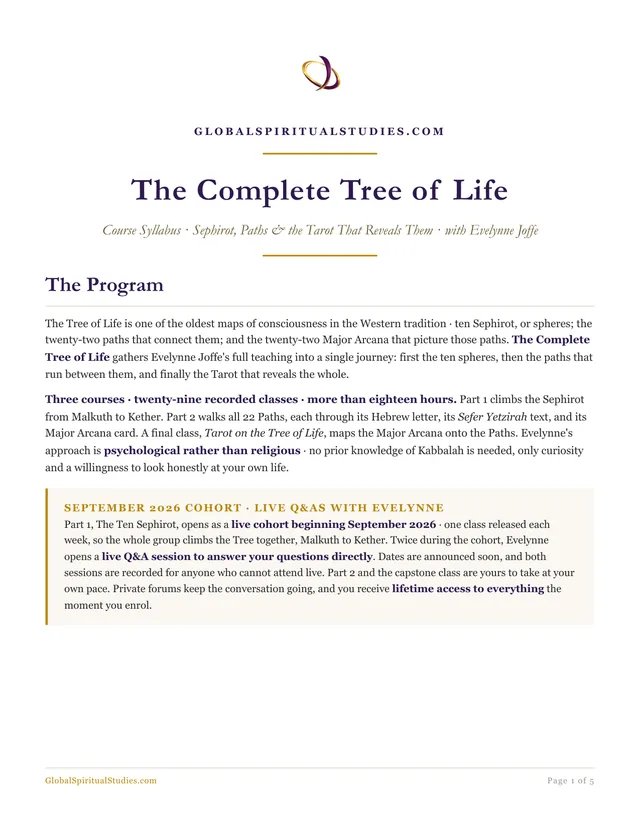
The Complete Tree of Life
Sephirot · Paths · Tarot on the Tree · with Evelynne Joffe
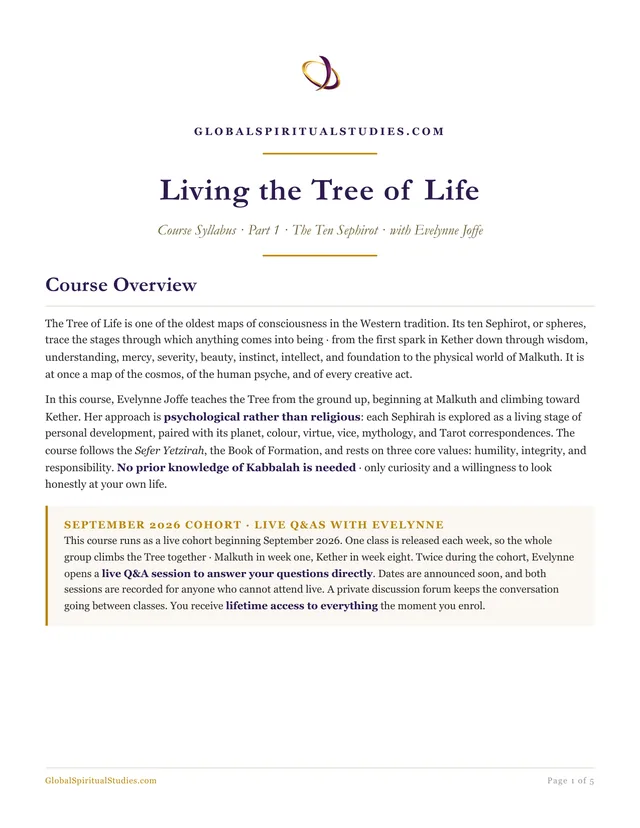
Three courses in one program: Part 1’s eight classes on the Ten Sephirot with their two recorded Q&As, Part 2’s twenty classes on the twenty-two Paths with the 2026 Cohort’s two live Q&As, and Tarot on the Tree of Life. You climb in order, the Sephirot first and then the Paths that join them.
- Three courses
- 29 classes
- Four Q&As (two recorded, two live)
- Three certificates
- Handouts & transcripts
- Lifetime access
What Is the Path of Samekh?
The Path of Samekh connects the sixth and ninth Sephiroth on the Tree of Life. Tiferet (Beauty) is the heart of the Tree, the central Sephirah of integration. Yesod (Foundation) is the ninth Sephirah, the seat of the unconscious and the astral substrate, the foundation on which the physical world of Malkuth rests. Path 25 is the central vertical line that descends from the heart of the Tree directly into the foundation, running straight down the Middle Pillar.
The Sefer Yetzirah calls this path the Intelligence of Probation (sometimes translated "Tentative" or "Trial-making"). The translation captures the path's most distinctive quality. Probation is the long testing period in which a practice is repeated until it has worn its grooves into the substance of the practitioner. This is the work of Temperance: pouring back and forth, waiting, testing, refining, until what was raw becomes capable.
In the descending direction, Path 25 is how the integrated heart of Tiferet is delivered into the unconscious foundation of Yesod, gradually shaping the dream-life and the habitual self around the heart's deepest commitments. In the ascending direction, the patient work performed in Yesod (the daily practices, the slow recovery from old patterns, the unspectacular accumulation of skill) rises back to Tiferet and becomes the heart's own steadier knowing.
Samekh is the central vertical path of the lower Tree, often called by the Golden Dawn the "path of the Holy Guardian Angel" because it is the path on which the practitioner first comes into sustained contact with the deeper guidance that the work has been calling forth. The Temperance figure on the card is sometimes read as this guidance personified: the patient angel who pours.
Correspondences at a Glance
| Attribute | Correspondence |
|---|---|
| Path Number | 25 |
| Hebrew Letter | Samekh (ס) |
| Letter Type | Simple Letter (one of twelve) |
| Letter Meaning | Support; tent peg; the prop |
| Numerical Value | 60 |
| Tarot Card | XIV · Temperance (Art in Crowley's Thoth deck) |
| Astrological Sign | Sagittarius (♐) |
| Element of the Sign | Fire (mutable) |
| Sephiroth Connected | Tiferet (6) ↔ Yesod (9) |
| Sefer Yetzirah Title | Intelligence of Probation |
| Pillar | Middle Pillar (vertical descent at the centre) |
| Body Correspondence | Hips, thighs (Sagittarius) |
| Colour (Queen Scale) | Yellow |
The Hebrew Letter Samekh
Samekh (ס) is the fifteenth letter of the Hebrew alphabet and one of the twelve Simple Letters. It is the only Hebrew letter that is fully closed, a complete circle: a self-contained loop with no opening at top or bottom.
The pictographic origin of Samekh is variously read as a tent peg, a support beam, or, in some traditions, as the circle that the letter's shape literally suggests. Each reading reveals a facet of the path's meaning. The tent peg holds the structure upright through the long night. The support beam carries the load that the upper structure cannot bear by itself. The circle is the practice that returns to itself, the discipline that loops without ending.
Samekh appears in the Hebrew word somekh (to support, to lean upon, also "to ordain": the laying-on of hands by which one generation supports the authority of the next). The path's deepest teaching is that long practice produces something capable of supporting others, and that the discipline of being supported by what came before is the same discipline as becoming a support oneself.
Numerically, Samekh equals 60. Sixty is a complete cycle in many ancient calendars: the sexagesimal hour, the sixty-year zodiacal cycle in some Asian traditions. The path's number is the number of patient turning. To meditate on Samekh is to feel the slow rotation of the practice you are most committed to and to notice that the rotation itself is the practice.
Temperance: Tarot Correspondence
The Temperance card depicts an angel standing with one foot on land and one foot in water, pouring liquid between two cups. The pouring is not a single act; it is continuous, the same liquid moving back and forth. On the angel's chest is a square containing a triangle; on her brow, a solar disc. Behind her, a path winds through the landscape toward distant mountains, with a crown of light just visible at the path's end.
The Golden Dawn assigned Temperance to the Path of Samekh. The match works on every level the tradition tests:
- The pouring between cups is the most precise visual rendering of probation imaginable. The same liquid moves back and forth, and through the back-and-forth, it changes. This is what practice does. Temperance is not a single act of moderation; it is the long, repeated pouring through which the substance is refined.
- One foot on land, one foot in water shows the practitioner straddling conscious (Tiferet) and unconscious (Yesod). The angel does not stand entirely on either side. She is at home in both, which is what the long practice of Samekh produces.
- The path winding to distant mountains is the visible trace of the long journey. The Path of Samekh is a long path; the mountains in the distance are the work that the practice is heading toward, even if no individual day's work appears to make progress.
- The crown of light at the path's end is the higher Sephirah glimpsed through long discipline. The Golden Dawn read this as Kether seen through the keyhole of consistent practice. Samekh is the path that allows this glimpse without the practitioner having to attempt the ascent all at once.
A.E. Waite, in The Pictorial Key to the Tarot, called Temperance "the truth of moderation" but emphasised that the moderation is not abstinence: "It is rather the perfect tempering of forces, the pouring of essence into life." Dion Fortune, in The Mystical Qabalah, was characteristically practical: "Samekh is the path on which the heart and the unconscious learn to speak the same language, and the language is the language of repeated practice." Crowley, in his Thoth deck, retitled the card "Art" to emphasise the alchemical quality of the path's work: the long combining and recombining that produces the philosopher's stone.
Sagittarius: The Astrological Correspondence
The astrological correspondence of Samekh is Sagittarius, the ninth sign of the zodiac. Sagittarius is a mutable fire sign, ruled by Jupiter, symbolised by the centaur archer aiming his bow at the heavens. Its archetypes are the long quest, the philosophical journey, the truth-seeker, the wanderer who carries the bow toward distant targets.
This is the temperament of the Path of Samekh. Sagittarius's arrow does not aim at the immediate. It aims at the far. The Path of Samekh is a long path because the targets it serves are far, and the practice required to reach them is correspondingly sustained. Sagittarius's mutability (its capacity to update aim mid-flight) is what allows the Path of Samekh to remain practical: the work adjusts as it goes, refining the aim through the long pouring.
In the body, Sagittarius governs the hips and thighs: the great muscles of long travel. The Path of Samekh is felt in the body as the steady stride, the pace that does not exhaust itself by trying to arrive too quickly. To work with this path in the body is to bring attention to the legs, to the felt sense of long movement, and to the patient power of the hips that holds the rhythm of journey across years.
Tiferet to Yesod: What This Path Connects
Path 25 joins the sixth and ninth Sephiroth: Tiferet and Yesod. Both are on the Middle Pillar of Equilibrium, and the path is a straight vertical line between them, the longest unbroken vertical segment on the Tree.
Tiferet is the heart, the central Sephirah of integration. Its divine name is YHVH Eloah ve-Da'at, its planet the Sun. Tiferet is where the abstract becomes the felt, where the universal becomes the personal.
Yesod is the ninth Sephirah, the foundation on which physical existence (Malkuth) rests. Its divine name is Shaddai El Chai, its archangel Gabriel, its planet the Moon, its colour violet. Yesod is the seat of the unconscious, the astral substrate, the dream-life, and the habitual patterns that shape daily action without the daylight self knowing it.
The Path of Samekh carries the energy from one to the other. In the descending direction, the integrated heart of Tiferet pours its lessons down through Samekh into Yesod, where they gradually reshape the dream-life and the habitual self. The change is invisible day-to-day; it appears only across long stretches of time. In the ascending direction, the patient work performed in the unconscious (the daily practices, the dream-work, the slow processing of trauma and material) rises back through Samekh into Tiferet and becomes the heart's deepened knowing.
Geometrically, Samekh is the central path of the lower Tree, and it passes through no other Sephirah on its way down. This is unusual: most paths cross at least one boundary. Samekh is direct. The Golden Dawn read this as confirmation that the path of the Holy Guardian Angel is unmediated: the practitioner who walks Samekh long enough comes into direct sustained contact with the source of guidance, not by jumping there but by pouring back and forth until the channel is open.
Pathworking and Meditation
Pathworking is the meditative practice of imaginatively travelling a path on the Tree of Life. The Path of Samekh is the path of practice itself, and so the most natural pathworking is the establishment of any sustained practice and the patient continuation of it.
An Exercise · Sitting with Samekh
Sit comfortably with your spine upright. Place a Tarot card of Temperance in front of you, or simply visualise the Hebrew letter Samekh (ס) as a closed circle, a quiet loop holding its centre.
Bring to mind a practice you have committed to (or are considering committing to) for the long term: a meditation, a creative discipline, a vocation, an ethical commitment. Hold it in attention.
Imagine the angel of Temperance pouring liquid between two cups. The liquid is your practice. It pours from one vessel to another, day after day, year after year. Watch it pour. Notice that the liquid is changing through the pouring, even though no individual moment of pouring looks different from any other.
Ask: What in my practice is asking for more pouring? What is asking to be poured back? Where am I trying to drink the cup before the liquid has finished its refining?
Wait. The Path of Samekh teaches in slow time. After ten or fifteen minutes, return to ordinary attention. Notice whether you can extend a little more patience to the practice today than you could yesterday.
Practitioners working in the Golden Dawn tradition often pair this meditation with the colour yellow, the Queen Scale colour of Samekh, and with the divine name Shaddai El Chai (associated with Yesod) vibrated as the practice closes. Evelynne Joffe's Living the Tree of Life: The Paths course at Global Spiritual Studies treats Samekh as the spine of the entire pathwork curriculum, since the long vertical descent is what the longer practice itself enacts.
Temperance in a Tarot Reading
When Temperance appears in a Tarot reading, the path of Samekh is being invoked in the querent's life. The card asks: What practice is asking to be sustained? Where are you being called to pour back and forth long enough for the substance to refine?
Temperance is the card of patient, sustained, alchemical work. In context, the card tends to indicate:
- The middle of a long journey in which immediate progress is hard to see but the work is genuinely refining the practitioner. The card affirms that the unspectacular daily practice is doing exactly what it should be doing.
- The integration of opposites through time rather than through sudden insight: a relationship in which two people have stayed together long enough to develop a shared rhythm, a profession in which competing demands have been balanced through years of practice.
- Healing in the slow sense: not the sudden shift but the patient pouring that lets old material become workable.
- Reversed, Temperance can indicate impatience, the attempt to drink the cup before the refining is complete, or imbalance that has accumulated because the long practice has been abandoned. The card calls the querent back to the patient work.
Read alongside its Kabbalistic correspondence, Temperance reminds the querent that the deepest gifts of practice arrive only after a long time, and that the time is not lost during which they have not yet arrived. The pouring is itself the gift.
Common Misconceptions
"Temperance means abstinence or moderation in the modern sense." Temperance on the Path of Samekh has nothing to do with abstaining from pleasure. It refers to the alchemical tempering of metal: the long heating and quenching that gives steel its strength. The practitioner is not being asked to give things up; they are being asked to commit to the slow work that makes them durable.
"Sagittarius is restless, so the Path of Samekh is fickle." Sagittarius's mutability is not fickleness; it is the capacity to update aim mid-journey. The Path of Samekh is one of the most disciplined paths on the Tree precisely because Sagittarius's long aim does not allow short-term distraction.
"The Path of Samekh is only for advanced practitioners." Samekh is the path of practice, and any practitioner with any sustained discipline is already walking it. The path's wisdom is not reserved for the advanced; it is given to anyone who continues.
"Temperance is dull because it doesn't promise transformation." Temperance does promise transformation, but not the dramatic kind. The card's transformation is the slow alchemy that turns raw material into refined substance. To readers who want the spectacular, the card looks unimpressive. To practitioners who have lived the patient pour, the card describes one of the most powerful processes available to a human life.
Recommended Courses
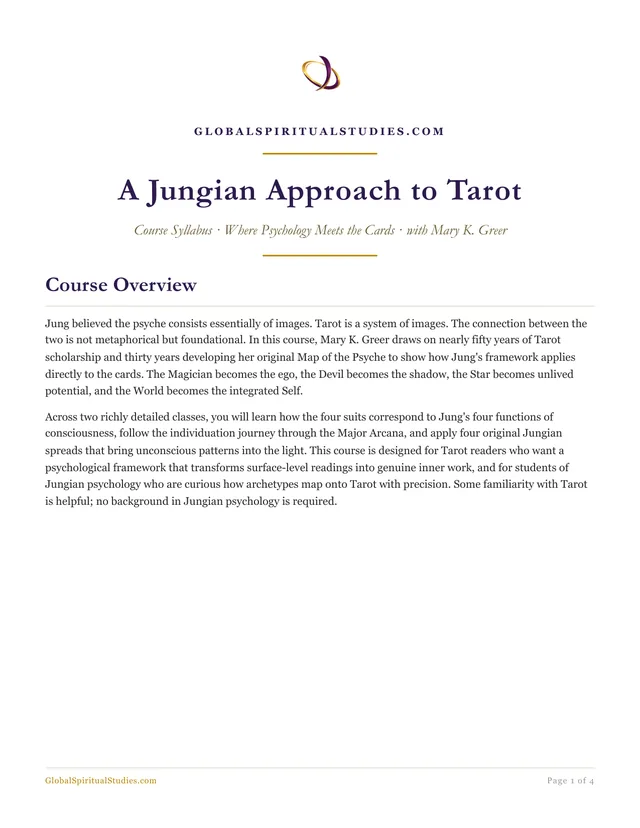
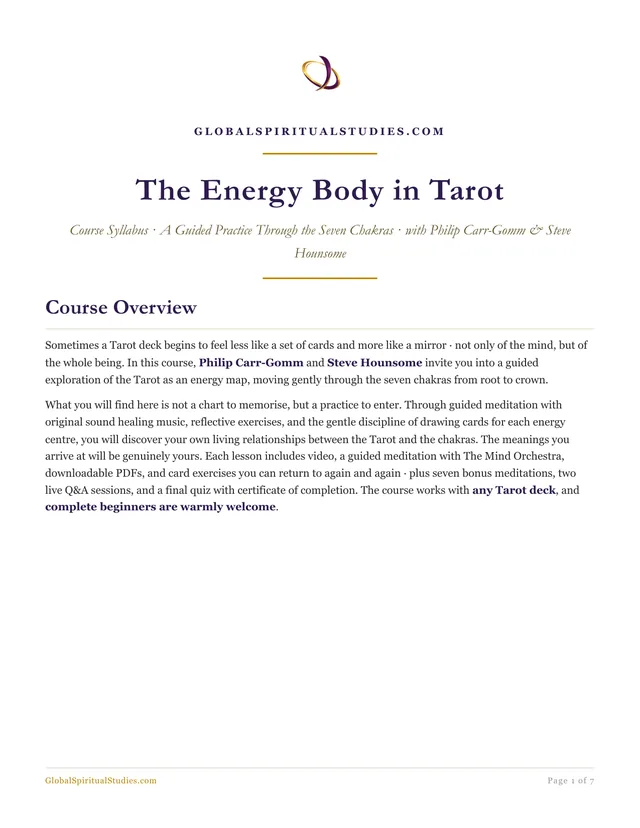
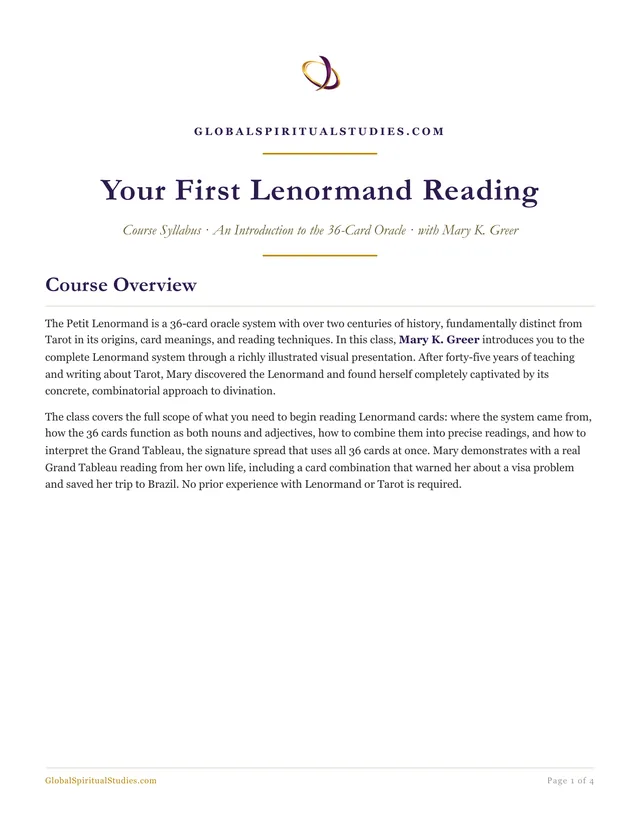
For students who feel drawn not only to understand these symbols but to enter them through guided practice, Evelynne Joffe's teachings offer a steady and deeply experienced path. Her work has shaped how the Tree of Life is taught at Global Spiritual Studies, and her courses are the natural next step after this guide.
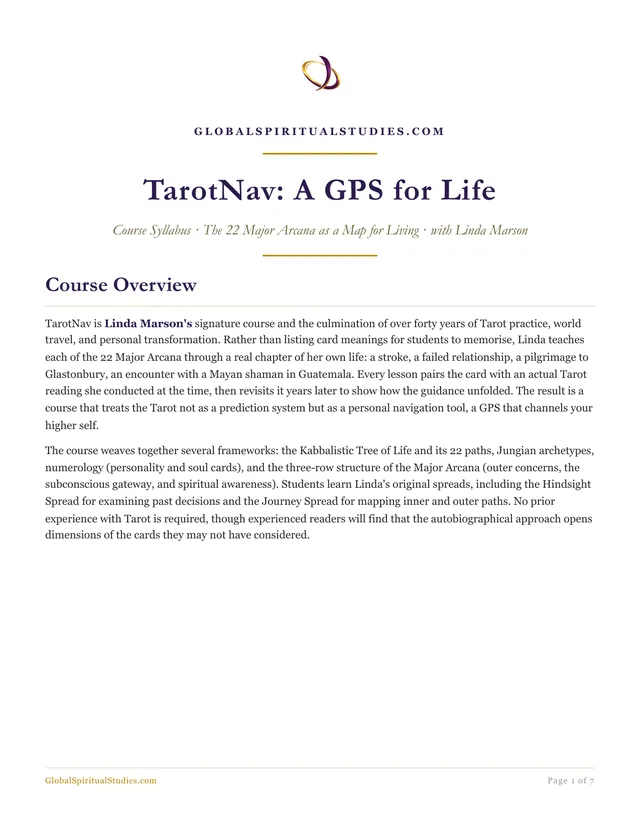
Twenty recorded classes covering all twenty-two paths in depth. The Path of Samekh is treated as the central spine of the path-work curriculum, the long vertical descent that the practice itself enacts.
The companion course covering all ten Sephiroth, including Tiferet and Yesod, the two Sephiroth that the Path of Samekh connects.
Everything in this guide · and twenty-one paths more. Evelynne Joffe walks every path and every Sephirah on the Tree of Life across twenty-nine recorded classes, with sixty-seven downloadable PDFs (transcripts, study guides, workbooks, reference cards, glossaries, and self-assessment quizzes), three private course-group forums, three certificates of completion, and lifetime access. This is the complete curriculum that these guides are drawn from.
Explore The Complete Tree of Life →For a printable reference to all ten Sephiroth and twenty-two paths, download our free Kabbalah Tree of Life PDF guide.
To see how all twenty-two paths relate to the Major Arcana at once, see the complete 22 Paths and Tarot Correspondences guide.
For more in this tradition, browse our Kabbalah course collection.
Frequently Asked Questions
Why does Temperance correspond to Samekh?
The pairing was formalised by the Hermetic Order of the Golden Dawn in the late nineteenth century. The match works because Samekh literally means "support" or "tent peg," the prop that holds the practitioner steady through long work. Temperance depicts the long pouring back and forth that refines substance over time. Both the letter and the card teach the same lesson: real transformation comes from sustained practice, not from sudden revelation, and the practitioner must learn to lean into the support that the practice itself provides.
Why is the Path of Samekh called the path of the Holy Guardian Angel?
In Golden Dawn tradition, the Path of Samekh is named the path of the Holy Guardian Angel because it is the path on which the practitioner first comes into sustained contact with the deeper guidance that long practice calls forth. The angel on the Temperance card is sometimes read as this guidance personified. The path is direct: it descends straight down the Middle Pillar, passing through no other Sephirah, which is why long practice on Samekh produces unmediated contact with the source of guidance. The terminology is specific to the Western Qabalah tradition and not part of Jewish Kabbalah.
Why is Sagittarius assigned to the Path of Samekh?
Sagittarius is mutable fire, ruled by Jupiter, symbolised by the centaur archer aiming his bow at the heavens. Its archetypes are the long quest, the philosophical journey, and the disciplined aim toward distant targets. This is exactly the temperament the Path of Samekh requires: the long, sustained practice that aims at goals which cannot be reached by a single day's work. Sagittarius's mutability (the capacity to update aim mid-flight) is what keeps the practice practical across years.
How long does it take to feel the effects of working with the Path of Samekh?
Long enough that the question itself is part of the test. The Path of Samekh is the path of probation, and probation is the long testing period in which a practice wears its grooves into the substance of the practitioner. Some effects are felt within weeks (steadier mood, clearer aims, more capacity to sit with difficulty). The deeper transformation, the slow restructuring of the unconscious, takes years. The card's promise is not speed; it is durability. What is built on Samekh stays built.
The angel of Temperance does not pour to fill anything. The angel pours so that the pouring will continue. The Path of Samekh teaches that practice is not a means to a destination, but the form a life takes when it has stopped asking the practice to deliver a result, and the result, when it arrives, is the practitioner.

About this article
Based on the teachings of Evelynne Joffe
Kabbalist, Tarot Counsellor & Dream Therapist · Director, Institute of Esoteric Studies
This article was written by the Global Spiritual Studies editorial team, drawing on Evelynne Joffe's Kabbalah teaching for Global Spiritual Studies. Evelynne directs the Institute of Esoteric Studies in Melbourne, Australia, and has spent more than thirty years teaching students to read the Tree of Life as a practical map for self-realization. In 1992 she co-founded the Tarot Guild of Australia.
Study this with her
Living the Tree of Life · Part 1: The Ten Sephirot
Living the Tree of Life · Part 2: The Twenty-Two Paths
The Complete Tree of Life
More from Evelynne Joffe →