Snake and Fox
Snake and Fox arrives with a reputation for double-dealing, and the order decides whether the person asking is the target or the tactician. Put the Snake first and the complication takes the subject slot, described as cunning: a tangle somebody is actively working, a story being kept in good repair. With the Fox leading, the manoeuvre is the subject and the complication is what it is made of or aimed at, which is why the one writer who gives the two orders separate entries files outsmarting and narrowly avoided snares under this direction rather than fresh deceit. And a whole branch of the literature declines the deception reading entirely and reads these two as guarded desire, which is a third page altogether.
- Snake + Fox (7 + 14)
- A complication as the subject, described as calculated. Something tangled that has an author: a story being maintained, a rivalry with a plan behind it, office politics with a beneficiary.
- Fox + Snake (14 + 7)
- A manoeuvre as the subject, described as complicated. Either a strategy that has turned devious, or the one being used to get clear of a trap. The escape reading lives here and nowhere else in the pair.
- The cards
- Snake · card 7 · Queen of Clubs · negative. Fox · card 14 · 9 of Clubs · negative.
- Yes or no
- A qualified no when the Snake leads: the situation is not what it appears. Undetermined when the Fox leads, because the same two cards cover walking into a trap and walking out of one.
- Timing
- The second card sets the pace. Snake + Fox takes the Fox's fourteen, which comes with the traditional warning that the timing itself is unreliable. Fox + Snake takes the Snake's seven and rarely arrives by the direct route.
The two cards
The Snake is the card of complexity and indirection. Its keyword lists carry deception and desire side by side, and always have: the same picture serves for the lie, the rival, the detour and the craving. Which sense wakes is settled by the question and the neighbours rather than by preference, and that split is the single reason two well-known references can describe this pair in words that share no vocabulary at all.
The Fox is divided the same way, along a different seam. Older German sources put falseness there: a schemer, someone whose surface does not match what is underneath. Modern French-derived practice reduces it to plain employment, nothing sinister at all. One English reference sets its two senses out plainly and warns readers to keep the work meaning and the cunning meaning apart, because both can be live in the same spread.
Put the two together and the popular expectation is doubling: deceit multiplied by deceit. That is one of the pair's readings and not the only one, and it is worth noticing before the grammar starts. In the directional method used on this site, we read the first card as the subject and the second as its modifier, which for two cards this slippery is the difference between a description and an accusation. Neither card carries a favourable charge among the Lenormand card meanings, yet that shared low temperature says nothing about who or what is actually being described.
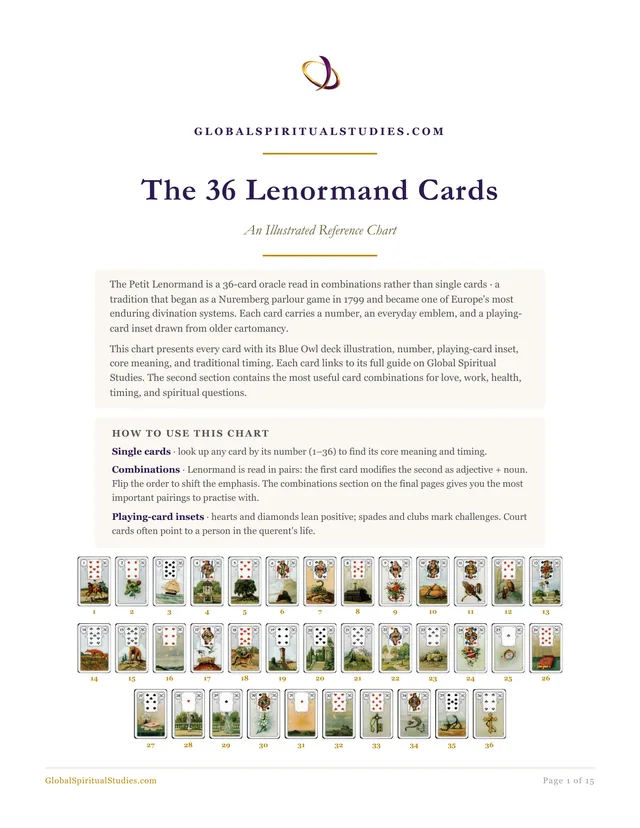
Two cards with two senses each is four possible sentences before the spread has said anything, and the neighbours are what settle it. Our free 36-card Lenormand chart lays out every card's keywords, polarity, playing-card insert and Grand Tableau house on a single printable sheet, which is the fastest way to see whether the Fox in front of you is the tactic or the job.
Snake + Fox
The Snake leads, so the complication is the noun. Something is tangled, and the Fox arrives as the adjective: calculated, self-interested, worked. The sentence is a complication with an author. Not bad luck, not a misunderstanding, but a situation somebody is steering, and steering for a reason of their own.
That is where the classic reading belongs, and the sources are emphatic about it. Lisa Boswell gives this order as a false friend you would never suspect and being manipulated into believing a lie. German lists give a fraud that is hard to expose, and getting steadily more entangled in one. The common thread is not malice so much as maintenance: the deceit in this direction is being kept up rather than committed once.
The Fox's other sense produces a much duller and more common version of the same order: a complication at work. Politics, a territorial colleague, a process somebody has bent to suit themselves. That is where our own material's line about workplace manipulation comes from, and it is usually the right reading when the question was about a job rather than a person.
You would see this order when someone asks why a straightforward thing keeps not resolving, and the answer is that it is not straightforward and somebody prefers it that way.
Fox + Snake
Reverse them and the manoeuvre becomes the noun. The Fox is the tactic, the job, the piece of positioning, and the Snake describes it: complicated, entangled, working against something with its own agenda. The sentence is a strategy operating in difficult terrain.
This is where the pair stops being a simple accusation, and the field bears it out. Boswell's entry for this order includes outsmarting a false friend and narrowly avoiding an enemy's snares, alongside the darker readings of someone posing as a friend in order to take advantage. Both of those are the same grammar: the manoeuvre is the subject, and whether it is being used to set a trap or to get out of one is not something the two cards decide.
That ambiguity is the useful part. Snake + Fox says a tangle is being managed by someone, and the question is who. Fox + Snake says a move is being made through a tangle, and the question is whether the person asking is the one making it. Readers who take the pair as an accusation in both directions lose the direction in which the querent is the competent one.
A third reading sits underneath both, and it is not about deception at all. Where the Snake is read as desire rather than deceit, this order is caution about wanting something: an appetite being handled carefully, or kept quiet.
The pair across five areas of life
| Area | Snake + Fox | Fox + Snake |
|---|---|---|
| Love | A complication inside the relationship that somebody is managing: an omission kept up, a third interest, a version of events maintained for the sake of quiet. | Manoeuvring inside a complicated relationship, and the person doing it may well be the one holding the cards. Also, where the Snake reads as desire, an attraction being kept private. |
| Work | The most frequent use of the pair. Politics with an author: a process bent to suit one person, a rivalry being run rather than merely felt. | Navigating a difficult situation deliberately. A career move made through a tangle, or handling a person everybody else avoids. Competence rather than guilt. |
| Money | An arrangement more complicated than it was presented as being. The pair reports the complexity and not its size, and the reading points toward wanting the terms set out plainly before anything is agreed. | A shrewd move through complicated money. Whether the shrewdness is prudent or sharp is decided by the neighbours, and only the person whose money is at stake can weigh that. |
| Health | A complication being managed, or a course of action that is not straightforward. German lists carry the wrong remedy here: a picture of circumstances, never a diagnosis to act on. | Working strategically through a difficult system: appointments, referrals, second opinions from an independent professional. The cards describe the navigation rather than the condition. |
| Timing | Pace follows whichever card is second, and here that hands it to the Fox: fourteen days, weeks or months, with the traditional caution attached that the Fox's own timing runs the least reliable in the deck. Expect it early and awkwardly. | The Snake sets it instead: seven, and an indirect route. Delays here are caused by the complication rather than by anybody's diary, so the date moves when the situation does. |
Snake and Fox in the Grand Tableau
Side by side, this pair takes its verdict from the card beyond it more than most. Snake, Fox and Book is something being kept hidden on purpose. Snake, Fox and Key is the same tangle resolved definitively, which is a good deal more encouraging than either card looks alone.
Distance is the discipline. Two negative cards several positions apart are not a conspiracy, and a reader who links a Snake in one corner to a Fox in another has assembled a plot rather than read one. The tableau is perfectly capable of saying that there is a complication in the family and a strategic question at work, with no connection between them.
The houses are unusually well matched here, because both cards have a house that asks nearly the same question. House 7 asks where the complications are, so the Fox landing there says the complication is being handled strategically, by somebody. House 14 asks where you must be strategic, so the Snake landing there says the place that needs care is the tangled one, which is often work. Read together they can describe an entire situation: what is knotted, and where the thinking has to be done.
Worth flagging: neither card carried a divinatory sense at the deck's start, since it began life strictly as a board game. Passing square 7 in the Game of Hope rules · the parlour game, advertised in 1799, that the deck grew out of · cost the player three marks to get by the snake unharmed, the steepest single toll on the whole board, while landing on square 14 cost nothing in coin and instead knocked the token backward to the wood on square 5. Money lost in one case, ground lost in the other, and the fox's method of harm was misdirection rather than a direct strike. None of that is a card meaning, it is only how tokens moved, yet the split between a toll and a setback still echoes in how these two cards get read today.

Where the traditions differ
Three readings of this pair are in print, and none of the three acknowledges the other two.
The deceit reading is the popular one and the one our own material carries in both directions, as double deception and extreme cunning. Boswell belongs here for the Snake-first order, as do the German references, which add a medical register English lists do not carry and describe a fraud that resists exposure.
The escape reading exists in exactly one place among the sources reviewed here: Boswell's Fox-first entry, where outsmarting a false friend and narrowly avoiding a snare sit alongside the darker glosses. Boswell never actually spells out a direction rule herself, so treat this as a supporting data point rather than a settled ruling. It matters because it is the only published sentence about these two cards in which the reader is winning.
The desire reading ignores deception altogether. Labyrinthos prints one line on both its Snake page and its Fox page, and that line is about selfish desires and caution about what one wants. Anna.K's entry is the same family: being guarded or secretive about desire, and unspoken tension. For readers who take the Snake as appetite rather than as a liar, this pair is about wanting something carefully, and no false friend appears anywhere in it.
There is also a habit in the German lists worth naming rather than importing. Madame-Lenormand.de gives this pair almost entirely as a woman: a deceitful rival, a woman lying, a schemer working out of sight. That comes from the Snake's Queen of Clubs insert and from older usage that attached a person, usually female, to the card. Modern practice has largely de-gendered it, and this page follows that, because putting a specific woman into a spread before the question has asked for one turns a description into an allegation. One German writer also declines the technique of reading which way the fox is looking on the card, on the ground that it changes with the artwork, and that caution applies to any rule drawn from a picture rather than from a position.
The oldest written meanings are stricter than any of them and quieter. Card 7, in the instruction sheet the New York paper The Evening World ran whole on 19 October 1903, is a misfortune whose extent depends on how near it lies to the person, bringing deceit and sorrow with it, while card 14 warns to distrust the people you are connected with, some of whom mean to deceive you, adding explicitly that at a distance there is nothing to fear. Two entries about the same danger at two scales, both conditional on proximity, and no suggestion anywhere that one card deceives the other. The pair as a doubling is a later invention.
Mary K. Greer and Caitlín Matthews, who both teach with us, have each produced a standard reference on this deck; on this specific pair, though, neither one is on record with a directional reading, so this page does not put words in their mouths. The escape reading's tie to the Fox-leading order is a house conclusion, reached by working the grammar through on its own terms rather than borrowed from either instructor.
A reading in three cards
A man asks whether to take a role at a company where somebody he fell out with years ago now works. The line comes up Fox · Snake · Key.
The move is the subject. The Snake says the terrain is complicated, which is the old quarrel rather than a new one, and then the Key says the matter resolves definitively. Read as a sentence: a deliberate step taken through difficult ground, and it settles. Nothing in the line calls him a schemer, and nothing tells him to go.
Deal the same three as Snake · Fox · Key and the subject changes hands. The complication leads, the Fox says somebody is working it, and the Key still resolves it, but now the resolution belongs to the tangle rather than to his move. Same three cards, same job, and the difference between a man crossing difficult ground and a situation being steered by whoever is already standing on it.
What readers get wrong about this pair
Hearing two deceivers and stopping. It is the natural first thought and it accounts for perhaps half the pair's range. Both cards carry a second sense, and one of the two orders is regularly a defence rather than an offence.
Reaching for a schemer before the question ever called for one. The card describes a complication as readily as a schemer, and the inherited habit of making that person a woman has caused more damage in this deck than any other single convention.
Deciding the querent must be the one on the receiving end of it. The pair names a calculation and not its target. Sometimes it is aimed elsewhere, sometimes at an institution, and occasionally the person holding the cards is the one with the plan.
Taking it as proof. These two cards describe a shape: something tangled, something calculated. They do not identify a culprit, and the surrounding cards are usually where the actual information is.
Questions about Snake and Fox
Is the Snake and Fox combination always about deception?
No, and this is the pair where that assumption costs the most. A substantial branch of the published literature reads the Snake as desire rather than as a lie, and files these two cards under guarded wanting and caution about one's own appetites, with no deceit in the entry at all. The Fox is similarly divided between cunning and plain employment. Deception is the commonest reading in the sources reviewed here, and it is not the only one on offer.
What changes when you reverse the Snake and Fox combination?
Whether the tangle or the tactic is being described. Put the Snake first and the complication becomes the topic, worked by somebody, which is the false-friend reading. Put the Fox first and the manoeuvre becomes the topic with the complication as its terrain, which is why that order also covers outmanoeuvring somebody or getting clear of a snare. Most published lists collapse both orders into one sentence and quietly drop the second reading.
Does the Snake and Fox combination mean a false friend?
It can, in the order where the Snake goes first: the complication takes the subject slot there, with calculation as its descriptor: a story maintained, a friendliness with an interest behind it. What the pair does not do is name the person or prove the intent. Where a specific relationship is in question, the cards standing on either side carry far more information than these two do, and the honest report is usually that something is not what it appears rather than that somebody is lying.
Is the Snake and Fox combination a yes or a no?
A qualified no in the order where the Snake leads, given that matters are not what they appear. Undetermined when the Fox leads, since that order covers both walking into a trap and walking out of one, and the neighbouring cards are what decide which. Neither direction is a flat refusal, and neither is a warning to abandon anything.
How quickly does the Snake and Fox combination play out?
Around one to two weeks in one direction and less predictably in the other, with the second card setting the pace in both. Snake + Fox runs on the Fox's fourteen, and the Fox's traditional timing carries a warning attached to it, so expect the thing earlier and at a less convenient moment than planned. Fox + Snake runs on the Snake's seven and takes the indirect route, which means the delay comes from the complication itself and the date moves whenever the situation does.
Related combinations
Every pair in the deck is indexed in our Lenormand card combinations guide, where you can look up any two cards together.
Learn Lenormand · explore our Lenormand courses with Mary K. Greer and Caitlín Matthews.
Two cards with two senses each is where reading from a list quietly fails, because the list picked one sense for you and did not say so. The Complete Lenormand teaches the system underneath the meanings · subject and modifier, neighbours, distance, houses and the full Grand Tableau · so that a slippery pair reads as a described situation rather than a suspicion.