Rider and Whip
Rider and Whip together mean news with friction in it: a message, a visitor or a development that arrives carrying an argument, a contest or a demand. With the Rider in front, the arrival is the event and the Whip says what kind it is, so the news itself provokes the row. With the Whip in front, the quarrel is the event and the Rider says how it travels, so a dispute reaches you at speed or turns up at your door. The published readings run from a sporting fixture to an assault, and most of that spread is the Whip, not the Rider.
- Rider + Whip (1 + 11)
- Contentious news. A message that starts an argument, a rival or competitor arriving, a visit that turns heated.
- Whip + Rider (11 + 1)
- A dispute on the move. The argument comes to you, news arrives from someone you have fallen out with, or a reply lands in the middle of a quarrel.
- The cards
- Rider, card 1, 9 of Hearts, positive. Whip, card 11, Jack of Clubs, negative.
- Yes or no
- Leans no on any question about peace or ease. Undetermined on whether the news itself is good: the cards around the pair decide.
- Timing
- The second card governs. Rider + Whip closes on the Whip, which answers with a pattern that comes back around rather than a date. Whip + Rider closes on the Rider, which modern lists make quick and the oldest checkable text makes deliberately later.
The two cards
The Rider, card 1, is arrival: news, messages, visitors, the first motion of something about to happen. It is positive in most traditional references, but it is a carrier before it is a verdict. What it brings depends on what it is standing beside.
The Whip, card 11, has three registers that modern lists tend to blur. There are words: debate, argument, criticism, negotiation. There is the body: sport, training, exertion, physical contact. And there is force: punishment, aggression, abuse. Its oldest written sense belongs to none of these cleanly, because the 1846 instruction sheet that shipped with Petit Lenormand decks reads the Rod as quarrelling inside the family, the "want of peace among married persons", and also as fever and long illness. The sports reading is a later development.
A messenger beside a quarrel, then. In the directional method used on this site, we read the first card as the subject and the second as its modifier. The case for this convention, alongside the alternatives some readers prefer, lives in our full Lenormand guide.
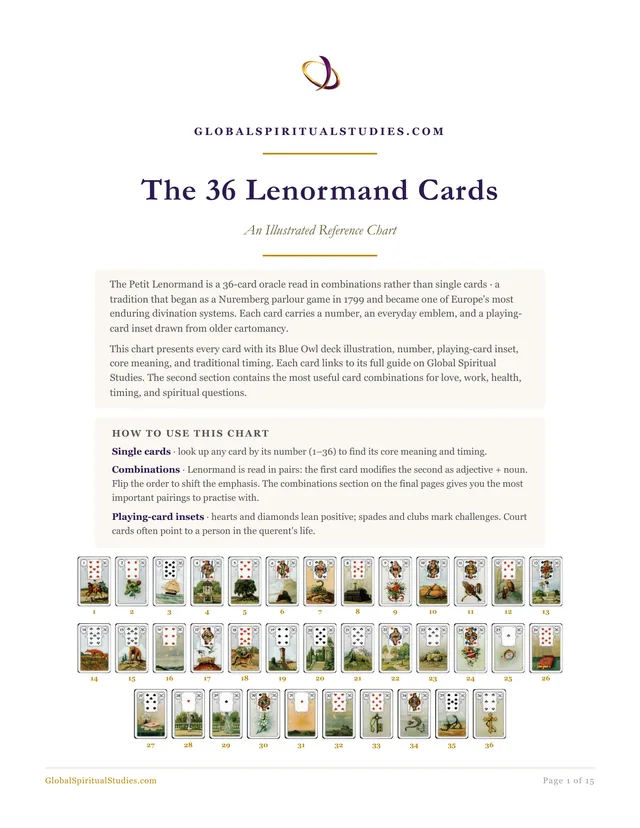
Which register of the Whip you are holding is decided by the cards that sit around this pair, so it pays to have all thirty-six to hand. Our free 36-card Lenormand chart puts every meaning, polarity and house on one printable sheet.
Rider + Whip
With card 1 leading, the arrival becomes the noun, and card 11 hangs on it as a description. The sentence is: what is coming is contentious. That can be a message whose contents start an argument, a piece of news that reopens an old grievance, a visitor who brings tension into the room, or an announcement that sets two people competing. Lisa Boswell gives this order as a sporting competition, the abuse of messages, and physical contact, and Labyrinthos reduces it to news about a competition. Learn Lenormand pairs mediation with news that brings quarrels.
Read carefully, the common thread is that the Rider is the cause. Something arrives and the friction follows from it. That distinguishes this order from a quarrel already underway. The reader is looking at a trigger: the email that should not have been sent, the result of a contest, the inspection that turns into a dispute, the challenger who shows up to compete.
Where the Whip's sporting register is awake, this order can be cheerful. A fixture announced, a race entered, a training plan arriving: the Whip as exertion and the Rider as the call to it. Where its force register is awake, it is the reverse, and Anna K's entry for these two cards (which she writes without regard to order) leans hard that way, giving attack, aggression directed at the querent, someone who says hurtful things, and a person who brings destruction with them. Which version you have is not in the two cards.
Whip + Rider
Reversed, the conflict becomes the noun and the Rider describes how it behaves: quickly, mobile, arriving. The sentence is: the dispute is on its way. Boswell's entry for this order is the most specific in the field, and every item in it puts the quarrel first and the movement second: news from someone you are estranged from, telling somebody about abuse, turning up at a home purely to have an argument, an act of punishment, shooting the messenger. Learn Lenormand has troubling news and feedback.
One German reference gives this order a register the English lists lack, which is repair. Its entry for the Whip with the Rider includes sending an apology and a message that asks the recipient to look honestly at their own conduct, and its love reading describes a message that starts a necessary argument, one in which plain words clear up a misunderstanding. That is the Whip as discussion rather than as blow, and it follows naturally from this order: when the quarrel is the subject, the Rider can carry either the next round or the way out of it.
So the orders separate on causation. Rider first, the news makes the friction. Whip first, the friction makes the news, and the second card says only that it travels.
The pair across five areas of life
| Area | Rider + Whip | Whip + Rider |
|---|---|---|
| Love | A message that sets off an argument, or a new admirer who arrives as competition for someone already in the picture. The arrival is what unsettles things. | A disagreement that will not stay put: it follows one partner out of the room and comes back by text. Also the apology sent after it, if the surrounding cards are kind. |
| Work | A rival bid, a contested announcement, a performance review whose contents start a dispute. Debate and negotiation are the milder end of this column. | A complaint escalating quickly, or a conflict between colleagues carried to someone else's desk. Feedback that is pointed rather than cruel sits here too. |
| Money | A bill or demand that arrives and is disputed, or competition for the same contract. The pair names the friction and says nothing about who prevails. Independent advice belongs beside any decision with real stakes. | A money disagreement that keeps resurfacing in letters or calls. The reading describes a pattern of contact rather than an amount. |
| Health | Modern lists push this order towards sport, training and physical exertion. That describes an activity, not a condition, and nothing here speaks to a body. | The 1846 Rod carries fever and lengthy illness, a register most current readers have dropped. It is history, not a forecast, and health questions belong with a clinician. |
| Timing | The Whip closes the pair and governs, and card 11 tends to answer in recurrence: the news is not a single event but something that comes round again. November or a count of 11 if a figure is wanted. | The Rider closes the pair and governs. Modern lists give it days or a week. The 1846 entry pointedly says the Cavalier's news arrives later rather than at once, so the honest reading is soon, but not as soon as hoped. |
Rider and Whip in the Grand Tableau
Touching, these two behave as described in the sections above, and whatever lies next along the row settles which Whip has turned up. Birds or the Letter push the Whip towards words. The Tree, the Bear or the Garden can push it towards sport or physical effort. The Clouds, the Fox or the Scythe nearby push it towards force, and that is the configuration in which Anna K's reading deserves to be taken seriously.
Apart, the two cards stop forming a phrase. Card 1 up near the top row and card 11 down by the bottom edge are two separate reports, and stitching them together uninvited is how a perfectly ordinary letter gets promoted into a menace.
Our own house material is silent on both placements, so what follows is worked out from what each house asks. The Whip in house 1, the position of what is arriving, says the incoming matter is itself the argument or the effort: what comes next is contested. The Rider in house 11, the position of conflict and repetition, puts movement in the place of the quarrel. Something arrives into an existing dispute: the next letter, the next visit, the next round.

Where the traditions differ
The oldest layer is unusually direct about this pair. The 1846 sheet makes the Rider's good news conditional. It brings good tidings, the sheet says, "if not surrounded by unlucky cards". The Whip is one of those cards. At the earliest point that can be checked, then, Rider with Whip is not a neutral combination: it is the Rider's own stated caveat coming true, a message whose good fortune is in question because of the company it keeps. Neither the 1846 entry nor any other early text gives a two-card combination, so this is an inference from the sheet's wording rather than a reading it prints.
The modern field splits on severity. The words-and-contest group, Labyrinthos and Learn Lenormand among them, reads this pair as news about a competition, mediation, troubling news, feedback. Anna K reads it as attack and aggression aimed at the querent. Boswell sits between, with sport and physical contact in one order and estrangement and punishment in the other. Nobody in the sources reviewed here explains the spread, and the explanation is the Whip's three registers rather than any disagreement about the Rider.
On order, the field is divided. Anna K says plainly that her examples do not account for which card lies left or right, and Labyrinthos prints one line for the pair. Boswell and Learn Lenormand print different entries for each order. Boswell's split falls where the subject and modifier grammar would put it, arrival first, then quarrel first; Learn Lenormand's is less clear-cut, since its Whip-first line is troubling news. Our own card data carries only a Whip-first line. The directional distinction on this page is house method, and Boswell's split supports it.
A note on names. Two of our own instructors, Caitlín Matthews and Mary K. Greer, are often cited on Lenormand, but we found no checkable entry by either for card 1 beside card 11, and their names stay off every reading given here.
A reading in three cards
A man who fell out with his brother over a family loan months ago asks whether he will hear from him. The line comes out Rider · Whip · Dog.
The arrival leads, the Whip qualifies it, and the Dog adds loyalty and friendship. Read straight through: contact comes, it is contentious, and the relationship is still in it. The message probably reopens the argument, but the Dog says the bond has not been abandoned, which is a different thing from saying the argument is over. The line describes a difficult conversation between people who still matter to each other.
Swap the first two. Whip · Rider · Dog makes the quarrel the subject: the dispute itself is moving, and the Dog follows it. This is closer to the German repair reading, the argument travelling towards a friend, which can mean the apology or the olive branch. The first line says the brother writes and the old row comes with the letter. The second says the row is what is being carried, and that loyalty is at the end of the road it travels.
What readers get wrong about this pair
Hearing violence by default. Anna K's reading is real and it belongs in the range, but it is the severe end of it. Most published entries sit in debate, competition and contentious news, and the force register needs harsh company before it applies.
Assuming the Rider guarantees good news. The 1846 text never did. It made the Cavalier's good fortune depend on the cards around him, and card 11 is exactly the sort of neighbour that suspends it.
Missing the sporting reading. In a question about a race, a match or a training goal, Rider with Whip can simply mean the fixture has arrived. Treating every appearance of card 11 as a fight misreads an athlete's spread.
Reading one blow instead of a pattern. Card 11 repeats. When it governs the pair, the question to ask is how often the news arrives, because this combination often describes a correspondence that has turned into a habit.
Questions about Rider and Whip
Does the Rider and Whip combination mean an argument is coming?
Often, though not always an angry one. In the sources reviewed here the usual gloss is news or a visit that brings friction: a contested message, a rival, a debate. The Whip also carries sport and negotiation, so in the right company the same two cards announce a contest or a hard conversation rather than a fight. The neighbouring cards settle which.
What is the difference between Rider + Whip and Whip + Rider?
Cause and effect. Rider first makes the arrival the subject, so something comes in and the argument follows from it. Whip first makes the quarrel the subject, so the dispute already exists and the Rider describes it moving, reaching you or being carried to someone else. Boswell's two entries fall on the same sides: sporting competition and contentious messages for one, estrangement and arriving somewhere just to argue for the other.
Can the Rider and Whip combination mean abuse?
It can describe it, and some sources include it, Anna K most strongly and Boswell in both orders. It cannot identify it. Two cards name friction and arrival, not who is responsible or how serious it is. If something like this is actually happening, support from people trained to help is worth far more than anything a deck of cards can offer.
Is the Rider and Whip combination a yes or a no?
It leans no if the question is whether things will stay calm, in either order, since card 11 is negative. On whether the news is welcome it is undetermined, because the Rider carries good tidings only when its company allows, and here the company is mixed.
How quickly does the Rider and Whip combination play out?
The second card governs. Rider + Whip ends on the Whip, which answers with repetition rather than a fixed date: expect the matter to recur, with November or a count of 11 as fallbacks. Whip + Rider ends on the Rider, which modern lists treat as days to a week, while the 1846 text says the Cavalier's news comes some time after rather than at once.
Related combinations
Look up any two cards in the deck through our Lenormand card combinations guide.
A card with three registers next to a card that carries whatever it is given is a test of reading the neighbours. The Complete Lenormand teaches how surrounding cards, houses and the question itself decide which version of a pair is speaking, from two cards up to the full Grand Tableau.