House and Bear
House and Bear together describe power in the domestic sphere, and the order decides whether that power is a building or a person. House first makes the home the subject and the Bear its description: property with weight, a house that is an asset, a residence that belongs to someone powerful, often a mother. Bear first makes the strong figure the subject and the House its setting: a parent, the head of the family, the relative whose word is law at home, protective or overbearing. Sources split between wealth-in-property and authority-in-the-family, and the card order sorts most of the split.
- House + Bear (4 + 15)
- A home with weight behind it. Property as an asset, real estate investment, a parent's house, a household with means.
- Bear + House (15 + 4)
- The powerful one at home. A parent or family head, a protective or dominant relative, strict household rules.
- The cards
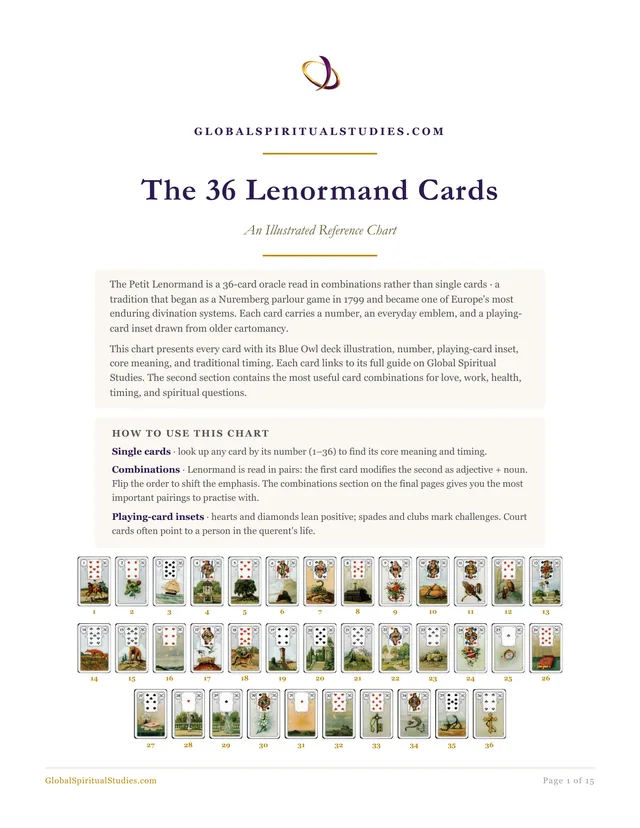
- House, card 4, King of Hearts, positive. Bear, card 15, 10 of Clubs, neutral.
- Yes or no
- Yes on stability and resources, in both orders. Undetermined on harmony, since the Bear can protect or dominate.
- Timing
- The second card decides. House + Bear ends on the Bear: fifteen units, or after a period of rest. Bear + House ends on the House: four units, slow, once the household has settled.
The two cards
The House, card 4, is the home and what goes with it: family, property, privacy, the settled base. Its insert, the King of Hearts, makes it a father or patriarch when it stands for a person.
The Bear, card 15, is power, resources and protection. It is the boss, the money, the strong figure, and in the German reference reviewed for this page it is very often the mother. It is neutral rather than negative: its protective side and its domineering side are equally part of the card.
Put those inserts and those traditions side by side and something becomes visible that the lists rarely say: in a family reading this pair can name both parental figures at once, the King of Hearts and the mother-Bear of German readings. That is our observation rather than a published rule, and it only holds when the question is about family.
In the directional method used on this site, we read the first card as the subject and the second as its modifier. Our Lenormand cards guide gives the background to that method.
This pair turns on whether the Bear is guarding the household or running it, and the neighbouring cards usually tell you. Our free 36-card Lenormand chart sets out every meaning, polarity and house on one sheet, ready to sit beside a spread.
House + Bear
With card 4 in front, the home is the noun and the Bear supplies its quality: strong, substantial, well resourced, or owned by somebody with power. The plain sentence is a house with weight behind it. Learn Lenormand gives this order as real estate investment, buying a house, expanding a house. A widely read German reference, listing the two cards together, gives growing rich through house and land, a property with room to rise in value, and ownership as a source of security. That is the asset reading, and it fits this order well: the property heads the sentence and card 15 turns it into wealth.
Lisa Boswell's House-first entry adds a person without making the person the subject: your mother's house, a landlord, strong branding. Each of these is a place described by its powerful owner or by its force. The mother's house is a home whose authority belongs to someone else; the landlord's property is a residence held by a party with leverage over you.
You would meet this order on questions about buying, inheriting, renting or valuing a home, and on questions about living under someone else's roof.
Bear + House
Reversed, the strong figure is the noun and the House tells you where their power operates. The sentence is: the authority is at home. Boswell's Bear-first entry is entirely about people: your parents, you as a parent, dominating your surroundings, forcing yourself to be comfortable, hibernating in your house. Labyrinthos gives a parent, a family leader, protecting the family, tradition as influence.
Anna K, who writes one entry for the pair in both orders, covers this side most fully, and she holds both faces of the Bear in it. On the protective side: guarding the family or the home, a security system, a relative with more power or more practical knowledge. On the other: the dominant family member, the family tyrant, a clash of wills, heated arguments at home, very strict rules, asserting the rules again.
Boswell's last item, hibernating in your house, is a gentler reading worth keeping. It reads the Bear as rest and withdrawal, and the House as where it happens: someone gathering their strength at home, not ruling it.
The pair across five areas of life
| Area | House + Bear | Bear + House |
|---|---|---|
| Love | A relationship lived in a home that belongs to someone powerful: a parent's house, a partner's property. The question of whose roof it is matters. | A partner who runs the household, protectively or controllingly. Also the in-law whose influence over home life is felt by both of you. |
| Work | A property business, real estate, a well-established family firm. The work is attached to an asset. | A boss who treats the workplace like a family, or a family business with one firm hand on it. Working from home under someone else's rules. |
| Money | Property as wealth: an investment, a valuation, an inheritance of a home. The pair describes resources tied up in bricks; any decision belongs with independent professional advice. | A household where one person controls the money. Protective budgeting or tight control, and the neighbouring cards say which. |
| Health | A secure, well-provided home. Nothing in this order describes a body. | Rest at home, the hibernating Bear. Boswell's Bear also covers physical wellbeing generally; any real health concern belongs with a clinician. |
| Timing | The Bear falls second and governs: fifteen units, and Boswell adds that the Bear can mean resting first before events move on. Unhurried. | The House falls second and governs: four days, weeks or months, or once domestic life is stable. The slower of the two in practice. |
House and Bear in the Grand Tableau
When the two cards touch, the readings above apply, and a person card nearby usually tips the balance: the Lady or the Gentleman beside the pair makes the Bear-first reading about a specific relative. The Fish or the Key beside it pulls towards property and money.
When they lie apart, the home and the powerful figure are two separate reports. A strong boss in one region of the layout is not automatically ruling the household described in another.
Our own house notes carry nothing for either placement, so these come from the house questions. The House in house 15, which asks where power and resources lie, answers that they lie in property or in the family: the home is the power base. The Bear in house 4 puts the strong figure inside the home, so somebody's authority is the defining feature of domestic life, for shelter or for pressure.

Where the traditions differ
The oldest layer adds a note of caution to both cards. The 1846 instruction sheet that shipped with Petit Lenormand decks gives the House as success and prosperity, but says that if it lies in the centre of the layout under the significator it is a hint to "beware of those who surround" the querent. Its Bear cuts two ways as well. It may herald good luck, or it may counsel keeping one's distance from others, and from envious people most of all. Both entries, then, carry a warning about the people around the querent. The sheet gives no combinations, so this does not make House and Bear a warning pair, but it is worth knowing that the two cards share that thread at the earliest checkable point.
The modern field divides by register. One group reads property and wealth: Learn Lenormand's real estate investment and the German reference's riches through house and land. The other reads family authority: Anna K, Labyrinthos and Boswell's Bear-first entry. The German reference also gives jealousy over a house or a flat, which sits comfortably beside the sheet's envy.
There is one placement disagreement worth naming. Boswell gives your mother's house under House first. The German reference gives the mother's house too, but in a list headed Bear and House. Under the subject and modifier grammar used on this page, it belongs to House first, since the house is what is being described and the mother is whose it is. That resolution is our method, not a ruling either source makes.
Caitlín Matthews and Mary K. Greer, who both teach with us, have no entry for this pair that we could verify, and no reading here is theirs.
A reading in three cards
A man in his thirties asks whether to move back into his family home for a year to save money. The line comes out House · Bear · Ring.
The home leads, the Bear describes it as substantial and belonging to someone with power, and the Ring adds an agreement. Read straight through: a well-provided home, held by his parents, with terms attached. The line describes security on someone else's conditions. Whether that suits him is his decision; the cards only say that an arrangement is part of the picture.
Lead with the Bear. Bear · House · Ring makes the parent the subject: a strong figure whose domain is the home, bound by an agreement. Now the reading is about the person and their rules rather than the property. The first line says the house comes with terms. The second says the parent does, and that the household runs on their commitments. Same three cards, and the question shifts from what he is moving into to whom he is moving in with.
What readers get wrong about this pair
Reading only the property. The asset reading is popular, but in a question about family life the Bear-first order is usually about a person. A reader who answers with a valuation has missed the parent.
Reading only the tyrant. Anna K's family tyrant sits in the same entry as protecting the home and the security system. Card 15 shelters at least as often as it overrules, and a positive card beside a neutral one needs harsher neighbours before the reading turns oppressive.
Assuming the Bear is always a father. The King of Hearts on the House already supplies a patriarch. In the German material reviewed here the Bear is more often the mother, and in a modern reading it can be anyone with resources: a landlord, a boss, an older sibling.
Forgetting the rest reading. Boswell's hibernating Bear turns this pair into withdrawal and recovery at home, which is a fair answer to a question about needing time out.
Questions about House and Bear
Does the House and Bear combination mean buying a house?
It can describe it. Learn Lenormand gives real estate investment and buying or expanding a house, and a German reference gives growing rich through property. That reading belongs most naturally to the House-first order, where the dwelling leads and card 15 marks it out as something of value. The cards describe circumstances; the purchase itself is a decision for the buyer and their advisers.
What is the difference between House + Bear and Bear + House?
Building or person. House first describes a home with power behind it: a valuable property, a parent's house, a landlord's residence. Bear first describes a powerful person whose sphere is the home: a parent, the head of the family, the relative who sets the rules. Boswell's pair of entries splits along exactly that line.
Can the House and Bear combination mean a parent?
Yes, and it is among the readings the sources reviewed here repeat most. Boswell gives your parents and you as a parent; Labyrinthos and Anna K give a parent or family leader. The Bear is often the mother in German readings, and the House carries the King of Hearts, so in family questions the pair can name either parent or both.
Is the House and Bear combination a yes or a no?
Yes on stability, security and resources, in both orders. On harmony it is undetermined, because the Bear can shelter a household or dominate it, and the surrounding cards decide which.
How long does the House and Bear combination take?
The second card governs. House + Bear closes on card 15, counted in fifteens, and Boswell's Bear asks for a pause to rest before anything moves. Bear + House ends on the House: four units, or once the home situation settles. Neither order is quick.
Related combinations
Look up any two cards in the deck through our Lenormand card combinations guide.
Telling a building from a person in the same two cards is a skill, and it is mostly the skill of reading order and context. The Complete Lenormand teaches it through lines, houses and the full Grand Tableau.